CH 01
 OPEN ACCESS
 The Seven Deadly Sins of Artificial Intelligence
Uses, excesses and dilemmas of a technology that amplifies our decisions
José Enrique Hernández de la Cruz (Author)· Libardo Ramón Polanía (Author)· Verenice Sánchez Castillo (Author) ·and 8 additional contributors
About this book
Description
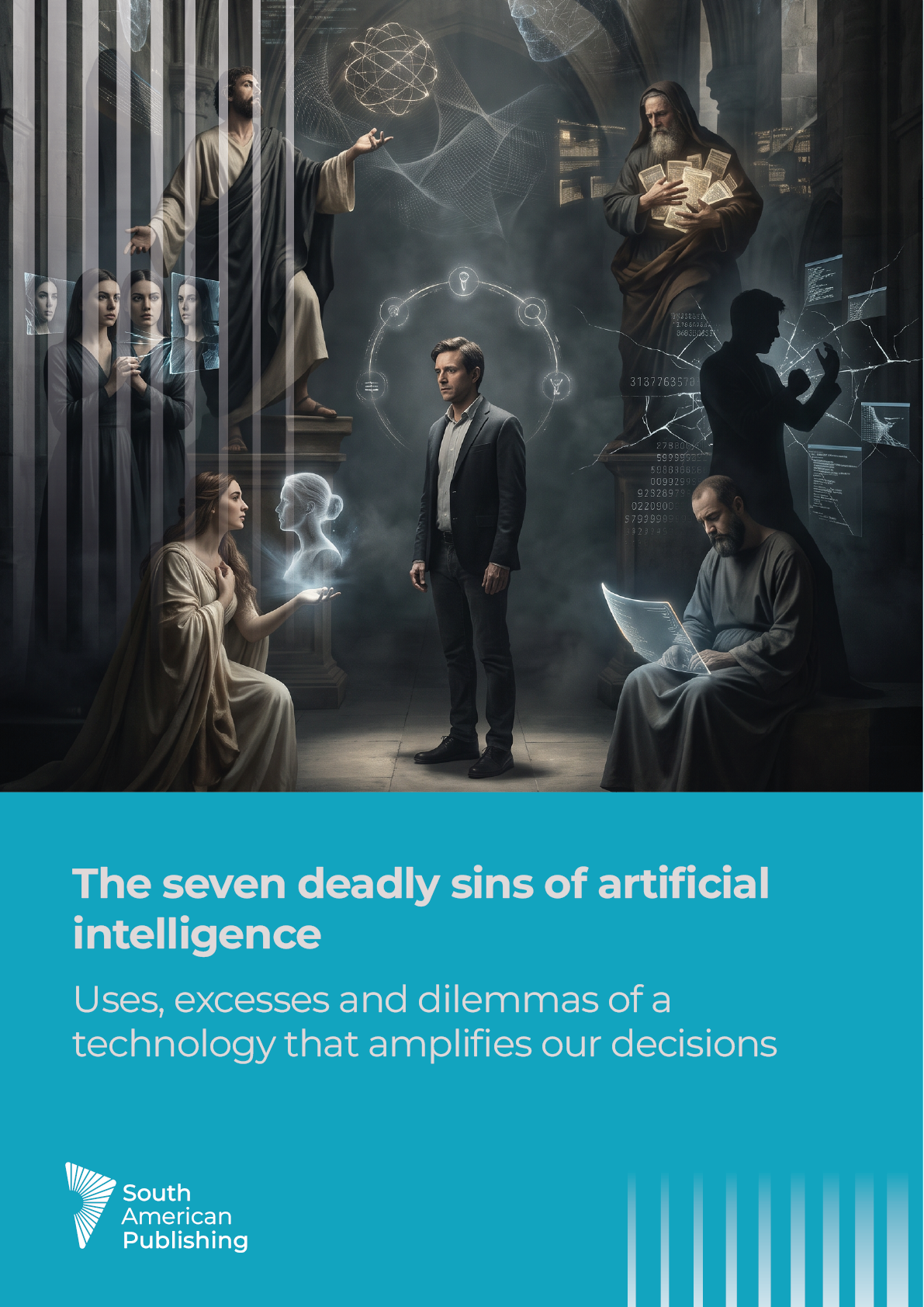
Artificial intelligence is transforming knowledge production, education, professional practice, communication, and decision-making, creating opportunities for innovation while introducing significant ethical, social, economic, and environmental challenges. Understanding these transformations requires examining not only technological capabilities but also the human expectations, institutional incentives, and power structures that shape their development and use. Seven traditional categories of human excess provide a conceptual framework for critically analyzing the tensions associated with artificial intelligence without attributing moral agency to technological systems. Pride addresses algorithmic authority, misplaced confidence, and the acceptance of automated outputs without adequate verification. Greed examines the concentration of technological power, data ownership, economic benefits, and inequalities in access. Lust explores excessive fascination with artificial interaction, anthropomorphism, emotional dependence, and the limits of personalization. Envy focuses on imitation, impersonation, intellectual authorship, and the authenticity of generated content. Gluttony considers the environmental implications of computational infrastructure, resource consumption, and excessive digital production. Wrath analyzes automated disinformation, digital violence, harmful manipulation, and human responsibility for technological misuse. Sloth investigates cognitive dependence, intellectual disengagement, and the consequences of delegating learning and decision-making processes. Through a critical synthesis of interdisciplinary research and conceptual analysis, these dimensions are connected to questions of accountability, autonomy, sustainability, and social justice. The discussion emphasizes the importance of evidence-based evaluation, contextual interpretation, and meaningful human oversight. Responsible technological development ultimately requires preserving the capacities to verify information, choose alternatives, terminate interactions, acknowledge contributions, establish reasonable limits, and correct harmful outcomes. These principles support a human-centered approach that balances technological innovation with critical judgment, ethical responsibility, and institutional accountability.
Artificial intelligenceAI ethicsHuman autonomyAlgorithmic accountabilityResponsible innovation
Contents
Chapters
7 chapters
CH 02
CH 03
CH 04
CH 05
CH 06
CH 07
No chapters match this search.
Citation
How to cite
José Enrique Hernández de la Cruz, Libardo Ramón Polanía, Verenice Sánchez Castillo, Yasniel Sánchez Suárez, Camilo Enrique Barragán Morales, Alfredo Javier Pérez Gamboa, Fabio Edisson Morera Forero, Juan Manuel Andrade Navia, Elvia María Jiménez Zapata, Carlos Alberto Gómez Cano, Juan Ernesto Pérez-Pérez. The Seven Deadly Sins of Artificial Intelligence: Uses, excesses and dilemmas of a technology that amplifies our decisions. South American Publishing. 2026. https://doi.org/10.62486/978-9915-9928-6-0
Authors and affiliations
All contributors are shown here. Affiliations are grouped when they are available in the book metadata.
Universidad Juárez Autónoma de Tabasco. Tabasco, México.
Universidad de la Amazonia. Florencia, Colombia.
Libardo Ramón Polanía
Author
Universidad de Matanzas. Matanzas, Cuba.
Yasniel Sánchez Suárez
Author
Institución Universitaria Mayor de Cartagena. Cartagena, Colombia.
Centro de Investigación en Educación, Naturaleza, Cultura e Innovación para la Amazonia – CIENCIA. Florencia, Colombia.
Broward International University. Miami, Estados Unidos.
Universidad Surcolombiana. Pitalito, Colombia.
Corporación Unificada Nacional de Educación Superior – CUN. Florencia, Colombia.
Universidad Simón Bolívar. Cúcuta, Colombia.
Juan Ernesto Pérez-Pérez
Author
Metadata
Bibliographic information
- Book title
- The Seven Deadly Sins of Artificial Intelligence
- Book subtitle
- Uses, excesses and dilemmas of a technology that amplifies our decisions
- Authors
- José Enrique Hernández de la Cruz, Libardo Ramón Polanía, Verenice Sánchez Castillo, Yasniel Sánchez Suárez, Camilo Enrique Barragán Morales, Alfredo Javier Pérez Gamboa, Fabio Edisson Morera Forero, Juan Manuel Andrade Navia, Elvia María Jiménez Zapata, Carlos Alberto Gómez Cano, Juan Ernesto Pérez-Pérez
- DOI
- https://doi.org/10.62486/978-9915-9928-6-0
- Publisher
- South American Publishing
- Imprint
- South American Publishing
- ISBN
- 978-9915-9928-6-0 (eBook, Spanish)
978-9915-9928-7-7 (Softcover, Spanish) - Published
- 2026-10-10
- Language
- Spanish
- Edition number
- 1
- Publication type
- monograph
- Subject area
- Social Sciences & Humanities
- BISAC
- COM004000 (Primary)
COM100000
SOC071000
PHI005000 - THEMA
- UYQ
UBJ
JBFV5 - License
- Creative Commons Attribution 4.0 International
- Copyright
- © 2026 The Authors
Publish with us
Planning a scholarly book?
Explore the editorial policies or send an initial proposal to the South American Publishing Books team.