
Abstract
This research aims to disseminate the results of teaching university students to use free Generative AI tools to generate presentations and websites, and at the same time bring university students closer to the topic of Artificial Intelligence. Artificial Intelligence is considered in this research a cross-cutting issue, which will really affect many areas of knowledge, and because it is considered of great interest mainly for students in technologies, it is decided to work with students who are studying various subjects related to technologies. In this research, we worked with university students who study their careers in virtual or 100% e-learning mode, students of the LTI (Bachelor of Information Technologies) and LSDW (Bachelor of Systems in Web Development) careers, enrolled in the subjects of Structured Programming, Application Design and Digital Multimedia Production, corresponding to the LTI career. and the subjects of Project III and Project IV, which are taught in the LSDW career, during the 2025A school calendar. Both LTI and LSDW careers are offered at the University Center for Exact Sciences and Engineering (CUCEI-UdgPlus) of the University of Guadalajara.
Keywords
Generative AI, Presentations, Websites, University
INTRODUCTION
This research stems from the identified need to teach university students how to use free Generative AI tools to generate presentations and websites, tools that have emerged and evolved in recent years, while also bringing university students closer to the topic of Artificial Intelligence.
Artificial Intelligence (IA), according to the RAE, is the “scientific discipline, which deals with creating computer programs that execute operations comparable to those performed by the human mind, such as learning or logical reasoning”. In this research, it is considered a cross-cutting topic that will affect many areas of knowledge. According to Alibaba Cloud (2025), “Artificial intelligence has multiple applications in various sectors, among them are: Education, health, cybersecurity and citizen security”.
For the aforementioned reasons, and because AI is a topic of great interest, mainly for students in technology fields, it was decided to introduce the topic of AI and Generative Artificial Intelligence to Information and Communication Technologies students as an additional topic in their study program. Students in these areas will be primarily responsible both for the creation of this type of Artificial Intelligence system and for the use and creation of this type of Generative Artificial Intelligence tool. Likewise, degree programs related to Information and Communication Technologies will be affected by the evolution of this type of system, and many of these Generative Artificial Intelligence tools will help Information and Communication Technologies students become more efficient and productive. In this research, we worked with university students pursuing their degrees in virtual or 100% e-learning mode, specifically students from the LTI (Bachelor's Degree in Information Technologies) and LSDW (Bachelor's Degree in Web Development Systems) programs. They were enrolled in Structured Programming, Application Design, and Digital Multimedia Production, corresponding to the LTI program, and in Project III and Project IV, taught in the LSDW program, during the 2025A academic calendar. Both LTI and LSDW programs are offered at the University Center for Exact Sciences and Engineering (CUCEI-UdgPlus) of the University of Guadalajara.
It is important to note that, in order to introduce the topic of AI and Generative AI to students in a 100% virtual educational modality, a didactic activity had to be designed to deliver this knowledge to technology students from the virtual setting using technological mediation. In this research, technological mediation was based on the official virtual platform called MiSUV of CUCEI-UdgPlus and on videoconferencing systems that were scheduled synchronously, so that both the professor and participating students would meet in the same time frame but remotely.
Theoretical Framework
E-learning – Modalidad virtual
According to Bernárdez (2007:16), e-learning is “all those methodologies, strategies or learning systems that employ digital technology and/or computer-mediated communication”.
In this research, we, the participating students and professor, were immersed in a virtual e-learning modality. For this purpose, the official platform called MiSUV at CUCEI-UdgPlus was used. On this platform, interactions and the educational process took place.
Artificial Intelligence (AI)
Bellman (1978) defined it as the automation of activities that are normally associated with human thought, such as decision-making, problem solving, learning, etc.
In this research, the professor involved in this training process delivered a lecture on Artificial Intelligence as an additional topic in the study syllabus of the students enrolled in each of the subjects covered in this research, which were mentioned previously.
Chatbot
According to Velasco, E. and Bárcenas, J. (2023:121), Chatbot “is a computer program designed to simulate human conversation”.
In this research, the participating students used ChatGPT, among others. However, the professor who authored this study conducted a practical demonstration of the use of Qwen AI with the participating students, with the aim of bringing the students closer to this new AI tool.
According to Alibaba Cloud (2025), Qwen is an artificial intelligence tool developed by Alibaba Cloud.
Like ChatGPT and other similar tools, Qwen AI works from a PROMPT, which we understand as a textual input serving as a request for information provided to Qwen AI so that it in turn returns a result. It is important to mention that the more elaborate the PROMPT is, the better the result the AI can return; for this reason, there is an entire engineering discipline dedicated to PROMPT elaboration.
Generative AI
UNESCO (2024:8) states that “Generative AI is an Artificial Intelligence (AI) technology that automatically generates content in response to written instructions in natural language conversational interfaces (PROMPTS).”
In this research, Generative AI tools were used to generate presentations and websites.
Presentations
According to Ladrón (2022:30), “A Presentation Program is software used to display information, normally outlined on a slide or more.”
To generate presentations and websites, the Generative AI tool called Gamma AI was used. The professor performed a demonstration of the tool's use, and the participating students learned to use it to generate presentations and websites.
According to Barragán, R., Palacios, A., León, A., y Fernández, M. V. (2025:307) “Gamma AI is a tool that stands out for its ability to generate visual presentations”. It is worth mentioning that Gamma AI also allows generating websites.
Websites
It is a set of web pages related to each other (Luján, 2002).
Context
This research was conducted during the 2025A academic calendar among university students from the LTI programs who are taking the subjects of Structured Programming, Application Design, and Digital Multimedia Production, and students from the LSDW program (Bachelor's Degree in Web Development of Web Systems) offered at the Centro Universitario de Ciencias Exactas e Ingenierías (Udg Plus) of the Universidad de Guadalajara. 25 students participated, 17 LTI students and 8 LSDW students.
METHODS
The didactic activity is based on the following learning methodologies:
Learning by doing
Dewey (1899) “proposes the pedagogy of experience; the principle embraced is that of the educational function of experience. The need to test thought through action if it is to become knowledge”.
In this research, the student learns by doing:
First, through active listening to the presentation given by the professor via videoconference with the participating students, on the topic of Artificial Intelligence and Generative AI, in these videoconferences the participating students express their opinion on the topic and the topic of AI is debated among all participants, based on the prior knowledge that the students possess about the topic of AI, as well as the new knowledge they learn through the professor's exposition via the videoconference and the presentation of the topic.
Second, through interaction with the generative AI tools themselves.
Active learning
Active learning is present throughout the research, as the student is the center of their own learning; the student ultimately generates presentations and websites using Generative AI tools, the same tools that the professor teaches students to use through practical demonstrations, which are carried out by sharing the screen of her computer through synchronous videoconferences.
Development of the virtual didactic activity step by step
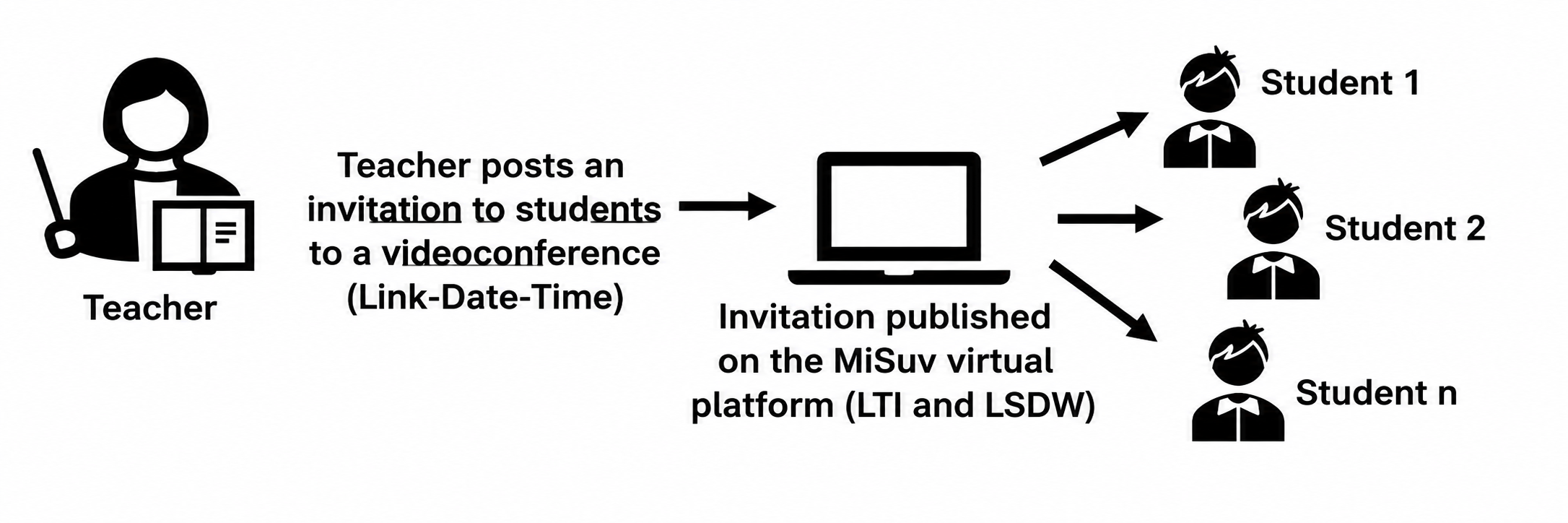
1.-The professor invites the students from the various subjects and degree programs mentioned earlier in this document to a synchronous videoconference, indicating the link and date (time and day). Meet was used to conduct the videoconferences. It should be noted that students are invited to the videoconference always a week before the videoconference takes place, so that they can schedule their activities. It is important that this invitation is recorded on the official virtual platform (platform called MiSUV) through discussion forums. The duration of the videoconference is 2 hours.
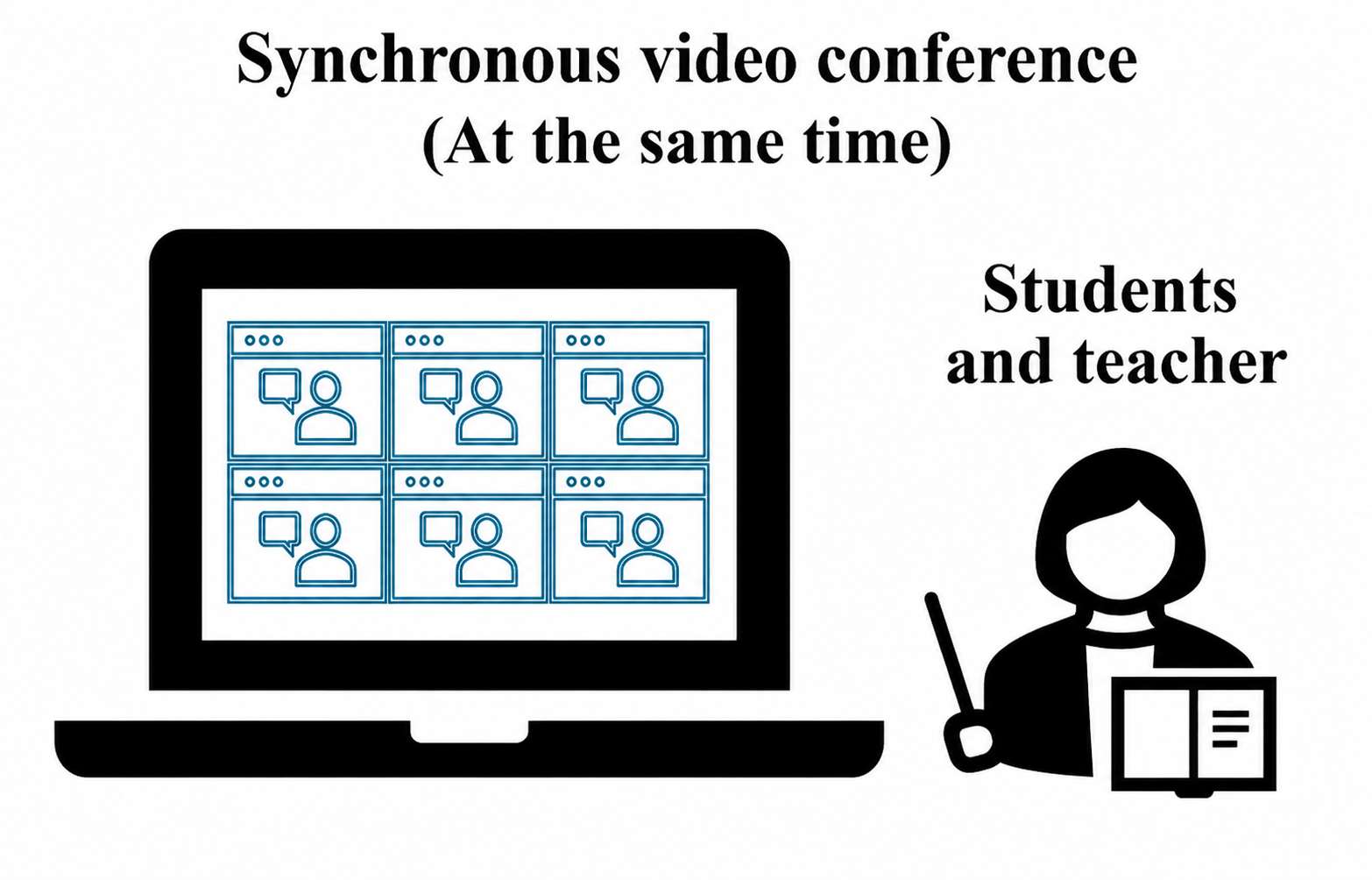
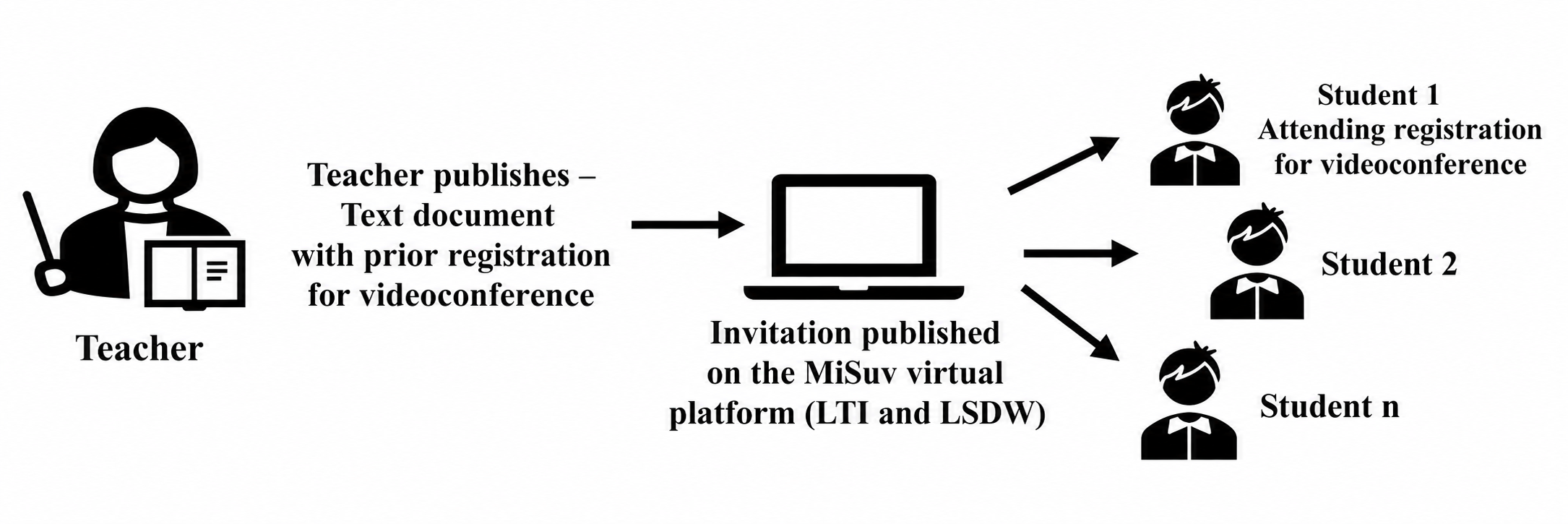
2.-The professor, prior to the videoconference, prepares her presentation on the topic of AI and Generative AI in advance, and also enables a text document (editable online) that she shares with her students. Here, students can register their participation in the videoconference in advance; they must indicate: Name, subject, degree program, and email (they are invited to use a Gmail email). This text document (editable) is shared with students through the official MiSUV platform via discussion forums (as a web link).
3.- The professor, prior to the videoconference, enables a web space, in this case a Google Sites (a free Google website), and adds the students with editor privileges (via the email address that the students share when registering before the videoconference session).
In this way, during the videoconference session held with the students, students will be able to provide evidence of their participation and what they learned during the videoconference through posts on the Google Sites website.
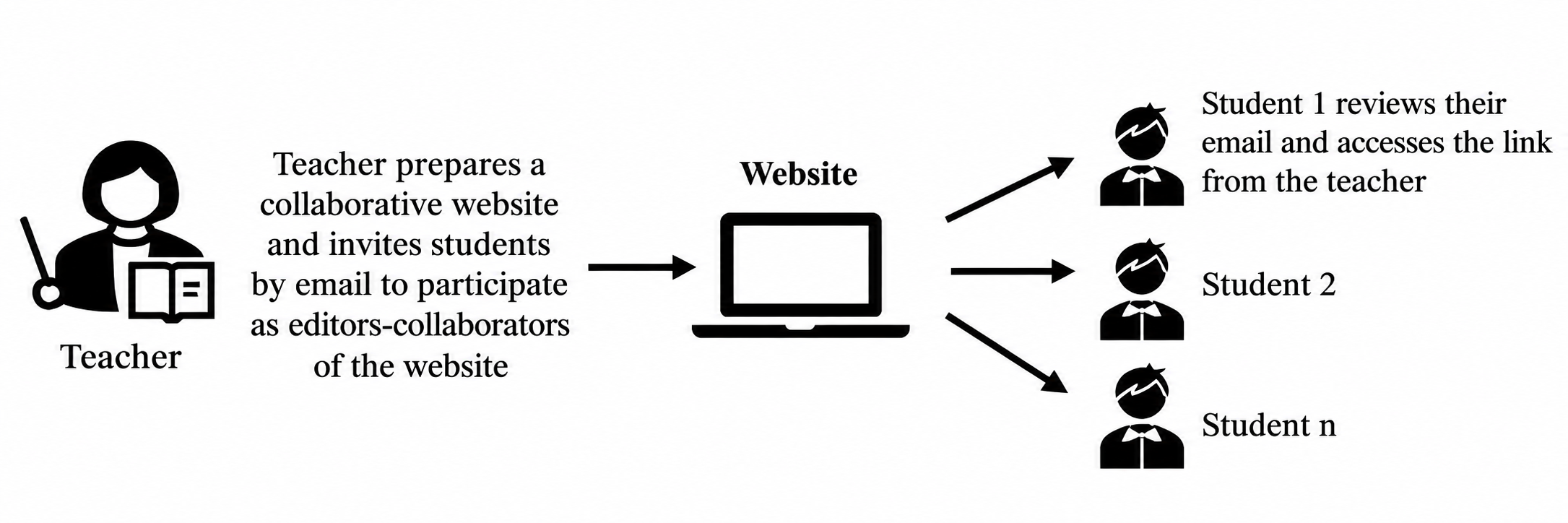
(Collaborative editing by the videoconference attendees.)
4.- During the videoconference, the teacher and the students are present simultaneously. During the session, the teacher presents the AI topic to the students by sharing a presentation on the subject, and invites the students to keep the videoconference session open where the master class is held. The students are likewise invited to check their Gmail email and to click on the link, which will redirect them to the Google Sites section where they will leave their participation in the videoconference through a post.
During the session, the professor shares her computer screen, and the students can observe the practical demonstration of the use of the AI chatbot tool called qwen.ai. The professor asks the attendees whether they knew this AI, qwen, and the attendees respond that they did not. The attendees mention knowing: ChatGPT, Bard, Copilot, Meta, and DeepSeek. Additionally, they mention knowing Siri and Alexa, virtual assistants. From the above, it can be deduced that the attendees have prior notions and knowledge about Artificial Intelligence.
During the session, the professor shares her computer screen, and the students can observe the practical demonstration of the use of the Generative AI tool, in this case they were taught to use the Gamma AI tool. After the students observed the practical class on the use of the Gamma AI tool.
Students are asked to generate a presentation and a website using the Gamma AI tool, and additionally modify 5 contents of the website generated with Gamma AI. It is important to mention that they had to generate presentations and websites with themes related to Information and Communication Technologies.
Additionally, the professor asks the videoconference attendees, "Did you know Gamma AI?", to which the attendees answered "no".
5.- After the students generated their presentation and a website on some topic related to Information and Communication Technologies. The teacher asks them to publish their (prompts) presentations and websites generated with the generative AI tool Gamma AI, in the collaborative Google Sites, which all participants have open and enabled, alongside the videoconference.
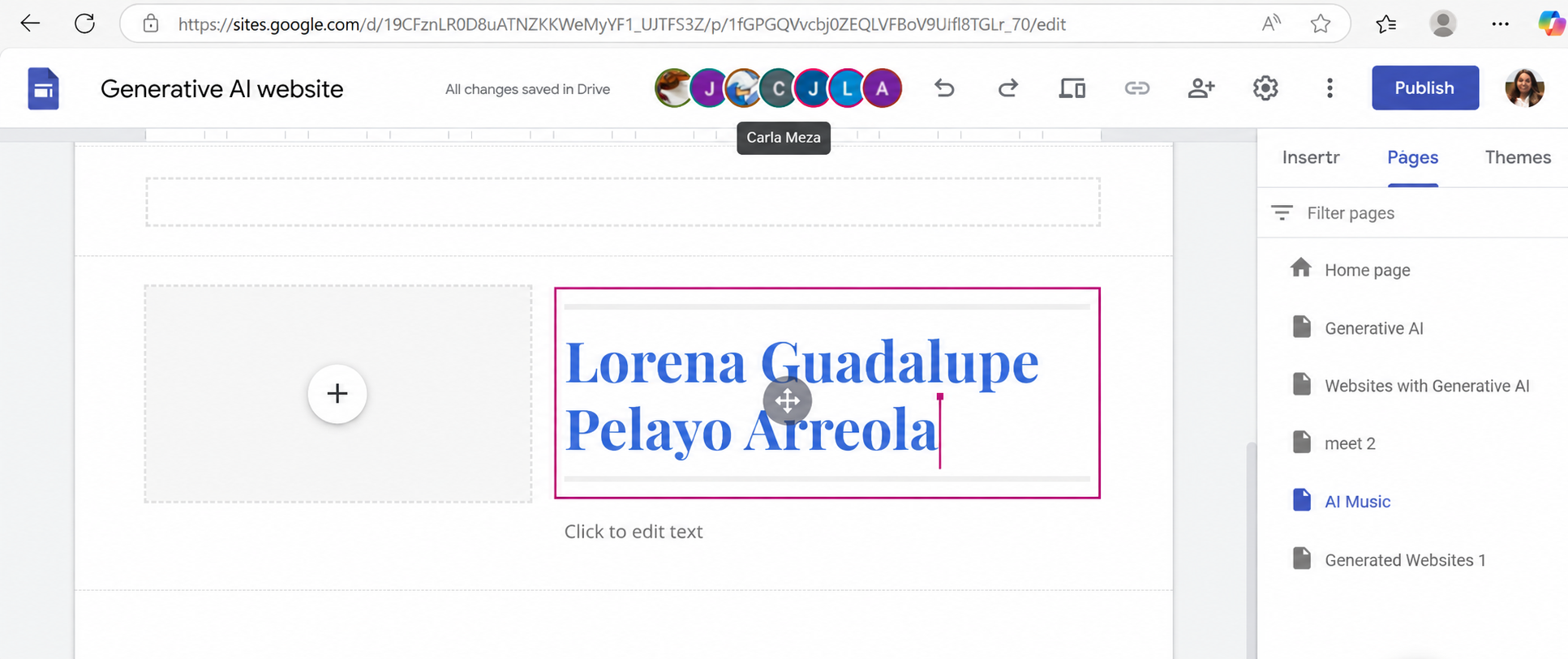
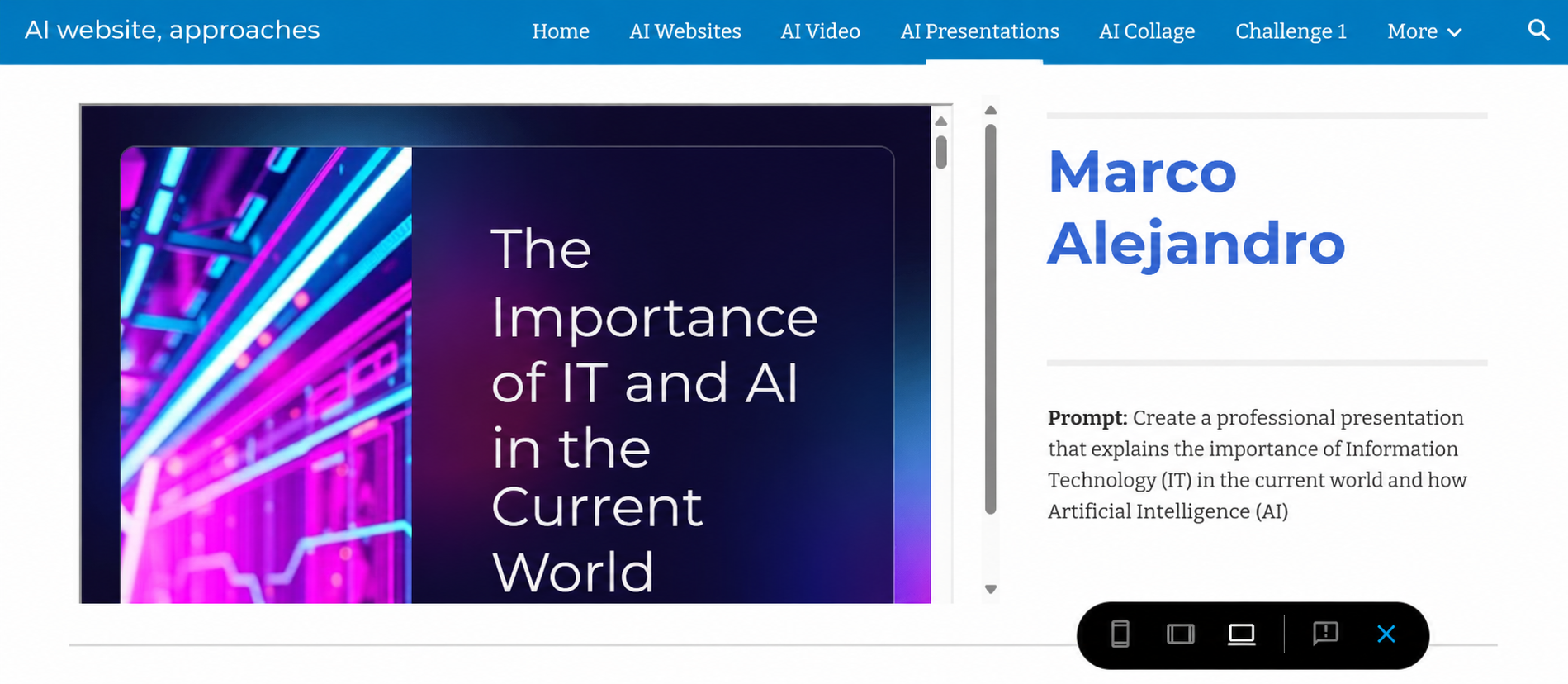
(Students publish their presentations and websites generated with Gamma AI).
6.-Finally, questions are posed to the students during the videoconference, with the aim of reflecting on the topic of AI and Generative AI. The participating students are also asked about their opinion on the Generative AI tools used during the videoconference.
The active participation of students is evidenced by the publication of their presentations and websites on the collaborative Google Sites.
It should be noted that when collaborating on the development of the Google Sites, both students and professor used qween.ai to generate illustrative images on the topic of AI and generative AI, and these same images were included in the collaborative web system.
Below, an image generated by the AI Qwen.ai, result of the following PROMPT “Create an image illustrating the applications of artificial intelligence in various areas of knowledge”.
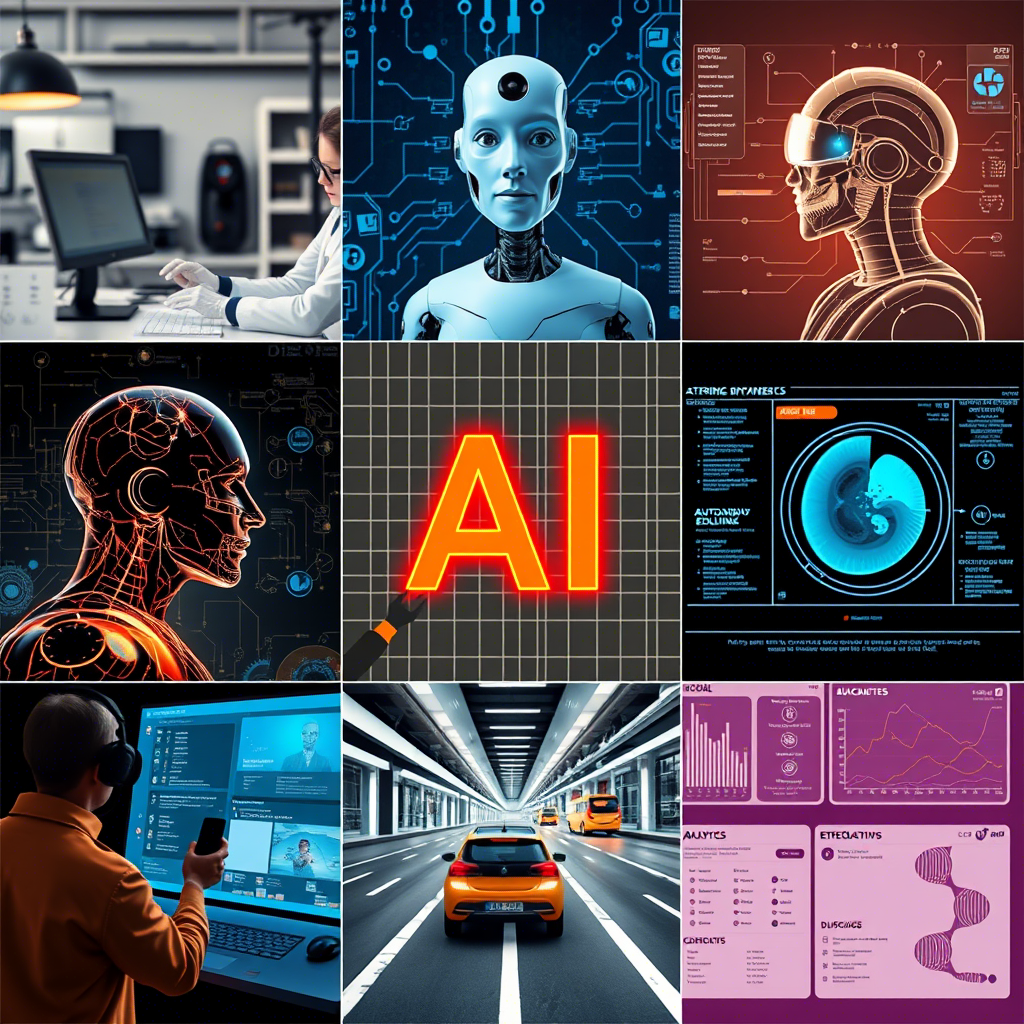
Source: https://www.aliyun.com/product/dashscope/qwenhttps://www.aliyun.com/product/dashscope/qwen
Below, the Information and Communication Technologies are shown, as well as AI Chatbot and Generative AI, used for this activity in virtuality:
Official Virtual Platform MiSUV.
TIC | AI ChatBot | Generative AI |
|---|---|---|
Google Meet (videoconferencing system) It was used as educational mediation, for interaction and communication among participants. | Chat GPT | Gamma AI It was used to generate presentations and websites. |
Google Sites (Website) It was used to collaboratively publish the presentations and websites generated by the videoconference participants. | Qwen.ai AI Chat https://chat.qwen.ai/ | [empty cell] |
Google Docs (Text Editor) It was used for the prior registration of the videoconference participants. | [empty cell] | [empty cell] |
PowerPoint Presentation Presentation on AI and Generative AI, prepared by the professor and shared with the students attending the videoconference. | [empty cell] | [empty cell] |
Email (Gmail) Here, participants received the Google Sites invitation with editor authorization. | [empty cell] | [empty cell] |
RESULTS
Students attending the videoconference were introduced to the use of artificial intelligence and generative AI tools. These topics, which are additional to the students' curriculum, generated curiosity about AI and generative AI among the participating students.
The chatbot Qwen.ai and the generative AI tool Gamma AI were used.
Presentations and websites were generated using the free version of the generative AI tool Gamma AI. These presentations and websites were published on a collaborative Google Site.
The professor's presentation on AI and generative AI was shared on the collaborative Google Site that had been enabled for the videoconference session.
Students were invited to reflect on the topic of AI and its implications in various areas of knowledge and, especially, to use Generative AI tools in an ethical and responsible manner.
At the beginning of the videoconference session, the students were asked, “Do you know the Generative AI tool Gamma AI?” All attendees responded “no.” They were then asked, “Do you know the AI qwen?” and again all attendees responded “no.” Therefore, it is intended to continue working with the students on the topic of Generative AI tools, promoting their ethical and responsible use.
CONCLUSIONS
Artificial Intelligence and Generative AI tools are evolving rapidly; as teachers, we must bring students closer to these topics and invite them to use Generative AI tools ethically and responsibly. It is also important to raise awareness of the risks and benefits of Artificial Intelligence.
The following is a personal reflection from the professor's perspective, by way of conclusion:
As teachers, we must learn to unlearn, to update ourselves through the use of new technologies, and to use them in the best possible way in educational processes.
We now face a problem, and I have several questions:
How can we generate richer learning experiences from these emerging new technologies (AI, generative AI, etc.)?
How can we ensure that our students, who will grow up with these new technologies, learn to use them correctly, with responsibility and ethics, for the benefit of humanity?
How will we ensure that our students learn meaningfully and develop critical thinking, if it is increasingly easy for this type of generative AI tool to do all the work for them (research, presentations, digital multimedia content, etc.)?
I believe that it will be quite a challenge for us as teachers to achieve meaningful learning in students and to help them develop critical thinking. I think that, to achieve this, we must be more creative, innovative, and proactive, and continue seeking to generate richer learning experiences. Rising to the challenge should be our ultimate goal.
An option for facing the challenges of the near future as teachers could be to create experimental laboratories of emerging technologies in our classrooms, incorporating new learning methodologies combined with old methodologies, taking the best of two worlds. Being resilient in the face of the results obtained, without fear of failure (we learn more from failure), without fear of success (we always win, experience to keep experimenting).
Undoubtedly, there are many challenges that we will face as teachers with these new technological advances. With Darwin's thinking, adapting to change to survive.
Bibliografía
Alibaba Cloud. (2025). Qwen3 [Herramienta de inteligencia artificial]. https://huggingface.co/QwenLM/Qwen3
Alibaba Cloud. (2025). Imagen generada por Qwen [Imagen generada por inteligencia artificial]. https://www.aliyun.com/product/dashscope/qwen
Barragán, R., Palacios, A., León, A. y Fernández, M. V. (2025:307). Acciones Educativas Innovadoras en el Ámbito Universitario. Publicaciones Dykinson. p. 307.
Bellman RE. An introduction to artificial intelligence: can computers thinks?/Richard Bellman Bib ID 949715. Bell-man, Richard,1920-1984. Richard Ernest Bellman (Open Library) Descriptio San Francisco: Boyd & Fraser Pub. Co,1978.
Bernárdez, M. (2007). Diseño, producción, implementación E-learning. Metodología Herramientas Modelos. Estados Unidos de América:AuthorHouse, pp. 16.
Dewey, J. (1989) Como pensamos. Nueva exposición de la relación entre pensamiento y proceso educativo. Barcelona: Paidós.
Ladrón, M. (2022). Aplicaciones informáticas para presentaciones gráficas de información. UF0323. Editorial Tutor Formación.p.30.
Luján, S. (2002). Programación de aplicaciones web: historia, principios básicos y clientes web. España: Editorial Club Universitario.
UNESCO. (2023, 21 julio). Guía para el uso de IA generativa en educación e investigación . https://www.unesco.org/es/articles/guia-para-el-uso-de-ia-generativa-en-educacion-e-investigación. p.8.
Velasco, E. y Bárcenas, J. (2023). Inteligencia Artificial para la transformación de la educación. Editor SOMECE. p. 121
Declarations
Funding
No financing.
Conflict of interest
None.
Authorship contributions
Drafting – original draft: Lotzy Beatriz Fonseca Chiu.
Writing–review and editing: Lotzy Beatriz Fonseca Chiu.