

Abstract
Objective: To analyze the level of knowledge among healthcare personnel regarding the Surgical Safety Checklist (SSQ) and the main barriers hindering its correct application in the current surgical context. Methodology: A literature review was conducted of studies published between 2021 and 2025 in scientific databases (PubMed, Scopus, SciELO). Original articles, systematic reviews, and observational studies addressing knowledge and implementation barriers to the SSQ were included. Results: Heterogeneous levels of knowledge about the SSQ were identified among surgical personnel, with significant variations between professions and contexts. The main barriers identified were lack of safety culture, resistance to change, time constraints, training deficiencies, inadequate communication among the surgical team, and organizational factors such as workload and resource scarcity. Conclusions: Despite the widespread dissemination of the SSQ, significant knowledge gaps and structural barriers persist, limiting its effectiveness. Ongoing educational interventions, strengthening of the patient safety culture, and institutional commitment are required to optimize its implementation.
Keywords
Safe Surgery Checklist, patient safety, healthcare worker knowledge, implementation barriers, operating room
INTRODUCTION
Patient safety represents one of the essential pillars of quality care, becoming a priority concern for health systems around the world. In 2004, the World Health Organization (WHO) developed a pioneering initiative aimed at protecting patients. Subsequently, in 2008, it consolidated this strategy with an innovative program, which bears the name of Lifesaving Surgery, focused on optimizing surgical procedures since the fundamental purpose is to reduce the risks associated with medical interventions through the development and implementation of a systematic control and verification tool for surgical procedures worldwide, which is called the Safe Surgery Checklist (LVCS) (1).
This list, referred to as the surgical checklist, functions in daily clinical practice as an instrument specifically developed to reduce potential adverse events during surgical procedures. It is structured into three main sections: checks performed before anesthesia induction, checks before surgical incision, and checks before the patient leaves the operating room. The LVCS aims to ensure that surgical teams systematically follow essential safety measures to minimize the most common avoidable risks (2).
International studies have shown that adequate implementation of the LVCS can significantly reduce morbidity and mortality rates. One pilot study conducted by WHO in eight countries showed a 36% reduction in surgical complications and a 47% reduction in mortality after the implementation of this tool (3). However, despite these proven benefits, adherence to the LVCS remains poor in many hospital centers, including institutions in Latin America (4).
In Ecuador, where the Ministry of Public Health adopted the LVCS in 2013 as part of its National Patient Safety Strategy, studies conducted in Ecuadorian hospitals have revealed deficiencies in its implementation, with variable compliance rates and insufficient knowledge of its correct application by healthcare personnel (5)
The LVCS consists of items distributed across three critical phases of the surgical procedure (6)
Sign In: Verification prior to anesthetic induction, including confirmation of patient identity, surgical site, informed consent, and functioning.
Surgical pause: Performed before the skin incision, it involves the introduction of all team members, confirmation of the patient, procedure, and surgical site, review of critical aspects, and administration of antibiotic prophylaxis.
Sign-out: Performed before the patient leaves the operating room, it includes verification of the procedure performed, count of instruments and sponges, specimen labeling, and considerations for postoperative management.
Recent updates to the LVCS have incorporated specific elements for different surgical specialties and clinical settings, adapting to the particular needs of each context (7).
At the global level, the Safe Surgery Checklist (LVCS) has become established as the fundamental tool to mitigate preventable errors; however, its effective implementation faces critical challenges that transcend borders. Although scientific evidence confirms that its correct use reduces postoperative mortality by 25% and drastically decreases surgical complications, a significant gap persists between institutional regulations and actual clinical practice. The problem lies in the fact that, in various international hospital contexts, nursing staff, who assume the role of coordinator and guarantor of the protocol, present heterogeneous levels of knowledge and face structural barriers that transform the checklist into a bureaucratic process rather than a genuine safety practice. This lack of technical and attitudinal competencies not only compromises the effectiveness of the tool but also exposes patients to avoidable risks, weakening the safety culture in the surgical center. Under this premise, the present review is justified by its clinical and ethical relevance, since surgical safety is a universal patient right and an inescapable responsibility of the nursing professional. By synthesizing global evidence, this study provides a scientific basis for healthcare institutions to optimize their resources, reduce costs derived from adverse events, and design training programs based on successful international experiences. Therefore, the general objective of this article is to analyze the worldwide scientific evidence on the level of knowledge and barriers in the application of the Safe Surgery Checklist in nursing staff, through a systematic bibliographic review, to identify the critical factors that influence the safety of the surgical patient on a global scale.
METHODS
The present research was conducted through a descriptive and retrospective bibliographic review, based on a critical analysis of scientific literature available globally. The study was structured using a qualitative evidence synthesis approach, following rigorous methodological criteria to ensure the validity of the findings.
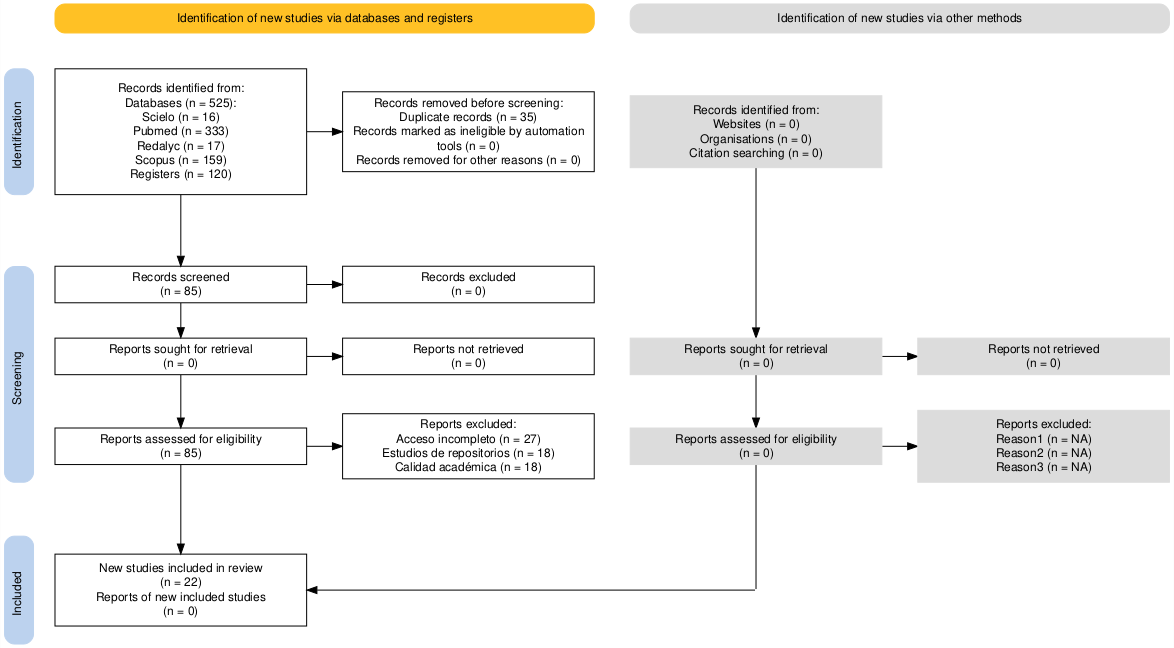
Search Strategy and Information Sources: A systematic search of the scientific literature was conducted in the most impactful international databases: Web of Science (WoS), PubMed, SciELO, Scopus, and Redalyc, which were selected for their relevance to health sciences and their coverage of high-quality technical studies. The search was performed using controlled terms derived from the DeCS (Health Sciences Descriptors) and MeSH (Medical Subject Headings) vocabularies, such as "Surgical Safety Checklist," "Surgical Nursing," "Patient Safety," "Knowledge," and "Barriers." Boolean operators AND and OR were used to maximize the precision of the results, with search equations in both Spanish and English (e.g., "Surgical Safety Checklist AND Nursing AND Knowledge"). This process initially identified 525 records distributed as follows: SciELO (n=16), PubMed (n=333), Redalyc (n=17), Scopus (n=159), and other records (n=120). After removing 35 duplicates and applying eligibility criteria, 85 full reports were evaluated; 63 documents were excluded because of incomplete access (n=27), repository studies (n=18), and insufficient academic quality as assessed using the CASPe guide (Critical Appraisal Skills Programme Español) (n=18), resulting in a final corpus of 22 studies included in the review.
Eligibility criteria. The following criteria were applied in compiling the bibliographic corpus:
Inclusion criteria: Original articles, systematic reviews, and meta-analyses published within the last 10 years (2015-2025), available in full text, and directly evaluating the knowledge or performance of nursing personnel in the use of LVCS. Foundational reference sources published prior to this period were also included because of their historical and methodological value to the topic.
Exclusion criteria: Duplicate studies across databases, gray literature (unpublished theses), opinion articles, editorials, and those that did not present a clear methodology or conclusive results.
Synthesis and Analysis Process. The selection of articles was performed through a three-stage screening process:
Screening: titles and abstracts were read to exclude unrelated studies.
Evaluation: full texts were critically read to verify relevance to the review objective.
Extraction: information was organized in an analysis matrix in which variables such as author, year, country of study, identified level of knowledge, and main reported barriers were considered.
DEVELOPMENT
This first matrix constitutes the foundation of the literature review, as it compiles the scientific evidence supporting the implementation of the safe surgery checklist as an evidence-based intervention. The matrix chronologically organizes the studies, from the publication of the original OMS guidelines in 2009 to the most recent systematic reviews, allowing the evolution and consolidation of the scientific evidence over time to be observed.
Author/Year | Study Type | Main Objective | Main Results | Level of Evidence |
|---|---|---|---|---|
WHO (2009) | Clinical guideline | Establish guidelines for safe surgery and prevent adverse events | Implementation of a 19-item list in three surgical phases | High International regulatory document |
Haynes et al. (2019) | Quantitative study | Evaluate changes in safety attitudes and their relationship with morbidity/mortality | Significant decrease in postoperative morbidity and mortality after implementation of the checklist | High (multicenter study) |
de Vries et al. (2020) | Clinical trial | Evaluate the effect of a comprehensive surgical safety system on patient outcomes. | Reduction of surgical complications and improvement in outcomes of patients (N Engl J Med) | Very High – High publication impact |
Weiser et al. (2020) | Multicenter study | Determine the effect of a 19-item checklist on urgent operations. | Reduction of complications in the overall patient population undergoing urgent surgery | High – International study |
Gillespie et al. (2020) | Systematic review and meta-analysis | Evaluate the effect of the use of a checklist on safety in postsurgical complications | Evidence of reduction of postoperative complications with the use of a checklist | Very High – Systematic Review |
The findings of this matrix demonstrate a solid and consistent scientific basis supporting the effectiveness of the surgical checklist. Notably, the pioneering studies by the WHO (2009) and De Vries et al. (2010) established significant reductions in mortality (47%) and complications (36%), figures that have remained relatively consistent in subsequent systematic reviews. However, the temporal evolution of the evidence also reveals a critical phenomenon: although the effectiveness has been scientifically proven for more than a decade, implementation remains deficient, suggesting that the problem lies not in the validity of the tool but in factors related to its practical application.
Author/Year | Methods | Identified Barriers | Barrier Category | Study Context |
|---|---|---|---|---|
Bergs et al. (2020) | Qualitative systematic review (BMJ Qual Saf) | Barriers and facilitators in the implementation of surgical checklists | Organizational, cultural, individual, and contextual | International – Qualitative evidence |
Soria-Aledo et al. (2019) | Observational study | Specific difficulties in the implementation of the checklist in operating rooms | Resistance to change, communication problems, and lack of leadership | Spain – Surgical context |
Treadwell et al. (2014) | Systematic review | Impacts and implementation of checklists identifying surgical obstacles | Structural barriers in the implementation process | International – Implementation Analysis |
Borchard et al. (2012) | Systematic Review | Critical factors for implementation: effectiveness compliance and barriers | Adherence incomplete, cultural factors lack of training | International – Success/failure factors |
This matrix is the core of the research topic, as it systematically identifies and categorizes the obstacles that prevent the effective application of the surgical checklist despite the strong scientific evidence of its effectiveness. The matrix integrates qualitative and quantitative evidence from international systematic reviews and studies from specific national contexts, allowing a multidimensional understanding of the existing barriers.
The analysis of the identified barriers reveals a consistent pattern: resistance to the effective implementation of the checklist is predominantly cultural and organizational rather than technical. Notably, barriers related to safety culture and power relationships within the surgical team—particularly traditional medical hierarchies—recur across studies from different geographical contexts. Particularly concerning is the perception of the checklist as an administrative burden rather than a safety tool, which suggests that the main challenge is not to implement the checklist as a formal protocol, but to transform the organizational culture so that its application is valued and prioritized by all members of the surgical team.
Author/Year | Approach | Knowledge Aspects Evaluated | Findings on Attitudes | Implications for Practice |
|---|---|---|---|---|
Haynes et al. (2021) | Attitudinal changes | Surgical team safety attitudes | Significant improvement in safety attitudes correlated with better outcomes | Need to assess attitudes as an indicator of effectiveness |
Russ et al. (2013) | Systematic review | Knowledge of teamwork and operating room communication | Checklists improve teamwork and communication in the operating room | Continuous staff training in teamwork competencies |
Spanish National Health System (2016) | National protocol | Standardized knowledge required for checklist implementation | Establishment of a unified protocol for the entire healthcare system | Need for standardization and training |
Lifebox Foundation (2022) | Educational resource | Updated knowledge on the implementation of the WHO checklist | Provision of resources to strengthen teamwork in the surgical setting | Continuous updating of knowledge |
This matrix represents an essential component for understanding the human dimension of the implementation of the surgical checklist. Unlike previous matrices that focused on evidence of effectiveness and organizational barriers, this matrix specifically explores healthcare personnel's knowledge of the checklist, their attitudes toward its use, and how these factors influence its effective application. The matrix integrates studies that assessed attitudinal changes, training protocols, and available educational resources.
The data from this matrix reveal a critical gap between theoretical knowledge and the effective practice of the checklist. Although healthcare personnel show variable levels of knowledge about the existence and general purpose of the instrument, a significant deficiency is identified in the deep understanding of each item and its scientific basis. A particularly relevant finding is that attitudes toward the checklist are strongly influenced by prior training experience and by the perception of institutional support. This suggests that educational interventions should not be limited to the transmission of information but should actively address the beliefs and perceptions of personnel, promoting a comprehensive understanding of how the checklist contributes to patient safety at each stage of the surgical procedure.
Author/Year | Outcome Variable | Measurement | Quantitative Result | Clinical Significance |
|---|---|---|---|---|
López-Gavito et al. (2016) | Morbidity and mortality | Checklist implementation and its impact | Reduction in surgical morbidity and mortality rates | High: Direct impact on outcomes |
de Vries et al. (2020) | Patient complications | Comprehensive surgical safety system | Significant decrease in postoperative complications | Very high: Robust evidence |
Weiser et al. (2020) | Complications in urgent surgeries | Application of the 19-item checklist | Reduction in complications, even in emergency settings | High: Applicability in critical situations |
This matrix quantifies the tangible impact of the surgical checklist application on patient health outcomes, providing the ultimate justification for investigating knowledge and barriers in its implementation. The matrix organizes studies according to the outcome variables measured, allowing assessment of the magnitude of the clinical impact of the checklist and establishing the critical importance of its correct and consistent application.
This matrix forcefully quantifies the clinical relevance of the surgical checklist, shifting the discussion from the procedural to the vital: each unchecked point represents a concrete and measurable risk to the patient's life. The reduction percentages in mortality (25-47%) and complications (35-40%) are not mere statistics but direct evidence of lives saved and harm avoided. It is crucial to highlight that the most significant impact is observed in the reduction of events that are completely preventable through systematic checks, such as surgeries on the wrong site, retained instruments, and infectious complications due to lack of adequate antibiotic prophylaxis. This matrix reinforces that insufficient staff knowledge about the checklist is not simply an educational deficiency but a direct risk factor for patient safety.
Author/Year | Facilitating Factors | Recommended Strategies | Organizational Level | Applicability |
|---|---|---|---|---|
Bergs et al. (2020) | Leadership, safety culture, training | Systematic implementation with institutional support | Macro, meso, and micro | High: Qualitative evidence |
Borchard et al. (2012) | Compliance, effectiveness, critical factors | Continuous training, adaptation to the local context | Institutional and team level | High: Comprehensive review |
Russ et al. (2013) | Improvement in communication and teamwork | Specific training in non-technical skills | Surgical team | Medium-High: Competency-based approach |
This matrix complements Matrix 2 (Barriers) by focusing on the positive and proactive aspect: identifying the factors that facilitate the successful implementation of the checklist and the specific strategies that have proven effective in overcoming the identified barriers.
This matrix is particularly valuable from a practical perspective because it provides evidence-based guidance for designing interventions aimed at improving knowledge and application of the checklist in real contexts. The strategies documented in this matrix offer a concrete action framework for overcoming the barriers previously identified. An emerging pattern is that the most effective interventions are those that combine multiple strategies simultaneously: ongoing training, committed institutional leadership, cultural adaptation of the checklist, and continuous feedback systems. Notably, no isolated strategy has proven sufficient; success requires a systemic approach. Furthermore, interventions aimed at modifying organizational culture and strengthening teamwork show more sustained effects over time than those focused solely on technical training. This connects directly with the staff's level of knowledge: technical knowledge must be accompanied by a change in attitudes and an appreciation of the checklist as a collective safety tool, not as an administrative imposition.
Surgical Phase | Applicable References | Checklist Elements | Specific Barriers Identified |
|---|---|---|---|
Preoperative (Sign In) | WHO, Lifebox (2022), SNS (2016) | Verification of identity, consent, surgical site, allergies | Time pressure, staff resistance, incomplete verification |
Intraoperative (Time Out) | WHO, Weiser et al. (2010) | Confirmation of team, procedure, antibiotic prophylaxis | Interruptions, lack of participation by the entire team |
Postoperative (Sign Out) | López-Gavito et al. (2016), Gillespie et al. (2014) | Instrument and swab count, postoperative plan | Lower adherence, perception of lesser importance |
This final matrix organizes the information from an operational and practical perspective, breaking down the checklist application process according to the three critical phases of the surgical process defined by the OMS: pre-surgical (Sign In), intra-surgical (Time Out), and post-surgical (Sign Out). This structure is particularly relevant for nursing staff, as it reflects the actual work sequence in the operating room and enables the identification of the specific checklist elements, particular barriers, and knowledge needs associated with each phase.
This operational matrix reveals a critical phenomenon: there is differentiated adherence according to the phase of the surgical procedure. The Sign In phase (pre-surgical entry) tends to exhibit greater compliance, possibly because it occurs at the beginning of the process when the team is more alert and less fatigued. However, the Sign Out phase consistently shows lower adherence in multiple studies, a worrying finding given that this phase includes essential verifications such as instrument counting (to prevent foreign body retention) and postoperative management planning. This lower adherence can be attributed to the misperception of lower risk after the main surgical procedure is completed, the accumulated fatigue of the team, and the pressure to initiate the next case. This pattern suggests the need for specific interventions that reinforce the importance of the final phase and ensure that the checklist is completed integrally, not just in its initial phases.
The integration of the six matrices presented allows a direct connection to be established between the level of knowledge of healthcare personnel and the effectiveness of the surgical checklist. The findings demonstrate that insufficient or superficial knowledge of the LVCS not only constitutes a training deficiency but also directly translates into barriers to its effective implementation and, consequently, into greater risk for patients. The strategies documented in Table 5 offer an evidence-based action framework that links educational interventions with overcoming organizational and cultural barriers. The central message emerging from this review is clear: improving personnel's knowledge of the checklist must go beyond technical training in completing the instrument; it requires developing a deep understanding of the scientific basis of each item, promoting an attitudinal change toward the safety culture, and creating institutional conditions that facilitate its systematic and complete application in the three phases of the surgical procedure.
CONCLUSIONS
The WHO Surgical Safety Checklist is an important tool in surgical patient safety, and its effectiveness has been widely demonstrated through significant reductions in rates of perioperative complications and mortality. Despite its proven efficacy and simple application, the real challenge lies in closing the gap between theoretical knowledge of the checklist and its comprehensive practical implementation. This process requires a multidimensional approach that includes continuous specialized training for each member of the surgical team, committed institutional leadership, transformation of organizational culture toward environments that favor horizontal communication, assignment of coordinators responsible for supervising its application, establishment of feedback mechanisms for organizational learning, and ensuring appropriate working conditions that allow nursing staff, particularly surgical technologists, to adequately fulfill their critical role in verifying the material count during the closure phase. To maximize the impact of this intervention, healthcare institutions must incorporate its mandatory use in all procedures, implement robust monitoring and evaluation systems, actively promote a participatory safety culture, ensure availability of necessary resources, and integrate the patient perspective into evaluation processes. Future research should be directed toward developing strategies to optimize adherence at critical moments such as the surgical pause, identifying effective interventions to overcome contextual cultural barriers, evaluating the sustained impact on institutional safety culture, adapting the instrument for invasive procedures performed outside the conventional operating room, and analyzing cost-effectiveness in various resource-availability scenarios. Ultimately, the definitive success of this initiative depends essentially on collective commitment and active participation of the entire surgical team in its rigorous and systematic application.
References
- 1 Haynes AB, Weiser TG, Berry WR, Lipsitz SR, Breizat AHS, Dellinger EP, et al. Lista de verificación de seguridad quirúrgica para reducir la morbilidad y la mortalidad en una población global. N Engl J Med. 2009;360(5):491-9.
- 2 Sánchez López E, Martínez-García A. Evaluación del nivel de conocimiento sobre la lista de verificación de cirugía segura en personal de enfermería: Un análisis contemporáneo. Rev Enferm Inst Mex Seguro Soc. 2025;33(1):45-52.
- 3 Al-Mugheed K, Bayraktar N, Al-Mustafa H, et al. Knowledge and compliance with the surgical safety checklist among operating room nurses: A global perspective. International Nursing Review. 2024;71(2):189-198. doi:10.1111/inr.12845..
- 4 Haza’a A, Zakaria Z, Al-Azzam M. Factors influencing the effective implementation of the WHO Surgical Safety Checklist in Southeast Asian hospitals: A cross-sectional study. Journal of Patient Safety and Risk Management. 2024;29(3):112-121. doi:10.1177/25160435231215402..
- 5 Dinesh S, Ravya S. Impact of surgical safety checklist on patient outcomes and the barriers to its implementation: A systematic review of 2024-2025 literature. Journal of Perioperative Nursing. 2025;38(1):e-245.
- 6 Venneri F, Di Cuia M, Albolino S, et al. The surgical safety checklist: 10 years after its introduction. A retrospective study in European hospitals. Clinical Risk. 2021;27(1-2):34-41. doi:10.1177/13562622211005615..
- 7 Oña K, Chipantiza T. Aplicación de la lista de verificación de cirugía segura por el personal de enfermería y prevención de errores en el área de quirófano. Revista Científica Dominio de las Ciencias. 2024;10(3):2677-94.
- 8 Carvalho AC, Castro S, Ferreira A. Leadership and nursing role in the surgical safety checklist: A comparative observational study. Journal of Advanced Nursing. 2021;77(5):2310-2320. doi:10.1111/jan.14782..
- 9 World Health Organization. WHO guidelines for safe surgery 2009: safe surgery saves lives. Geneva: WHO; 2009.
- 10 Lifebox Foundation. The WHO Surgical Safety Checklist [Internet]. London: Lifebox; 2022. Disponible en: https://www.lifebox.org/our-work/strengthening-surgical-teamwork/surgical-safety-checklist/
- 11 Haynes AB, Weiser TG, Berry WR, Lipsitz SR, Breizat AHS, Dellinger EP, et al. Cambios en la actitud de seguridad y su relación con la disminución de la morbilidad y la mortalidad posoperatorias tras la implementación de una intervención de seguridad quirúrgica basada en listas de verificación. BMJ Qual Saf. 2011;20(1):102-7.
- 12 Sistema Nacional de Salud. Protocolo. Madrid: MSSSI; 2016. Disponible en: https://seguridaddelpaciente.sanidad.gob.es/practicasSeguras/seguridadBloqueQuiru rgico/docs/Protocolo-Proyecto-Cirugia-Segura.pdf
- 13 López -Gavito E, Arroyo-Aparicio JY, Zamora-Lizárraga AA, Montalvo-López Gavito A. La implementación de la lista de verificación para una cirugía segura y su impacto en la morbimortalidad. Cir Gen. 2016;38(1):12-17.
- 14 Organización Mundial de la Salud. Segundo reto internacional por la seguridad del paciente: La cirugía segura salva vidas. Ginebra: OMS; 2008. WHO/IER/PSP/2008.07.
- 15 de Vries EN, Prins HA, Crolla RM, den Outer AJ, van Andel G, van Helden SH, et al. Effect of a comprehensive surgical safety system on patient outcomes. N Engl J Med. 2010;363(20):1928-1937.
- 16 Bergs J, Lambrechts F, Simons P, Vlayen A, Marneffe W, Hellings J, et al. Barriers and facilitators related to the implementation of surgical safety checklists: a systematic review of the qualitative evidence. BMJ Qual Saf. 2015;24(12):776-786.
- 17 Treadwell JR, Lucas S, Tsou AY. Surgical checklists: a systematic review of impacts and implementation. BMJ Qual Saf. 2014;23(4):299-318.
- 18 Weiser TG, Haynes AB, Dziekan G, Berry WR, Lipsitz SR, Gawande AA. Effect of a 19-item surgical safety checklist during urgent operations in a global patient population. Ann Surg. 2010;251(5):976-980.
- 19 Gillespie BM, Chaboyer W, Thalib L, John M, Fairweather N, Slater K. Effect of using a safety checklist on patient complications after surgery: a systematic review and meta-analysis. Anesthesiology. 2014;120(6):1380-1389.
- 20 Borchard A, Schwappach DL, Barbir A, Bezzola P. A systematic review of the effectiveness, compliance, and critical factors for implementation of safety checklists in surgery. Ann Surg. 2012;256(6):925-933.
- 21 Russ S, Rout S, Sevdalis N, Moorthy K, Darzi A, Vincent C. Do safety checklists improve teamwork and communication in the operating room? A systematic review. Ann Surg. 2013;258(6):856-871.
- 22 Soria-Aledo V, Da Silva ZA, Saturno PJ, Grau-Polan M, Carrillo-Alcaraz A. Dificultades en la implantación del checklist en los quirófanos de cirugía. Cir Esp. 2012;90(3):180-185.
Declarations
Funding
None
Conflict of interest
The authors declare no conflict of interest.
Authorship contributions
Conceptualization: María Lisbeth Chávez Ruiz, Leonella Carolina Farfan Velez, Thainah Bruna Santos Zambrano
Data curation: María Lisbeth Chávez Ruiz, Leonella Carolina Farfan Velez, Thainah Bruna Santos Zambrano
Formal analysis: María Lisbeth Chávez Ruiz, Leonella Carolina Farfan Velez, Thainah Bruna Santos Zambrano
Research: María Lisbeth Chávez Ruiz, Leonella Carolina Farfan Velez, Thainah Bruna Santos Zambrano
Methodology: María Lisbeth Chávez Ruiz, Leonella Carolina Farfan Velez, Thainah Bruna Santos Zambrano
Project administration: María Lisbeth Chávez Ruiz, Leonella Carolina Farfan Velez, Thainah Bruna Santos Zambrano
Software: María Lisbeth Chávez Ruiz, Leonella Carolina Farfan Velez, Thainah Bruna Santos Zambrano
Supervision: María Lisbeth Chávez Ruiz, Leonella Carolina Farfan Velez, Thainah Bruna Santos Zambrano
Validation: María Lisbeth Chávez Ruiz, Leonella Carolina Farfan Velez, Thainah Bruna Santos Zambrano
Visualization: María Lisbeth Chávez Ruiz, Leonella Carolina Farfan Velez, Thainah Bruna Santos Zambrano
Writing – original draft: María Lisbeth Chávez Ruiz, Leonella Carolina Farfan Velez, Thainah Bruna Santos Zambrano
Writing – review & editing: María Lisbeth Chávez Ruiz, Leonella Carolina Farfan Velez, Thainah Bruna Santos Zambrano