
Abstract
This study highlights the importance of socio-emotional resources to build communities of knowledge of Spanish (CCE). These communities require the development of empathy in adolescents, which in turn develops their social interaction and favors the skills-based approach of the New Mexican School (NEM). The socio-emotional resources within a community require knowing the intricacies of social interactions, for which a sociometric test was carried out and later with the results it was represented in a sociogram. Results were obtained about identifying leaders, subgroups and isolated members, to form communities of knowledge within the classroom and promote collaborative work, with which adjustments could be made in practice
Keywords
socio-emotional resources, knowledge communities, empathy, Sociometry
INTRODUCTION
This paper proposes a methodology that integrates social diagnosis and pedagogical reflection within the classroom, closely linking good educational practices and innovation for learning. Sociometry and the sociogram serve as innovative tools that provide teachers with an overall view of the classroom, revealing interpersonal dynamics, leadership, exclusions, and opportunities for a collaborative dynamic to emerge among students. This reading of the group enables the reorganization of the Spanish Knowledge Communities (CCE) by developing teachers' capacity to interpret and reconfigure human interactions as a starting point for meaningful learning.
In complex and intricate social contexts, the capacity of individuals to act effectively and constructively has become crucial. Accordingly, this paper explores the fundamental interconnection between the development of socioemotional resources and the creation of learning communities, taking into account social roles and the context of each situation. I argue that a well-functioning student group is more than just a “team,” since it strengthens empathy, tolerance, solidarity, critical thinking, inclusion, and assertive and effective communication—essential pillars for social coexistence and the formation of engaged citizenship.
In this study, we seek to demonstrate how the cultivation of these socio-emotional skills in educational settings can reduce academic and community problems for the benefit of future generations.
Theoretical Framework
Sociometry and sociogram
“The objective of sociometry is to measure the amount of attraction and repulsion that exists among the individuals of one given group, or, in other words, the amount of social feeling existing in said group” (Moreno, 1951). This tool, created by the psychosociologist Jacob Levy Moreno, was fundamental in the knowledge communities (CCE) created within the classroom, to identify the crossing of social circles, leaders and subordinates, as well as isolated individuals—people who are not leaders but neither are they subordinates; they do not find a social place within the classroom and, therefore, have difficulties with social interaction. Sociometry is carried out with a “sociometric test” and, when the results are obtained, a sociogram can be constructed.
"The sociogram is the map of interpersonal relationships of a group at a given moment" (Moreno, 1951). This is one of the easier ways to represent the results obtained by the test.
Socioemotional resources
"Socioemotional resources (social responsibility, physical care, and affective emotional well-being) constitute the articulating axis that seeks for students to be formed as responsible, honest citizens committed to physical, mental, and emotional well-being, both personal and social, since it is at this stage where this formation will allow them to work with greater autonomy in the classroom, the school, the community, solidarity, inclusion, and diversity, as well as the recognition of gender perspectives and contributions to a culture of peace, to value the effort of legal conduct and fair and honest work, by putting into practice citizen actions and community school projects" (SEP, 2023, p.4). Socioemotional education is a factor that enhances cognitive learning. Students who develop their socioemotional resources have shown a greater capacity for concentration and motivation, which translates into better school performance and the creation of an adequate learning community. In addition, community education fosters collaborative work through practice-based management and evaluation, as well as the ability to share knowledge with others.
Social interaction
"La socialización solo se presenta cuando la coexistencia aislada de los individuos adopta formas determinantes de cooperación y colaboración que caen bajo el concepto general de la acción recíproca" (Simmel, 1908). El ser humano, por el simple hecho de la cohabitación, desarrolla un impulso de compartir ideas mediante el habla. Una vez que surge esta acción, la relación se convierte en una dinámica recíproca en la cual los individuos velan por sus intereses, construyendo pequeñas comunidades que relacionen y llenen sus necesidades; esto, a su vez, forma una sociedad.
Society can be viewed from various points. It is a system of hierarchy, composed of a leader, what Simmel calls superordinate (1908), and a subject or more, what Simmel in this regard calls subordinates (1908). This is not maintained through submission, but by the subjects' own choice, finding in the leader characteristics beneficial to their interests; although this hierarchy is not fair, it is the most used since ancient times. And why is it not fair? Well, by adopting this means of organization, a percentage of the community does not agree with the choice of the “leader” and that is how rejection of individuals within society is born.
State of the art
Two theses were analyzed that discuss a little about the problem that I address in this article: the first one is from the repository of the National Autonomous University of Mexico (UNAM), of the Faculty of Psychology; this thesis discusses social skills, causes and consequences, as well as how the family of children or preteens influences these, and, of course, also seeks to solve it through a study of three phases: pre-evaluation: observation and application of questionnaire, intervention: workshop and post-evaluation: application of the same instruments as in the first phase; “The institution sought a strategy to resolve social conflicts, so it was established that the workshop would be mandatory, expository, and interactive. The topics addressed through various activities were assertiveness, self-concept, communication, and decision-making. Different strategies were used such as modeling, feedback, role-playing, material design, drawing […]” (Cárcamo, 2017, p. 37).
The second thesis was taken from the repository of the Universidad Señor de Sipán (USS), Faculty of Humanities; it addresses social interactions “Human beings can live alone but not entirely; at some point we group together to form societies since we are gregarious, we work as a team to achieve common goals that benefit us all, making us feel good, fulfilled, and successful; in order to live together in peace, it is necessary to put into practice our social skills, which are learned behaviors that will allow us to express emotions, feelings, disagreements, points of view, among other emotions inherent to human beings, allowing us to interact harmoniously, to avoid conflicts, quarrels, and misunderstandings, with the common good being the main objective for society to develop prosperously” (Briones, 2019, p. 7). In this thesis, it can be observed that its method was qualitative, taking into account the classification and definition of social skills.
Justification
This problem, which this study addresses, arises from experiences with secondary school adolescents who do not engage in healthy and respectful coexistence, as evidenced by the observed lack of development of socioemotional resources; consequently, they fail to empathize with situations arising within the CCE themselves, which can limit their perspective on interaction as participants in a community society outside the classroom.
The CCE allow students to play the roles of social characters and to understand the community context around them; they are presented with a broader perspective on how to regulate their emotions in the best way through empathy, tolerance, and assertive communication. The problematic situations they may face in coexistence involve applying critical thinking to organize a harmonious plan, thereby promoting citizen participation and social commitment by using the knowledge of Spanish to read news, laws, norms, and community regulations. This allows individuals to become informed, to actively participate in social life, to recognize their rights and responsibilities, and to form a more aware citizenship. A society with informed and committed citizens is a more democratic, ethical, and participatory society.
Purpose
The purpose is that students develop and use socioemotional resources through the implementation of diagnostics (sociometric test) and sociograms for the development of good social interaction inside and outside the classroom, employing ethical tools such as moral values, sociocognitive tools, and the use of Spanish learning.
Methods
The participatory action research method was applied in accordance with the Whitehead (1991) model, which ranges from perceiving a problem to modifying practice in light of the results. In addition, a non-statistical convenience sampling was carried out, which gives the present research a descriptive character.
When experiencing a socio-educational problem, a possible solution could be proposed based on the reflection of narratives constructed during the weeks of teaching practice. Once the problem and possible solutions were identified, social test type diagnoses were applied to identify the existing hierarchies within the classroom among students. Obtaining the qualitative results, the sociometry and sociograms of Jacob L. Moreno (1930) were addressed, declaring the nodes with greater social interaction and the nodes with no social interaction or rejection in the learning community; for this time, the research method was mixed, since the data of the diagnoses were quantified.
RESULTS
The results were obtained from a table representing the social relationships of the classroom group (Table 1).

Table 1. Sociometry.
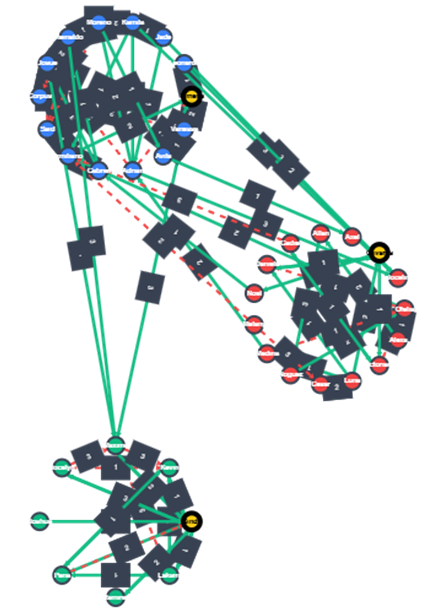
The relationships and rejections within the classroom student community could be observed in the global classroom sociogram (Figure 1).
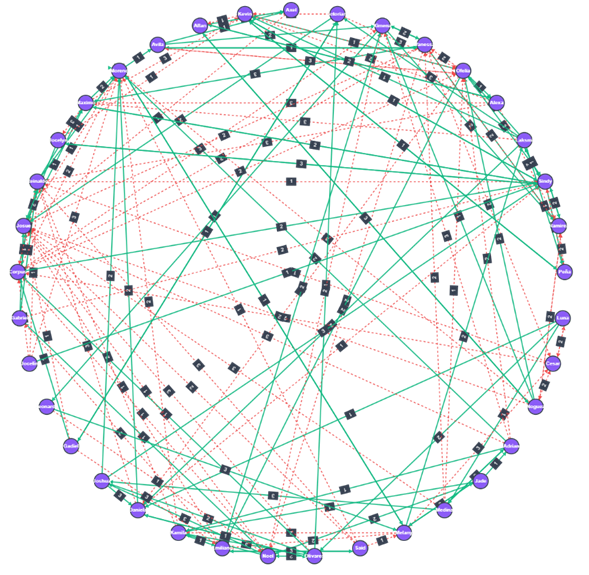
The analysis of the global sociogram yielded 3 subgroups, each with its own components and interactions (Figures 2, 3, and 4).
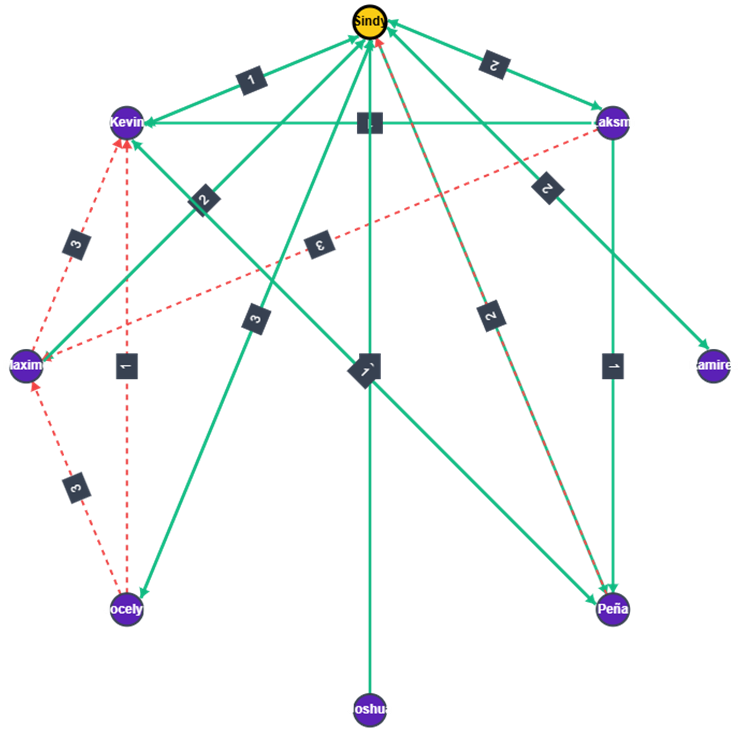
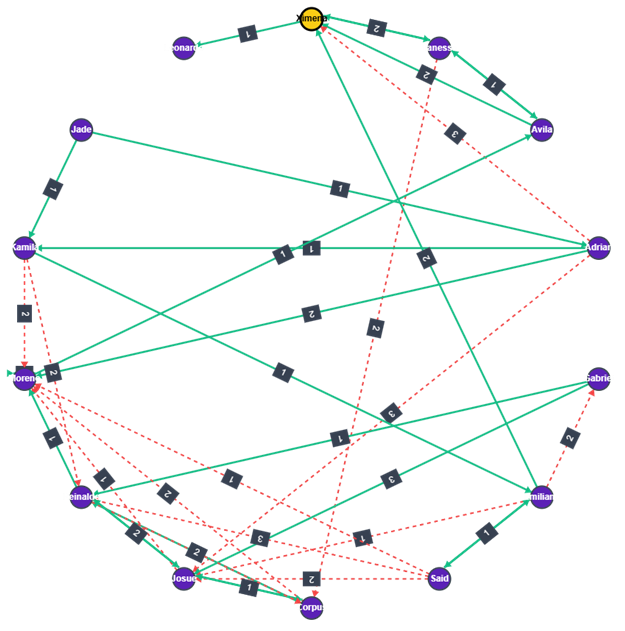
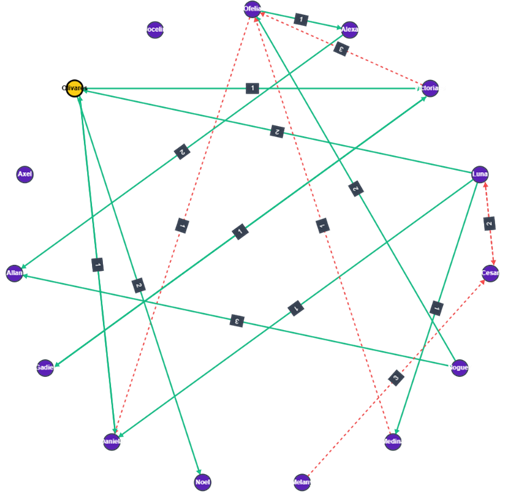
After analyzing the subgroup data, a final sociogram was created to depict the social interactions among the 3 subgroups within the classroom (Figure 5).
DISCUSSION
After analyzing the aforementioned theses, observing the results, and comparing them with my own findings, it is shown that motivating children, preadolescents, and adolescents to self-regulate and manage their emotions yields better school performance and social interaction development, fostering a harmonious, tolerant, empathetic, and beneficial community learning environment for future generations.
It is agreed that these social resources are learning developed through the social formation areas written and investigated by the SEP (2024), in which school problems such as lack of motivation, school dropout, and lack of interest in solidarity can be reduced, as well as fostering citizen practice and collaboration.
CONCLUSIONS
In conclusion, the results obtained, in line with previous analyses, underscore that the motivation to self-regulate and manage emotions helps foster healthy interactions within CCEs. Likewise, knowing the social roles and contexts of students within CCEs allows the teacher to make changes and modifications within the communities and promote harmony in the classroom.
References
- 1 Briones Moya, H. (2019). Habilidades sociales: una revisión teórica. TESIS, UNIVERSIDAD SEÑOR DE SIPÁN, Facultad de Humanidades, PERÚ. Recuperado el 6 de junio de 2025, de https://repositorio.uss.edu.pe/bitstream/handle/20.500.12802/5731/Briones%20Moya%2C%20Hilda.pdf
- 2 Moreno, J. L. (1951). Recuperado el 12 de octubre de 2025.
- 3 Samantha, C. M. (2017).
- 4 SEP. (2023). Programa de estudios de los recursos socioemocionales y ámbitos de la formación socioemocional. artículo, SEP, SEP, Ciudad de México. Recuperado el 6 de junio de 2025, de https://dgb.sep.gob.mx/storage/recursos/2023/08/gPFXY9rDGP-Recursos-Socioemocionales.pdf
- 5 SEP. (2024). Programa de estudio de la formación socioemocional. artículo, SEP, Ciudad de México. Recuperado el 6 de junio de 2025, de https://repositorio.uss.edu.pe/bitstream/handle/20.500.12802/5731/Briones%20Moya%2C%20Hilda.pdf
- 6 Simmel. (1908). Formas de socialización.
Declarations
Funding
No financing.
Conflict of interest
None.
Authorship contributions
Drafting – original draft: Enríquez M. Evelyn Citlally, San German R. Erika, Salazar B. Alberto.
Writing–review and editing: Enríquez M. Evelyn Citlally, San German R. Erika, Salazar B. Alberto.