Abstract
During the 2024–2025 school year, the use of Generative Artificial Intelligence (AGI) by high school students has grown both in the development of assignments and academic projects. This paper is based on a descriptive, qualitative-quantitative methodology and talks about the way in which students use the IAG in their classes, assignments and projects and how they validate it.
Keywords
artificial intelligence, academic ethics, strategies, high school, validation of information
INTRODUCTION
To begin the discussion of this topic, it is necessary to revisit that the incorporation of technology in the classroom has multiple potentialities and is considered fundamental these days. According to Cabrera (2001), it has been represented as the possibility of compensating for school deficiencies with imagination, creativity, and information through the abundance of options available via the Internet, within reach of a movement on any device. It is pertinent to recognize that the users involved, teachers and students, have varied experiences and prior trajectories that nuance the use of devices in classrooms and delimit the pedagogical practices that can be carried out (Cabrera, 2001, as cited in Inclán (2016)).
In the last quinquennium, artificial intelligence has grown exponentially worldwide and has permeated different fields in science, health, economics, engineering, and above all, education; this leads to urgent and accelerated changes for institutions regarding protocols for the use of AI in classes, lesson plans, research papers, and publications, in order to be on the same frequency between students and teachers and get the most out of this tool that is already here and that some AIs such as Open AI’s ChatGPT, Google Gemini, and Microsoft’s Copilot have become preferred due to their free access and ease of use, and it is necessary to know how to use it appropriately to achieve better use while respecting the ideas of others. According to the Generative Artificial Intelligence working group of UNAM, this technology provides elements that can become disruptive for the teaching and learning process, when used in an ethical, responsible, and well-informed framework. In this final stage of student education, emphasis is placed on the importance of fostering values and promoting the use of academic integrity through the use of strategies that help them question the information generated by AI both in their classes, assignments, and research papers, and promote skills of critical thinking, reflective thinking, and creativity.
What is generative AI?
IAGen (Generative AI) is a branch of artificial intelligence that is based on the use of deep learning techniques applied to language-generating models, with training based on two main approaches: a) Unsupervised, in which large amounts of data are used, and b) Supervised, in which there are small volumes of data that are monitored by humans in order to improve results (Radford et al., 2018; OpenAI, 2023 cited in UNAM, 2023:6). This has made this tool potentially attractive to high school students and teachers, and it is necessary to know how to use and apply it in our daily teaching practice to achieve benefits that support the teaching-learning process of students and promote academic integrity. On the other hand, attention must be paid to ensuring that it does not increase the digital divide, which had already been increasing before and during the pandemic, and that changes must now be made at the global, national, and institutional levels to prevent greater student lag and regulate the use of these tools so as not to harm the right to education, which is among the greatest rights that human beings have. Therefore, it is important to develop protocols that support the use of this new technology while respecting the rights of others.
The use of AI in Education
Artificial Intelligence (IA), as a constantly evolving field, plays an increasingly crucial role in academic work. By emulating the capacity for learning and processing human data, IA can accelerate analyses, discover hidden patterns in large datasets, and provide new perspectives that traditional approaches might overlook. (Pérez y Salcedo, 2023)
AI opens new horizons; what we must do now is identify how, in the educational field, we need to analyze how to leverage it to strengthen our courses, sequences, and materials by incorporating applications that lead us to generate texts, images, audio, or multimedia content that contribute to the planned sequence and support the contents of study programs, with an emphasis on developing students' critical thinking, and not merely use it for novelty without achieving innovation and deep learning.
What is the role of Academic Integrity in high school students?
Information management implies not only respect for sources and honesty in the attribution of credits, but also responsibility in handling information when using IAGen applications (Giannini, 2023; Lim et al., 2023). It is essential to promote responsible and ethical practices in information management, ensuring that data are used constructively for the achievement of learning and the generation of knowledge. (Cited in UNAM, 2023:12) Academic integrity plays a crucial role in the educational development of high school students and students at any educational level, as it promotes trust, credibility, and mutual respect in the academic sphere.
Strategies to address these challenges should focus on maintaining an ethical code regarding the handling of platforms in educational and assessment activities, emphasizing the shared responsibility of users, as well as designing educational activities that require human attributes such as creativity, critical-analytical thinking, and collaboration. (13). The role of the teacher is fundamental at this point because it must change its teaching and learning methods so that students carry out activities where they experience a strong cognitive load, and for them, in addition to the aforementioned activities, it is required that, as an additional or introductory part of the study programs, academic ethics and how to validate information be introduced.
How to foster academic integrity and the responsible use of AI?
Academic integrity is part of UNAM's values, and this value aims to act with honesty, without lying, plagiarizing, inventing data, or cheating in the activities that correspond to us in the academic field, whether in teaching, research, or dissemination (UNAM, 2015). This means that we must respect and cite any work, publication, piece, or research generated by others, not appropriating it as our own, but always giving credit to the original authors.
Pérez and Salcedo (2023) propose 20 principles that guarantee the use of AI in academic works, of which, for this paper, we list those considered to adapt to high school students:
Transparency in the use of AI,
Accurate citations and references,
Originality and personal contribution,
Review and validation,
Ethics in research, academic papers and assignments,
Compliance with anti-plagiarism standards,
Ethical responsibility,
Liability for AI errors,
Respect for copyright and software licenses,
Promotion of Ethical Education in AI
Transparency in the use of AI seeks that if AI has been used, it be made evident and that the model used to generate the information be explained, as well as citing and referencing the information generated by AI and giving appropriate credit. Originality must be promoted so that skills such as critical thinking and creativity are not lost; furthermore, it is not possible to trust everything that AI provides, and it is always good to review and validate the information to avoid falling into hallucinations or information biases or having a negative impact. In the case of the high school level, it is necessary to foster among students ethical responsibility and responsibility for AI errors, and they must act with ethical principles when using AI for their work, tasks, or any information that this tool provides them, which implies that in the case of some AIs that already provide the sources from which the information was taken, copyright must be respected, and to achieve this it is necessary that institutions, teachers, and students be trained in ethical education to use AI and consider that this tool has advantages but also disadvantages and consequences.
What advantages can be found in AI?
Whenever technology evolves, there is a positive side and a negative side, and this section mentions advantages and disadvantages that AI has. Among the advantages, AI provides immediate feedback, since within seconds you have an answer according to the instruction you have given it; it all depends on whether you need it to support you, clarify something for you, or give you complete information, which allows you to contrast the original version with the final version generated by IAGen, leading to opportunities to learn and reflect and stimulating analytical reasoning. AI is a support for adaptive learning because it helps understand complex topics in a personalized way and each person can learn according to their needs, complementing traditional teaching with clear explanations; however, information must be validated to avoid hallucinations and so that the generated information can be useful.
What disadvantages can be mentioned. Among the most important disadvantages is the risk of plagiarism or AI-generated works that make fair evaluation difficult and affect academic integrity. Another is the excessive dependence on this tool, which can affect the development of critical, reflective, and creative thinking. In addition, inaccurate or incomplete responses can be generated; therefore, students must be provided with strategies that support them in validating information so that their learning is not affected. Another important advantage, especially because they are high school students and minors, is the impact on data privacy and security. Finally, the identification of works of original authorship compared to those generated by AI becomes complicated.
The role of the teacher remains a key piece in guiding students on the use of AI in their education and therefore, must engage in a process of constant updating to support students and ensure they achieve a meaningful and successful teaching-learning process.
METHODS
This work is based on a descriptive approach with a mixed design, of a quantitative-qualitative type, and for this purpose a main instrument was carried out, it is a questionnaire titled 'The use of Generative Artificial Intelligence tools in the academic activities of high school students', consisting of 22 questions and divided into 8 sections: 1. General information, 2. Use of Generative Artificial Intelligence (IAGen) tools, 3. Frequency of use of Generative Artificial Intelligence, 4. Quality of Artificial Intelligence tools, 5. Information validation, 6. Academic performance, 7. Ethics of use, 8. English subject. Due to the title of this work, only sections 1, 2, 3, 4, 5 and 7 were taken into account, and from these, the questions that refer to the use that students make of IAGen and how they validate the information that it generates.
RESULTS
The survey titled "The use of Generative Artificial Intelligence tools in the academic activities of high school students https://docs.google.com/forms/d/e/1FAIpQLSeaCMAmXoJYOMy2yfqXfgZBpm3Sdy3r0hrCOzcThz1CewNI_A/viewform?usp=sharing&ouid=110074204891728723940" was validated with experts from the Faculty of Higher Studies (FES) Acatlán of the Permanent Seminar for the Dissemination of Research (SEPEDI), from the Coordination of Open University and Distance Education (CUAED), and from the Center for Higher Studies in Education (CESE).https://docs.google.com/forms/d/e/1FAIpQLSeaCMAmXoJYOMy2yfqXfgZBpm3Sdy3r0hrCOzcThz1CewNI_A/viewform?usp=sharing&ouid=110074204891728723940
This questionnaire was designed to identify the use of generative artificial intelligence tools in the academic activities of high school students, in order to learn about the tools they use, the frequency of use, their quality, the methods used to validate the information, the impact on academic performance, and the ethical decisions when applying it. In the first part, the grade level of the students and their ages were requested. It was applied to 221 high school students from the National Preparatory School No. 6 of the UNAM; 101 fourth-year students, 76 fifth-year students, and 46 sixth-year students, and their ages range between 14-15 (10.9%), 15-16 (31.7%), 16-17 (32.6%), 17-18 (19.5%), 18-19 (5.4%).
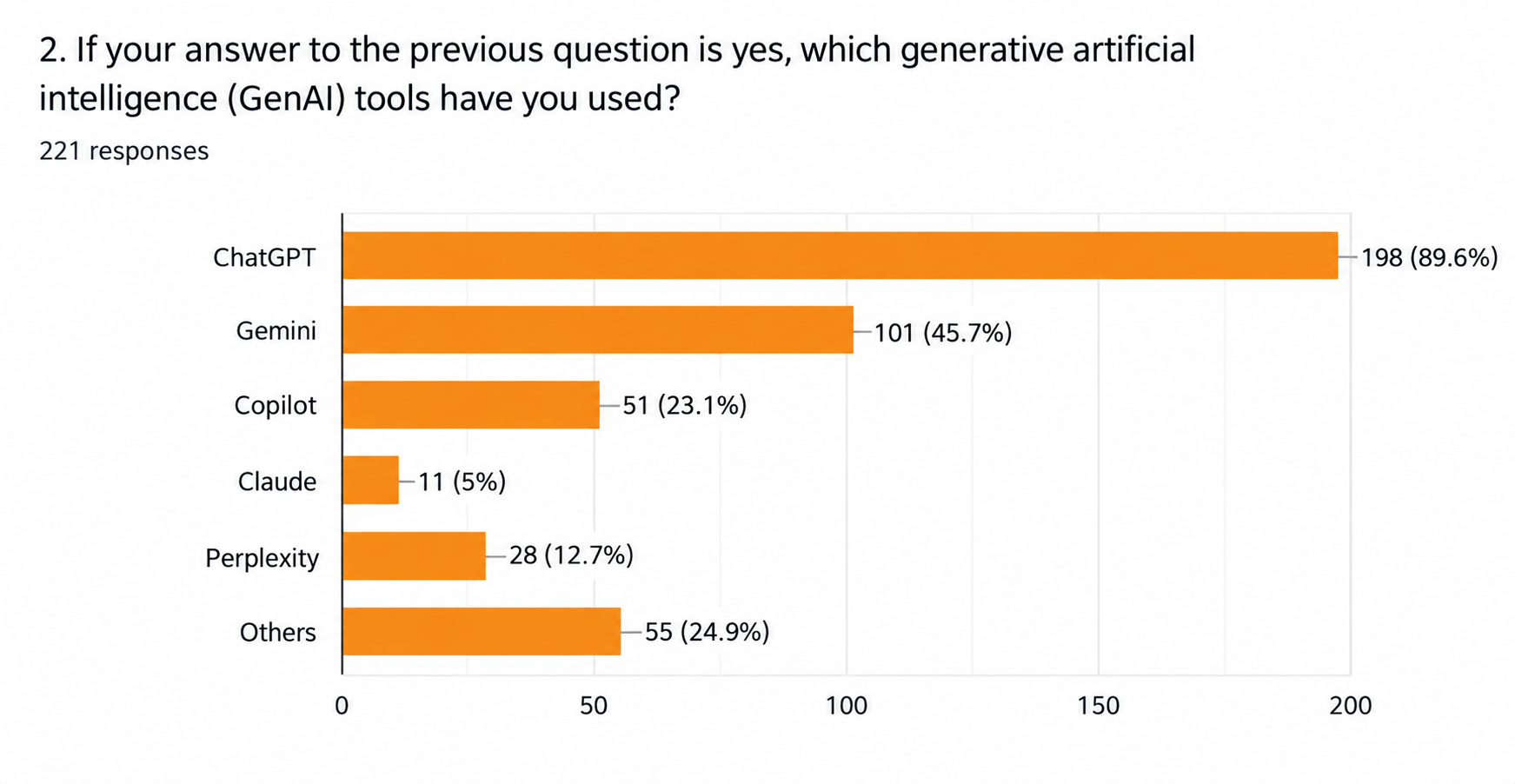
In the second section, Use of Generative Artificial Intelligence (GenAI) tools, questions 1 to 3 were analyzed. 96.8% of the students interviewed use some Generative Artificial Intelligence (GenAI) tool in their daily study, while 3.2% do not. The Generative Artificial Intelligence (GenAI) tools most used by students are: ChatGPT (89.5%), Gemini (45.7%), Copilot (23.1%), and Others (24.9%).
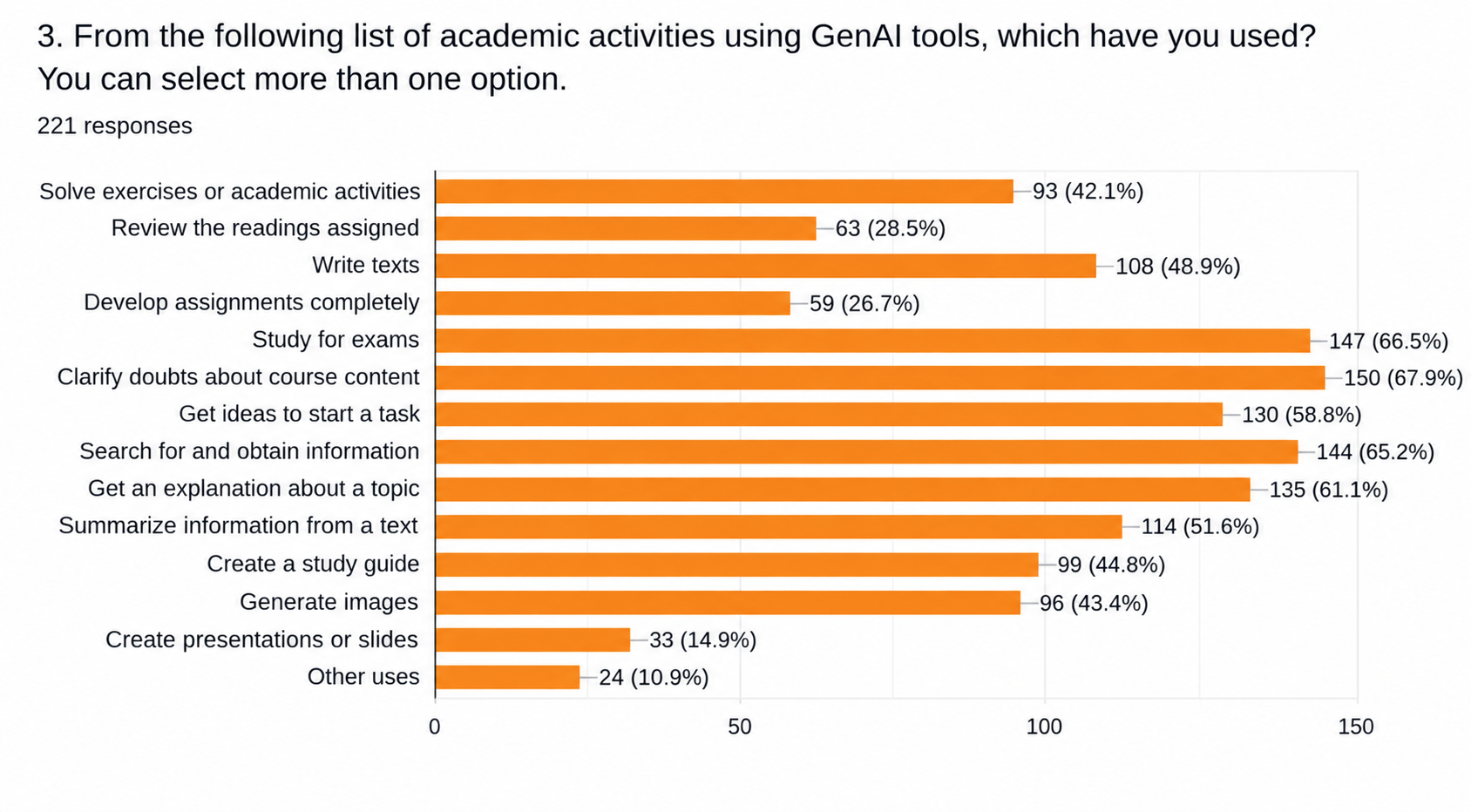
Among the academic activities with IAGen listed, the ones students have used the most are: clarifying doubts about class content (67.9%), studying for exams (66.5%), searching for and obtaining information (65.2%), obtaining an explanation about some content (61.1%), and obtaining ideas to start a school activity or assignment (58.8%), among others.
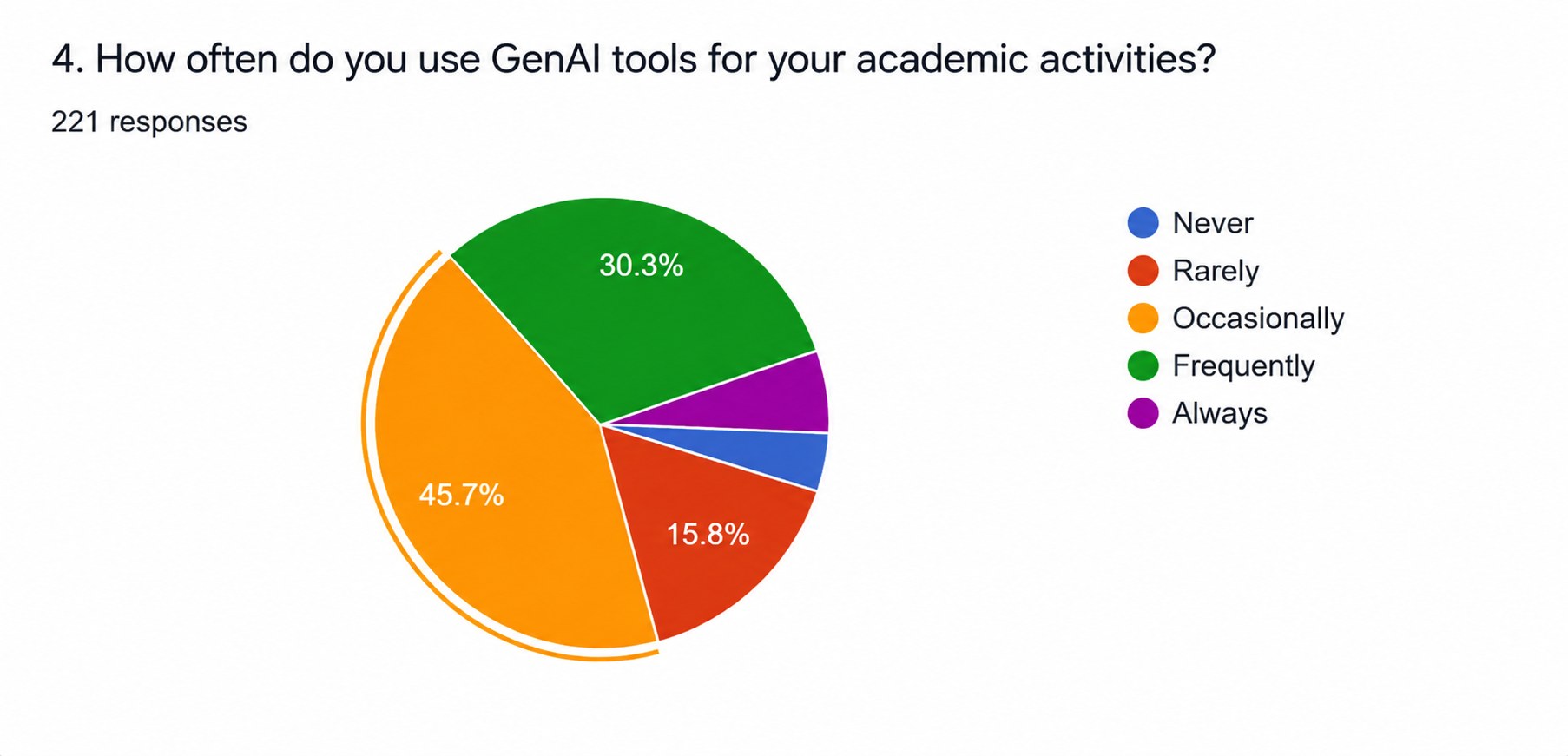
In the third section, Frequency of Use of Generative Artificial Intelligence, question 4 seeks to determine the frequency with which they use IAGen tools: 45.7 of the students mentioned that they use it occasionally, 30.3% use it frequently, 15.8% use it rarely, 5.4% always, and 2.7% never. This means that 76% of the surveyed students already use IAGen as part of their academic life.
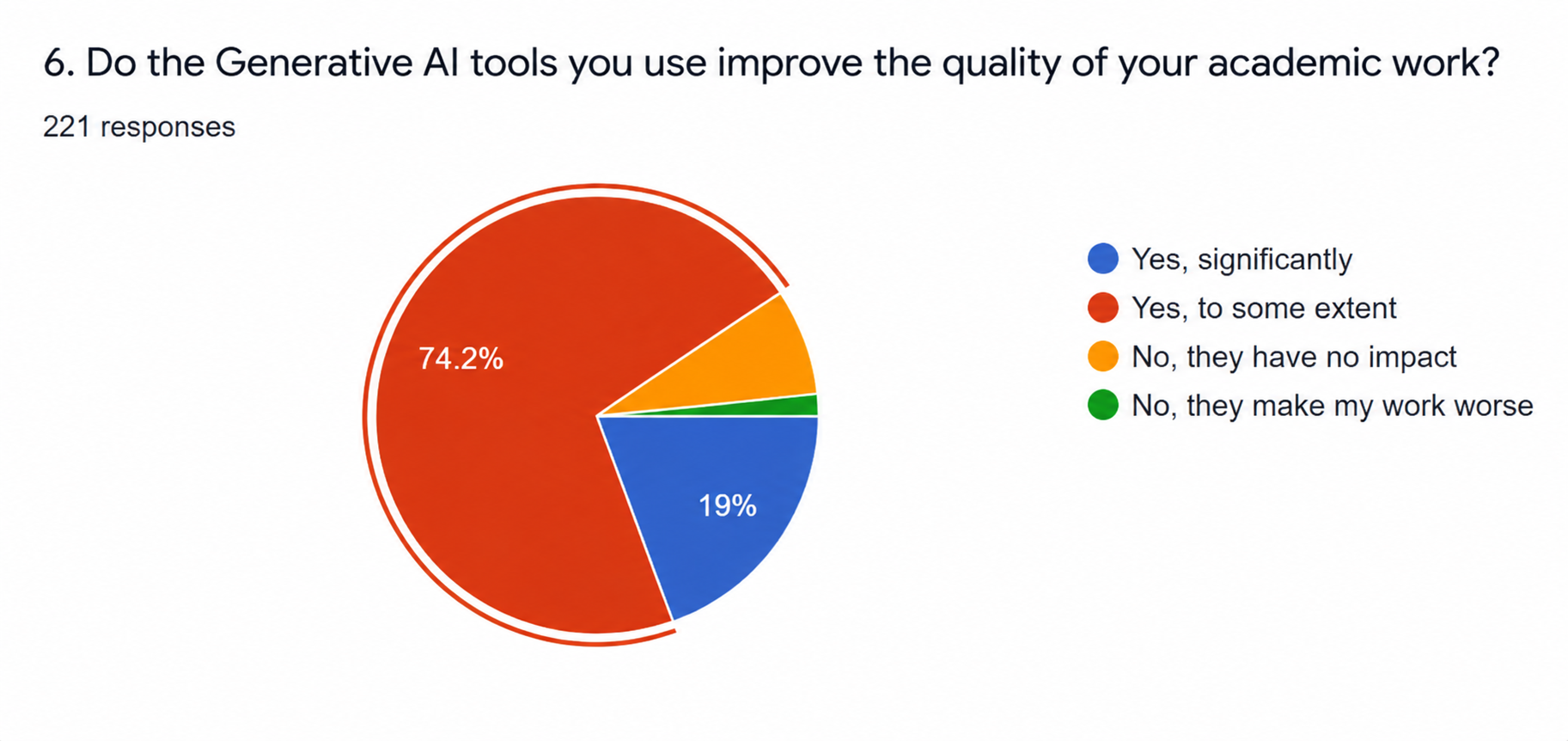
In the fourth section, which discusses Quality of Artificial Intelligence tools, question 6 asks whether the IAGen tools they use improve their quality in academic work; 74.2% mention that to some extent they do, 19% significantly, 6.3% have no impact, which means that 94% are moderately satisfied with the information that IAGen provides them.
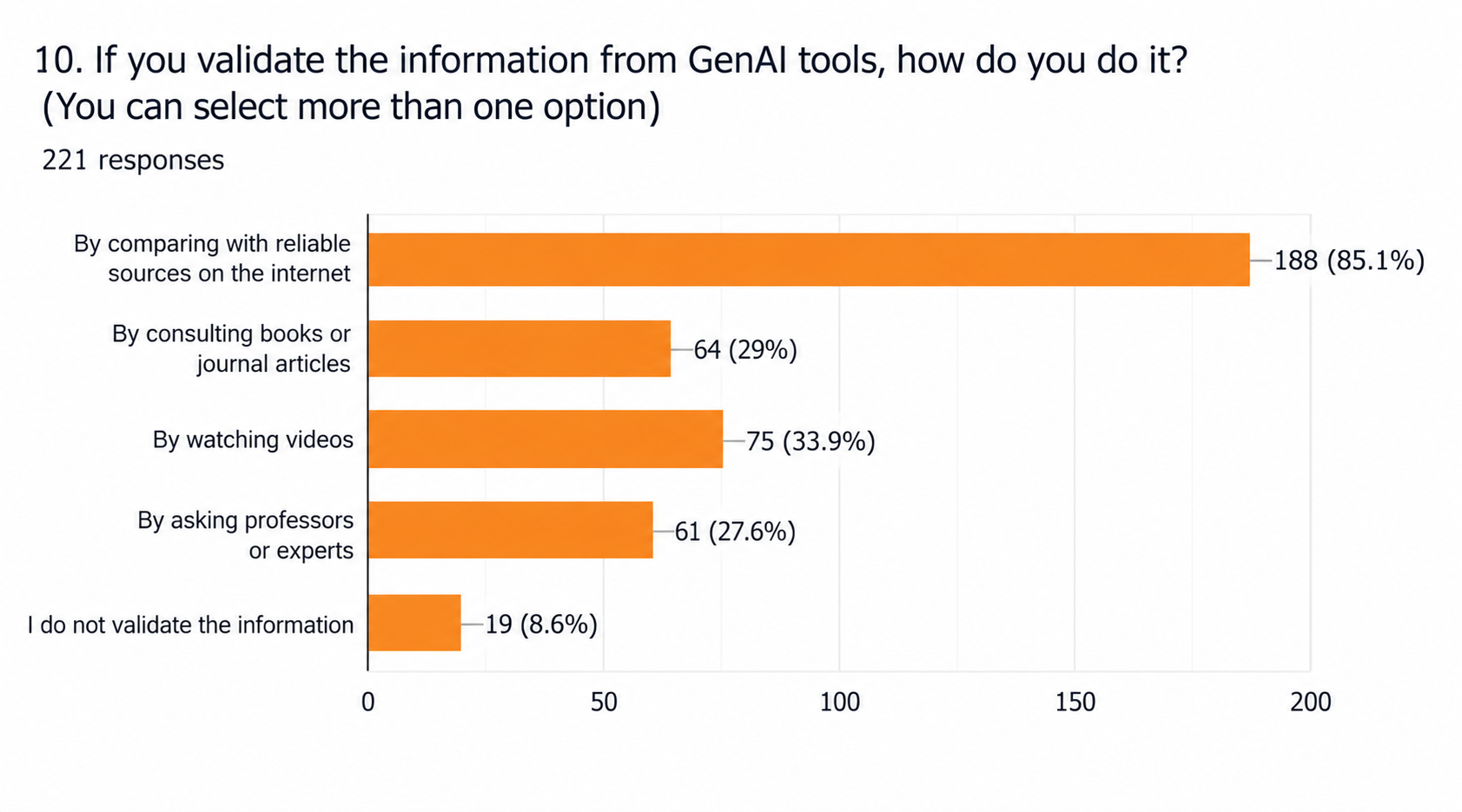
In the fifth section, which refers to Information Validation, question 10 asks them whether they validate the information that the IAGen provides them and how they do it. 91.9% of the students responded that they do verify the information provided by the IAGen before using it in their academic work, and 85.1% do so by comparing with reliable sources on the internet, 29% do so by consulting videos or books or journal articles, and 27.6% by consulting their professors or experts. The majority have information validation strategies.
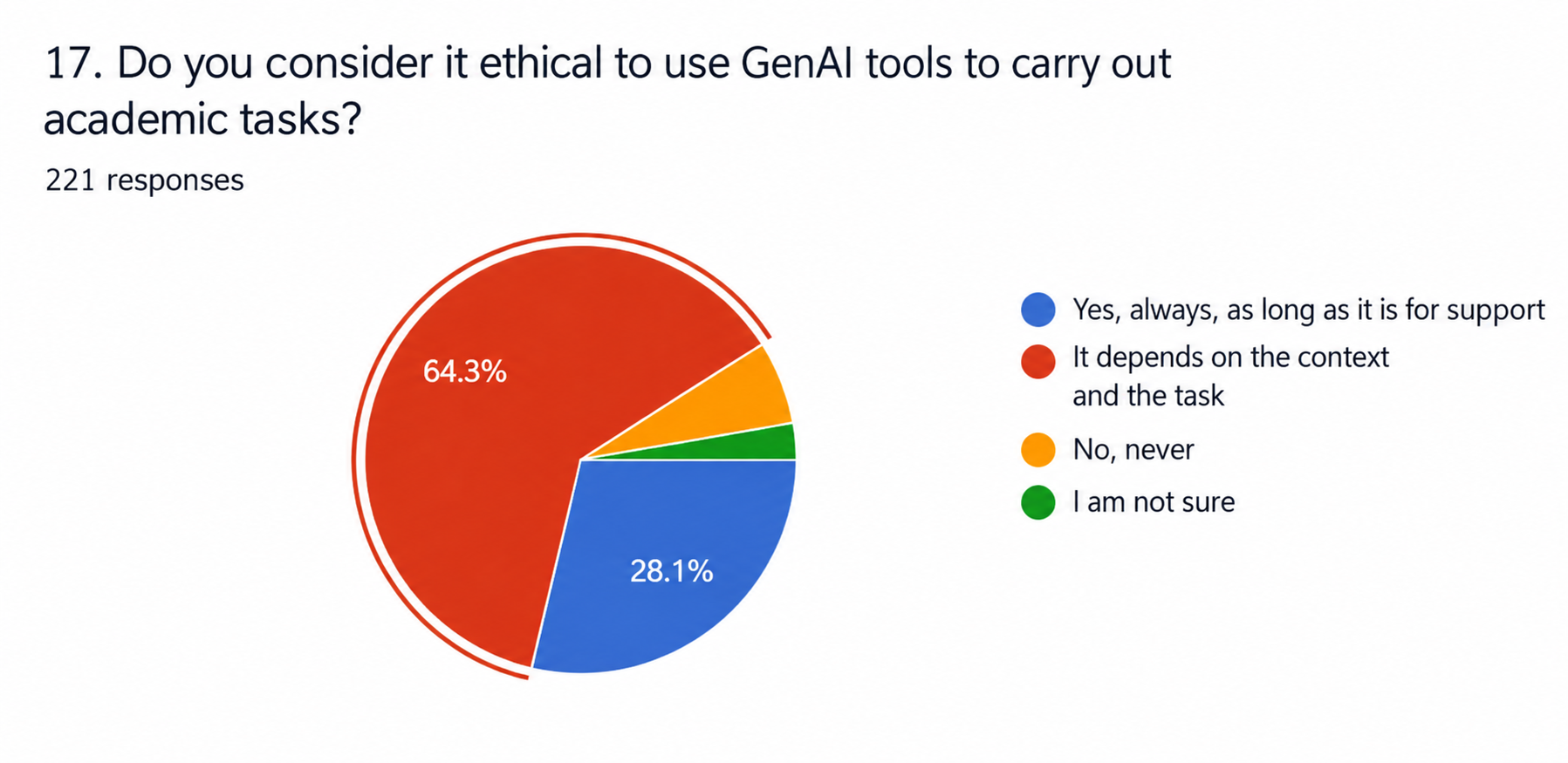
The seventh section focuses on the ethics of use. Question 17 asks them whether they consider it ethical to use IAGen tools for academic tasks, and 64.3% of the students consider that it depends on the context and the task, while 28.1% consider that yes, as long as it is a support.
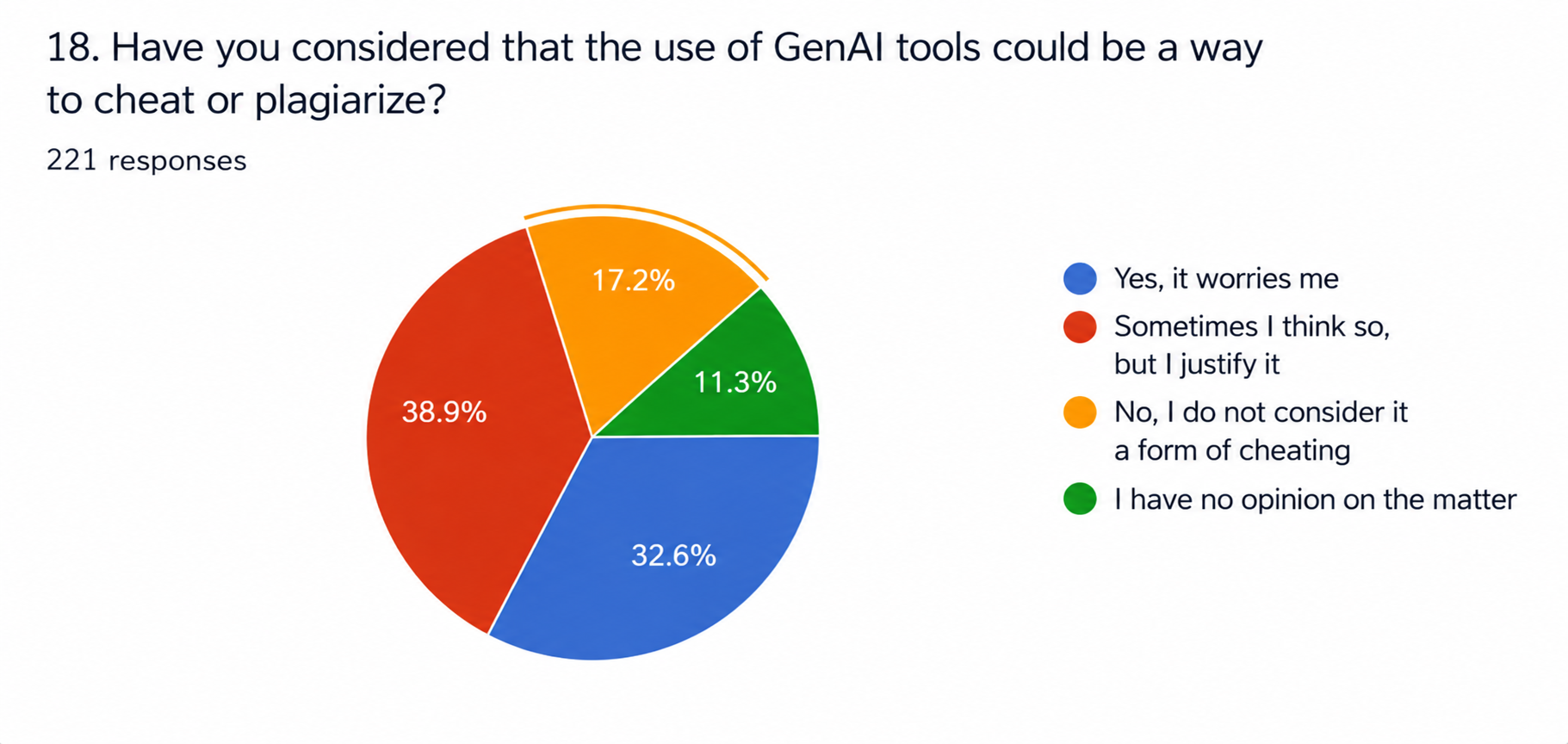
On the other hand, when students are asked whether they consider that the use of IAGen tools could be a form of cheating or plagiarism, 39.8% state that they think so but justify it, 32.6% feel worried, 17.2% do not consider it cheating, and it should be noted that the majority do not consider that they are committing plagiarism, or there is a justification for not considering it so.
CONCLUSIONS
IAGen has revolutionized the world and has led to changes in different aspects of academic life, so it is necessary for students to be aware that all information generated by IA must be validated, and therefore it is indispensable that today more than ever, critical, reflective thinking and academic ethics be promoted for the benefit of all the agents that make up an institution.
It was also observed that students know that IAGen has great advantages but also disadvantages, and this confronts them with the fact that it does not always provide accurate answers; furthermore, they feel dependent on technology, so a challenge for teachers is to design activities with a high cognitive demand through questions that stimulate critical thinking and creativity.
Students perceive that most teachers have not provided clear instructions for using generative AI; therefore, it is advisable for teachers to update their knowledge of generative AI to ensure its appropriate and responsible use. Generative AI should be gradually incorporated into classrooms judiciously and creatively to achieve effective, adaptive, and personalized learning.
Students also validate information in various ways, such as comparing AI-generated information with reliable sources on the internet, in books, journals, and videos, and by asking teachers or experts. Very few do not validate the information and instead simply copy and paste.
The suggested strategies include motivating students not to settle for what AI provides but to engage in lateral reading and consult at least 2 other sources to determine whether there is consensus or divergence in the information. If there is consensus, they should also identify the author or organization behind it to assess their expertise on the subject and thus determine reliability. The teacher's role is to make students aware that AI has limitations and can provide information, false citations, or hallucinations; hence, validating information is important. In this way, critical reading will be encouraged, and the digital competence of both students and teachers will be strengthened.
An AI use declaration should be designed to inform readers that part or all of the academic work was generated using artificial intelligence, thereby making its use transparent. Both students and instructors must be aware that AI-generated information must be cited and referenced as a mandatory requirement to avoid copyright infringement.
Finally, the institution must establish clear rules about what can or cannot be done with the support of artificial intelligence in academic work. It must always keep in mind that the values of respect, academic integrity, and justice must be preserved so that we can coexist better with AI by using it appropriately without depending on it, while promoting reflection, critical thinking, and creativity.
References
- 1 Inclán, C. (2016). Ctrl-C, Ctrl-V La práctica escolar de copiar y pegar en el bachillerato. Perfiles Educativos | vol. XXXVIII, núm. 154, IISUE-UNAM. Suplemento 2016, Plagio académico.
- 2 Pérez, Jorge & Salcedo, Arturo (2023). Consideraciones éticas al utilizar Inteligencia Artificial para trabajos académicos (una propuesta para la Universidad Nacional),PrimediaeLaunch/ Universidad Nacional Autónoma de México. ISBN: 979-8-89217-680-4 https://www.academia.edu/107199674/Jorge_P%C3%A9rez_and_Arturo_Salcedo_Consideraciones_%C3%A9ticas_al_utilizar_IA_en_trabajos_acad%C3%A9micos
- 3 Pitts,G. Marcus,V. Motamedi,S. (2025). Students Perspectives on the Benefits and Risks of AI in Education, arXiv:2505.02198 [cs.CY], https://arxiv.org/abs/2505.02198.
- 4 Ruiz, P., y Fusco, J. (2023). Glossary of Artificial Intelligence Terms for Educators. https://circls.org/educatorcircls/ai-glossary.
- 5 Universidad Nacional Autónoma de México.(2015). Valor UNAM. [Sitio web], https://valorunam.wordpress.com/page/2/
- 6 Universidad Nacional Autónoma de México. (2023). Recomendaciones para el uso de Inteligencia Artificial Generativa en la docencia, Grupo de trabajo de Inteligencia Artificial Generativa de la UNAM. https://cuaieed.unam.mx/.
- 7 Universidad Nacional Autónoma de México (2025). Recomendaciones para el uso educativo de la Inteligencia Artificial Generati¬va en la UNAM”, Grupo de trabajo de Inteligencia Artificial Generativa de la UNAM. https://www.ceide.unam.mx/wp-content/uploads/2025/05/Recomendaciones_IAGEN_UNAM_2025.pdf
Declarations
Funding
No financing.
Conflict of interest
None.
Authorship contributions
Drafting – original draft: Dulce María Verónica Montes de Oca Olivo.
Writing–review and editing: Dulce María Verónica Montes de Oca Olivo.