

Abstract
Introduction: artificial intelligence (AI) is reshaping how diseases are diagnosed, treated and monitored, integrating machine learning, deep learning and natural language processing into the analysis of large volumes of clinical data. Objective: to comprehensively analyze the impact of artificial intelligence on medicine, examining its main diagnostic, therapeutic and clinical-management applications, as well as the challenges, limitations and ethical considerations that condition its safe, equitable and patient-centered integration. Development: AI has matured most in medical imaging, oncology and precision medicine, complementing rather than replacing clinical judgment; randomized evidence in cardiology shows improved workflow efficiency and reduced adverse events, including all-cause mortality. Implementation nonetheless faces technical, organizational and social barriers—data quality and interoperability, lack of explainability, algorithmic bias, and gaps in clinician training—alongside ethical and regulatory challenges regarding privacy, accountability and informed consent. Conclusions: AI offers considerable potential to reduce costs, increase diagnostic accuracy, personalize care and expand access to quality services, provided its deployment overcomes technical, ethical and regulatory barriers through proactive, adaptive and patient-centered governance.
Keywords
Artificial Intelligence, Medical Informatics Applications, Precision Medicine
INTRODUCTION
Artificial intelligence (AI) has established itself as one of the most transformative forces in contemporary medicine, with the capacity to rethink the way diseases are diagnosed, treated, and monitored. Defined as the set of technologies capable of executing tasks that usually require human intelligence, AI in health encompasses machine learning, deep learning, and natural language processing, applied to the analysis of large volumes of clinical data. (1,2) Its rapid evolution has raised expectations that it can improve patient outcomes and increase the efficiency of increasingly complex healthcare systems.(3)
Health systems worldwide face growing challenges, including rising costs, staff shortages, and disparities in access to and quality of care, particularly in low- and middle-income countries.(4) In this context, AI has emerged as a tool capable of enhancing diagnosis, therapeutic planning, patient monitoring, and resource management.(4,5) By integrating and analyzing electronic health records, medical images, and genomic profiles, algorithms can identify patterns, predict disease progression, and recommend optimized treatment strategies.(4,6)
Medical imaging is among its most mature applications, with algorithms identifying neoplastic cells and lesions with increasing accuracy and sensitivity, favoring earlier diagnoses and directly impacting outcomes.(7) AI also drives personalized medicine by tailoring treatments to each patient's individual profile and integrating genomic, lifestyle, and clinical history data to design customized therapeutic strategies.(4) These advances represent a paradigm shift from standardized clinical protocols toward truly individualized care.(4)
The role of AI is better understood not as a substitute for healthcare professionals but as a support tool. It can serve as a triage instrument, replace repetitive and laborious tasks, and, above all, complement clinical judgment, since the combination of clinician and algorithm produces superior results to those of either alone.(8) Recent evidence from randomized trials in cardiology shows that AI-assisted care improves workflow efficiency, strengthens patient engagement, and reduces adverse clinical events, including all-cause mortality.(9)
However, the integration of AI into routine practice faces considerable obstacles. These include fragmentation and insufficient data quality, interoperability issues with existing infrastructure, the lack of transparency and explainability of models, and the need for rigorous multicenter validation.(10,11,12) Additional ethical and legal concerns relate to data privacy, algorithmic bias (which can accentuate existing inequities), accountability, and the preservation of the physician-patient relationship.(1,5,12) Organizational culture, training, and AI literacy among clinicians are likewise decisive for successful adoption.(10,11)
In summary, AI offers considerable potential to reduce costs, increase diagnostic accuracy, personalize care, and expand access to quality services, although its responsible deployment requires overcoming technical, ethical, and regulatory barriers.(4,5,12) The objective of this review is to comprehensively analyze the impact of artificial intelligence in medicine, examining its main diagnostic, therapeutic, and clinical management applications, as well as the challenges, limitations, and ethical considerations that influence its safe, equitable, and patient-centered integration into clinical practice.
METHODS
A descriptive and narrative literature review was conducted to characterize the impact of artificial intelligence in medicine, including its diagnostic, therapeutic, and clinical management applications, as well as the barriers to its implementation and ethical and regulatory considerations.
A literature search was conducted between January and March 2026 in the academic databases PubMed/MEDLINE, Scopus, Web of Science, ScienceDirect, and SciELO. Search strategies adapted to each database were constructed using health sciences descriptors (DeCS/MeSH) and free-text terms, combined with the Boolean operators AND and OR:
Equation in English: ("Artificial Intelligence" OR "Machine Learning" OR "Deep Learning") AND ("Medicine" OR "Clinical Practice" OR "Diagnosis" OR "Therapeutics") AND ("Ethics" OR "Healthcare Delivery")
Equation in Spanish: ("Inteligencia Artificial" OR "Aprendizaje Automático") AND ("Medicina" OR "Diagnóstico" OR "Tratamiento") AND ("Ética")
Inclusion and exclusion criteria
Inclusion criteria:
Original articles, systematic reviews, meta-analyses, and narrative reviews published in peer-reviewed journals.
Publications with a publication date between 2019 and 2026.
Works explicitly focused on the clinical application of AI, organizational barriers, algorithmic biases, or ethical-regulatory frameworks in healthcare.
Articles in English or Spanish.
Exclusion criteria:
Editorials, letters to the editor, conference abstracts, or brief notes without explicit methodology or data.
Studies whose exclusive focus was theoretical or computational, without direct applicability to medical practice or clinical management.
Duplicate publications across multiple databases.
Selection process and study flow
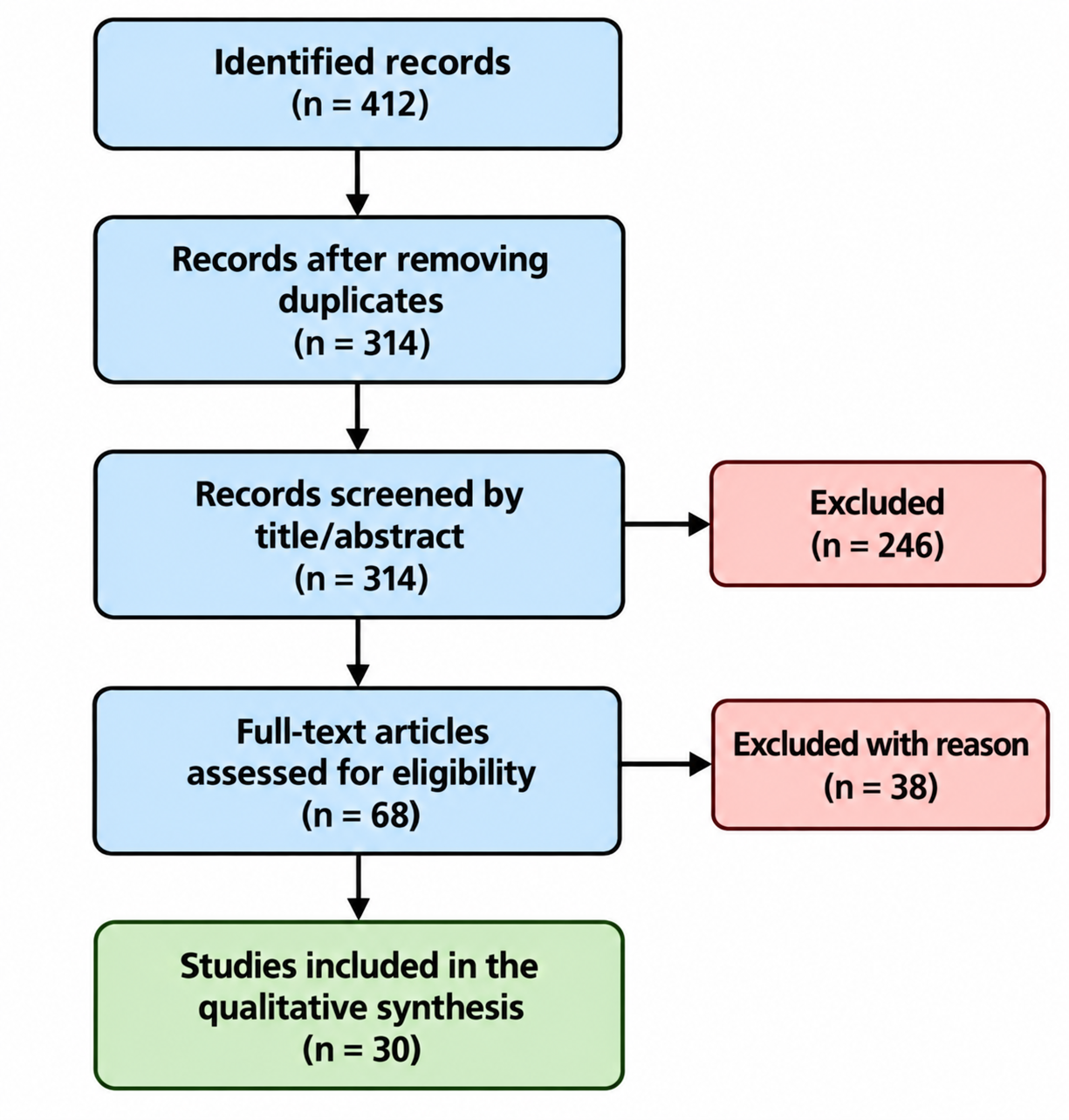
A total of 412 records were identified in the initial search (PubMed: 185, Scopus: 120, Web of Science: 62, ScienceDirect: 30, SciELO: 15); 98 duplicates were removed. The remaining 314 records were assessed by title and abstract, and 246 were excluded because they did not meet the study objective. A total of 68 articles were selected for full-text reading, of which 30 essential studies were ultimately included, comprising the primary evidence synthesized in this review (references 1 to 30).
Information processing and limitations
Data analysis was conducted through a qualitative narrative synthesis of the findings, organizing the development into thematic axes (key concepts, diagnostic imaging, oncology, personalized medicine, chronic management, outcomes, barriers, and ethics). No formal risk-of-bias assessment or meta-analysis was performed because of the narrative design of the review. The main limitation of this design is the selection bias inherent in the extracted literature and the impossibility of generating combined statistical estimates of effect size.
Development
Conceptual foundations of artificial intelligence in medicine
Artificial intelligence in health refers to a set of technologies capable of emulating selected forms of intelligent human behavior—perception, reasoning, learning, and decision-making—with a certain degree of autonomy.(13) Its main branches are machine learning, deep learning based on neural networks that learn patterns directly from raw data, and natural language processing.(14,13) Deep learning has achieved notable success in image classification, which explains the surge in research in specialties that depend on visual interpretation.(14)
The substrate of these systems is the availability of large volumes of heterogeneous data: electronic health records, medical images, laboratory results, data from portable sensors, and genomic sequences, each of which provides a partial view of the patient.(15) The ability of multimodal models to simultaneously fuse text, images, signals, and omics data makes it possible to discover complex relationships that no isolated data source reveals.(15) This shift marks the transition from reactive medicine toward proactive, data-driven care.(16)
Diagnostic applications in medical imaging
Image interpretation constitutes the most mature domain of clinical AI. Algorithms assist radiologists in limited functions such as detection, workflow triage, quantification, and image enhancement.(17) Quantification functions segment and measure anatomical structures—breast density, brain structures, cardiac flow, or lung tissue density—while triage flags and communicates suspicious findings such as intracranial hemorrhage, large-vessel occlusion, pneumothorax, or pulmonary embolism.(17)
The FDA has authorized more than 200 commercial AI products in radiology, developed by companies from more than 20 countries; some hospitals already use them successfully, with greater adoption in large practices.(17) These systems have improved accuracy in tasks such as mammography interpretation, cardiac function assessment, and lung cancer screening, addressing not only diagnosis but also risk prediction and treatment.(14)
The scope extends beyond radiology: AI interprets electrocardiograms, pathology slides, and ophthalmological images.(17) In pathology, using whole-slide imaging, the models efficiently identify areas of interest, determine the origin of the primary tumor, and detect structural variants or driver mutations, offering benefits that even exceed those of review by expert pathologists.(14) In gastroenterology, colonoscopy support systems improve polyp detection and increase the sensitivity of the procedure.(14)
Artificial intelligence in oncology
In oncology, early-stage cancers and recurrences are difficult to diagnose from radiology and pathology reports, especially in clinically stable patients.(18) Convolutional neural networks, trained on thousands to millions of images of normal and malignant lesions, learn to classify both groups and detect subtle differences imperceptible to the human eye.(18) AI-assisted diagnosis offers early detection with high accuracy, greater efficiency, and scalability across health systems.(18)
Melanoma illustrates the clinical value of this technology: it accounts for only 5% of skin cancers, but its 5-year survival drops to 32% at the metastatic stage versus 99% when detected early.(18) Differentiating early melanoma from benign lesions of similar appearance is visually difficult, a scenario in which AI helps identify fine-grained variability and enables earlier interventions.(18) Pioneering studies in dermatology, which compared neural networks with board-certified dermatologists, laid the foundations for the design of AI for oncological diagnosis.(18)
Personalized medicine, genomics, and pharmacogenomics
Precision medicine aims to identify subpopulations that differ in disease risk, drug response, and therapeutic outcomes.(19) AI rapidly analyzes multidimensional clinical and biological data generated by genomic sequencing, supporting precise diagnoses, early detection, and the identification of new therapeutic targets.(19,20) This approach shifts the focus from uniform protocols to individualized, data-driven interventions.(20)
Deep learning models integrate genomic, demographic, and lifestyle data to predict patient response to different treatments.(21) For example, they analyze the tumor's genomic characteristics—mutations, copy number variations, and epigenetic modifications—to predict response to various chemotherapeutic agents and identify biomarkers associated with efficacy.(21) They can also estimate the risk of post-surgical complications such as infection or bleeding, recommending additional monitoring for high-risk patients.(21)
Pharmacogenomics adapts pharmacological therapy to the individual genetic profile, reducing the risk of adverse reactions.(22) Machine learning and deep learning models predict drug response and refine the identification of genetic variants, as exemplified by tools such as DeepVariant and AlphaFold.(22) Large language models can interpret pharmacogenetic tests—for example, CYP450 alleles—and translate raw genetic data into personalized medication and dose-adjustment recommendations, improving understanding of complex genomic results.(15,22)
Likewise, AI accelerates drug discovery by navigating chemical structures and predicting drug-target interactions, reducing the time and cost of bringing new medications to market.(19,20) The analysis of large-scale genetic datasets enables identification of variants associated with disease susceptibility, drug response, and treatment outcomes.(23)
Continuous Monitoring and Management of Chronic Diseases
Chronic non-communicable diseases—cardiovascular diseases, cancer, respiratory diseases, and diabetes—cause about 41 million deaths annually—74% of global mortality—and exert sustained pressure on health systems.(13) Traditional care models rely on periodic and reactive adjustments based on episodic laboratory tests and clinical visits, limiting personalization and timely intervention.(16,13) The literature review identifies four consistent functions of AI in chronic care: personalized decision support and treatment optimization; continuous monitoring and risk prediction from patient-generated data; conversational agents for education, adherence, and behavioral support; and mobile health platforms that connect patients with clinicians.(24)
In diabetes, AI predicts hypoglycemia and hyperglycemia, optimizes insulin dosing, and personalizes education, integrating continuous glucose monitoring data, dosing history, and physiological metrics.(16) Automated insulin delivery systems reduce the burden of minute-to-minute adjustments for patients and clinicians.(16) In the cardio-reno-metabolic spectrum, multimodal models that integrate electronic records, genomics, imaging, and wearable sensor data achieve risk stratification superior to that of unimodal models.(16) Nevertheless, most of these technologies remain in early phases of algorithm development or feasibility, and support for emotional self-management is less developed than that for medical or behavioral self-management.(25)
Impact on Clinical Outcomes
AI is best understood as a complement to clinical judgment rather than a substitute for the professional.(8) The most robust aggregate evidence comes from cardiology: a systematic review of 32 randomized trials showed that AI-based implementations improved workflow efficiency (SMD −0.71), strengthened patient engagement and effective care delivery (RR 1.36), and reduced adverse clinical events (RR 0.80).(9) These included significant reductions in all-cause mortality (RR 0.84; 95% CI, 0.75-0.94) and major cardiovascular events (RR 0.89; 95% CI, 0.82-0.98).(9) The value of clinical AI lies not in isolated algorithmic performance but in its integration as a validated auxiliary tool within existing care pathways.(9)
Barriers to Clinical Implementation
Despite its potential, the translation of AI into routine practice faces interrelated barriers. A systematic review classified them into three levels—technical/algorithmic, stakeholder, and social—identifying 19 major themes, including the lack of explainability, the need for validation protocols and interoperability standards, potential job loss, distrust in AI, and workflow challenges.(26) From a technical perspective, the need for interpretable models compatible with fragmented computing infrastructures, together with interoperability problems with legacy systems, complicates deployment.(11)
Insufficient data quality—unstructured and incomplete information, with variable formats and labels, outdated, or scarce for certain types of patients—makes it difficult to build and maintain reliable models.(10) Bias in datasets—which underrepresent patients by race, gender, ethnicity, or age—constitutes an additional concern, compounded by complicated access to data due to legal and organizational barriers.(10) At the organizational level, cultural readiness, change management, structured training, and clinicians' AI literacy are decisive; without cultures that support experimentation, initiatives encounter resistance linked to professional routines and norms.(11) The high costs of implementation and maintenance, together with legal uncertainty, limit adoption in resource-constrained settings.(11)
Ethical and Regulatory Considerations
The development of AI has outpaced the social, institutional, and regulatory infrastructure necessary for equitable implementation.(27) Data privacy and security are paramount and require robust encryption, anonymization techniques, and responsible data-handling practices.(28) Algorithmic bias poses a significant challenge: since most digitalized health data originate from high-income countries, models may incorporate geographic, racial, and socioeconomic biases that risk perpetuating—rather than resolving—existing inequities.(27,28) Mitigating this bias requires diverse datasets and continuous monitoring.(28)
Transparency and explainability strengthen trust and accountability; regulators face a fundamental tension, since requiring full explainability may exclude the most accurate algorithms, while allowing “black box” systems raises safety concerns.(27) Interpretability gaps make it difficult for clinicians to determine when to follow or override an algorithmic recommendation.(27) Accountability frameworks must clarify attribution when a system contributes to an error, as responsibility may fall to the clinician, the institution, or the developer.(27)
Informed consent acquires new complexities: patients must know how AI is used in their care—risks, benefits, and limitations—and be able to opt out of its use.(29) Emerging regulatory instruments, such as the risk-based classification of the European Union's AI Act and the General Data Protection Regulation (GDPR), which requires transparency, explainability, and human oversight under privacy-by-design principles, represent significant steps, although they remain voluntary or incipient in many contexts.(27,29) AI governance must be proactive and adaptive, with patient-centered oversight and clear accountability mechanisms to prevent the proliferation of biased systems.(30)
Conclusions
Artificial intelligence is emerging as a transformative force in contemporary medicine; its value lies in complementing clinical judgment to optimize diagnostic accuracy, therapeutic personalization, and reduce morbimortality, as demonstrated by evidence in imaging, oncology, and cardiology. However, for its impact to transcend algorithmic performance and achieve effective routine integration, it is essential to overcome technical and infrastructural barriers—such as the low quality and interoperability of data—as well as gaps in professional literacy. Ensuring that this transition benefits patients equitably requires addressing algorithmic bias, resolving “black box” opacity, and establishing adaptive and transparent governance focused on safety, privacy, and the preservation of the physician-patient relationship.
References
- 1 Alowais SA, Alghamdi SS, Alsuhebany N, et al. Revolutionizing Healthcare: The Role of Artificial Intelligence in Clinical Practice. BMC Med Educ. 2023;23(1):689. https://doi.org/10.1186/s12909-023-04698-z
- 2 Razai MS, Al-Bedaery R, Bowen L, et al. Implementation challenges of artificial intelligence (AI) in primary care: Perspectives of general practitioners in London UK. PLoS One. 2024;19(11):e0314196. https://doi.org/10.1371/journal.pone.0314196
- 3 Singh K, Prabhu A, Kaur N. The Impact and Role of Artificial Intelligence (AI) in Healthcare: Systematic Review. Curr Top Med Chem. 2025. https://doi.org/10.2174/0115680266339394250225112747
- 4 Fahim YA, Hasani IW, Kabba S, Ragab WM. Artificial intelligence in healthcare and medicine: clinical applications, therapeutic advances, and future perspectives. Eur J Med Res. 2025;30(1):848. https://doi.org/10.1186/s40001-025-03196-w
- 5 Das A, Arora D, Deswal G, Grewal AS, Bansal S. Harnessing Artificial Intelligence in Healthcare: Advancing Diagnosis, Treatment, and Patient-Centered Care. J Natl Med Assoc. 2026;118(3):463-488. https://doi.org/10.1016/j.jnma.2026.02.007
- 6 Ramezani A, Bagheri M, Mahmoudian F, et al. The Expanding Role of Artificial Intelligence in Medical Diagnosis: From Molecular Diagnostics and Multi-Omics to Digital Health and Medical Imaging. Expert Rev Mol Diagn. 2026;26(9):755-774. https://doi.org/10.1080/14737159.2026.2706000
- 7 Katwaroo AR, Adesh VS, Lowtan A, Umakanthan S. The Diagnostic, Therapeutic, and Ethical Impact of Artificial Intelligence in Modern Medicine. Postgrad Med J. 2024;100(1183):289-296. https://doi.org/10.1093/postmj/qgad135
- 8 He J, Baxter SL, Xu J, et al. The practical implementation of artificial intelligence technologies in medicine. Nat Med. 2019;25(1):30-36. https://doi.org/10.1038/s41591-018-0307-0
- 9 Lin YE, Yang SM, Huang CJ, et al. Impact of artificial intelligence on cardiovascular workflow, engagement, and outcomes: a systematic review. NPJ Digit Med. 2026;9(1):536. https://doi.org/10.1038/s41746-026-02690-7
- 10 Nair M, Svedberg P, Larsson I, Nygren JM. A comprehensive overview of barriers and strategies for AI implementation in healthcare: Mixed-method design. PLoS One. 2024;19(8):e0305949. https://doi.org/10.1371/journal.pone.0305949
- 11 Lanfranchi G, Gembillo G, Santoro D, Villari M. Artificial intelligence adoption in healthcare: a systematic review of implementation challenges and health services implications. BMC Health Serv Res. 2026;26(1):1187. https://doi.org/10.1186/s12913-026-14960-x
- 12 Kelly CJ, Karthikesalingam A, Suleyman M, Corrado G, King D. Key challenges for delivering clinical impact with artificial intelligence. BMC Med. 2019;17(1):195. https://doi.org/10.1186/s12916-019-1426-2
- 13 Miao S, Zhang Z, Bao C. Applications of Artificial Intelligence Technologies in Nursing for Noncommunicable Chronic Diseases: A Scoping Review. J Nurs Manag. 2026;2026(1):e5288231. https://doi.org/10.1155/jonm/5288231
- 14 Rajpurkar P, Chen E, Banerjee O, Topol EJ. AI in health and medicine. Nat Med. 2022;28(1):31-38. https://doi.org/10.1038/s41591-021-01614-0
- 15 Shaikh M, Ebrahimi A, Wiil UK. Towards convergence of AI and blockchain for personalized medicine in pharmacogenomics. Sci Rep. 2026;16(1):24464. https://doi.org/10.1038/s41598-026-53058-6
- 16 Young CF, MacLeod J. Artificial intelligence in cardio-kidney-metabolic care: Transforming integrated disease management through data-informed innovation. Int J Obes. 2026;50(8):1666-1674. https://doi.org/10.1038/s41366-026-02119-x
- 17 Rajpurkar P, Lungren MP. The Current and Future State of AI Interpretation of Medical Images. N Engl J Med. 2023;388(21):1981-1990. https://doi.org/10.1056/NEJMra2301725
- 18 Kolla L, Parikh RB. Uses and limitations of artificial intelligence for oncology. Cancer. 2024;130(12):2101-2107. https://doi.org/10.1002/cncr.35307
- 19 Mumtaz H, Saqib M, Jabeen S, et al. Exploring Alternative Approaches to Precision Medicine Through Genomics and Artificial Intelligence - A Systematic Review. Front Med. 2023;10:1227168. https://doi.org/10.3389/fmed.2023.1227168
- 20 Bhushan A, Misra P. Unlocking the potential: multimodal AI in biotechnology and digital medicine—economic impact and ethical challenges. NPJ Digit Med. 2025;8(1):619. https://doi.org/10.1038/s41746-025-01992-6
- 21 Li YH, Li YL, Wei MY, Li GY. Innovation and challenges of artificial intelligence technology in personalized healthcare. Sci Rep. 2024;14(1):18994. https://doi.org/10.1038/s41598-024-70073-7
- 22 Jakka AL, Chacko RM, Vasam M, et al. From Genomics to Clinic: The Transformative Impact of AI in Pharmacogenomics and Personalized Medicine. Pharmacogenomics. 2025;1-14. https://doi.org/10.1080/14622416.2025.2591596
- 23 Basumatary D, Devi SG, Swargiary D, Borah JC. AI-Based Drug Discovery and Design for Different Genetic Designs. Methods Mol Biol. 2025;2952:125-148. https://doi.org/10.1007/978-1-0716-4690-8_8
- 24 Du Y, Yang P, Liu Y, Deng C, Li X. Artificial Intelligence in Chronic Disease Self-Management: Current Applications and Future Directions. Front Public Health. 2025;13:1689911. https://doi.org/10.3389/fpubh.2025.1689911
- 25 Hwang M, Zheng Y, Cho Y, Jiang Y. AI Applications for Chronic Condition Self-Management: Scoping Review. J Med Internet Res. 2025;27:e59632. https://doi.org/10.2196/59632
- 26 Li LT, Haley LC, Boyd AK, Bernstam EV. Technical/Algorithm, Stakeholder, and Society (TASS) Barriers to the Application of Artificial Intelligence in Medicine: A Systematic Review. J Biomed Inform. 2023;147:104531. https://doi.org/10.1016/j.jbi.2023.104531
- 27 Raj T, Philip A, Thomas V. Artificial intelligence in public health—challenges and opportunities. Eur J Clin Nutr. 2026;80(6):566-573. https://doi.org/10.1038/s41430-026-01745-y
- 28 Elendu C, Amaechi DC, Elendu TC, et al. Ethical Implications of AI and Robotics in Healthcare: A Review. Medicine (Baltimore). 2023;102(50):e36671. https://doi.org/10.1097/MD.0000000000036671
- 29 Kermansaravi M, Chiappetta S, Shahabi Shahmiri S, et al. International expert consensus on the current status and future prospects of artificial intelligence in metabolic and bariatric surgery. Sci Rep. 2025;15(1):9312. https://doi.org/10.1038/s41598-025-94335-0
- 30 Budhu JA, Anderson N, Branson C, et al. Health Equity Considerations in the Age of Artificial Intelligence. Neurology. 2025;105(12):e214356. https://doi.org/10.1212/WNL.0000000000214356
- 31 Conflicto de intereses
- 32 The authors declare no conflicts of interest.
Declarations
Funding
The authors received no funding for the development of this research.
Conflict of interest
None.
Authorship contributions
Conceptualization: Laura Beatriz Fernández Feitó, Mariam Alejandra González González
Investigation: Laura Beatriz Fernández Feitó, Mariam Alejandra González González, Gabriela González Pernas, Andy Alonso Pazos, Lauren Beatriz Gonzalez Claro
Writing – initial draft: Laura Beatriz Fernández Feitó, Andy Alonso Pazos, Lauren Beatriz Gonzalez Claro