

Abstract
Introduction: Surgical nursing required knowledge, technical skills, and attitudes that ensured patient safety. Gaps were identified between the theoretical training received and the practical skills developed, which may compromise future professional performance. Objective: To synthesize the available scientific evidence on knowledge, attitudes, and practices related to basic surgical techniques in nursing students and professionals published between 2019 and 2024, identifying strengths, deficiencies, and effective educational strategies documented in the literature. Methods: A descriptive bibliographic review was conducted, selectively adopting PRISMA standards. A systematic search was carried out in PubMed, Scopus, Web of Science, and SciELO between January and February 2025, using MeSH and DeCS descriptors. Twenty-five original articles and reviews in Spanish and English published between 2019–2024 were included. Data were thematically organized into six dimensions through narrative synthesis. Results: The results were organized into six dimensions: theoretical knowledge, professional attitudes, surgical practices, academic training, clinical simulation, and patient safety. Clinical simulation constituted a fundamental strategy for reducing the theory-practice gap. Positive attitudes toward evidence-based practice were associated with better clinical outcomes. Variability in theoretical domain was identified according to academic level and prior practical experience. Conclusions: Competencies in basic surgical techniques required the integration of cognitive mastery, ethical disposition, and practical skills. Clinical simulation emerged as a necessary bridge between academic training and hospital practice. Adherence to safety protocols was essential for preventing adverse events.
Keywords
surgical nursing, nursing students, clinical competence, knowledge attitudes and practices in health, clinical simulation, patient safety
INTRODUCTION
The field of surgical nursing constitutes a fundamental area in the training of nursing professionals, requiring a specific set of knowledge, technical skills, and attitudes that guarantee patient safety and well-being during surgical procedures. The acquisition of competencies in basic surgical techniques represents an essential axis in academic training, allowing the development of the necessary skills for professional performance in surgical environments.(1)
Surgical clinical practice constitutes for nursing students a unique formative experience that links theoretical knowledge with the development of practical skills in real environments. These experiences allow them to face clinical situations under supervision, facilitating the consolidation of professional competencies and promoting critical thinking in decision-making.(2)
Several studies have identified gaps between the theoretical training received and the practical skills developed in the surgical area, which can compromise future professional performance.(3)
The development of surgical competencies includes not only technical aspects, but also attitudinal components that integrate ethical and bioethical values fundamental to professional practice.(4) The integration of ethical principles into the training of surgical personnel ensures that future professionals develop a practice centered on respect for human dignity and patient rights. These ethical values complement technical knowledge and constitute a differentiating element in the quality of care provided.
The process of acquiring practical knowledge in surgical nursing involves a complex system that requires the progressive integration of theoretical and practical knowledge, where personal, institutional, and contextual factors intervene and determine the quality of learning.(5) Teaching-learning methodologies play a crucial role in this process, with problem-based learning being an effective strategy for promoting the development of surgical competencies.
The evaluation of the level of knowledge about specific surgical procedures constitutes a relevant indicator of the quality of the training received. Recent studies demonstrate significant differences among students from different academic levels, highlighting the need for specific educational strategies to strengthen these aspects.(6)
The relationship between experienced nursing professionals and students during surgical practices represents another determining factor in the development of competencies, where the quality of accompaniment and the feedback provided can facilitate or hinder the learning process (7).
Surgical patient safety represents a central concern in nursing education, requiring the development of specific competencies aimed at ensuring safe practices in the surgical environment. This approach must be cross-cutting throughout the entire educational process, integrating with technical and attitudinal knowledge through mastery of standardized protocols and adherence to international safety standards.
The methodologies used in the training of surgical techniques have evolved considerably, incorporating technological and pedagogical innovations. Clinical simulation and the use of virtual reality technologies emerge as valuable complements to traditional clinical practices, offering opportunities to optimize the training process and allowing practice in safe environments before facing real clinical situations.(8)
Additionally, continuing education for nursing staff in surgical areas constitutes a key element for maintaining the quality of care, highlighting the importance of constant updating in procedures and protocols (9).
The humanistic component of surgical care represents another fundamental dimension in training. The incorporation of human and technical aspects in surgical care promotes a person-centered approach that recognizes the comprehensive needs of the patient beyond procedural aspects.(10) This humanistic perspective complements technical training and contributes to developing professionals committed to the quality and warmth of care.
Health education as a central approach to nursing care takes on special relevance in the surgical context, where patients require clear information and emotional support to face procedures that generate anxiety. Nursing students must develop communicative and pedagogical skills that allow them to effectively exercise this educational role as an integral part of their surgical competencies.
Despite the relevance of the topic, gaps persist in the comprehensive understanding of how knowledge, attitudes, and practices are articulated in surgical nursing education. The available literature tends to address these dimensions in a fragmented manner, without a comprehensive synthesis that allows identifying the main strengths, deficiencies, and effective educational strategies documented.
This literature review aims to synthesize the available scientific evidence published between 2019-2024 on knowledge, attitudes, and practices related to basic surgical techniques in nursing students and professionals, with the purpose of identifying the main strengths, deficiencies, and areas for improvement reported in professional training, as well as the most effective educational strategies documented in the literature.
METHODS
Type of review
The present research is a descriptive bibliographic review with narrative synthesis. The standards of the PRISMA statement (Preferred Reporting Items for Systematic Reviews and Meta-Analyses) were selectively adopted as a procedural guide, specifically following the items referring to: (1) systematic search in multiple databases, (2) 2-phase selection process by independent reviewers, (3) explicit inclusion and exclusion criteria, (4) process recording in a PRISMA flow diagram, and (5) data extraction using a standardized matrix. The “partial” nature lies in the fact that the review was not registered in PROSPERO, no formal methodological quality assessment tool (such as CASP, JBI, or RoB2) was applied, and no quantitative meta-analysis was performed; these are elements that characterize systematic reviews stricto sensu. The study focused on a critical and narrative analysis of the literature to identify global trends in the training and performance of nursing staff in the surgical environment.
Search strategy
The bibliographic search was conducted between January 15 and February 10 of the year 2025, in four high-impact databases: PubMed (National Library of Medicine), Scopus (Elsevier), Web of Science (Clarivate), and SciELO (Scientific Electronic Library Online). The search strategy was based on the use of controlled descriptors MeSH (Medical Subject Headings) and DeCS (Health Sciences Descriptors), as well as keywords in Spanish and English.
Search terms used:
In English (MeSH): "Surgical Nursing" OR "Operating Room Nursing" OR "Perioperative Nursing" AND "Nursing Students" OR "Student Nurses" AND "Clinical Competence" OR "Professional Competence" OR "Technical Skills" AND "Knowledge" OR "Attitude" OR "Practice" OR "Health Knowledge, Attitudes, Practice"
In Spanish (DeCS): "Surgical Nursing" OR "Perioperative Nursing" AND "Nursing Students" AND "Clinical Competence" OR "Professional Competence" AND "Health Knowledge, Attitudes, Practice" OR "Biosecurity" OR "Patient Safety"
The terms were linked using Boolean operators (AND, OR) to delimit and optimize the results. Search filters were applied to limit the results to: articles published between 2019-2024, Spanish and English languages, and document types (original articles, descriptive studies, observational studies, quasi-experimental studies, and reviews).
Selection criteria
Inclusion criteria
Original articles and reviews published in peer-reviewed scientific journals
Studies published between January 2019 and December 2024
Publications in Spanish or English
Studies that addressed at least a single dimension of the CAP model (knowledge, attitudes, practices) in surgical nursing
Research focused on nursing students, nursing staff in training, or surgical nursing professionals.
Studies that presented empirical data or systematic analyses on academic training, clinical simulation, biosafety, or patient safety in surgical contexts
Exclusion criteria:
Undergraduate, postgraduate, or doctoral theses not published in indexed journals
Gray literature (institutional manuals, non-peer-reviewed guides, technical documents)
Documents without an identifiable publication date
Opinion articles, editorials, or letters to the editor without empirical data
Studies focused exclusively on other health professions (physicians, physiotherapists) without inclusion of nursing
Duplicate publications or preliminary versions of already published studies
Selection process
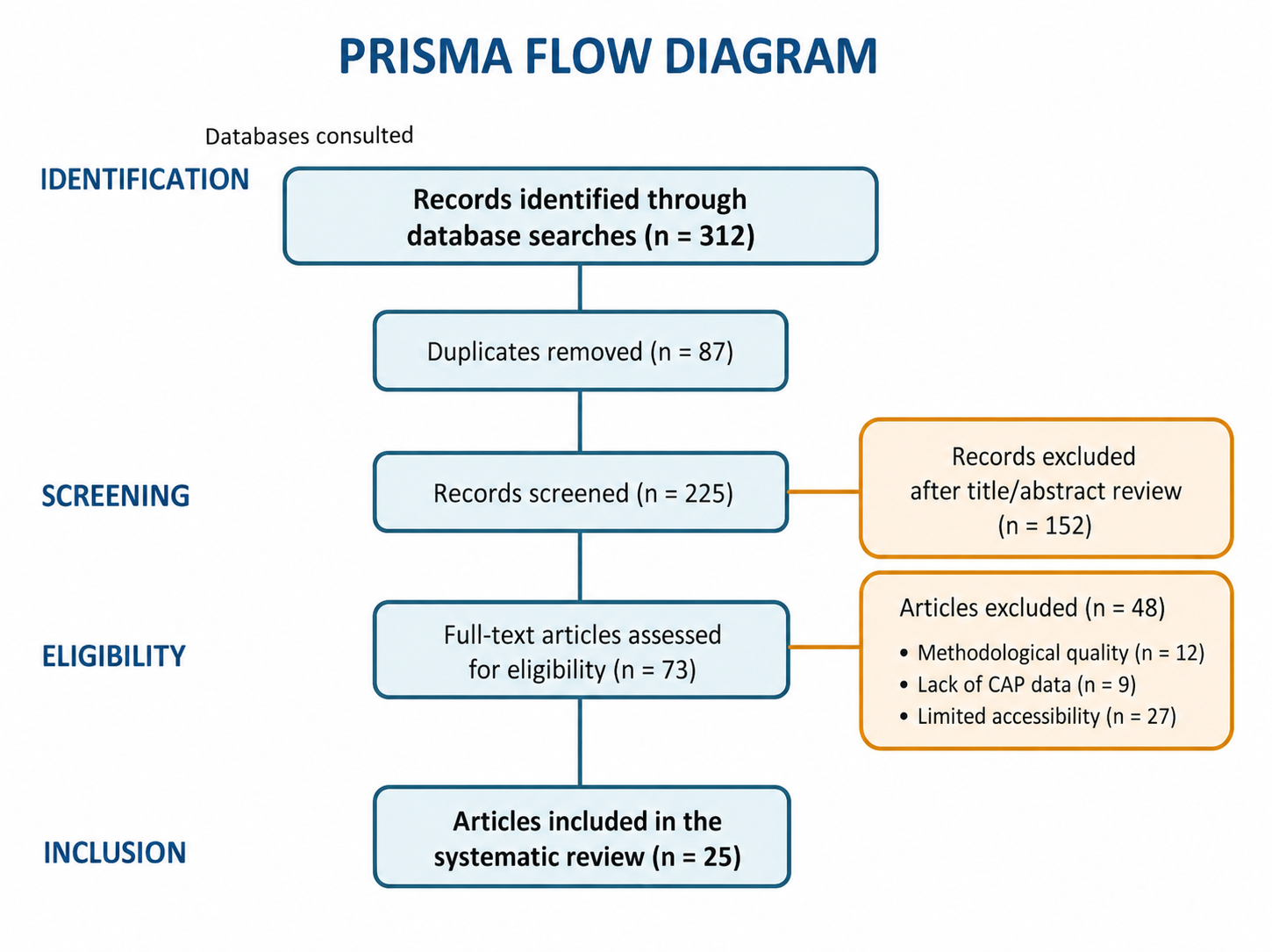
The selection process was carried out in three phases by two independent reviewers, following the PRISMA recommendations. The initial search identified a total of 312 records in the four databases consulted: 98 in PubMed, 127 in Scopus, 64 in Web of Science, and 23 in SciELO. After removing 87 duplicates using the Mendeley bibliographic manager, 225 unique records were obtained that passed to the screening phase, where they were evaluated by title and abstract reading by both reviewers independently. This process led to the exclusion of 152 articles that did not meet the inclusion criteria: 68 for topics unrelated to the object of study, 41 for being gray literature or lacking peer review, 28 for being published in languages other than Spanish or English, and 15 for being outside the established time period. Disagreements between reviewers, which amounted to 8 cases, were resolved through discussion and consensus, resulting in the selection of 73 articles for full-text evaluation. In the final eligibility phase, the 73 articles were subjected to full reading and detailed analysis, which led to the exclusion of 48 additional articles: 12 presented insufficient methodological quality, 9 lacked relevant empirical data on the CAP dimensions, and 27 showed limitations in full-text accessibility. As a result, 25 articles were finally included that met all eligibility criteria and were subjected to data extraction and narrative synthesis.
The complete selection process is documented in the PRISMA flow diagram (Figure 1), which presents the exact quantities at each stage of the process.
Source: Own elaboration.
Data Extraction and Analysis
Data extraction was performed using a standardized matrix that included the following variables: author and year of publication, country of origin, methodological design, population and sample size, measurement instruments, specific CAP model variables evaluated, educational intervention (when applicable), main results, and conclusions. The data were organized thematically into six main dimensions: theoretical knowledge, professional attitudes, surgical practices, academic training, clinical simulation, and safety and protocols.
The information was analyzed through thematic narrative synthesis, following a qualitative approach to evidence integration. A critical and reflective reading of the selected texts was performed to identify patterns, convergences, and divergences in the reported results. Studies were grouped according to the CAP model dimensions, and data triangulation was performed to strengthen the validity of the conclusions.
Quality Assessment
A formal methodological quality assessment tool (e.g., CASP, JBI, or RoB2) was not applied, given the descriptive and narrative nature of this bibliographic review. However, articles published in peer-reviewed journals indexed in recognized databases were prioritized, and the methodological quality reported in each study (design, sample size, validated instruments) was considered during the synthesis. This methodological limitation is acknowledged, and future updates of this review should incorporate systematic quality assessment using standardized tools.
Ethical Considerations
As this is a literature review based on publicly accessible secondary sources, ethics committee approval was not required. Copyright was respected through proper citation according to Vancouver guidelines, and transparency in reporting the methodology was ensured.
RESULTS
The results of this review are organized into six thematic dimensions that represent the fundamental components of surgical training and practice in nursing. The evidence synthesis included 25 studies that met the established inclusion criteria (Table 1). The results are presented below, organized by the CAP model dimensions (Knowledge, Attitudes, and Practices).
Theoretical knowledge in surgical nursing encompasses fundamentals of anatomy and physiology, surgical pharmacology, and biosafety protocols. Systematic evaluation of these cognitive competencies allows for validation of students' preparation before entering clinical practice. Studies show variability in theoretical mastery according to academic level and previous practical experience.
Professional attitudes constitute a fundamental pillar in surgical training. Studies reveal that empathy, ethical commitment, and professional responsibility significantly determine the quality of care provided. Institutional and academic factors influence the development of positive dispositions toward evidence-based practice and adherence to safety protocols.
Surgical practices require the progressive development of procedural skills through active learning methods. Evidence shows that deliberate practice with structured feedback significantly reduces the rate of technical errors and improves problem-solving in complex clinical situations.
Effective academic training is characterized by integrated and flexible curricular designs that respond to the changing demands of the surgical field. The theory–practice integration through supervised experiences is essential for the development of professional expertise.
Clinical simulation emerges as a fundamental strategy for training in safe environments. This methodology allows learning through error without risk to the patient, facilitating the development of both technical skills and non-technical competencies essential for surgical teamwork.
Adherence to safety protocols and an institutional safety culture are crucial for preventing adverse events in the surgical environment. Effective communication and collaborative work by the multiprofessional team are identified as fundamental protective factors.
Dimension | Main results | Main sources |
|---|---|---|
Theoretical knowledge | The theoretical basis integrates anatomy and physiology, pharmacology, and biosafety. Systematic evaluation validates cognitive competence. Knowledge of biosafety measures, surgical checklists, and aseptic techniques is fundamental for safe practice. | (11,12,13,14). |
Professional attitudes | Empathy, ethical commitment, and responsibility determine the quality of care. Institutional and academic factors influence professional disposition. Positive attitudes towards evidence-based practice and biosafety improve clinical outcomes. | (15,16,17). |
Surgical practices | Skill development is based on practical methods. Procedural evaluation improves technical problem-solving. Practices in minimally invasive surgery and practical knowledge require continuous professional development. Deliberate practice with feedback reduces errors. | (18,19,20). |
Academic background | Integrated and flexible curricular design responds to the demands of the surgical area. Theory-practice integration and supervised experiences are essential for professional expertise. Continuing education and extensive internships improve perceived competence. | (21,22). |
Clinical simulation | Clinical simulation is a fundamental strategy for training in safe environments. It allows learning through error without risk to the patient. Development of technical and non-technical skills requires structured training. High-fidelity simulation improves retention and transfer of skills. | (23,24). |
Safety and protocols | Strict adherence to asepsis standards and safety culture prevents adverse events. Effective communication and teamwork are crucial elements. Non-technical skills and knowledge of surgical checklists (WHO) reduce postoperative complications and infections. | (25). |
Source: Own elaboration based on the literature review.
DISCUSSION
The research in this review confirms that the development of competencies in basic surgical techniques requires the harmonious integration of knowledge, attitudes, and practices. This competency triad cannot be developed in isolation; rather, it requires educational strategies that promote critical thinking and evidence-based decision making (11).
The persistent gap between theoretical training and clinical practice constitutes a challenge consistently identified in the literature. This discordance reflects the inherent complexity of translating abstract knowledge into contextualized skills in dynamic clinical environments. Educational interventions based on active learning methodologies have demonstrated effectiveness in reducing this gap (12).
Professional attitudes, particularly those related to care ethics and commitment to patient safety, are significant predictors of the quality of surgical practice. Attitudinal training represents a pedagogical challenge that requires methodologies going beyond content transmission and promoting critical reflection and the development of moral judgment (13).
The relationship between experienced professionals and students during clinical placements consistently emerges as a determining factor in learning. Positive mentoring experiences facilitate not only the acquisition of technical skills but also professional socialization and the transmission of safety culture (14).
Patient safety protocols, particularly surgical checklists, represent interventions with proven effectiveness in reducing adverse events. However, there is frequently a gap between declarative knowledge and consistent application in practice, suggesting that effective implementation requires not only education but also changes in organizational culture (15).
The methodological heterogeneity of the reviewed studies limits the ability to establish definitive conclusions about the comparative effectiveness of different educational strategies. This limitation reflects the inherent challenges of educational research in complex clinical settings and underscores the need for studies with greater methodological rigor (16).
The globalization of nursing highlights the need for curricular harmonization and the establishment of common minimum competencies. The reviewed evidence originates predominantly from Ibero-American contexts, limiting the generalizability of results to other cultural contexts and health systems (17).
The role of technology in surgical training, particularly high-fidelity simulation, shows promising results. However, further research is required on cost-effectiveness, skill transferability, and optimal modalities of curricular integration (18).
Surgical nursing training should be conceptualized as a continuous process that extends beyond undergraduate education. Continuing education programs are essential to keep staff updated on new procedures, technologies, and evidence (19).
Non-technical skills in surgery, such as effective communication, teamwork, and leadership, are crucial elements for ensuring patient safety. These competencies must be explicitly integrated into training programs through specific pedagogical strategies (20).
Quality indicators of nursing care in the surgical block constitute essential tools for the systematic evaluation of professional performance. The implementation of continuous monitoring systems allows the detection of deviations from established standards and guides timely corrective interventions (21).
Humanization of care in the surgical center represents a complementary paradigm to technical excellence. The recognition of emotional needs, the preservation of patient dignity, and empathic communication constitute inseparable components of quality surgical care (22).
The contemporary role of nursing in the surgical area has evolved significantly, expanding beyond traditional functions to encompass responsibilities in risk management, interprofessional coordination, and leadership in quality improvement initiatives (23).
The practical challenges that students face in real surgical clinical practice environments include stress management, adaptation to diverse institutional protocols, and the development of professional autonomy under supervision. These challenges require a pedagogical approach that prepares students for the transition from academic to professional environments (24).
CONCLUSIONS
The reviewed evidence allows the conclusion that the development of competencies in basic surgical techniques requires the systematic and balanced integration of three inseparable domains: the cognitive (solid theoretical knowledge), the affective (professional attitudes oriented to ethics and safety), and the procedural (technical skills developed through supervised practice). None of these domains is sufficient by itself to guarantee safe and quality surgical practice.
In response to the objective of this review, the evidence identifies the following main strengths in surgical nursing education: the increasing use of clinical simulation as a pedagogical strategy, the incorporation of evidence-based practice, and the development of mentoring between professionals and students. The main deficiencies reported are the persistent gap between theoretical training and clinical practice, curricular heterogeneity among programs, and insufficient training in non-technical skills (effective communication, teamwork, and leadership).
The most effective educational strategies documented in the literature are high-fidelity clinical simulation, problem-based learning, deliberate practice with structured feedback, and theory-practice integration through supervised internships. These strategies should be complemented with continuing education programs that keep the competencies of practicing staff up to date.
For future research, it is recommended to conduct systematic reviews with formal quality assessment using standardized tools (CASP, JBI), to develop longitudinal studies that evaluate the long-term impact of educational interventions, and to move toward international curricular harmonization with mandatory minimum competencies in surgical nursing.
References
- 1 Maas Góngora L, García Jiménez MA, Tello Pompa CA. Subjetividades de los saberes y prácticas profesionales en estudiantes de enfermería. Ciencia Latina. 2022;6(6):5116-37. Disponible en: https://doi.org/10.37811/cl_rcm.v6i6.3900
- 2 Requelme-Jaramillo MJ, Suconota-Pintado AL, Salvatierra-Ávila LY, Almache-Delgado VJ, Calderón-González DE. Práctica Clínica Quirúrgica: Experiencias del estudiante de enfermería. Ciencia Latina. 2023;7(5):6361-75. Disponible en: https://doi.org/10.37811/cl_rcm.v7i5.8031
- 3 Calle-Díaz S, García-Osorio S, Flórez-Arango JF, Torres-Silva EA, Luna-Gómez IF, Fernández-Ramírez SM. Methodologies and materials for training in surgical techniques: Systematic review. Rev CES Med. 2021;35(2):159-73. DOI: https://doi.org/10.21615/cesmed.5773
- 4 Estrada González C, Carrillo González S, Maldonado Rincón BA. Ética y bioética en Instrumentación Quirúrgica. En: Bermeo JE, editor. Lecturas de bioética. Bogotá: Editorial Universidad El Bosque; 2022. p. 308-32.
- 5 Lorente González P, Acebedo Urdiales MS. Adquisición del conocimiento práctico de las enfermeras de un área quirúrgica. Enferm Glob. 2021;20(61):286-318. DOI: https://doi.org/10.6018/eglobal.416681
- 6 Hidalgo AJT. Conocimiento en estudiantes de enfermería sobre sepsis quirúrgico. Rev Esc Enferm. 2023;2(1):1-8.
- 7 Elizalde-Ordeñez H, Ortiz-Dávalos G, Rodríguez-Quezada F, Aya-Roa KJ, Moreno-González MM. Experience of the nursing professional in his relationship with the student during clinical practice. SANUS. 2021;6(1):e192. DOI: https://doi.org/10.36789/revsanus.vi1.192
- 8 Silva MS, Santos BM, Almeida AN. Tecnologias de realidade virtual na formação em enfermagem cirúrgica. Rev Bras Enferm. 2020;73(2):e20190345. DOI: https://doi.org/10.1590/0034-7167-2019-0345
- 9 Reis DLA, Kietzer KS. Manual de orientações para a educação permanente em centro cirúrgico. Belém: Universidade Federal do Pará; 2021.
- 10 Pinto AG, Santana AB, Oliveira CFP, Selvati FS, Silva JSLG, Silva MMB, et al. Centro cirúrgico: Humanização da assistência e a enfermagem. Rev Pró-UniverSUS. 2021;12:72-7.
- 11 Bustamante Espinoza LK, Vásquez Bustamante RS, Reyes Reinoso JR. El rol de enfermería en el área quirúrgica: Una revisión sistemática. MQRInvestigar. 2024;8(1):1254-73. Disponible en: https://doi.org/10.56048/MQR20225.8.1.2024.1254-1273
- 12 Russo Fojo MC, Tizón-Bouza E, Pesado-Cartelle JÁ. Evaluación del conocimiento de los profesionales sanitarios de quirófano sobre el listado de verificación quirúrgica en el área sanitaria de Ferrol. Enferm Clin. 2021;31(3):155-62. DOI: https://doi.org/10.1016/j.enfcli.2020.05.009
- 13 Sacoto Abad AC, Mesa-Cano IC, Ramírez-Coronel AA, Abad-Martínez NI. Knowledge of biosafety measures in health personnel: Systematic review. Salud Cienc Tecnol. 2023;3:452. DOI: https://doi.org/10.56294/saludcyt2023452
- 14 Valdiviezo Castro RE, Fajardo Durán JG, Almache Delgado VJ. Conocimientos y actitudes del personal de enfermería frente a las medidas de bioseguridad en un hospital público. Rev Conrado. 2023;19(91):398-405. Disponible en: https://conrado.ucf.edu.cu/index.php/conrado/article/view/2981
- 15 Pozueco Menéndez N. La evolución de la Enfermería Quirúrgica y la figura del perfusionista. Ocronos. 2021;4:45-58.
- 16 Fernandes SC, Pinto VMP, Santos MLP, Mesquita LMR, Clemente FAM, Santos MJE, et al. Estratégias supervisivas dos estudantes de enfermagem em ensino clínico. Recien. 2022;12(35):211-24. DOI: https://doi.org/10.24310/recien.2022.v12i35.14277
- 17 Riofrío Arboleda JV, Elizalde Ordóñez H, Ordóñez Sigcho MI, Toledo Gaona KG. La ética en la formación profesional de enfermería. Anat Digit. 2021;4:6-21.
- 18 Miguel Sánchez A. Instrumentación quirúrgica: educación basada en simulación clínica. Rev Cub Tecnol Salud. 2021;12(2):60-7. Disponible en: https://revtecnologia.sld.cu/index.php/tec/article/view/2145
- 19 Castro Rodríguez Y. Development of research skills in students of health sciences systematization of experiences. Univ Soc. 2021;13:362-8.
- 20 Mustelier Duanes Y. Nivel de conocimientos de enfermeras sobre intervenciones de enfermería en personas con cirugía ambulatoria por enfermedades anorrectales. Rev Cub Enferm. 2021;37(1):e3816. Disponible en: http://www.revenfermeria.sld.cu/index.php/enf/article/view/3816
- 21 Espirito Santo IMB, Vieira EBF, Sousa Júnior NB, Barbosa MAM, Leite CAB, Oliveira NVD, et al. Processo de contagem cirúrgica como responsabilidade da equipe multiprofissional para a segurança do paciente. Braz J Health Rev. 2021;4(5):20154-70. DOI: https://doi.org/10.34119/bjhrv4n5-035
- 22 Arteaga Yánez YL, Peraza de Aparicio CX, Ortega Guevara NM, González Díaz EM, López Gamboa Y, Márquez Ortega BD, et al. Técnicas y procedimientos en la práctica docente de enfermería quirúrgica. Quito: Universidad Metropolitana del Ecuador; 2022.
- 23 Pullas Moyano LC, Bolaños Jara DA, Guamañi Vargas SP, Cuaical Chiran EF, Simaliza Vichisela RA, González Cerón RL. Desafíos prácticos que enfrentan los estudiantes de Técnico Superior en Enfermería en entornos reales de práctica clínica quirúrgica. Rev Cient Retos Cienc. 2023;7(13):138-48. Disponible en: https://retosciencia.utelvt.edu.ec/index.php/retos/article/view/201
- 24 Sousa JA, Brandão MGSA, Ximenes MAM, Farias TRC, Cunha LGS, Barros LM. Competências profissionais do enfermeiro: Revisão integrativa de literatura. Cult Cuid. 2023;27(65):249-69. DOI: https://doi.org/10.14198/cuid.2023.65.20
- 25 Vassallo-Palermo M, Morao-Pompili JL, Linares Medina AS. Habilidades no técnicas en cirugía: Una revisión de la literatura. Rev Argent Cirug. 2020;112(3):298-308. DOI: https://doi.org/10.25132/raac.v112.n3.1497
- 26 FINANCIACION
- 27 The authors did not receive funding to conduct the present research.
- 28 CONFLICTO DE INTERESES
- 29 The authors declare no conflict of interest.
- 30 CONTRIBUCION DE AUTORIA
- 31 Conceptualization: Julio Andrés Vásquez Pinos, Gloria Elizabeth Solórzano Zambrano, Thainah Bruna Santos Zambrano.
- 32 Data curation: Julio Andrés Vásquez Pinos, Gloria Elizabeth Solórzano Zambrano, Thainah Bruna Santos Zambrano.
- 33 Formal analysis: Julio Andrés Vásquez Pinos, Gloria Elizabeth Solórzano Zambrano, Thainah Bruna Santos Zambrano.
- 34 Investigation: Julio Andrés Vásquez Pinos, Gloria Elizabeth Solórzano Zambrano, Thainah Bruna Santos Zambrano.
- 35 Methodology: Julio Andrés Vásquez Pinos, Gloria Elizabeth Solórzano Zambrano, Thainah Bruna Santos Zambrano.
- 36 Project administration: Julio Andrés Vásquez Pinos, Gloria Elizabeth Solórzano Zambrano, Thainah Bruna Santos Zambrano.
- 38 Software: Julio Andrés Vásquez Pinos, Gloria Elizabeth Solórzano Zambrano, Thainah Bruna Santos Zambrano.
- 39 Supervision: Julio Andrés Vásquez Pinos, Gloria Elizabeth Solórzano Zambrano, Thainah Bruna Santos Zambrano.
- 40 Validation: Julio Andrés Vásquez Pinos, Gloria Elizabeth Solórzano Zambrano, Thainah Bruna Santos Zambrano.
- 41 Visualization: Julio Andrés Vásquez Pinos, Gloria Elizabeth Solórzano Zambrano, Thainah Bruna Santos Zambrano.
- 42 Writing – original draft: Julio Andrés Vásquez Pinos, Gloria Elizabeth Solórzano Zambrano, Thainah Bruna Santos Zambrano.
- 43 Writing – review and editing: Julio Andrés Vásquez Pinos, Gloria Elizabeth Solórzano Zambrano, Thainah Bruna Santos Zambrano.
Declarations
Funding
No financing.
Conflict of interest
None.
Authorship contributions
Drafting – original draft: Julio Andrés Vásquez Pinos, Gloria Elizabeth Solórzano Zambrano, Thainah Bruna Santos Zambrano.
Writing–review and editing: Julio Andrés Vásquez Pinos, Gloria Elizabeth Solórzano Zambrano, Thainah Bruna Santos Zambrano.