
Abstract
Urban aerial cable cars have become the flagship transport response to the mobility exclusion of hillside informal settlements in Latin America. This narrative review traces the trajectory of the cable car systems of Medellin and La Paz-El Alto between 2004 and 2026 and synthesizes what the literature documents about their contribution to mobility justice. The earliest evaluations credited the Medellin Metrocable with travel time savings, fare integration and reduced social exclusion, and the La Paz-El Alto system extended these gains to a metropolitan scale from 2014. Later work reported mixed evidence on employment, neighborhood change and quality of life, while critical studies questioned the distribution of benefits by gender, income and disability and flagged gentrification pressures. The evidence suggests that cable cars reduce the accessibility penalty of steep peripheries but do not, by themselves, deliver mobility justice when land, housing and operational conditions remain unequal.
Keywords
mobility justice, aerial cable cars, informal settlements, urban transport, Latin America, transport equity
INTRODUCTION
The steep hillsides of Latin American cities concentrate informal settlements whose residents confront a double penalty of terrain and distance. Households in these peripheries settle on slopes that public transport cannot serve with conventional buses, and they spend long, costly and physically demanding journeys to reach jobs, schools and services located in the valley. Transport-related social exclusion has long been documented as a multidimensional process in which limited mobility options restrict participation in the ordinary activities of society.( 1)
In the Colombian periphery, Oviedo Hernandez and Titheridge( 2) showed that informality and poor access combine to exclude residents from opportunities even when they live within the metropolitan area.
The origin of the cable car response lies in Medellin. Between 1990 and 2002 the city recorded some of the highest homicide rates in the world, and its stigmatized hillside comunas were both the epicenter of violence and the least connected part of the urban fabric.( 3)
In 2004 the municipal metro operator opened Metrocable Line K, a gondola lift connecting the Acevedo metro station with the Santo Domingo Savio neighborhood, conceived within the framework of social urbanism that paired transport investment with libraries, schools and public space.( 4)
This first integration of an aerial cable car into a mass transit network marked a turning point from which the technology circulated across the region.( 5)
Line K was not a transport project alone. Its stations were paired with libraries, schools and public space under the social urbanism program, and the municipal government presented the gondola as a device that would compress the vertical distance separating the comunas from the valley and restore the dignity of their residents.( 4)
The design choice that made the model replicable was its integration with the existing metro, because the cable car fed the heavy rail system under a single fare and thereby inherited its frequency, tariff and institutional authority rather than operating as a separate system.( 6)
From that point onward the model scaled in two directions. In 2014 La Paz and El Alto inaugurated the first three lines of Mi Teleferico, a network that grew into the largest urban cable car system in the world, linking a conurbation of roughly two million inhabitants across a topographic divide that separates the wealthy city from its poorer highland neighbor.( 7)
Between 2017 and 2019 Mi Teleferico added seven further lines and reached ten, and by 2019 the network had become the largest public transit cable car system in the world. By 2021 Medellin operated six Metrocable lines, Bogota had opened TransMiCable in 2018, Mexico City inaugurated its first Cablebus line in 2021, and Manizales and Rio de Janeiro had adopted their own versions.
Parallel to this expansion, the normative vocabulary of the field shifted from transport equity toward mobility justice, which extends distributive concerns to the differential mobilities of gendered, racialized and disabled bodies across scales.( 8-10)
The Bogota replication added a health evaluation arm through the TrUST natural experiment, which tracked quality of life and air pollution in exposed neighborhoods from 2018 onward.( 11)
The evidence base, however, remains dispersed across transport engineering, urban geography, public health and critical urban studies, and its conclusions diverge sharply. Early evaluations emphasized accessibility gains and social inclusion, while later ethnographic and economic work questioned who actually benefits and whether the cable car delivers justice or merely a celebrated infrastructure.
This review traces that trajectory and addresses a single question: to what extent, and through which mechanisms, have the aerial cable cars of Medellin and La Paz-El Alto advanced mobility justice for residents of informal settlements between 2004 and 2026. The objective is to synthesize the documented effects on access, travel time, affordability, social inclusion and neighborhood change, and to identify the critiques and evidence gaps that persist.
METHODS
This narrative review was organized to delimit the trajectory of the two systems into identifiable periods, from the Medellin pilot of 2004 through the metropolitan scaling of La Paz-El Alto after 2014 and the period of consolidation and critique from 2019 onward.
The searches were run on 28 October 2026. Search terms combined the modes and the places of interest, including "cable car", "aerial cable", "gondola", "ropeway", "metrocable", "teleferico", "Medellin", "La Paz", "El Alto", "informal settlement" and "mobility justice", in English and Spanish.
DEVELOPMENT
The synthesis matrix groups the evidence into five axes: the conceptual framing of mobility justice and the accessibility deficit of hillside informality, the documented effects on access and travel time, the social and neighborhood dimensions, the distributive and procedural critiques, and the governance and replication of the model. (Table 1) The five axes draw on 51 core studies published between 2014 and 2026.
Axis | Key findings | Representative studies | Gaps |
|---|---|---|---|
Mobility justice and hillside informality | Cable cars respond to the transport exclusion of steep, peripheral informal settlements | Oviedo Hernandez and Titheridge, 2016; Heinrichs and Bernet, 2014; Garsous et al., 2019 | Few studies measure exclusion before intervention |
Access, travel time and fare integration | Travel time savings, mode substitution and fare integration dominate the documented gains | Bocarejo et al., 2014; Garsous et al., 2019; Martinez et al., 2024; Cardona-Urrea et al., 2026 | Panel evidence is scarce; effects on employment are mixed |
Social inclusion, stigma and neighborhood change | Reduced stigma, security gains and neighborhood upgrading accompany the lines | Zapata Cordoba et al., 2014; Galvin and Maassen, 2020; Villarroel Salgueiro, 2025 | Causal attribution of violence reduction is contested |
Limits of the infrastructural fix | Benefits are uneven by gender, income and disability; gentrification pressures emerge | Alvarez Rivadulla and Bocarejo, 2014; Posada and Garcia-Suaza, 2022; Perez Fernandez, 2025 | Gentrification evidence is short term and localized |
Governance and replication | Institutional coordination and metro integration condition success; the model travels across the region | Bocarejo et al., 2014; Sarmiento et al., 2020; Prieto-Rodriguez et al., 2025 | Transferability without a metro backbone is unresolved |
Mobility justice and the accessibility deficit of hillside informality
The conceptual point of departure is that the harm the cable car was meant to repair is an injustice of movement rather than a deficit of infrastructure.
Martens( 9) framed transport as a matter of distributive justice in which fairness requires a minimum level of accessibility for all, and Pereira, Schwanen and Banister( 10) consolidated the equity metrics used to compare who gains from transport investments. Sheller( 8) extended the argument beyond distribution to the mobility regimes that normalize some movements and stigmatize others.
These frameworks give the review its evaluative language, and they converged on Latin America precisely because the region's informal settlements are the clearest illustration of the problem they name.( 2,12)
The framework also names what conventional accessibility metrics omit: the mobility of women who combine care work with paid work, of people with disabilities for whom a station is not enough, and of residents whose informal status makes movement across the city precarious.( 8)
These are the populations the review follows through the empirical record. Medellin and La Paz-El Alto were chosen as the reference cases because they represent the two institutional forms the technology has taken: a metro-integrated feeder and a freestanding metropolitan network.
The Medellin case was framed from the start in these terms. Heinrichs and Bernet( 13) examined the Metrocable in the municipalities of Santa Cruz and Popular, where the line has operated since 2004, and documented how the gondola inserted a formal, scheduled and affordable link into neighborhoods that depended on steep walks and informal feeders.
Garsous, Suarez-Aleman and Serebrisky( 7) described the La Paz-El Alto system as a response to a topographic divide that separates a conurbation of about two million inhabitants with high rates of poverty, settled on the high plateau of El Alto. El Alto sits on the plateau at roughly four thousand meters above sea level, and before 2014 its residents crossed the divide to La Paz on congested and irregular minibus routes, so the cable car replaced an informal service rather than a formal one.( 7)
Both accounts treat the cable car as a device that compresses vertical distance, and both note that the intervention arrived in territories that had accumulated decades of infrastructural deficit.( 14)
Measuring the deficit proved difficult from the outset. The first wave of studies relied on origin-destination surveys and on travel time before and after the opening, and they interpreted the difference as an accessibility gain without a formal counterfactual.( 6,13)
Later work introduced gravity based accessibility measures, difference-in-differences and instrumental variables, which allowed the La Paz and Bogota studies to compare exposed and unexposed populations and to estimate effects net of the trends that would have occurred without the cable car.( 7,15) The evolution of the measurement itself is part of the trajectory: the evidence became stronger precisely as the design moved from description toward causal inference.
The chronological anchor of the axis is therefore the opening of Line K in 2004 and the expansion of Mi Teleferico from 2014. By 2021 Medellin operated six lines and the Bolivian network had become the reference for metropolitan scaling. The section that follows examines whether the documented effects of these interventions matched the framing of justice that justified them.
Access, travel time and fare integration
The most consistent body of evidence concerns the immediate mobility outcomes, and it is the axis with the largest number of core studies. Bocarejo and colleagues( 6) assessed the Metrocable against the transport needs of low income users and found that the line reduced travel times and improved access to the central labor market, with the benefit concentrated among households that previously depended on slow and informal feeders.
Heinrichs and Bernet( 13) reached a similar conclusion for Santa Cruz and Popular, adding that the integration with the metro and the single fare protected affordability for the poorest users.
Zapata Cordoba and colleagues( 16) measured the social exclusion dimension directly and reported that the cable car increased participation in activities outside the neighborhood for disadvantaged residents.
The affordability mechanism deserves emphasis because it is what separates the cable car from a technological curiosity. In Medellin the gondola was absorbed into the metro fare structure, so a journey from the hillside to the center cost the same as any other integrated trip and could be made with the same card.( 6)
In La Paz-El Alto the state operator set fares below those of the minibus routes it replaced, which made the system attractive to the low income users of El Alto rather than to the wealthier residents of the valley.(7,15) When the fare advantage is absent or eroded, the equity rationale weakens, a point the critical literature returns to repeatedly.
The La Paz-El Alto evidence reproduced these findings at a metropolitan scale.
Garsous, Suarez-Aleman and Serebrisky( 7) quantified commuting time savings for users of a network that, by its extension and ridership, operates as a backbone rather than a feeder.
Martinez, Sanchez and Yanez-Pagans( 15) used an instrumental variables design and found that cable car users substituted private transport for public transit, reallocated the commuting time saved toward educational activities and increased self-employment, with the effects driven by residents of El Alto.
Londoño Henao( 17) applied a difference-in-differences design to Line K over the periods 2005-2012 and 2005-2017 and examined land value per square meter, housing density, average years of schooling, travel time and transport mode; the author reported gains in schooling and income that allowed part of the population to move out of the territory, a finding read as social mobility.
The more recent wave extended the analysis to activity participation and mode choice.
Cardona-Urrea and colleagues( 18,19) evaluated TransMiCable in Bogota and found gains in accessibility to discretionary activities and in activity participation among disadvantaged communities, extending earlier evidence of inequitable accessibility to work and study across the Bogota region.( 20)
In Manizales, Cardona-Urrea, Soza-Parra and Raveau( 21) showed that transport-related social exclusion shapes the decision to use the aerial cable car, confirming that the mode is chosen by precisely the population it was built to serve.
Guzman and colleagues( 22) reported longitudinal gains in accessibility and satisfaction, while Escobar and colleagues( 23) linked accessibility improvements to lower carbon dioxide emissions by socioeconomic stratum.
The environmental case follows the same logic as the equity case: if the mode captures trips that would otherwise be made by bus or motorcycle, the emission savings accrue to the city as a whole, but the accessibility benefits accrue first to the strata that the line serves.( 23)
Against this favorable record, Matsuyuki and colleagues( 24) and Okami and colleagues( 25) found that travel behavior in the serviced settlements changed less than expected, with walking and informal transport persisting for short trips, which suggests that the cable car competes poorly for the journeys that dominate daily life.
One recurring caveat qualifies the access findings. The cable car compresses the vertical segment of the journey but leaves the horizontal first and last mile to the street, and in the steepest settlements those segments remain the most dangerous and time consuming part of the trip.( 24,25)
Residents who cannot walk comfortably to the station, or who must pay an additional feeder fare, capture only part of the time saving that the mode creates, which explains why the measured gains concentrate among households located close to the stations.( 13,22)
The first and last mile is therefore the point at which the accessibility argument meets the urban design argument.
Social inclusion, stigma and neighborhood change
A second axis of evidence moves from travel metrics to the social meaning of the intervention. Zapata Cordoba and colleagues( 16) argued that the cable car's contribution was not only physical but symbolic, reducing the stigma attached to the comunas by inserting them into the visible, formal network of the city.
Levy and Davila( 26) reached a parallel conclusion from the socio-environmental justice perspective, and the pride mechanism was documented beyond the cable car in the electric escalator of Comuna 13.( 27)
Galvin and Maassen( 28) developed the long term view of the Medellin case and located the durable legacy of the Metrocable in the way the city now plans for disinvested areas rather than in any single mobility indicator.
Villarroel Salgueiro( 29) documented how the Mi Teleferico transformed the everyday spaces of El Alto, turning stations into points of encounter and commerce and reshaping the rhythm of the highland city, while Capille and Reiss( 30) read the Metrocable together with the library parks as instruments that altered visibility and power in the hillside districts. The neighborhood level evidence therefore converges on a symbolic effect that precedes any measurable economic one.
The security dimension is the most contested. Bea( 31) associated the Metrocable with a reduction in crime in the serviced neighborhoods, an effect consistent with the broader security transformation of Medellin over the same period.
Franco( 32) showed that the international media amplified this reading and turned Medellin into a global model, which in turn reinforced local political commitment to the technology. The chronological pattern matters here: the security narrative was strongest between 2008 and 2014, when the city's homicide decline coincided with the visible success of the cable car, and it weakened thereafter as critics pointed out that the decline owed as much to demobilization and policing as to transport.( 33)
The security and stigma findings connect the transport literature to the health literature. The quality of life gains reported for TransMiCable in Bogota( 34) suggest that the mode can improve wellbeing through channels other than time savings, including perceived safety, the reduction of transport related stress and the sense of belonging to the formal city. Recognition is therefore not a byproduct of the infrastructure but one of its principal outputs.( 16,29)
The international circulation of the Medellin model had a double edge. Franco( 32) documented how the transformation was packaged for a global audience of planners and mayors, which attracted investment and legitimated further cable car projects, while the critical literature noted that the exported image smoothed over the unresolved questions of land and displacement.( 35,36)
Between 2014 and 2019 the model traveled from Medellin to La Paz and then to Bogota on the strength of this image, and each adoption replayed the same tension between the visible success of the infrastructure and the less visible conditions that made it work.
The limits of the infrastructural fix
The critical literature contests the inference from infrastructure to justice. Alvarez Rivadulla and Bocarejo( 14) warned from the early period that the cable car was being celebrated as a magical solution to problems of poverty and housing that it cannot solve, a critique they grounded in the Soacha case of Cazuca.
Freire-Medeiros and Name( 35) extended the argument to tourism and decoloniality, showing that the cable car can aestheticize the favela for outside consumption while leaving its material inequalities intact, a reading that recurs in the Portuguese-language literature( 36) and in the capabilities approach applied to everyday mobilities in Bogota.( 37)
Perez Fernandez( 38) described the current generation of interventions as a retrofit of the periphery that reengineers space without redistributing the land and services that structure disadvantage.
The distributive evidence supports part of this skepticism. The accessibility gains documented in the previous axis are not uniform across social groups, and the gender dimension is the clearest case.
Heinrichs and Bernet( 13) found that female residents experienced the Metrocable differently, with security along the access paths conditioning whether the mode widened their mobility.
Okami and colleagues( 25) reported that travel behavior in the low income settlement changed only partially, and Matsuyuki and colleagues( 24) identified barriers that persisted after the opening of the line, including the cost of the integrated fare for the poorest households and the difficulty of reaching the station on foot across steep and unpaved paths.
The gender findings point in the same direction, because a mode that is safe inside the cabin does not by itself make the surrounding public space safe for the women who walk to and from it.( 13)
Posada and Garcia-Suaza( 39) assessed an expansion of the Metrocable and found effects on informal housing that point toward land market pressures, while Franco Murillo and Henao Palacios( 40) documented gentrification dynamics in a Colombian intermediate city that replicate the risks observed near the cable car stations.
Flesser and Friedrich( 41) reviewed the operational record and noted that queuing, capacity limits and breakdowns can erode the reliability of a mode whose users have few alternatives, a limit also present in the capacity analysis of the technology.( 42)
Procedural justice is the least documented dimension. The cable car arrived in most of these cities as a decision of the municipal or national executive, and the community was positioned as beneficiary rather than as participant in the design of the routes, stations and fares.( 14,43)
Where participatory mechanisms existed, they were layered onto a project already defined, which limited the scope of what residents could contest. The absence of procedural accounts in the empirical record is itself a finding: the literature measures distribution and recognition far more than it measures voice.( 38)
The theoretical critique is not that the cable car is useless, but that it is insufficient. The benefits are real and concentrated, yet they depend on conditions that the transport intervention does not control: tenure security, last mile walkability, the distribution of jobs and the governance of the land market. From 2019 onward, studies of Medellin itself reframed the miracle as a postponed city whose planning paradigm shifted without closing the gap it promised.( 44)
Perez Fernandez( 45) makes the same point for Bogota, where the gondola reweaves the urban fabric at the edge without altering the property relations that produced the edge in the first place. Against this, the longitudinal and health evidence reviewed below suggests that some of these pessimistic readings understate the durable gains in satisfaction and quality of life that the systems can deliver when they are embedded in broader policy.( 22,34)
Governance, integration and replication
The final axis concerns how the model was built and how it travels. Bocarejo, Velasquez and Galarza( 5) compared the implementation of bus rapid transit and cable cars in Colombia and identified the institutional coordination between the metro operator, the municipality and the national government as the binding constraint. Alshalalfah, Shalaby and Dale( 46) reviewed the early ropeway experiences and reached the same conclusion: the technology is mature, while the institutional design is not.
The Medellin arrangement, in which the cable car was folded into an existing metro authority with an integrated fare, became the template that subsequent cities tried to copy.( 6) Betancur and Brand( 47) revisited that arrangement after the period of acclaim and found that its achievements rested on a governance coalition that later weakened.
The technology and its policy conditions are themselves documented, from the propulsion systems( 48) to the circumstances under which the mode becomes a viable policy option.( 49)
The transferability of the model is not automatic. Medellin embedded the cable car in a metro authority that already managed a heavy rail line, a bus network and a single fare, whereas La Paz-El Alto built a freestanding network that had to create its own institutional and tariff arrangements.( 7)
Bogota and Mexico City replicated the mode within existing integrated transport authorities, and Manizales operated it in a medium sized city without metro infrastructure.( 50)
The comparison across these cases suggests that the institutional endowment of the host city, more than the technology, determines whether the cable car behaves as a backbone or as an isolated gadget.( 5,46)
The replications generated a second generation of evidence. Bogota opened TransMiCable in 2018 to serve Ciudad Bolivar, and Villar-Uribe( 51) examined whether the modernization of formal transport in the periphery displaced informal operators.
Sarmiento and colleagues( 11) designed the TrUST natural experiment to measure the health effects of the intervention through a longitudinal comparison of neighborhoods exposed to TransMiCable with unexposed controls, and Baldovino-Chiquillo and colleagues( 34) reported gains in quality of life for the exposed communities. Morales-Betancourt and colleagues( 52) measured the personal exposure of commuters to air pollutants after the line opened, and Prieto-
Rodriguez and colleagues( 53) assessed the effect of the Mexico City cable car on air quality. Escobar and colleagues( 50) evaluated the Manizales system with analytical, simulated and accessibility approaches, and Guimaraes and colleagues( 54) compared the implementation in Medellin and Rio de Janeiro.
The Manizales case matters because it shows that a medium sized city without a metro can operate a cable line, while the Rio comparison shows the limits of transferring the model to a context with different land and institutional conditions.( 54)
These replications shifted the evaluation question from travel time alone to the health and environmental outcomes that justify the mode on welfare grounds. The trajectory of the model from a single line in 2004 to a continental portfolio is represented in the cumulative growth of the two reference systems (Figure 1).
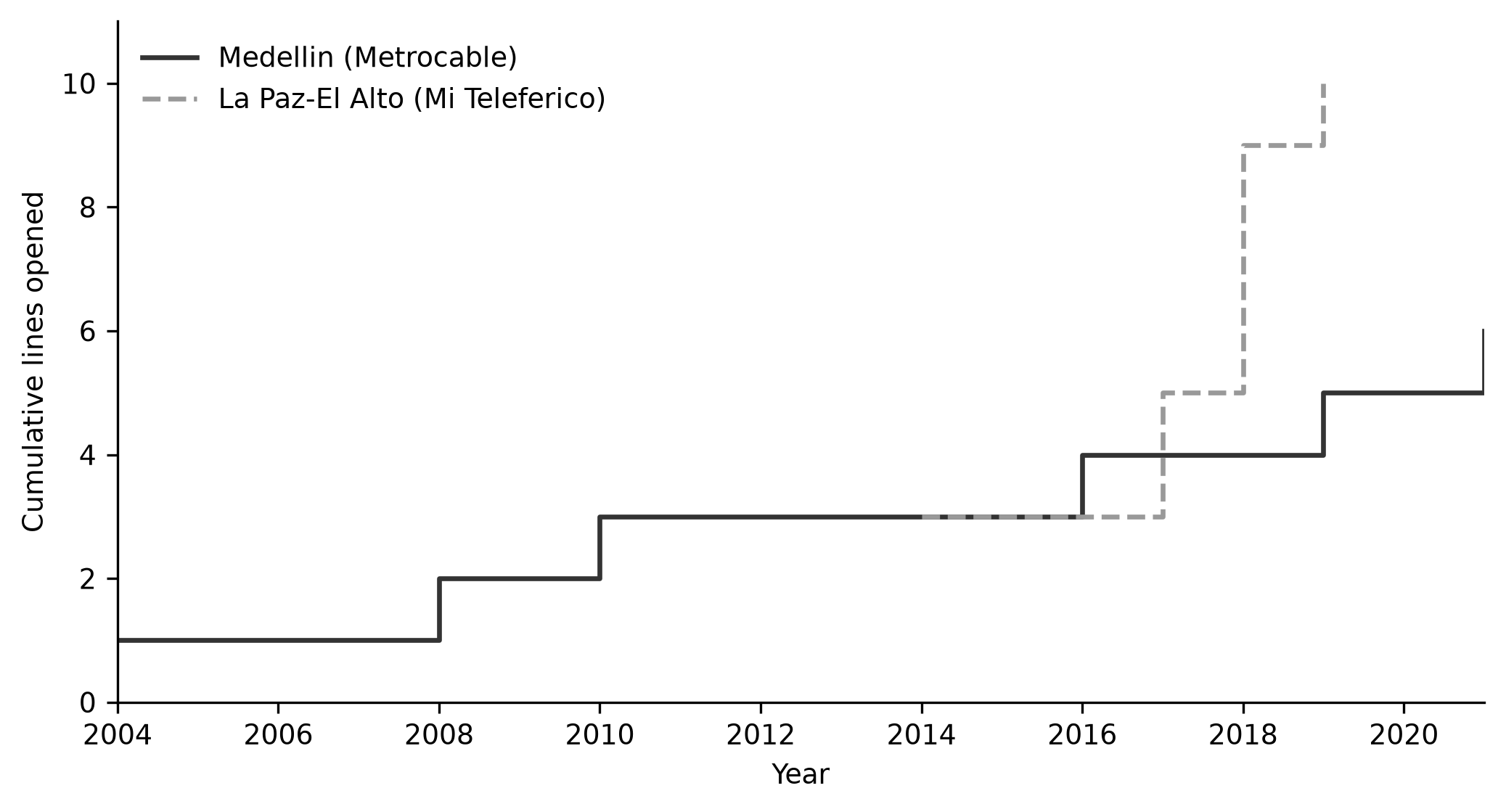
Figure 1. Cumulative aerial cable car lines opened in Medellin and La Paz-El Alto, 2004-2021.
DISCUSSION
The objective of this review was to establish to what extent the cable cars of Medellin and La Paz-El Alto have advanced mobility justice for the residents of informal settlements, and the trajectory traced above supports a qualified answer. The two systems consistently reduced the time and monetary cost of reaching the formal city, and they did so for the low income population of steep peripheries that conventional transport had abandoned.
The trajectory is also one of diminishing novelty: the early security and inclusion narratives of 2004-2014 gave way, from 2015 onward, to more cautious evaluations and to a critical literature that relocated the question from infrastructure to land, housing and governance. The periodization is more than descriptive; it tracks a shift in the questions that researchers asked, from how much time the cable car saved to for whom the savings accrued and at what cost.
The access findings are the most robust and the least contested, because they converge across designs and cities. The travel time savings reported for Medellin( 6,13) are reproduced at metropolitan scale in La Paz-El Alto( 7,15) and in the replication studies for Bogota.( 18,19)
The convergence is explained by the mechanism the systems share: a segregated vertical route that bypasses congested road networks and connects directly to a metro backbone. Where the literature diverges is on the size of the behavioral response. The survey based work of Okami and colleagues( 25) and Matsuyuki and colleagues( 24) found modest changes in everyday travel behavior, whereas the quasi experimental designs detected larger effects on time use and employment.
The discrepancy reflects measurement: diary based travel behavior captures short, frequent trips on which the cable car competes poorly, while econometric designs capture the infrequent but consequential journeys to work and study that the cable car unlocks. The two readings are not incompatible; they describe different parts of the same day, and the justice judgment depends on which part is held to matter most.
The social inclusion findings are more fragile, and here the review parts company with the celebratory literature. The crime reduction associated with the Metrocable( 31) sits within a citywide decline in violence whose origins precede the cable car, as documented in the natural experiment on neighborhood upgrading of Cerda and colleagues,( 3) and Doyle( 33) showed that demobilization and policing account for much of the decline attributed to transport.
The media amplification documented by Franco( 32) inflated the model precisely when the causal claims were weakest. The critical literature therefore does not refute the accessibility evidence; it argues that accessibility was never the binding constraint, and that justice claims built on the cable car overstate what a single mode can do for poverty, tenure and gender inequality.( 14,43)
The comparison with prior reviews places this synthesis in a broader conversation. The review of Cardona-Urrea and colleagues( 55) classified the technological advances and societal impacts of aerial cable cars in Latin America and the Caribbean and reached a similar conclusion about the maturity of the technology and the variability of the social outcomes.
Flesser and Friedrich( 41) reviewed the same mode from the perspective of sustainable transport integration and reached a comparable verdict about the gap between the technical promise and the institutional conditions.
Yanez-Pagans and colleagues( 56) situated the cable car among the transport interventions of the region and cautioned against reading any single mode as a substitute for systemic reform, a verdict shared by the critical dialogue between the Global South and the Global North on the Medellin model.( 57)
The governance comparison is equally instructive: where the cable car was embedded in an existing transit authority it sustained the fare and operational integration on which the equity outcomes depend, and where it was built as a standalone network it had to create those conditions after the fact.( 7,47)
The theoretical literature on distributive justice( 10) and mobility justice( 8) supplies the evaluative standard that the empirical record only partially meets: the cable car improves the accessibility dimension of justice while leaving the recognition and participation dimensions largely untouched.
Read against the mobility justice framework, the trajectory of the two systems illustrates both the power and the limits of an infrastructural reading of justice.
Martens( 9) requires that transport policy guarantee a minimum level of accessibility, and on that criterion the cable cars of Medellin and La Paz-El Alto succeed for the population they reach.
Sheller( 8) requires attention to the mobility regimes that produce differential exposure to risk and stigma, and on that criterion the record is thinner, because the mode improves the journey without reorganizing the care obligations, the tenure insecurity or the policing that structure movement in the periphery. The synthesis therefore supports a middle position: the cable car is a genuine advance in distributive accessibility and an incomplete one in recognition and participation, which is exactly the gap the framework was designed to make visible.
The limitations of this review are specific to its design. First, the synthesis is narrative and selective rather than exhaustive, so the possibility remains that relevant gray literature and non indexed studies were missed. A future update should search institutional repositories and Spanish language regional journals systematically.
Second, the core window excludes the earliest Medellin evaluations before 2013, which means the trajectory rests on studies published after the system had matured; earlier reports should be incorporated to test whether the initial claims survived later scrutiny. Third, the review aggregates two systems with different governance and geography, and the generalization from a metro integrated Medellin to a freestanding network such as Mi Teleferico requires caution.
Fourth, the gentrification evidence remains short term and localized, and it cannot yet support firm conclusions about long run displacement. Fifth, the review favors English, Spanish and Portuguese records indexed in the four bibliographic sources, so French and indigenous language work and local gray literature may be underrepresented.
For policy and research, the implications follow from the trajectory. Planners should treat the cable car as one component of a package that includes tenure security, last mile infrastructure and employment, not as the package itself, and they should monitor the gender and disability distribution of benefits from the outset. They should also protect the fare advantage that produced the early equity gains, because the affordability mechanism is what distinguishes the mode from a prestige project.( 6,7)
The research agenda should prioritize longitudinal designs that follow the same households across the periods before and after opening, and comparative work that isolates the governance conditions under which the mode delivers justice rather than symbolic change.
Equity reviews through the pandemic period show that accessibility gaps widened where such monitoring was absent,( 58) the sustainability challenges of the region extend beyond the mode itself,( 59) and perceived quality remains a distinct determinant of the user experience of public transport.( 60)
A concrete next step is to link the ridership and fare data of the two systems to household panels, so that the distributional claims of the review can be tested against administrative records rather than against surveys alone. The trajectory from 2004 to 2026 shows that the technology is proven; what remains unproven is whether the institutions that adopt it will match its ambition.
CONCLUSIONS
Between 2004 and 2026 the aerial cable car evolved from a single Medellin feeder line into the flagship transport intervention of Latin American peripheries, and the two reference systems of Medellin and La Paz-El Alto delivered measurable gains in travel time, access and affordability for residents of informal hillside settlements. The evidence for these mobility outcomes is consistent across designs and cities, and it is strongest when the cable car is integrated with an existing metro network and a single fare.
The same trajectory shows that the mode did not, by itself, convert mobility gains into mobility justice. The benefits are uneven across gender, income and disability, the security and inclusion claims rest on contested causal evidence, and the land market pressures that follow the infrastructure reproduce the exclusion the mode was meant to correct. The conclusion that follows for research and policy is that the cable car is a necessary but insufficient instrument, and that its justice potential depends on the tenure, housing, last mile and governance conditions that surround it rather than on the technology alone.
References
- 1 Lucas K. Transport and social exclusion: Where are we now?. Transport Policy. 2012;20:105-113. doi: 10.1016/j.tranpol.2012.01.013
- 2 Oviedo Hernandez D, Titheridge H. Mobilities of the periphery: Informality, access and social exclusion in the urban fringe in Colombia. Journal of Transport Geography. 2016;55:152-164. doi: 10.1016/j.jtrangeo.2015.12.004
- 3 Cerda M, Morenoff JD, Hansen BB, Tessari Hicks KJ, Duque LF, Restrepo A, et al. Reducing Violence by Transforming Neighborhoods: A Natural Experiment in Medellin, Colombia. American Journal of Epidemiology. 2012;175(10):1045-1053. doi: 10.1093/aje/kwr428
- 4 Brand P, Dávila JD. Mobility innovation at the urban margins. City. 2011;15(6):647-661. doi: 10.1080/13604813.2011.609007
- 5 Bocarejo JP, Velásquez JM, Galarza DC. Challenges of Implementing à la Mode Transport Projects. Transportation Research Record: Journal of the Transportation Research Board. 2014;2451(1):131-138. doi: 10.3141/2451-15
- 6 Bocarejo JP, Portilla IJ, Velásquez JM, Cruz MN, Peña A, Oviedo DR. An innovative transit system and its impact on low income users: the case of the Metrocable in Medellín. Journal of Transport Geography. 2014;39:49-61. doi: 10.1016/j.jtrangeo.2014.06.018
- 7 Garsous G, Suárez-Alemán A, Serebrisky T. Cable cars in urban transport: Travel time savings from La Paz-El Alto (Bolivia). Transport Policy. 2019;75:171-182. doi: 10.1016/j.tranpol.2017.05.005
- 8 Sheller M. Theorising mobility justice. Tempo Soc. 2018;30(2):17-34. doi: 10.11606/0103-2070.ts.2018.142763
- 9 Martens K. Transport Justice. Routledge; 2016. doi: 10.4324/9781315746852
- 10 Pereira RHM, Schwanen T, Banister D. Distributive justice and equity in transportation. Transport Reviews. 2017;37(2):170-191. doi: 10.1080/01441647.2016.1257660
- 11 Sarmiento OL, Higuera-Mendieta D, Wilches-Mogollon MA, Guzman LA, Rodríguez DA, Morales R, et al. Urban Transformations and Health: Methods for TrUST—a Natural Experiment Evaluating the Impacts of a Mass Transit Cable Car in Bogotá, Colombia. Front Public Health. 2020;8:64. doi: 10.3389/fpubh.2020.00064
- 12 Hidayati I, Tan W, Yamu C. Conceptualizing Mobility Inequality: Mobility and Accessibility for the Marginalized. Journal of Planning Literature. 2021;36(4):492-507. doi: 10.1177/08854122211012898
- 13 Heinrichs D, Bernet JS. Public Transport and Accessibility in Informal Settlements: Aerial Cable Cars in Medellín, Colombia. Transportation Research Procedia. 2014;4:55-67. doi: 10.1016/j.trpro.2014.11.005
- 14 Álvarez Rivadulla MJ, Bocarejo D. Beautifying the Slum: Cable Car Fetishism in Cazucá, Colombia. Int J Urban Regional Res. 2014;38(6):2025-2041. doi: 10.1111/1468-2427.12201
- 15 Martinez S, Sanchez R, Yañez-Pagans P. Getting a Lift: The Impact of Aerial Cable Cars in La Paz, Bolivia. lse-j-elaceaj. 2024;23(1):204-229. doi: 10.31389/eco.439
- 16 Zapata Cordoba D, Stanley J, Stanley JR. Reducing Social Exclusion in Highly Disadvantaged Districts in Medellín, Colombia, through the Provision of a Cable-Car. SI. 2014;2(4):1-13. doi: 10.17645/si.v2i4.127
- 17 Londoño Henao CA. El cable aéreo Línea K de Medellín, Colombia, 2005-2017. ecoins. 2022;24(47):145-160. doi: 10.18601/01245996.v24n47.06
- 18 Cardona-Urrea S, Soza-Parra J, Ettema D. Flying the gap: Evaluating the impact of aerial cable car on accessibility to discretionary activities: The case of TransMiCable in Bogotá. Journal of Transport Geography. 2026;134:104693. doi: 10.1016/j.jtrangeo.2026.104693
- 19 Cardona-Urrea S, Soza-Parra J, Ettema D. Activity participation among disadvantaged communities and the impact of an aerial cable car: The case of TransMiCable, Bogotá. Cities. 2026;169:106568. doi: 10.1016/j.cities.2025.106568
- 20 Guzman LA, Oviedo D, Rivera C. Assessing equity in transport accessibility to work and study: The Bogotá region. Journal of Transport Geography. 2017;58:236-246. doi: 10.1016/j.jtrangeo.2016.12.016
- 21 Cardona-Urrea S, Soza-Parra J, Raveau S, Ettema D. The role of transport exclusion and aerial cable cars in shaping commuting choices in steep cities. Journal of Public Transportation. 2026;28:100170. doi: 10.1016/j.jpubtr.2026.100170
- 22 Guzman LA, Sanchez JE, Cantillo-Garcia VA, Gomez Cardona S, Sarmiento OL. A lifeline for the disconnected: A longitudinal study of a cable car's impact on accessibility, satisfaction, and leisure activities. Transport Policy. 2025;165:85-96. doi: 10.1016/j.tranpol.2025.02.015
- 23 Escobar G DA, Sarache W, Jiménez-Riaño E. The impact of a new aerial cable-car project on accessibility and CO2 emissions considering socioeconomic stratum. A case study in Colombia. Journal of Cleaner Production. 2022;340:130802. doi: 10.1016/j.jclepro.2022.130802
- 24 Matsuyuki M, Okami S, Nakamura F, Sarmiento-Ordosgoitia I. Impact of aerial cable car in low-income area in Medellín, Colombia. Transportation Research Procedia. 2020;48:3264-3282. doi: 10.1016/j.trpro.2020.08.150
- 25 Okami S, Matsuyuki M, Sarmiento-Ordosgoitia I, Nakamura F. Residents’ travel behavior in a low-income settlement with aerial cable cars in Medellin, Colombia. Case Studies on Transport Policy. 2022;10(2):1332-1342. doi: 10.1016/j.cstp.2022.04.016
- 26 Levy C, Dávila JD. Planning for Mobility and Socio-Environmental Justice: The Case of Medellín, Colombia. In: Environmental Justice and Urban Resilience in the Global South. Palgrave Macmillan US; 2017. p. 37-55. doi: 10.1057/978-1-137-47354-7_3
- 27 REIMERINK L. Planners and the Pride Factor: The Case of the Electric Escalator in Medellín. Bull Latin American Res. 2018;37(2):191-205. doi: 10.1111/blar.12665
- 28 Galvin M, Maassen A. Connecting formal and informal spaces: a long-term and multi-level view of Medellín’s Metrocable. Urban Transform. 2020;2(1):4. doi: 10.1186/s42854-020-00008-8
- 29 Villarroel Salgueiro G. Nuevas alturas en El Alto y espacios transformados. Bolivian Studies. 2025:124-148. doi: 10.5195/bsj.2025.364
- 30 Capillé C, Reiss C. Formas de mobilidade, visibilidade e poder em Medellín: Metrocable e Parques- Biblioteca. Bitácora Urbano Territorial. 2019;29(3):79-90. doi: 10.15446/bitacora.v29n3.67844
- 31 Bea DC. Transport Engineering and Reduction in Crime: The Medellín Case. Transportation Research Procedia. 2016;18:88-92. doi: 10.1016/j.trpro.2016.12.012
- 32 Duque Franco I, Ortiz C. Medellín in the headlines: The role of the media in the dissemination of urban models. Cities. 2020;96:102431. doi: 10.1016/j.cities.2019.102431
- 33 Doyle C. ‘Orthodox’ and ‘alternative’ explanations for the reduction of urban violence in Medellín, Colombia. Urban Research & Practice. 2019;12(3):211-229. doi: 10.1080/17535069.2018.1434822
- 34 Baldovino-Chiquillo L, Sarmiento OL, Pasos DS, Palencia-Pérez L, O'Donovan G, Cantillo-Garcia V, et al. Effects of an urban cable car intervention on quality of life: an observational, quasi-experimental study in Bogotá, Colombia (TrUST). The Lancet Regional Health - Americas. 2025;47:101126. doi: 10.1016/j.lana.2025.101126
- 35 Freire-Medeiros B, Name L. Does the future of the favela fit in an aerial cable car? Examining tourism mobilities and urban inequalities through a decolonial lens. Canadian Journal of Latin American and Caribbean Studies / Revue canadienne des études latino-américaines et caraïbes. 2017;42(1):1-16. doi: 10.1080/08263663.2017.1281944
- 36 Name L, Freire-Medeiros B. Teleféricos na paisagem da “favela” latino-americana: mobilidades e colonialidades. GOT. 2017;1(11):263-282. doi: 10.17127/got/2017.11.012
- 37 Vecchio G. Microstories of everyday mobilities and opportunities in Bogotá: A tool for bringing capabilities into urban mobility planning. Journal of Transport Geography. 2020;83:102652. doi: 10.1016/j.jtrangeo.2020.102652
- 38 Pérez Fernández F. Retrofit: Aerial cable cars and the reengineering of urban peripheries. Environ Plan D. 2025;43(1):8-28. doi: 10.1177/02637758241274648
- 39 Posada HM, García-Suaza A. Transit infrastructure and informal housing: Assessing an expansion of Medellín's Metrocable system. Transport Policy. 2022;128:209-228. doi: 10.1016/j.tranpol.2022.09.011
- 40 Franco Murillo JA, Henao Palacios FS. Socio-spatial reconfiguration and gentrification in Armenia: between urban expansion and land use policy. SAP Land and Architecture. 2026;5:260. doi: 10.62486/la2026260
- 41 Flesser M, Friedrich B. Are We Taking Off? A Critical Review of Urban Aerial Cable Cars as an Integrated Part of Sustainable Transport. Sustainability. 2022;14(20):13560. doi: 10.3390/su142013560
- 42 University of Maribor, Težak S, Sever D, University of Maribor, Lep M, University of Maribor. Increasing the Capacities of Cable Cars for Use in Public Transport. JPT. 2016;19(1):1-16. doi: 10.5038/2375-0901.19.1.1
- 43 Santana Rivas LD. ¿Hacer pasar a Milton Friedman por John Rawls? Entre la retórica de la justicia liberal en el urbanismo social y las injusticias socioespaciales de la provisión neoliberal de la vivienda social en Medellín (2004-2020). SN. 2024;28(2). doi: 10.1344/sn2024.28.41836
- 44 De Boeck S, Pérez Jaramillo J, Vanoutrive T, Van Acker M. From the Medellín Miracle to the Postponed City: Social Urbanism as a shifting planning paradigm. Cities. 2026;179:107593. doi: 10.1016/j.cities.2026.107593
- 45 Pérez Fernández F. Of cables and threads. American Ethnologist. 2026;53(3):283-295. doi: 10.1111/amet.70113
- 46 Alshalalfah B, Shalaby A, Dale S. Experiences with Aerial Ropeway Transportation Systems in the Urban Environment. J Urban Plann Dev. 2014;140(1):04013001. doi: 10.1061/(asce)up.1943-5444.0000158
- 47 Betancur JJ, Brand P. Revisiting Medellin's Governance Arrangement After the Dust Settled. Urban Affairs Review. 2023;59(1):73-98. doi: 10.1177/10780874211047938
- 48 Tischler S, Mailer M. Cable Propelled Transit Systems in Urban Areas. Transportation Research Procedia. 2019;41:169-173. doi: 10.1016/j.trpro.2019.09.032
- 49 Johannes Fiedler. Urban Cable—A Policy Option. JTTE. 2016;4(5). doi: 10.17265/2328-2142/2016.05.003
- 50 Escobar DA, Tapasco OA, Giraldo JA. Medición de Desempeño del Sistema de Transporte Cable Aéreo de la Ciudad de Manizales en Colombia, usando Tres Enfoques: Analítico, Simulado y de Accesibilidad Urbana. Inf tecnol. 2015;26(6):199-210. doi: 10.4067/s0718-07642015000600020
- 51 Villar-Uribe JR. Modernización del transporte público en la periferia urbana: ¿el fin del transporte informal? Caso de estudio: sistema de cable aéreo Transmicable en la localidad de Ciudad Bolívar, Bogotá - Colombia. urbe, Rev Bras Gest Urbana. 2021;13:e20190367. doi: 10.1590/2175-3369.013.e20190367
- 52 Morales-Betancourt R, Wilches-Mogollon MA, Sarmiento OL, Mendez Molano D, Angulo D, Filigrana P, et al. Commuter's personal exposure to air pollutants after the implementation of a cable car for public transport: Results of the natural experiment TrUST. Science of The Total Environment. 2023;865:160880. doi: 10.1016/j.scitotenv.2022.160880
- 53 Prieto-Rodriguez J, Azuela-Flores JI, Groft D, Perez-Villadoniga MJ, Salas R. Assessing the impact of the new Mexico cable car on air pollution. Journal of Transport Geography. 2025;122:104052. doi: 10.1016/j.jtrangeo.2024.104052
- 54 Guimarães JDO, Marques CF, Lopes LAS. Diferenças na implantação do teleférico na cidade de Medellín/Colômbia e na cidade do Rio de Janeiro/Brasil. CLCS. 2024;17(10):e12203. doi: 10.55905/revconv.17n.10-491
- 55 Cardona-Urrea S, Soza-Parra J, Ettema D. Aerial cable cars as a transit mode: a review of technological advances, service area characteristics, and societal impacts in Latin America and the Caribbean. Transport Reviews. 2024;44(3):684-708. doi: 10.1080/01441647.2023.2294752
- 56 Yañez-Pagans P, Martinez D, Mitnik OA, Scholl L, Vazquez A. Urban transport systems in Latin America and the Caribbean: lessons and challenges. Lat Am Econ Rev. 2019;28(1):15. doi: 10.1186/s40503-019-0079-z
- 57 Steevens KNC, Ruiz-Vásquez JC, Peláez MFR. Beyond the ‘Medellín Miracle’: A Critical Dialogue between the Global South and the Global North. In: International Series on Public Policy. Springer Nature Switzerland; 2026. p. 133-150. doi: 10.1007/978-3-032-11061-9_8
- 58 Feng X, Yang Z, Guo Y, Li X, Qian X, Zhou Y. Transport equity and COVID-19: a systematic review of accessibility and policy implications. Eur Transp Res Rev. 2025;17(1):62. doi: 10.1186/s12544-025-00762-5
- 59 Aprigliano V, Barros GT, Santos MVSM, Toro C, Rojas G, Seriani S, et al. Sustainable Mobility Challenges in the Latin American Context. Sustainability. 2023;15(20):14748. doi: 10.3390/su152014748
- 60 Guzmán Oros GC, Martínez García VM, Romero YD, Valdez Lizárraga PA, Reyes Machain JDJ, Morán Sánchez SA. User experience of urban public transport in Mazatlán: A preliminary review of a scale. SAP Transport, Mobility & Society. 2026;5:300. doi: 10.62486/tms2026300
Declarations
Funding
No financing
Conflict of interest
None
Authorship contributions
Drafting – original draft: Verenice Sánchez Castillo, Carlos Alberto Gómez Cano.
Writing–review and editing: Verenice Sánchez Castillo, Carlos Alberto Gómez Cano.