

Abstract
Telework expanded sharply after COVID-19, but whether the commuting savings are offset by rebound effects in non-work travel and residential relocation remains uncertain. The included studies, concentrated in Europe and North America, showed that telework reduced commuting substantially. Work-related travel time was 97 to 98 percent lower among home workers in United States time-use data, and experienced Swiss teleworkers emitted 45.8% less weekly carbon dioxide. Rebound appeared through three channels: occasional and recent teleworkers traveled more by car for non-work trips, teleworkers lived farther from work, and remote-work exposure more than doubled the probability of starting long-distance commuting. Telework reduces commuting but does not uniformly reduce total travel; rebound through non-work travel and residential relocation partially offsets the commuting savings.
Keywords
telework, travel behavior, commuting, rebound effect, remote work, COVID-19
INTRODUCTION
Telework moved from a marginal arrangement to a mass practice during the COVID-19 pandemic and has persisted after the emergency ended. In the United States, the share of paid full workdays performed from home rose from roughly five percent before the pandemic to more than sixty percent at the spring 2020 peak and remained elevated well above its pre-pandemic level thereafter.( 1)
Comparable persistence has been documented through stated preferences for continued telework and through individual telework arrangements that outlasted the mandates that created them, in several countries rather than in a single market.( 2,3)
The transport relevance of this persistence is direct, because the number of commuting days removed per week is the primary input to any travel or emissions forecast. Transport and climate policy has absorbed this shift as a potential gain: if the commute is removed on teleworking days, then congestion, distance, and emissions are removed with it, which is the substitution logic that has anchored telework in travel demand management for decades and that underpins claims of greenhouse gas savings from remote work.( 4-6)
Studies that translate teleworking days into avoided commutes and then into carbon make that substitution assumption explicit, and they therefore inherit its incompleteness.
The substitution logic, however, has always been incomplete. Pre-pandemic studies showed that telecommuting reduces commuting trips but that a portion of the saved travel returns through longer commutes, additional non-work trips, and changes in residential location.( 7,8)
Telecommuting was also associated with more out-of-home activity among higher-income workers, which pointed to a rebound in non-work travel rather than a pure saving.( 9) Systematic work on the travel and energy effects of telecommuting likewise warned that the net benefit is smaller than the gross commute saving and depends on teleworking intensity and on what workers do with the reclaimed time.( 10,11)
This evidence sits inside a broader transport literature in which induced demand and the rebound effect erode the expected savings of efficiency gains, including for vehicle travel specifically, so that a policy lever assumed to delete trips can instead redistribute them.( 12-15)
Existing syntheses have not settled the post-pandemic question. Recent systematic reviews have mapped the travel-related impacts of telecommuting and its spatial, temporal, and modal consequences, but they rely substantially on evidence collected before 2020.( 16,17)
Reviews of teleactivities and accessibility have catalogued the indirect channels through which remote work reshapes daily mobility without isolating the rebound after COVID-19.( 18)
A large literature on remote work, productivity, health, and organizational outcomes has grown alongside, but it does not measure travel.( 6)
Earlier syntheses also predate the measurement innovations that the pandemic produced, such as real-time population surveys and location-based data, which is part of why their conclusions do not transfer automatically to the post-2020 period. What remains missing is a focused synthesis of the post-pandemic empirical studies that ask directly whether non-work trips and residential relocation offset the commuting reductions of telework, and under which conditions the rebound appears.
The rebound question has three concrete channels, and they pull total travel in different directions. Non-work travel is the first: when telework removes the commute, the time and the household car are freed for shopping, leisure, and escort trips that the working week previously compressed, and occasional teleworkers appear to use this margin more than intensive teleworkers.( 19)
Residential relocation is the second: a worker who commutes three days instead of five can accept a longer home-to-work distance, and the housing market prices that option into lower-density locations.( 20)
Delivery and e-shopping form a third, indirect channel, because a worker at home may move purchases from the trip to the parcel, and the resulting freight movement is not counted as commuting.( 21)
These channels operate against the commuting saving, so the net effect on total travel depends on which of them dominates for which workers and in which urban contexts. The measurement problem is that these channels are rarely observed together: surveys capture travel, registers capture residential distance, and time-use diaries capture the daily reallocation, so the net effect has to be assembled across instruments rather than read from any single one.
This review therefore addresses a single question: does telework reduce total travel after COVID-19, or do non-work trips and residential relocation offset the commuting reductions? In the language of the PICOS framework, the population is adult workers, the exposure is home-based remote work of any intensity, the comparator is in-office work or non-teleworking days, and the outcomes are commuting, non-work travel, and residential relocation.
The general objective is to synthesize the post-pandemic evidence on this rebound. The specific objectives are to quantify the commuting reductions associated with telework, to assess the rebound through non-work travel and residential relocation, to compare these effects across telework intensity, worker characteristics, and urban contexts, and to appraise the methodological quality of the included studies. The synthesis is narrative, because the designs and outcome measures of the evidence base are too heterogeneous to pool.
METHODS
This systematic review was reported according to the PRISMA 2020 statement.( 22) The searches were documented following the PRISMA for Searching extension, with each database query recorded together with its date and the number of records returned.
Studies were eligible when they reported an empirical estimate of the association between telework, telecommuting, or working from home and at least one travel outcome, published in English between 2020 and 2026. The population comprised adult workers in any country. The exposure was any form of home-based remote work, including full-day and part-day telework, telecommuting, and hybrid work, measured as frequency, intensity, experience, or occupational remote-work potential. The comparator was in-office work, non-teleworking days, or lower telework intensity.
The outcomes comprised commuting distance, trips, time, or mode; non-work travel; total daily or weekly travel; vehicle miles traveled; carbon emissions from travel; online shopping or delivery activity as an indirect travel channel; and residential relocation or home-to-work distance. Studies were excluded when they measured telework adoption, productivity, health, or well-being without a travel outcome, when they used pre-pandemic datasets only to describe telework without a travel measure, or when they were reviews, protocols, editorials, or reports in a language other than English. The core publication window of 2020 to 2026 operationalized the post-COVID scope and lies inside the project bibliographic window of 2013 to 2026; the support literature could draw on earlier work without a lower bound.
The full search string was TITLE-ABS-KEY((telework OR telecommuting OR "work from home" OR "working from home" OR "remote work") AND (travel OR commuting OR mobility OR "vehicle miles" OR "rebound effect")) AND PUBYEAR > 2019 AND PUBYEAR < 2027.
A second search string added rebound-specific terms: TITLE-ABS-KEY((telecommuting OR teleworking OR "working from home" OR "remote work") AND ("rebound effect" OR "induced travel" OR "vehicle miles traveled" OR "non-work travel" OR "residential relocation")) AND PUBYEAR > 2019 AND PUBYEAR < 2027.
Because the included studies used heterogeneous designs, exposures, and outcomes, the results were synthesized narratively by outcome domain rather than pooled in a meta-analysis. Where studies reported estimates, these were preserved in their original units and compared in direction and approximate magnitude across the two terms of each contrast.
Synthesis proceeded in three steps: the studies were grouped by outcome domain, the direction and magnitude of each contrast were tabulated, and the groups were then read against telework intensity, worker characteristics, and urban context to identify where the rebound appeared and where it did not. Vote counting by direction alone was avoided, because the studies differed in design and because direction-only summaries discard the magnitude information that distinguishes the rebound channels. No summary effect measure was computed, and no statistical heterogeneity was estimated.
RESULTS
Study selection
The searches identified 381 records, of which 37 were removed as duplicates, leaving 344 records for title and abstract screening (Figure 1). Screening excluded 227 records, and 117 reports were sought for retrieval. Full texts could not be retrieved for 104 reports because they were paywalled, so 13 reports were assessed for eligibility. Two reports were excluded at this stage, one because it measured willingness to telework without a travel outcome and one because it was an assessment without original travel data.
The title and abstract exclusions were dominated by studies of telework without a travel outcome, by reviews, and by records in languages other than English, which together accounted for the large majority of the 227 excluded records. In total, 11 studies were included in the review.

Figure 1. PRISMA 2020 flow diagram of study selection.
Characteristics of the included studies
The 11 included studies were published between 2020 and 2026, with 6 appearing in 2026 (Figure 2). By design, 5 were survey-based, 2 used national time-use diaries, 1 used a population register, 1 was a stated-preference experiment, and 2 were qualitative or mixed-methods studies. Geographically, 5 studies were conducted in Europe, 4 in North America, 1 in Oceania, and 1 in Asia (Table 1).
The two time-use studies drew on the American Time Use Survey and shared a diary-day definition of the exposure, whereas the register study used a within-person design over the full population of Swedish employees, which are the two strongest identification strategies in the set. The remaining studies relied on cross-sectional or repeated surveys, discrete choice experiments, or interviews, and they measured commuting distance, trips, time, and mode, non-work travel, travel-related emissions, and relocation intentions, which allowed the rebound to be examined through several complementary contrasts.
Three studies measured both commuting and a non-work or total travel outcome in the same instrument, four measured relocation or home-to-work distance, and two measured indirect channels through online shopping or time use, which is why the synthesis below is organized by outcome domain rather than study by study.
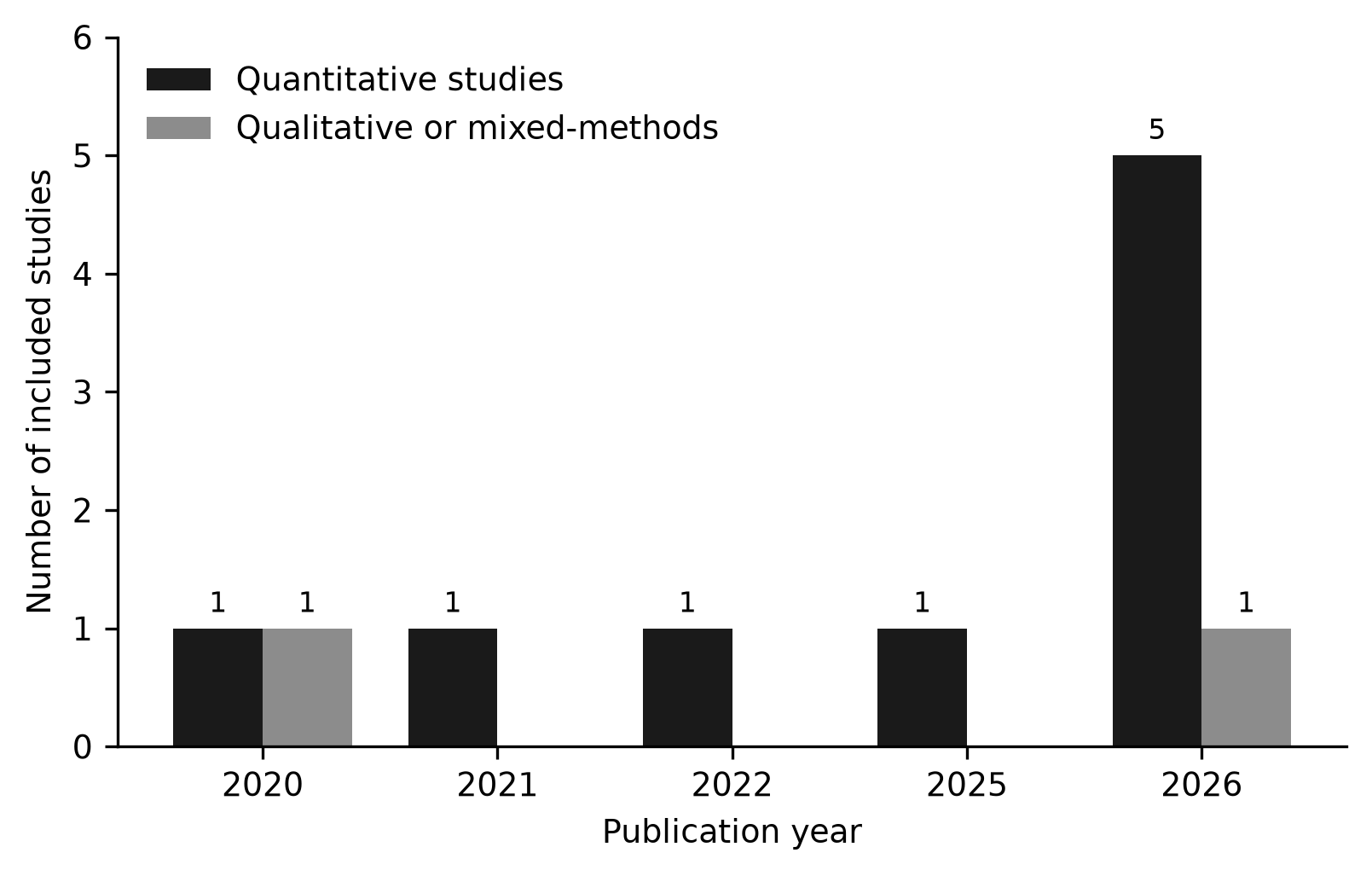
Figure 2. Included studies by publication year and design.
Study | Country | Design | Sample | Exposure | Travel outcome |
|---|---|---|---|---|---|
Johansson et al., 2026 | Sweden | Population register | Full population of employees | Occupation remote-work potential | Long-distance commuting |
Olaru et al., 2026 | Australia | Three-wave survey, SEM | Perth employees | Working from home | Commuting and travel satisfaction |
Kolarova and Dubernet, 2026 | Germany | Online survey, DCE | German commuters | Telework option and status | Residential location and mode choice |
Mohammadi et al., 2026 | United States | Cross-sectional survey, SEM | United States adults | Working from home | Online shopping frequency |
Restrepo and Zeballos, 2022 | United States | Time-use diaries, ATUS | United States workers | Working from home on diary day | Work-related and shopping travel time |
Ravalet and Rérat, 2026 | Switzerland | National survey | 5100 employed individuals | Telework frequency and experience | Commuting and non-work distance and CO2 |
Bhattacharjee, 2020 | India | Mixed methods | Working women, Mumbai | Working from home | Commuting time and drawbacks |
Bick, Blandin and Mertens, 2021 | United States | Repeated online survey | United States workers | Working from home | Commuting and WFH shares |
Stiles and Smart, 2021 | United States | Time-use diaries, ATUS | United States knowledge workers | Full-day versus part-day telework | Daily travel duration and peak-hour travel |
Kousalová, 2026 | Czechia | Qualitative interviews | 13 teleworkers | Telework with flextime | Spatiotemporal mobility barriers |
De Abreu e Silva and Colaço, 2025 | Portugal | Online survey, SEM | Lisbon Metropolitan Area residents | Telework attitudes and practices | Intention to move residence |
Note: WFH = work from home; SEM = structural equation modeling; DCE = discrete choice experiment; ATUS = American Time Use Survey.
Across the set, sample sizes ranged from thirteen interviews in the Czech qualitative study to the complete population of Swedish employees in the register analysis, with the Swiss national survey contributing 5100 employed individuals and the two United States time-use studies drawing on nationally representative diary samples.(19,20,23,24)
The survey designs supplied estimates for commuting and non-work travel in a single instrument, whereas the time-use and register designs isolated the exposure on a given day or within a person over time, and these designs were the ones rated low risk of bias in the appraisal below. The stated-preference and qualitative studies contributed counterfactual and mechanistic evidence rather than population estimates. The geographic concentration carries a coverage consequence that belongs to the results rather than to the interpretation: no included study was conducted in Africa or Latin America, and the single Asian study covered one metropolitan region, so the estimates cannot describe telework in lower-income or rapidly motorizing contexts.( 25)
Within the covered regions, the settings ranged from dense central cores to suburban and small-town labor markets, and the Swiss study explicitly compared telework adoption across urban and rural areas, which is the closest the evidence comes to a context gradient.( 19)
Risk of bias
The risk of bias was low in 3 studies, moderate in 6, and high in 2 (Table 2). The two time-use studies and the register-based study benefited from large, nationally representative or complete population data and were rated low risk, although the register analysis remained vulnerable to occupation-specific shocks that coincided with the exposure. The survey-based studies were rated moderate because they relied on self-reported travel and, in the structural models, on cross-sectional associations that could not establish temporal ordering.
The stated-preference experiment carried the additional risk of hypothetical bias. The qualitative study and the small mixed-methods study were rated high risk for generalizability, which reflects their design rather than an error in execution, and their contribution is to the mechanisms of the rebound rather than to its magnitude. Selection bias was lowest in the register and nationally representative diary studies and highest in the purposive qualitative and single-city samples. Measurement bias was most consequential in the survey studies, where both telework frequency and travel were recalled rather than observed. Within the moderate group, the stated-preference study and the structural models shared a weakness in different forms: the former risked hypothetical bias, and the latter risked reverse causality between travel and telework choices.
Study | Design | Overall risk | Main concern |
|---|---|---|---|
Johansson et al., 2026 | Register | Low | Occupation-specific confounding |
Olaru et al., 2026 | Survey, SEM | Moderate | Self-report, weak temporal ordering |
Kolarova and Dubernet, 2026 | DCE | Moderate | Hypothetical bias |
Mohammadi et al., 2026 | Survey, SEM | Moderate | Cross-sectional self-report |
Restrepo and Zeballos, 2022 | Time-use | Low | Observational comparison |
Ravalet and Rérat, 2026 | Survey | Moderate | Cross-sectional self-report |
Bhattacharjee, 2020 | Mixed methods | High | Small non-probabilistic sample |
Bick, Blandin and Mertens, 2021 | Repeated survey | Moderate | Self-reported work location |
Stiles and Smart, 2021 | Time-use | Low | Pre-pandemic baseline period |
Kousalová, 2026 | Qualitative | High | Small purposive sample |
De Abreu e Silva and Colaço, 2025 | Survey, SEM | Moderate | Stated intention, not observed move |
Commuting reductions versus non-work travel rebound
The included studies consistently reported large commuting reductions, while the non-work travel response divided teleworkers by intensity and experience (Table 3). In United States time-use diaries spanning 2010 to 2020, workers at home spent 97 to 98 percent less time in work-related travel than workers away from home, a difference of about 39 fewer minutes on the diary day, and the gap widened slightly during the pandemic.( 24)
The same national data showed that shopping-related travel fell by 26 to 34 percent among home workers during the pandemic, so the net time freed was partly reallocated away from shopping trips rather than toward them.( 24)
In Australia, a three-wave survey of Perth employees between 2021 and 2022 found that working from home reduced commuting and improved satisfaction with travel, which in turn contributed to life satisfaction after controlling for socio-economic factors, and the pre-pandemic work-from-home rate of 3.4 percent rose substantially during the survey period.( 26)
Compared with these commuting savings, the rebound appeared in the group of occasional teleworkers. Swiss national data on 5100 employed individuals showed that recent teleworkers who worked from home one or two days per week relied more on private cars and covered longer distances on both work and private journeys, whereas experienced teleworkers working from home at least three days per week emitted 45.8 percent less weekly carbon dioxide than non-teleworkers.( 19)
The same survey quantified the commuting margin: non-teleworkers traveled 153.5 kilometers per week for commuting, recent teleworkers 127.8 kilometers while avoiding 92.6 kilometers through telework, and experienced teleworkers 128.4 kilometers while avoiding 119.6 kilometers.( 19)
In the United States, time-use diaries showed that full-day telework reduced daily travel duration and increased peak-hour avoidance for work and non-work travel alike, but part-day telework produced no reduction in daily travel time and limited peak-hour avoidance to work-related travel.(27) The aggregate work-from-home share moved in the same direction, rising from about 8.5 percent to nearly 50 percent among college-educated workers between February and May 2020 while the commuting-only share fell and then only partially recovered.(1)
Two studies extended the rebound beyond the commute itself. In the United States, a structural equation model of a 2021 survey found a positive relationship in which increased working from home promoted online shopping engagement, a channel through which commuting savings can become delivery-related trips.( 21)
In Mumbai, a mixed-methods study of working women found that working from home saved commuting time but was not free of drawbacks, and that commuting time was not equivalent to wasted time because it retained value for role transition and autonomy.( 25)
The direction of the commuting reduction was consistent, but its size varied with measurement and context. In the United States diary data the work-related travel gap between home workers and away workers was already large before the pandemic and widened slightly during it.( 24)
The Swiss estimates separated recent from experienced teleworkers and showed that avoided commuting distance rose with teleworking experience, from 92.6 to 119.6 kilometers per week, while actual commuting distance converged around 128 kilometers for both teleworker groups.( 19)
The United States full-day and part-day comparison added a within-day margin: the travel reduction was confined to days worked entirely at home, so hybrid schedules that combine home and office on one day do not deliver the commute saving.( 27)
Study | Commuting outcome (estimate) | Non-work or total travel outcome (estimate) |
|---|---|---|
Restrepo and Zeballos, 2022 | Work-related travel 97 to 98 percent lower | Shopping-related travel 26 to 34 percent lower |
Ravalet and Rérat, 2026 | 119.6 km per week avoided by experienced teleworkers | Weekly CO2 45.8 percent lower for experienced teleworkers |
Stiles and Smart, 2021 | Full-day telework reduced daily travel | Part-day telework showed no travel reduction |
Mohammadi et al., 2026 | Not reported | Online shopping frequency increased with work from home |
Olaru et al., 2026 | Commuting reduced among home workers | Travel satisfaction improved |
Bick, Blandin and Mertens, 2021 | Work-from-home share rose from 8.5 to about 50 percent | Commuting share fell and only partially recovered |
Kolarova and Dubernet, 2026 | Teleworkers had lower travel time values | Car reduction only among young households |
Note: Estimates are reported as published; negative percentages indicate a reduction relative to the comparison group.
Read together, the studies place the rebound on a continuum rather than as a binary property of telework. The commuting reduction was present in every study that measured it, with the largest effects on teleworking days and among frequent teleworkers. The non-work response reversed the picture only for the least intensive teleworkers, and two studies reported no non-work increase at all because the reclaimed time moved into home activities or into travel satisfaction rather than into additional trips.( 24,26)
The intensity gradient therefore emerges as the single most consistent moderator across the set.
Residential relocation and longer commutes
The second rebound channel operated through where teleworkers chose to live. Teleworkers in Switzerland lived farther from work than non-teleworkers, with an average commuting distance of 23.6 kilometers compared with 17.0 kilometers, and the distance increased with teleworking intensity.( 19)
In Sweden, a within-person register analysis of the full population of employees found that workers with no prior long-distance commuting and occupations with high remote-work potential were substantially more likely to begin commuting fifty kilometers or more during the pandemic, an effect that more than doubled the baseline probability.( 20)
In Portugal, a structural equation model of a 2021 Lisbon survey found that telework practices during the pandemic, rather than attitudes toward telework, increased the stated intention to move residence, which the authors interpreted as a signal that telework could feed suburbanization, although push factors such as age and dwelling size were more decisive.( 28)
By contrast, two studies qualified the relocation effect. German stated-preference data showed that teleworkers valued travel time less than non-teleworkers and that, in a teleworking scenario, the burdensome elements of public transport became less important, but telework reduced car use only among young households and not among family households.( 29)
In Czechia, qualitative interviews with thirteen teleworkers using flexible schedules showed that spatial barriers shaped work-related travel between home and alternative workplaces, so the relocation response was constrained by where secondary workplaces could be negotiated.( 23)
The relocation evidence therefore points in one direction for telework intensity and in the opposite direction for household type, which prevents a single net relocation estimate from being read across the studies. The direction is nonetheless consistent in the studies that measured observed rather than stated behavior: teleworkers and remote-work-compatible workers ended up farther from the workplace than comparable non-teleworkers.
In Sweden the effect was strongest among high-skilled workers in sectors with low pre-existing remote work and longer commutes, and it represented more than a doubling of a small baseline probability, so the absolute number of new long-distance commuters remained modest even though the relative change was large.( 20)
In Switzerland the distance gap was already visible in the cross-section and increased with teleworking intensity.( 19)
The Lisbon model showed that the push factors of age, dwelling size, and tenure were more decisive than telework itself in the stated intention to move.( 28)
DISCUSSION
The expectation that telework reduces total travel after COVID-19 was only partially supported. Commuting fell sharply and consistently across the included studies, yet the evidence shows that a portion of this saving returned through non-work travel among occasional teleworkers and through residential choices that lengthened the commute.( 19,20)
The rebound was not uniform: it concentrated among recent and low-intensity teleworkers, whereas experienced and high-intensity teleworkers retained net travel and emission reductions.
The commuting savings are consistent with the pre-pandemic substitution literature, which found that telecommuting removes commuting trips even when the total effect is smaller than the simple commute count suggests.( 4,7)
The magnitude observed after COVID-19 is larger than the pre-pandemic evidence anticipated, partly because the pandemic compressed into months an adoption that earlier forecasts had spread over decades.( 8)
Compared with earlier systematic syntheses, which relied on pre-2020 studies, the present review finds the same qualitative pattern but stronger rebound evidence through non-work travel and relocation, which reflects both the scale of post-pandemic telework and the richer measurement of non-commute outcomes.( 16,17)
The non-work travel rebound matches the induced-demand logic documented for road transport, in which freed capacity is partly re-consumed.( 13,15)
Where telework freed weekday time and reduced the marginal cost of car availability, occasional teleworkers in Switzerland used the car more for private journeys, a finding that echoes pre-pandemic evidence that telecommuting can increase non-work activity and travel.( 9,11)
The contrast between occasional and experienced teleworkers in Switzerland is the clearest signal that frequency and experience condition the rebound, rather than telework itself.( 19)
The same intensity dependence appears in the causal and switching-model estimates, which show that telework reduces vehicle travel among some workers but not all, and that the effect varies by mode and by the number of teleworking days.( 30-32)
The relocation channel reconciles several apparently conflicting results. Longer home-to-work distances among teleworkers and the doubling of long-distance commuting in Sweden indicate that workers trade a less frequent commute for a longer one, a decision made rational by remote work.( 19,20)
This interpretation aligns with studies showing that remote work reshuffles residential sorting and redistributes population away from dense cores.( 33-35)
Compared with those findings, the German and Portuguese results add two caveats: the relocation response is heterogeneous across household types, and stated intentions can diverge from observed moves.( 28,29)
By contrast, the Polish and Australian housing evidence suggests that remote work does push housing demand toward suburban and lower-density locations, which would extend the commute over time.( 36,37)
Methodological heterogeneity explains part of the divergence across studies. Survey-based structural models captured associations rather than causal effects, whereas the register and time-use studies provided stronger identification at the cost of narrower outcomes.( 20,24,27)
The accessibility and activity-based studies further show that the travel response depends on the built environment and on what teleworkers do with the reclaimed time, including the in-home and out-of-home activities that substitute for the commute.( 38-40)
Where teleworkers shifted travel in time and space rather than eliminating it, the emissions accounting changed without a proportional change in total travel, which explains why emissions estimates diverge across settings.( 5,6,41)
The equity dimension runs through several of these channels. The Mumbai study showed that the commuting time saved by working from home was not experienced as a pure gain by working women, because the commute also separated home and work roles, which cautions against reading time savings as welfare gains.( 25)
The mode-specific estimates add a second distributional point: where telework removed transit commuting rather than car commuting, the aggregate travel reduction was smaller and the remaining travelers faced different service levels, so the rebound and its avoidance are not distributed evenly across modes or workers.( 11,31)
These distributional patterns are consistent with the accessibility literature, which finds that telework benefits concentrate among workers whose tasks and housing allow it.( 18)
The time-use studies add a mechanism that survey instruments miss. Home workers on a teleworking day redistributed time away from work-related and shopping-related travel and toward paid work at home, sleep, and household activities, which means that the reclaimed commute was only partly a travel rebound and partly a shift of time into non-travel activities.( 24,40)
This matters for forecasting, because a rebound modeled as a fixed proportion of the saved commute will overstate the travel response whenever the saved time is absorbed at home. The present review strengthens this evidence base by anchoring the synthesis in the two nationally representative time-use studies and the register study, which is a contrast with earlier syntheses that leaned on smaller cross-sectional surveys.( 16,17)
Several findings point toward rebound mechanisms that the included studies measured only partially. The positive path from work from home to online shopping in the United States suggests that commuting savings can be converted into delivery-related trips, an indirect rebound channel.( 21)
The qualitative interviews in Czechia described how time and space barriers reshaped non-work trip planning among teleworkers, a reminder that the rebound is constrained by daily schedules and secondary workplaces rather than released without limit.( 23)
The mode-specific and vehicle-miles estimates indicate that telework reduces vehicle travel among some workers but not all, which tempers any universal claim of savings.( 30,31)
Delivery and e-shopping illustrate the same logic at the margin of the household: a trip saved on the way to work can return as a freight trip or a delivery van pass on the residential street, and the rebound then appears in a mode that the travel surveys of the included studies measured only indirectly.( 21)
Across these channels, the certainty of the evidence is highest for the commuting reduction and moderate for the non-work rebound, whereas the relocation effect rests on fewer studies and on stated intentions as well as observed moves.
A further margin concerns mode rather than volume. Where telework removed commutes that had been made by public transport, the remaining ridership fell, and the mode-specific estimates show that the travel response differed between car and transit commuters.( 31)
The pre-pandemic active-travel evidence suggested that telecommuting can support walking and cycling when the reclaimed time is used locally, but the post-pandemic studies included here measured the active-travel margin only indirectly, through travel satisfaction and through the German stated-preference mode results.( 11,29)
Whether telework shifts travel toward or away from active modes therefore remains open. The Swedish pre-pandemic investigation of the expected substitution effect concluded that telecommuting reduces travel by less than the number of removed commutes, and the post-pandemic register evidence extends that finding to the residential margin.( 7,20)
The continuity is notable: the rebound is not a COVID-specific artifact but a structural property of the telework-travel relationship that the pandemic made easier to observe because it scaled the exposure.
The implications for travel demand management are sharper than the aggregate rebound suggests. Telework is not a policy that deletes trips but a policy that reallocates them, and the two margins move together: the same flexibility that removes the commute also lowers the cost of living farther out and of taking an extra non-work trip. Forecasts that treat telework as a fixed reduction in commute trips will therefore miss both directions of the response, which is the same lesson the pre-pandemic forecasting literature drew when it warned against overestimating the demand effects of telecommuting.( 4,8)
The empirical path is to model telework intensity and relocation jointly, because the two rebound channels share a worker-level decision. Heterogeneity across studies is not only noise; it traces the boundary conditions of the rebound.
The rebound appeared where telework was occasional and recent, where housing permitted relocation, and where the car remained the default for non-work trips. It did not appear where telework was intensive and long-standing or where the built environment kept non-work destinations close, and these boundary conditions are consistent with the activity-based and accessibility evidence that ties the travel response to what workers can reach from home.( 18,38-40)
The housing margin connects the commuting and relocation channels. When remote work raises the value of space and lowers the penalty of distance, housing demand shifts toward lower-density locations, house prices follow, and the longer commute is capitalized into the new location rather than experienced as a daily burden.( 33,35,37)
The county-to-county migration and urban-system evidence shows this reallocation operating at the regional scale, moving population and jobs away from the cores that used to anchor daily travel.( 34)
This mechanism explains why the relocation rebound is slow: it unfolds through moves and housing market adjustment over years, whereas the non-work rebound appears within weeks of a change in telework frequency.
Assessed against the objectives, the certainty of the evidence is graded rather than uniform. The commuting reduction is supported by the most designs, including the register and diary studies, and is the most certain finding. The non-work rebound is supported by fewer studies and by self-reported travel, so it is less certain and its magnitude should be treated as approximate.
The relocation effect is the least certain, because two of the four contributing studies measured stated intentions or preferences rather than observed moves. This grading means that the conditional conclusion, frequent telework reduces total travel, carries more confidence than the point estimates that accompany it.
The included studies were predominantly cross-sectional, so several travel estimates reflect associations rather than causal effects. The heterogeneity of exposures and outcomes prevented a meta-analysis, so no pooled rebound magnitude is reported. Each limitation suggests a corrective step: future syntheses should expand language and database coverage, seek institutional access to paywalled full texts, adopt dual independent screening, and standardize telework intensity and travel outcome measures to allow pooling.
For practice, the findings counsel against treating telework as an automatic travel-reduction policy. In concrete terms, a telework policy that supports one or two days per week may deliver the smallest net travel benefit, whereas a policy that supports three or more days and dense residential choices is more likely to retain the commuting saving.
This asymmetry is the practical translation of the intensity gradient that runs through the included studies, and it gives transport agencies a criterion for which telework arrangements to encourage. Transport and climate agencies should pair telework promotion with measures that contain the rebound, such as pricing non-work car travel, supporting dense and transit-accessible residential locations, and distinguishing occasional from intensive telework in forecasts.( 2,3,36)
For research, the priority is longitudinal evidence that follows the same workers across telework adoption and relocation, with measured non-work travel and mode, so that the net effect can be separated from the gross commuting saving.
CONCLUSIONS
Telework after COVID-19 reduced commuting travel substantially and consistently across the included studies. The rebound through non-work travel was real but concentrated among occasional and recent teleworkers, while experienced high-intensity teleworkers retained net travel and emission reductions. Residential relocation and longer home-to-work distances constituted a second rebound channel that partially offset the commuting savings, with heterogeneous responses across household types.
The evidence is limited by a small, mostly European and North American sample, open-access retrieval, and cross-sectional designs, so the net effect of telework on total travel remains an estimate rather than a settled quantity. The answer to the review question is therefore conditional rather than binary: telework reduces total travel when it is frequent and sustained, and it tends not to when it is occasional or when relocation lengthens the home-to-work distance. This conditionality, rather than any single magnitude, is the review's central message for policy and for future research, and it follows directly from the contrast between the commuting and non-work margins documented in the included studies.
References
- 1 Bick A, Blandin A, Mertens K. Work from Home Before and After the COVID-19 Outbreak. wp. 2021;2020(2017). doi: 10.24149/wp2017r2
- 2 Asgari H, Gupta R, Jin X. Impacts of COVID-19 on Future Preferences Toward Telework. Transportation Research Record: Journal of the Transportation Research Board. 2023;2677(4):611-628. doi: 10.1177/03611981221115078
- 3 Asmussen KE, Mondal A, Batur I, Dirks A, Pendyala RM, Bhat CR. An investigation of individual-level telework arrangements in the COVID-era. Transportation Research Part A: Policy and Practice. 2024;179:103888. doi: 10.1016/j.tra.2023.103888
- 4 Henderson DK, Mokhtarian PL. Impacts of center-based telecommuting on travel and emissions: Analysis of the Puget Sound Demonstration Project. Transportation Research Part D: Transport and Environment. 1996;1(1):29-45. doi: 10.1016/s1361-9209(96)00009-0
- 5 Ahn S, Hong JH. The greenhouse gas emission reduction effects in the transport sector of telecommuting in South Korea. International Journal of Sustainable Transportation. 2026:1-13. doi: 10.1080/15568318.2026.2693673
- 6 Santos G, Azhari R. Can we save GHG emissions by working from home?. Environ Res Commun. 2022;4(3):035007. doi: 10.1088/2515-7620/ac3d3e
- 7 Skåmedal HB. Does Telecommuting Reduce Travel? A Swedish Investigation of the Expected Substitution Effect. Journal of Human Resource Costing & Accounting. 2001;6(2):39-53. doi: 10.1108/eb029074
- 8 Tal G. Reduced Overestimation in Forecasting Telecommuting as a Travel Demand Management Policy. Transportation Research Record: Journal of the Transportation Research Board. 2008;2082(1):8-16. doi: 10.3141/2082-02
- 9 He SY, Hu L. Telecommuting, income, and out-of-home activities. Travel Behaviour and Society. 2015;2(3):131-147. doi: 10.1016/j.tbs.2014.12.003
- 10 Shabanpour R, Golshani N, Tayarani M, Auld J, Mohammadian A(. Analysis of telecommuting behavior and impacts on travel demand and the environment. Transportation Research Part D: Transport and Environment. 2018;62:563-576. doi: 10.1016/j.trd.2018.04.003
- 11 Chakrabarti S. Does telecommuting promote sustainable travel and physical activity?. Journal of Transport & Health. 2018;9:19-33. doi: 10.1016/j.jth.2018.03.008
- 12 Hymel KM, Small KA, Dender KV. Induced demand and rebound effects in road transport. Transportation Research Part B: Methodological. 2010;44(10):1220-1241. doi: 10.1016/j.trb.2010.02.007
- 13 Hymel K. If you build it, they will drive: Measuring induced demand for vehicle travel in urban areas. Transport Policy. 2019;76:57-66. doi: 10.1016/j.tranpol.2018.12.006
- 14 Byun J, Park S, Jang K. Rebound Effect or Induced Demand? Analyzing the Compound Dual Effects on VMT in the U.S. Sustainability. 2017;9(2):219. doi: 10.3390/su9020219
- 15 Mamkhezri J, Khezri M. Vehicle miles traveled induced demand, rebound effect, and price and income elasticities: A US spatial econometric analysis. Transport Policy. 2024;158:224-240. doi: 10.1016/j.tranpol.2024.09.023
- 16 Zhu P, Wang Y. The travel-related impacts of telecommuting: An active learning-based systematic review. Travel Behaviour and Society. 2024;36:100762. doi: 10.1016/j.tbs.2024.100762
- 17 Saha B, Fatmi MR, Khan NA. Investigating the impacts of telecommuting on the spatial, temporal, and modal distribution of travel using an agent-based transport simulation model. JTLU. 2024;17(1):903-922. doi: 10.5198/jtlu.2024.2513
- 18 Dianin A, Ceccato R. Accessibility implications of teleactivities: A literature review. Transportation Research Interdisciplinary Perspectives. 2026;36:101904. doi: 10.1016/j.trip.2026.101904
- 19 Ravalet E, Rérat P. Beyond the commute: teleworking, mobility patterns and CO2 emissions in Switzerland. npj Sustain Mobil Transp. 2026;3(1):57. doi: 10.1038/s44333-026-00119-y
- 20 Johansson E, Nilsson P, Larsson JP, Naldi L, Westlund H. Exposure to remote work and probability of long-distance commuting: evidence from pandemic lockdowns. Ann Reg Sci. 2026;75(4):128. doi: 10.1007/s00168-026-01567-7
- 21 Mohammadi M, Davatgari A, Asgharpour S, Shabanpour R, Mohammadian A, Derrible S, et al. The interaction between the recent evolution of working from home and online shopping. Transportation. 2026;53(2):535-570. doi: 10.1007/s11116-024-10506-4
- 22 Page MJ, McKenzie JE, Bossuyt PM, Boutron I, Hoffmann TC, Mulrow CD, et al. The PRISMA 2020 statement: an updated guideline for reporting systematic reviews. BMJ. 2021:n71. doi: 10.1136/bmj.n71
- 23 Kousalová M. Flexible Work, Constrained Mobility: Spatiotemporal Barriers to Teleworkers’ Daily Travel. SI. 2026;14:11643. doi: 10.17645/si.11643
- 24 Restrepo BJ, Zeballos E. Work from home and daily time allocations: evidence from the coronavirus pandemic. Rev Econ Household. 2022;20(3):735-758. doi: 10.1007/s11150-022-09614-w
- 25 Bhattacharjee S. ‘Work from home’ as an alternative to daily commuting for working women. hgeo. 2020;14(2). doi: 10.5719/hgeo.2020.142.5
- 26 Olaru D, Smith B, Reed TW, Biermann S. Travel and satisfaction changes in response to working from home (WFH) in Perth, Western Australia. EJTIR. 2026;26(3). doi: 10.59490/ejtir.2026.26.3.7850
- 27 Stiles J, Smart MJ. Working at home and elsewhere: daily work location, telework, and travel among United States knowledge workers. Transportation. 2021;48(5):2461-2491. doi: 10.1007/s11116-020-10136-6
- 28 De Abreu e Silva J, Colaço R. Residential dissonance of teleworkers: Implications on relocation and impacts on urban sprawl in a post-COVID world. JTLU. 2025;18(1):425-445. doi: 10.5198/jtlu.2025.2693
- 29 Kolarova V, Dubernet I. Household preferences regarding residential location and commuter choices, depending on household type and teleworking options. EJTIR. 2026;26(3). doi: 10.59490/ejtir.2026.26.3.7893
- 30 Wang X, Mokhtarian PL. Examining the treatment effect of teleworking on vehicle-miles driven: Applying an ordered probit selection model and incorporating the role of travel stress. Transportation Research Part A: Policy and Practice. 2024;186:104072. doi: 10.1016/j.tra.2024.104072
- 31 Qi C, Li S, Guo X. Examining the causal effects of teleworking on mode-specific travel frequencies: A double machine learning analysis using panel data. Transportation Research Part A: Policy and Practice. 2026;203:104742. doi: 10.1016/j.tra.2025.104742
- 32 Obeid H, Anderson ML, Bouzaghrane MA, Walker J. Does telecommuting reduce trip-making? Evidence from a U.S. panel during the COVID-19 pandemic. Transportation Research Part A: Policy and Practice. 2024;180:103972. doi: 10.1016/j.tra.2024.103972
- 33 Li W, Su Y. The great reshuffle: Remote work and residential sorting. European Economic Review. 2026;182:105195. doi: 10.1016/j.euroecorev.2025.105195
- 34 Yang Y, Song J. Work-from-home and the redistribution of the US urban system: evidence from county-to-county migration flows. Regional Studies, Regional Science. 2026;13(1):2706882. doi: 10.1080/21681376.2026.2706882
- 35 Azhdari A, Sigler T, Pojani D. The impact of work-from-home on population and job distribution in the United States. Regional Studies, Regional Science. 2026;13(1):2657689. doi: 10.1080/21681376.2026.2657689
- 36 Kuźmar S, Woźniak-Jęchorek B, Bole D. Will remote work drive a new wave of suburbanisation in Poland? Analysing the relocation preferences of Polish office employees. Applied Geography. 2026;186:103848. doi: 10.1016/j.apgeog.2025.103848
- 37 Swanzy-Impraim S, Adabor O. The impact of working from home on house prices during the COVID-19 pandemic in Australia. International Journal of Housing Policy. 2026;26(4):563-587. doi: 10.1080/19491247.2025.2595748
- 38 Victoriano-Habit R, El-Geneidy A. Studying the Interrelationship between Telecommuting during COVID-19, residential local accessibility, and active travel: a panel study in Montréal, Canada. Transportation. 2024;51(3):1149-1166. doi: 10.1007/s11116-022-10369-7
- 39 Balbontin C, Hensher DA, Beck MJ. The influence of working from home and underlying attitudes on the number of commuting and non-commuting trips by workers during 2020 and 2021 pre- and post-lockdown in Australia. Transportation Research Part A: Policy and Practice. 2024;179:103937. doi: 10.1016/j.tra.2023.103937
- 40 ArfaeiYazdiPour M, Mohammadi A, Askari S, Asgharpour S, Mohammadi M(, Hajibagher Najjar Z, et al. Working from home and changes in daily in-home and out-of-home activity time allocation. Transportation Letters. 2026:1-17. doi: 10.1080/19427867.2026.2706151
- 41 Liang J, Miwa T, Wang J, Morikawa T. Impact of telecommuting on Japanese Citizen's travel, activities, and residential locations: Experiences and future expectations under COVID-19 pandemic. Asian Transport Studies. 2023;9:100105. doi: 10.1016/j.eastsj.2023.100105
Declarations
Funding
No financing
Conflict of interest
None
Authorship contributions
Drafting – original draft: Dennyse María Patricia Hermosa Guzmán.
Writing–review and editing: Dennyse María Patricia Hermosa Guzmán.