

Abstract
Introduction: Women are persistently under-represented in bike-share systems, but the size of the gap and its variation across time and space remain poorly documented in Latin America. Methods: Trip-level records of the Ecobici system in Mexico City were analysed for 2019-2025. The female share of trips was computed overall, by year, time of day, day type, trip duration, round trips and station distance from the historic centre, and adjusted odds ratios were estimated with logistic regression. Results: Of 74,176,665 trips, 28.3% were made by women, 2.5 male trips for every female trip, a share that changed by 3.8 percentage points between 2019 and 2025. The female share was lowest in the night hours (25.2%) and highest in the morning peak (29.1%), higher on weekends (30.7%) than on weekdays (27.8%), and higher on longer trips (weekend odds ratio 1.12, 95% CI 1.11-1.13). Conclusions: The gender gap in Ecobici use is large and persistent, and it is widest at night and narrowest in the daytime, which indicates that safety after dark, rather than access to the system, is the binding constraint on women's use.
Keywords
bicycle sharing, sex factors, urban mobility, gender equity, Mexico City, travel behaviour
INTRODUCTION
Bicycling in cities remains a markedly gendered activity. Battiston et al.( 1) measured gender inequality in urban cycling with large-scale trip data from several metropolitan systems and concluded that women produced a minority of trips in nearly every setting they examined. Bean et al.( 2) argued that this imbalance is not incidental, because women face a distinctive set of barriers that range from road-safety concerns to the household responsibilities that structure their daily travel.
The same pattern reappears in bike-sharing, a mode that lowers the entry cost of cycling. Crossa et al.( 3) compared the sociodemographic profile of New York City bike-share subscribers with that of the city's cyclists and residents, and Chen and Li( 4) found that the spatio-temporal rhythm of bike-sharing trips differed by gender.
Lee( 5) estimated the gender gap in bike-sharing with explainable machine-learning models, and Cubells et al.( 6) showed that women's micromobility trips followed different speeds and routes. Ma et al.( 7) measured gender disparities in a campus system in Tianjin, Rodríguez et al.( 8) found gender differences in electric bike-sharing, and Cortez-Ordoñez et al.( 9) reported a gender and age effect in a small Spanish system, while Zhou et al.( 10) extended the analysis to gender-age groups. Kutela et al.( 11) compared perceptions of dockless bike-sharing across gender in Seattle, and Qawasmeh et al.( 12) reached a similar conclusion from unstructured text in Dayton.
In Latin America, Fortes et al.( 13) documented that access to bike systems across five Brazilian cities was uneven by gender, class and race. During the pandemic, Teixeira and Cunha( 14) observed that female and male users of Lisbon's bike-share responded differently, and Shaer et al.( 15) reported a comparable divergence in active mobility.
The explanations converge on safety and the built environment. Carboni et al.( 16) reported gender differences in the perception of active mobility across three European cities, and Sanjurjo-de-No et al.( 17) observed gendered patterns in micromobility behaviour and risk perception. AitBihiOuali and Klingen( 18) found that women in New York responded to protected cycling infrastructure differently from men, and Giacomantonio et al.( 19) associated bicycle facilities with women's cycling frequency.
Along the same lines, Pellicer-Chenoll et al.( 20) used a longitudinal natural experiment to show that new cycling infrastructure increased bicycle use more among women, and Russell et al.( 21) identified safety and social norms as central to women's cycling in a New Zealand city.
Most of this evidence rests on surveys or on systems that do not release a gender field for every trip. Trip-level records with the user's gender are comparatively rare, and they allow the gap to be measured across an entire population of trips rather than inferred from a sample of respondents. Ecobici is one of the few large Latin American systems that publishes such records, which makes Mexico City a suitable setting to test whether the patterns reported elsewhere also hold at the level of complete, observed travel.
Mexico City operates Ecobici, one of the largest bike-share systems in Latin America, and the system has published trip-level open data with a user gender field across its history, which permits the complete enumeration this study uses.
Barriola( 22) exploited gasoline shortages to study demand shocks in the system, and Gómez Márquez et al.( 23) optimised its station inventory, while Martínez et al.( 24) visualised trip flows between Ecobici stations. Cos et al.( 25) modelled the intention to cycle among non-users in the city, but these studies addressed operations, demand or intention rather than who actually rides. None of them quantified, with trip-level records across several years, how large the gender gap is in Ecobici use, or whether that gap shifts with the time of day, the likely purpose of the trip and the location of the station.
To fill that gap, this study analyses seven years of Ecobici trip records. It contributes a population-level estimate of the gap and a decomposition of it across the time of day, the day type and the geography of the network. The objective is to quantify the gender gap in Ecobici trips from 2019 to 2025 and to test whether the female share of trips varies by time of day, by weekday or weekend travel, by trip duration as a proxy for trip purpose, and by the distance of the origin station from the historic centre.
METHODS
This retrospective observational study used trip-level administrative records from Ecobici, the public bike-sharing system of Mexico City, covering January 2019 through December 2025. Ecobici is a dock-based system that operates across the central boroughs of the city; during the study period it expanded from a network of roughly 480 stations to more than 680, and its monthly trip records were published by the city's mobility secretariat as open data. The study is reported following the STROBE statement( 26) and its RECORD extension for routinely collected data.( 27)
The open-data portal publishes one comma-separated file per month with no registration required.( 28). Each record contains the user's gender, the user's age, a bicycle identifier, the identifiers of the origin and destination stations and the date and time of departure and arrival. Station coordinates were obtained from the system's General Bikeshare Feed Specification station information feed, which lists 677 stations with their latitude and longitude.( 29)
The raw files use heterogeneous column names, station formats and time formats across the study period. Columns were therefore read by position rather than by name, station identifiers were normalised by removing leading zeros and composite codes, and dates were parsed with a fixed day-month-year format. Records with values outside the plausibility ranges described below were counted and excluded rather than imputed.
All trip records published for the study period were eligible. Records were excluded when the user's gender was not recorded as male or female, when the age was missing or outside 15 to 99 years, when the date or time could not be parsed, and when the computed trip duration was zero, negative or longer than 720 minutes, values interpreted as data errors. Missingness was handled by exclusion rather than imputation, and the count of every exclusion is reported in the Results. Because these are complete enumerations of published records rather than a sample survey, no weights were applied.
The outcome was whether a trip was made by a woman. The calendar year of departure defined the year. The hour of departure was grouped into five periods, 00:00-05:59, 06:00-09:59, 10:00-15:59, 16:00-19:59 and 20:00-23:59, and the day type was classified as weekday or weekend.
Trip duration, computed in minutes as the difference between the departure and arrival date-times, was grouped into four categories, under 10, 10-19, 20-29 and 30 or more minutes, and treated as a proxy for trip purpose, with short trips taken as closer to commuting and longer trips as closer to errands or leisure. A trip that began and ended at the same station was classified as a round trip, a second purpose proxy, and the age of the user was retained as a continuous descriptor.
The location of the origin station was expressed as the straight-line distance from the Zócalo, the historic centre of the city, computed with the haversine formula from the station coordinates. Stations were assigned to three rings, under 3 km, 3-6 km and 6 km or more; trips whose origin station could not be matched to the catalogue formed a separate category and were retained in the overall analysis.
The time periods were chosen to separate the two commuting peaks from the midday and night periods, where gendered differences in paid work and care responsibilities should be most visible. The duration categories separate short one-way trips, dominated by the timed commute, from longer trips more compatible with errands and leisure, and the station rings separate the job-dense historic core from the residential periphery.
The female share of trips was computed overall, by year and within each category of the explanatory variables, and independence between gender and each variable was tested with chi-square tests. To estimate mutually adjusted associations, a logistic regression model was fitted with a female trip as the outcome and dummy indicators for year, time period, day type, duration, round trip and station ring; odds ratios are reported with 95% confidence intervals.
Because the full enumeration exceeds what can be fitted comfortably in memory, the model was estimated on a fixed random subsample of 2% of eligible trips drawn with a fixed seed, which preserves the joint distribution of the predictors while keeping the computation reproducible. The subsample, on the order of two million trips, was large enough to keep the confidence intervals of the odds ratios narrow on a single machine.
As a sensitivity analysis, the model was repeated on the subset of trips whose origin station matched the station catalogue. Odds ratios above one indicate a higher odds of a trip being made by a woman in that category relative to the reference category, after adjusting for the other terms in the model. Because the enumeration is large, even small differences reach nominal significance, so the results emphasise the size of the odds ratios and their confidence intervals rather than p values alone.
RESULTS
The 84 monthly files contained 76,523,094 records. Excluding 2,081,928 records whose gender was not male or female, 2,025 with an age outside 15 to 99 years, 203,074 with unparseable dates or times and 59,402 with a duration outside 1 to 720 minutes left 74,176,665 trips for analysis.
The median trip duration was 12 minutes for men and 13 minutes for women, and the mean age of users was 35.2 years for men and 33.0 years for women.
Of these trips, 20,999,698 were made by women, 28.3% of the total, equal to 2.5 trips by men for every trip by a woman (Table 1). The female share was 25.2% in 2019 and 29.0% in 2025, a change of 3.8 percentage points. In 2020, the year of the pandemic-related restrictions, the share stood at 26.1% (Table 1). Across the seven years, the share ranged from 25.2% in 2019 to 29.4% in 2024. The volume of trips moved on a different scale: the system carried 8,408,796 trips in 2019, 3,935,012 in 2020 and 19,299,458 in 2025.
Year | Trips (n) | Female trips (n) | Female share (%) |
|---|---|---|---|
2019 | 8408796 | 2122506 | 25.2 |
2020 | 3935012 | 1028614 | 26.1 |
2021 | 4007613 | 1159620 | 28.9 |
2022 | 4844267 | 1338346 | 27.6 |
2023 | 11900709 | 3358772 | 28.2 |
2024 | 21780810 | 6400206 | 29.4 |
2025 | 19299458 | 5591634 | 29.0 |
Overall | 74176665 | 20999698 | 28.3 |
The share varied with the hour of departure (Figure 1). It reached its lowest value in the night period, 25.2% between 20:00 and 23:59, and its highest in the morning peak, 29.1% between 06:00 and 09:59; the early morning, midday and evening periods showed values of 25.4%, 28.5% and 28.9%, respectively. The hourly profile shows that the female share was lowest in the late-night and early-morning hours and highest during the daytime. By day type, women made 27.8% of weekday trips and 30.7% of weekend trips (Table 2).
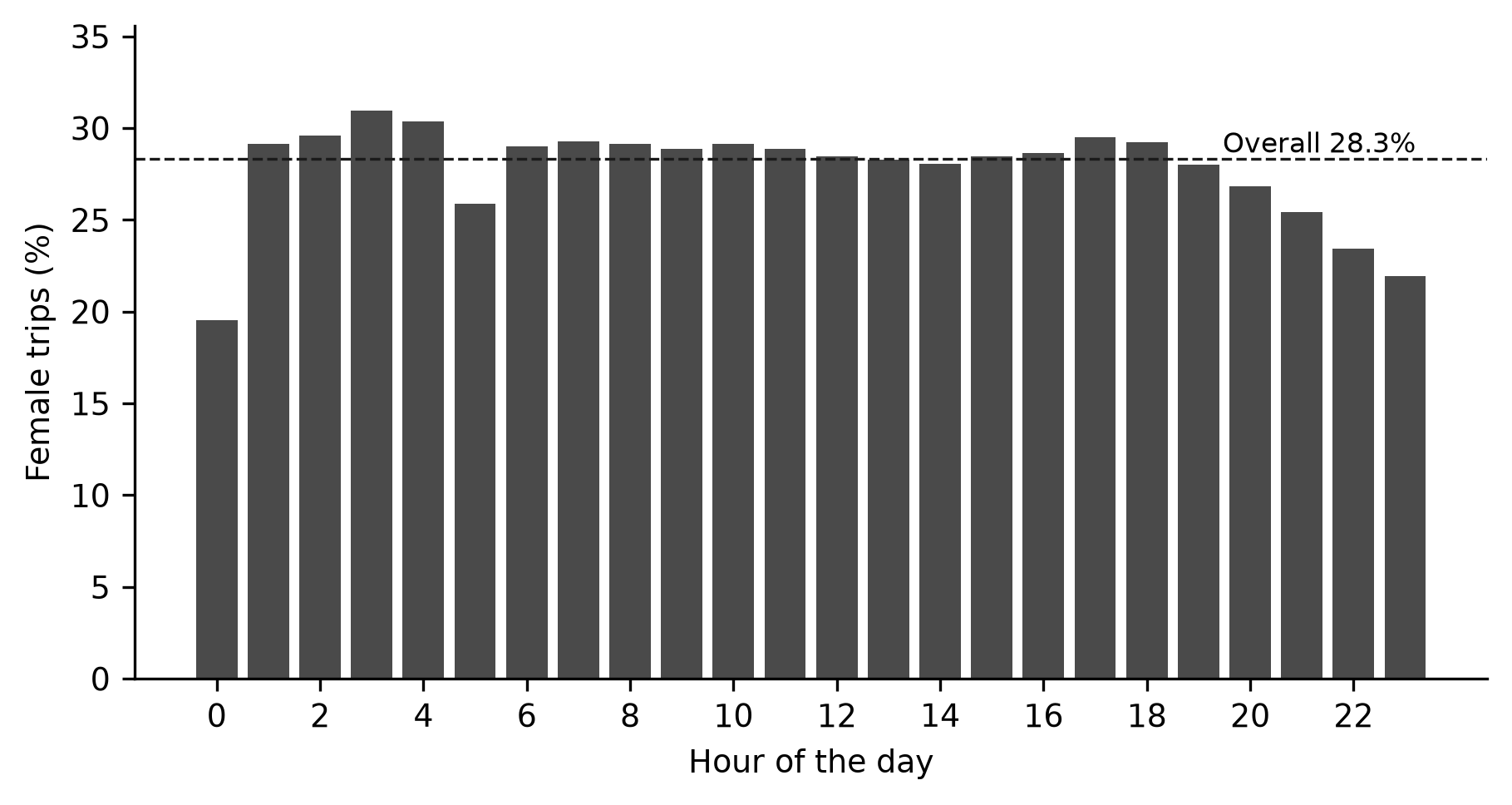
Figure 1. Percentage of trips made by women by hour of the day, 2019-2025.
The female share increased with trip duration, from 26.3% among trips under 10 minutes to 30.6% among trips of 30 minutes or more, with a monotonic gradient across the four categories (Table 2). Round trips, which began and ended at the same station, showed a female share of 26.2%, against 28.4% for one-way trips.
By station location, 28.3% of trips starting within 3 km of the Zócalo were made by women, 28.1% of trips starting between 3 and 6 km away, and 28.5% of trips starting 6 km or more away (Table 2).
In the mutually adjusted logistic model, estimated on 1,483,534 sampled trips, the odds of a trip being made by a woman were higher on weekends than on weekdays (OR 1.12, 95% CI 1.11-1.13) and on trips of 30 minutes or more than on trips under 10 minutes (OR 1.09, 95% CI 1.08-1.11), and lower in the evening peak than in the morning peak (OR 0.75, 95% CI 0.74-0.76), on round trips than on one-way trips (OR 0.83, 95% CI 0.82-0.85) and on trips starting in peripheral than in central stations (OR 0.70, 95% CI 0.69-0.70) (Table 2). After adjustment, the odds of a female trip in 2025 were lower than in 2019 (OR 0.71, 95% CI 0.70-0.71).
Category | Trips (n) | Female share (%) | Adjusted OR (95% CI) |
|---|---|---|---|
Time of day | |||
00:00-05:59 | 1152912 | 25.4 | 0.63 (0.61-0.65) |
06:00-09:59 (ref) | 16203688 | 29.1 | 1.0 |
10:00-15:59 | 26378938 | 28.5 | 0.73 (0.73-0.74) |
16:00-19:59 | 21731144 | 28.9 | 0.75 (0.74-0.76) |
20:00-23:59 | 8709983 | 25.2 | 0.62 (0.62-0.63) |
Day type | |||
Weekday (ref) | 60147566 | 27.8 | 1.0 |
Weekend | 14029099 | 30.7 | 1.12 (1.11-1.13) |
Trip type | |||
One-way (ref) | 71737612 | 28.4 | 1.0 |
Round trip | 2439053 | 26.2 | 0.83 (0.82-0.85) |
Trip duration (min) | |||
<10 (ref) | 28270618 | 26.3 | 1.0 |
10-19 | 26804708 | 29.1 | 0.97 (0.96-0.98) |
20-29 | 11271452 | 29.9 | 1.03 (1.02-1.04) |
>=30 | 7829887 | 30.6 | 1.09 (1.08-1.11) |
Station distance ring | |||
Central (<3 km) (ref) | 11873086 | 28.3 | 1.0 |
Intermediate (3-6 km) | 30225498 | 28.1 | 0.67 (0.67-0.68) |
Peripheral (>=6 km) | 29880135 | 28.5 | 0.7 (0.69-0.70) |
Station not matched | 2197946 | 28.2 | 0.69 (0.68-0.71) |
Note: OR = odds ratio; CI = confidence interval. Reference categories: morning peak, weekday, one-way trips, duration under 10 min, central ring.
The sensitivity model restricted to trips whose origin station matched the catalogue, 1,439,570 trips, reproduced the direction of the main estimates, with an odds ratio of 1.12 (95% CI 1.11-1.13) for weekend trips and 0.70 (95% CI 0.70-0.71) for peripheral stations.
DISCUSSION
The central finding of this study is a durable gender gap. Across seven years of Ecobici records, women contributed a minority of trips in every year, and although that minority rose modestly over the period, it remained far below parity. The gap is therefore not an artefact of the system's early years but a stable feature of its demand.
The size of the gap sits within the range that other authors have reported for station-based and dockless systems, and it places Ecobici among the more unequal systems documented to date. Battiston et al.( 1) showed with large-scale data that women are under-represented in urban cycling across many cities, and Lee( 5) estimated a gender gap of comparable magnitude in bike-sharing with explainable models.
Crossa et al.( 3) found that New York City bike-share subscribers were demographically narrower than the city's population, with women among the under-represented groups, whereas Félix et al.( 30) described how Lisbon moved toward a more balanced user base through infrastructure and bike-share together. Fortes et al.( 13) documented the same unevenness in five Brazilian cities, which strengthens the interpretation that the Ecobici pattern is regional rather than idiosyncratic.
Jin and Sui( 31) compared equity outcomes across station-based, hybrid and dockless micromobility, Chen and Huang( 32) traced bike-share inequality in the United States to structural causes, and Carboni et al.( 33) reached the same conclusion from an intersectional standpoint in two European cities.
Nor is the gap specific to the conventional bicycle. Rodríguez et al.( 8) reported gender dynamics in electric bike-sharing that parallel the conventional fleet, and Sanjurjo-de-No et al.( 17) linked gender to behaviour and risk perception in micromobility. That the same structure appears across electric and conventional fleets indicates the gap is a property of the rider's constraints, not of the technology.
Smaller systems tell a similar story. Cortez-Ordoñez et al.( 9) found a gender and age effect in Logroño's small network, and Kutela et al.( 11) and Qawasmeh et al.( 12) documented gendered perceptions of dockless systems in mid-sized American cities. That the gap appears in systems of very different size indicates it is not a scale problem that growth alone will solve, which is exactly what the Ecobici expansion between 2019 and 2025 shows.
The diurnal shape of the gap points to safety after dark. Chen and Li( 4) observed that the spatio-temporal rhythm of bike-sharing trips differed by gender in New York, and Cubells et al.( 6) reported that women's micromobility routes and speeds differed from men's. As previously noted by Bean et al.,( 2) safety concerns weigh most heavily on women at night, and the finding that the female share is lowest between 20:00 and 05:59 and highest in the daytime is exactly what that mechanism predicts.
Wolniak and Turoń( 34) likewise connected urban barriers to bike-share usage.
The night deficit is the sharpest feature of the hourly profile, and it is larger than any difference between the commuting peaks. The morning peak, far from being the most male period, is the most gender-balanced, which indicates that for the women who do ride, the timed commute is not the main barrier; riding after dark is.
The purpose proxies point in a consistent direction, with one nuance. The female share rises steadily with trip duration, from the shortest hops to trips of 30 minutes or more, and round trips that begin and end at the same station are relatively less common among women.
Just as Russell et al.( 21) found that women's cycling is shaped by the need to combine activities, the longer trips suggest that women use Ecobici for journeys that are not the shortest possible hop, while the lower share of same-station loops is consistent with men making more recreational round trips.
Tang et al.( 35) described the hidden mechanisms that reproduce unequal shared-mobility journeys, and Grüner and Kowald( 36) described how non-users evaluate the utility of bike-share, which together locate the obstacle in the conditions of use rather than in the service itself.
The records also show a difference in the age profile of female and male users, which mirrors the interaction between gender and age that Zhou et al.( 10) reported for dockless systems and that Cortez-Ordoñez et al.( 9) described in a small Spanish network. Age structures women's relationship with the bicycle differently from men's, and an equity programme that ignores age will misread the gap.
By station location the gap is essentially uniform: the female share differs little between the central, intermediate and peripheral rings, and after adjustment the odds of a female trip are actually somewhat lower for peripheral than for central stations.
Unlike the spatial gradients that Fortes et al.( 13) described in Brazilian cities, the Ecobici gap is not concentrated in the periphery but distributed across the network, which suggests that the constraints operating here are citywide. AitBihiOuali and Klingen( 18) showed that women in New York responded to protected lanes, Giacomantonio et al.( 19) associated bicycle facilities with women's cycling frequency, and Pellicer-Chenoll et al.( 20) found in a natural experiment that new infrastructure raised bicycle use more among women. These patterns are consistent with the intersectional reading that Zuniga et al.( 37) systematised and with the equity synthesis of Louro et al..( 38)
The results also speak to the design question of what would convert potential women riders into users. AitBihiOuali and Klingen( 18) and Giacomantonio et al.( 19) both linked women's cycling to the presence of separated facilities, and Pellicer-Chenoll et al.( 20) showed that the effect is causal in a natural experiment. The hourly pattern suggests that the missing women are concentrated in the night hours, so the marginal woman rider is better reached by lighting, maintenance and perceived safety on the routes she would use after dark than by marketing alone.
There is also a circularity worth naming. Stations are typically sited where demand is already observed, and demand is observed mostly from men, so a network planned on past usage can reproduce the gap it measures.
Chen and Huang( 32) made a related argument for the United States, and Fortes et al.( 13) showed for Brazilian cities that station coverage and the gender gap are entangled, although the flat spatial gradient here suggests that in Ecobici the gap is not primarily a matter of station coverage. Breaking the circularity still requires evaluation criteria that weight under-served women, not only observed trips.
The three patterns do not compete; they reinforce one another. A woman who avoids riding after dark will not make the late-night trips that men still make, and she will concentrate her travel in daylight hours, including the morning commute. The weekend and duration gradients point in the same direction, because women's trips are skewed toward the daytime, the weekend and the longer journey. Reading the results together, the gap is shaped less by the commute itself than by the hours in which women feel able to ride.
The adjusted model shows that these patterns are not artefacts of composition. After controlling for year, time of day, day type and duration, the weekend advantage and the duration gradient persist, and the location gradient remains essentially flat, which means the night deficit and the weekend difference are not explained away by when or how long women ride. The persistence of the estimates under mutual adjustment strengthens the conclusion that these patterns reflect distinct constraints rather than a single behavioural difference.
The results also connect to the growing literature on care mobility. Bean et al.( 2) and Russell et al.( 21) both located women's cycling within the obligations of care and household work, and the Ecobici patterns are what such a literature would predict: a female ridership that leans away from the night hours and toward the daytime, weekend and longer trips that care and safety jointly produce.
Treating the gender gap as a symptom of these constraints, rather than as a preference gap, changes the target of policy from the individual rider to the urban conditions that make those trips safe.
In the Mexican context, Cos et al.( 25) modelled the intention to cycle among Mexico City non-users and identified socio-psychological barriers that plausibly operate more strongly on women.
Barriola( 22) showed that external shocks such as gasoline shortages move Ecobici demand, but the gender structure of that demand was not part of those analyses. Taborda et al.( 39) and Félix et al.( 30) described how Lisbon reduced its cycling gender gap through infrastructure and policy, which provides a template for the measures Ecobici could adopt. Catulli et al.( 40) argued that access-based mobility is not gender-neutral, which applies to bike-share as much as to mobility-as-a-service.
The seven-year trend deserves emphasis. The female share rose from roughly a quarter to just under three in ten trips between 2019 and 2025, with most of the change concentrated in the pandemic years, and it then stabilised.
Battiston et al.( 1) showed that gender inequality in cycling is persistent across cities and years, and Ecobici illustrates both that persistence and a modest, one-time narrowing that a shock can produce. The gap did not converge to parity, but it did move, which suggests the constraints are not immovable.
Whether these results transfer to other Latin American systems is an open question that the Brazilian evidence of Fortes et al.( 13) makes plausible: the direction of the gender gap is shared across the region, but its size depends on local infrastructure, safety and the division of household labour.
Systems across the region could replicate this measurement at low cost, because the trip records with a gender field already exist. Cities that publish a gender field could run the same analysis overnight, and those that do not could add the field with negligible cost, which would turn the region's scattered evidence into a comparable base.
The study has several strengths. It uses a complete enumeration of seven years of trip records rather than a survey, it draws the gender of every trip from the operator's own registration, and it anchors station location in a geographic catalogue, which together allow the gap and its covariates to be measured with precision. The seven-year span also covers both a pandemic and a major network expansion, so the estimate of stability is not confined to a single period of the system's life.
The limitations are equally specific. The operator records gender only as male or female, so the analysis cannot represent non-binary users, and a future release with a broader gender field would allow that refinement. The records are trip-level and unlinked, so the study cannot trace the sequence of trips of one person and therefore cannot directly confirm the purpose of a trip or the chaining hypothesis it raises, which an individual-level linkage or an intercept survey would test.
Station identifiers changed with the migration of the system, and although the location analysis used the current catalogue for all years, some older identifiers may map imperfectly, so a panel of station identifiers across the system's history would remove that uncertainty. Finally, the study covers a single system, and the magnitude of the gap may differ in cities with different cycling cultures. The gender field itself is the one recorded at registration and may not match how a user identifies today, and the trip records are only as complete as the operator's publication; these are the same limits that any study of routine data must state, and they do not plausibly reverse the direction of a gap this large.
The gap matters for reasons beyond abstract equity. Cycling confers physical activity, and the under-representation of women in a system that provides it means that the health benefits of the mode are being distributed unequally across the population. The gap also signals a transport constraint rather than a preference: the women who are absent from the night hours are not absent from the city, and they are travelling by other, often less flexible means.
That is the cost the gap imposes, and it is why the night is the right place to look for a remedy. For the city, the gap also means that a public asset financed for the whole population is being used disproportionately by one group, and the imbalance compounds in the health and time savings that cycling confers.
A practical implication for operators is measurement itself. The female share by hour, day and station ring is computable from data that every bike-share system already collects, and publishing it as a routine equity indicator would let cities detect whether an intervention changes the gap. Such indicators are reported only sporadically today, which is why the evidence base still relies on one-off studies.
The gender gap is spatially uniform in Ecobici, but that does not make it socially uniform. Fortes et al.( 13) showed that class and race compound gender in Brazilian bike systems, and the same compounding is plausible in Mexico City even though the network-level gradient is flat. A single-axis reading of gender therefore risks prescribing solutions for the women who already ride rather than for those who do not.
Future work could link the trip records to user identifiers to reconstruct activity chains, merge the station data with a longitudinal catalogue that follows the system's migration, and combine the observed trips with intercept surveys of non-users, which would test the purpose and chaining hypotheses directly rather than through proxies.
For policy, the results suggest that closing the gap requires more than expanding the network. The over-representation of men in night travel and the under-representation of women in it point to the night hours as the first lever: lighting, maintenance and perceived safety on the routes women would use after dark.
The second lever is the recognition that women's trips are skewed toward weekends and longer journeys, so service and pricing designs that reward those trips would meet the demand that already exists. A gender-disaggregated indicator, updated monthly, would cost little and would turn the question of whether the gap is closing into a routine fact of the system's reporting. Teixeira and Cunha( 14) and Shaer et al.( 15) showed that such measures can shift women's mobility when they respond to the specific constraints women report.
CONCLUSIONS
Women made a minority of Ecobici trips in every year from 2019 to 2025, although the female share rose modestly over the period. The share varied with the time of day, being lowest at night and highest in the daytime, and it was higher on weekends than on weekdays and on longer than on shorter trips. The gap was essentially uniform across the station network, which locates the binding constraint in the conditions of riding, especially after dark, rather than in access to the system. The gap therefore narrowed without converging, and the night hours remain its widest point.
References
- 1 Battiston A, Napoli L, Bajardi P, Panisson A, Perotti A, Szell M, et al. Revealing the determinants of gender inequality in urban cycling with large-scale data. EPJ Data Sci. 2023;12(1):9. doi: 10.1140/epjds/s13688-023-00385-7
- 2 Bean R, Pojani D, Corcoran J. Natural barriers facing female cyclists and how to overcome them: A cross national examination of bikesharing schemes. Journal of Cycling and Micromobility Research. 2024;2:100025. doi: 10.1016/j.jcmr.2024.100025
- 3 Crossa A, Reilly KH, Wang SM, Lim S, Noyes P. If We Build It, Who Will Come? Comparing Sociodemographic Characteristics of Bike Share Subscribers, Cyclists, and Residents of New York City. Transportation Research Record: Journal of the Transportation Research Board. 2022;2676(3):634-642. doi: 10.1177/03611981211055664
- 4 Chen G, Li C. Gender differences in spatio-temporal dynamics: Visualizing bike-sharing mobility patterns in New York City. Environment and Planning B: Urban Analytics and City Science. 2024;51(7):1715-1718. doi: 10.1177/23998083241258521
- 5 Lee EH. Understanding Gender Gap in Bike-Sharing Services via eXplainable Artificial Intelligence. Transportation Research Record: Journal of the Transportation Research Board. 2025;2679(8):622-633. doi: 10.1177/03611981251335900
- 6 Cubells J, Miralles-Guasch C, Marquet O. Gendered travel behaviour in micromobility? Travel speed and route choice through the lens of intersecting identities. Journal of Transport Geography. 2023;106:103502. doi: 10.1016/j.jtrangeo.2022.103502
- 7 Ma X, Li J, Liu Z, Tian X, Ji Y, Cheng L. Gender disparities in bike-sharing usage: Unveiling regularity and influential factors in a large-scale campus in Tianjin, China. Research in Transportation Business & Management. 2025;62:101445. doi: 10.1016/j.rtbm.2025.101445
- 8 Rodríguez A, Delgado-Lindeman M, Sipone S, dell’Olio L. Gender dynamics in electric bike-sharing: Insights on usage and fare structures. Research in Transportation Economics. 2025;111:101561. doi: 10.1016/j.retrec.2025.101561
- 9 Cortez-Ordoñez A, Tulcanaza-Prieto AB. The Effect of Gender and Age in Small Bicycle Sharing Systems: Case Study from Logroño, Spain. Sustainability. 2023;15(10):7925. doi: 10.3390/su15107925
- 10 Zhou M, Guo Y, Yang Z, Li X, Teng L. Accessibility and equity in dockless bikesharing: a data-driven analysis of gender-age groups. Transportation Research Part D: Transport and Environment. 2026;150:105090. doi: 10.1016/j.trd.2025.105090
- 11 Kutela B, Kitali AE, Kidando E, Langa N, Novat N, Mwende S. Exploring commonalities and disparities of seattle residents' perceptions on dockless bike-sharing across gender. City, Culture and Society. 2023;32:100503. doi: 10.1016/j.ccs.2023.100503
- 12 Qawasmeh B, Aldalqamouni A. Dockless Bike-Sharing System Perceptions Across Gender in Dayton Using Unstructured Textual Data Mining Techniques. In: Advances in Science, Technology & Innovation. Springer Nature Switzerland; 2025. p. 113-118. doi: 10.1007/978-3-031-76025-9_10
- 13 Fortes LM, Giannotti M, Soares de Freitas F. Gender, class and race uneven access to bike systems across five Brazilian cities. Cities. 2024;148:104822. doi: 10.1016/j.cities.2024.104822
- 14 Teixeira JF, Cunha I. The effects of COVID-19 on female and male bike sharing users: Insights from Lisbon's GIRA. Cities. 2023;132:104058. doi: 10.1016/j.cities.2022.104058
- 15 Shaer A, Rezaei M, Moghani Rahimi B. Assessing the COVID-19 outbreak effects on active mobility of men in comparison with women. Journal of Urbanism: International Research on Placemaking and Urban Sustainability. 2023;16(4):480-497. doi: 10.1080/17549175.2021.1995028
- 16 Carboni A. Gender perceptions of active mobility: Insights from three European cities. European Transport/Trasporti Europei. 2021;(85):1-14. doi: 10.48295/et.2021.85.9
- 17 Sanjurjo-de-No A, María Pérez-Zuriaga A, Hortelano C, García A. Analyzing micromobility patterns: A gender perspective on behavior and risk perception. Transportation Research Part F: Traffic Psychology and Behaviour. 2025;109:1365-1382. doi: 10.1016/j.trf.2025.01.044
- 18 AitBihiOuali L, Klingen J. Inclusive roads in NYC: Gender differences in responses to cycling infrastructure. Cities. 2022;127:103719. doi: 10.1016/j.cities.2022.103719
- 19 Giacomantonio S, Mitra R, Ravensbergen L. Bicycle facilities and women's cycling frequency – An intersectional analysis of gendered travel behaviour. Transportation Research Part A: Policy and Practice. 2024;184:104094. doi: 10.1016/j.tra.2024.104094
- 20 Pellicer-Chenoll M, Antón-González L, Villarrasa-Sapiña I, Devís-Devís J, González LM, Pans M. Effects of building cycling infrastructure on bicycle use: Differences by gender through a longitudinal natural experiment study. Research in Transportation Economics. 2025;110:101531. doi: 10.1016/j.retrec.2025.101531
- 21 Russell M, Davies C, Wild K, Shaw C. Pedalling towards equity: Exploring women's cycling in a New Zealand city. Journal of Transport Geography. 2021;91:102987. doi: 10.1016/j.jtrangeo.2021.102987
- 22 Barriola X. The impact of gasoline shortages on public bike-sharing systems. ARLA. 2021;34(4):561-577. doi: 10.1108/arla-01-2021-0017
- 23 Gómez Márquez HR, López Bracho R, Ramirez-Nafarrate A. A simulation-optimization study of the inventory of a bike-sharing system: The case of Mexico City Ecobici’s system. Case Studies on Transport Policy. 2021;9(3):1059-1072. doi: 10.1016/j.cstp.2021.01.014
- 24 Martínez G, Benitez S, Guzmán A. Visualization of the Regular Mobility of Trips Between Bike Stations in the ECOBICI System. In: Communications in Computer and Information Science. Springer International Publishing; 2022. p. 76-99. doi: 10.1007/978-3-031-18082-8_6
- 25 Cos CAC, Zorrilla MC, Pérez-López R. From socio-psychological beliefs to urban policy: modelling cycling intention among non-users in Mexico City using SEM-MIMIC and COM-B approaches. Transportation Research Part F: Traffic Psychology and Behaviour. 2026;122:103763. doi: 10.1016/j.trf.2026.103763
- 26 von Elm E, Altman DG, Egger M, Pocock SJ, Gøtzsche PC, Vandenbroucke JP. The Strengthening the Reporting of Observational Studies in Epidemiology (STROBE) statement: guidelines for reporting observational studies. The Lancet. 2007;370(9596):1453-1457. doi: 10.1016/s0140-6736(07)61602-x
- 27 Benchimol EI, Smeeth L, Guttmann A, Harron K, Moher D, Petersen I, et al. The REporting of studies Conducted using Observational Routinely-collected health Data (RECORD) Statement. PLoS Med. 2015;12(10):e1001885. doi: 10.1371/journal.pmed.1001885
- 28 Secretaría de Movilidad de la Ciudad de México. Datos abiertos de viajes del sistema Ecobici [Internet]. 2026. Available from: https://ecobici.cdmx.gob.mx/datos-abiertos/
- 29 Sistema de Movilidad Integrada de la Ciudad de México. Ecobici station information feed (GBFS) [Internet]. 2026. Available from: https://gbfs.mex.lyftbikes.com/gbfs/gbfs.json
- 30 Félix R, Cambra P, Moura F. Build it and give ‘em bikes, and they will come: The effects of cycling infrastructure and bike-sharing system in Lisbon. Case Studies on Transport Policy. 2020;8(2):672-682. doi: 10.1016/j.cstp.2020.03.002
- 31 Jin ST, Sui DZ. Shared micromobility and equity: A comparison between station-based, hybrid, and dockless models. Transportation Research Part D: Transport and Environment. 2024;129:104113. doi: 10.1016/j.trd.2024.104113
- 32 Chen J, Huang L. Causes of transportation inequality: The case of bike sharing in the U.S. Case Studies on Transport Policy. 2024;16:101199. doi: 10.1016/j.cstp.2024.101199
- 33 Carboni A, Pirra M, Costa M, Kalakou S. Active mobility perception from an intersectional perspective: insights from two European cities. Transportation Research Procedia. 2022;60:560-567. doi: 10.1016/j.trpro.2021.12.072
- 34 Wolniak R, Turoń K. Between Smart Cities Infrastructure and Intention: Mapping the Relationship Between Urban Barriers and Bike-Sharing Usage. Smart Cities. 2025;8(4):124. doi: 10.3390/smartcities8040124
- 35 Tang F, Guo Y, Zhang L, Liu K, Shen Y, Yu J, et al. Unequal streets, unequal journeys: The hidden mechanisms of shared mobility. Travel Behaviour and Society. 2026;44:101284. doi: 10.1016/j.tbs.2026.101284
- 36 Grüner SL, Kowald M. Bike-sharing, why not? A framework of utility perceptions of BSSs' non-users based on qualitative data. Transport Policy. 2025;168:220-243. doi: 10.1016/j.tranpol.2025.03.024
- 37 Zuniga MJ, Duran-Rodas D, Fernández Núñez MB, Wulfhorst G. Intersectionality for sustainable mobility: a systematic literature review. Transport Reviews. 2026:1-24. doi: 10.1080/01441647.2026.2729300
- 38 Louro T, Geurs KT, Grigolon A, Cunha AL. Cycling accessibility and equity: a systematic literature review. Transport Reviews. 2026:1-24. doi: 10.1080/01441647.2026.2664409
- 39 Taborda S, Zuzarte M, Magalhães L, Carvalho G, Banza M. Addressing the gender gap in cycling: Lisbon's journey for a more inclusive cycling ecosystem. Transportation Research Procedia. 2023;72:2401-2408. doi: 10.1016/j.trpro.2023.11.735
- 40 Catulli M, Thomas R, Fenner R, Copsey SL, Walsh S. Exploring the gender inclusivity of mobility as a service through the access based consumption framework: A UK case study. Journal of Urban Mobility. 2025;7:100118. doi: 10.1016/j.urbmob.2025.100118
Declarations
Funding
No financing
Conflict of interest
None
Authorship contributions
Drafting – original draft: German Martínez Prats, Yoan Hernández Flores.
Writing–review and editing: German Martínez Prats, Yoan Hernández Flores.