

Abstract
Transport justice research has converged on accessibility as the currency of distributive justice, yet the empirical measurement of accessibility inequality rarely derives from an explicit normative principle. This narrative review synthesizes the normative foundations of transport justice and the approaches used to measure accessibility inequalities, and examines the alignment between commitments and measurement. The synthesis shows that egalitarian, sufficientarian, prioritarian and capabilities frameworks coexist but do not dictate the choice of indicator; distributional indices such as the Gini coefficient and Lorenz curve dominate empirical practice, joined by vertical and horizontal equity ratios and needs-gap thresholds. Measurement choices regarding the accessibility metric, time threshold and spatial unit materially alter inequality estimates. A persistent gap separates the philosophical and measurement literatures, although recent translation efforts that combine equality, priority and sufficiency indicators signal a path toward normatively explicit measurement. The review concludes with implications for appraisal and planning and a research agenda for conceptually coherent equity metrics.
Keywords
transport justice, accessibility, equity, distributive justice, capabilities approach, transport-related social exclusion
INTRODUCTION
Transport justice scholarship has settled on a deceptively simple claim: accessibility, not movement, is the currency in which transport equity should be assessed. Martens (1) argued that a just transport system distributes access to destinations fairly, and Pereira et al.(2) consolidated that position by connecting accessibility to distributive justice theory. Yet empirical practice has not followed. Most applied equity studies summarize accessibility with distributional indices borrowed from income research, chiefly the Gini coefficient, without stating which normative principle the index is meant to implement.(3) van Wee (4) describes exactly this tension as a conceptual gap between the accessibility and equity literatures, whereas Humberto et al.(5) report that equality, priority and sufficiency can now be translated directly into urban transport metrics, implying that the gap is closing.
This disagreement has practical stakes. Decisions about investment, fares, land use and service design redistribute accessibility across places and social groups. When an index carries an unexamined normative commitment, a policy can appear equitable by its own arithmetic while violating the principle it claims to serve. Martens and Di Ciommo( 6) showed that appraisal based on travel time savings systematically favors already mobile groups, because time gains accrue to those who travel most. van Wee and Roeser( 7) reached a similar verdict from ethical theory, finding that cost-benefit analysis embeds utilitarian assumptions that egalitarian and sufficientarian readers would reject.
The empirical magnitude of accessibility inequality reinforces the case for precise measurement. Weiss et al.( 8) estimated that a large share of the world population lives more than an hour from a city, and that the distribution of travel time to urban centers is strongly unequal across regions and income groups. Urban studies replicate the pattern at finer scales, with hospital, job and green space accessibility concentrated among higher-income and car-owning households.(9,10) If such inequalities are to be reduced, the field needs measures whose normative meaning is explicit.
Two developments make this review timely. The normative literature has matured into a recognized subfield since Pereira et al.( 2) systematized its principles, and the fifteen-minute city debate has moved accessibility from a technical indicator to a contested policy goal across Europe and the Americas.(11,12) The measurement literature has expanded in parallel, driven by new network, timetable and mobile data.( 13) These two bodies have grown side by side, yet they continue to borrow terms from each other without a shared standard. A synthesis that places them on the same table is therefore overdue.
The readership for such a synthesis is not confined to specialists. Planning agencies, transit operators and municipal governments are increasingly asked to demonstrate equity in their plans, and they must choose among indicators whose normative content they may not have time to reconstruct. A review that names the principles behind the indicators serves that audience directly, and it connects the social equity agenda of transport policy to the accessibility tools that make it measurable.( 14,15)
This review addresses that need. Its objective is to synthesize the normative foundations of transport justice and the empirical approaches used to measure accessibility inequalities, and to identify where commitments and measurement choices converge or diverge. Four questions guide the synthesis: which normative principles organize the field, why accessibility became its currency, how accessibility inequality is measured, and whether those measures express the principles they invoke.
DEVELOPMENT
The synthesis supports a middle position between the two sides named in the introduction. The normative literature has largely abandoned mobility as the object of distribution, yet the measurement literature has not adopted the corresponding indicators, and most applied indices remain normatively implicit. The exception is a recent cluster of studies that translates equality, priority and sufficiency into explicit metrics.
Axis | Key findings | Convergence | Representative studies |
|---|---|---|---|
Normative foundations | Four distributive principles and the capabilities approach coexist without dictating an indicator | High on the object, low on the index | Pereira et al., 2017; Randal et al., 2020; Vecchio and Martens, 2021 |
Accessibility as the currency | Accessibility displaces mobility and travel time savings as the distributed good | High | Martens, 2012; van Wee, 2022; Martens and Di Ciommo, 2017 |
Measurement of inequalities | Gini and Lorenz indices and vertical and horizontal equity dominate; results depend on metric and threshold | Medium, without a common standard | Delbosc and Currie, 2011; Karner, 2018; Kapatsila et al., 2023 |
Alignment of commitments and measurement | Persistent gap between theory and measure; explicit translations of equality, priority and sufficiency emerge | Low but narrowing | Lewis et al., 2021; Humberto et al., 2023; Lucas et al., 2015 |
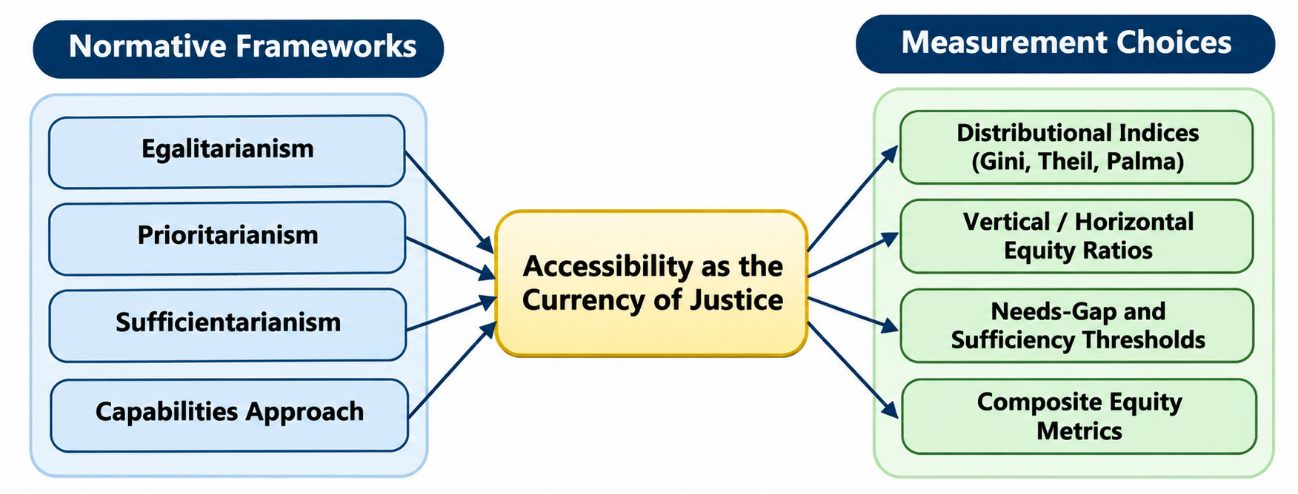
Figure 1. Conceptual route from normative frameworks to measurement choices in transport justice.
Normative foundations
Four distributive principles organize the normative debate. Pereira et al.( 2) reviewed them for transport and showed that egalitarianism, sufficientarianism, prioritarianism and utilitarianism each yield a different allocation rule when applied to accessibility. Egalitarianism demands equal accessibility for all. Prioritarianism weights gains toward those who start worse off. Sufficientarianism guarantees a minimum threshold. Utilitarianism maximizes total benefit regardless of its distribution. Pereira( 19) restated these distinctions for a transport audience and noted that the four principles cannot all be satisfied at once. Randal et al.( 20) reached the same conclusion and argued that the choice among principles is a political decision that appraisal cannot outsource to technique. van Wee and Roeser( 7) made the point against cost-benefit analysis specifically, whose utilitarian aggregation of travel time savings hides distributional judgments that egalitarian frameworks would make visible.
The differences among the principles are consequential in practice. A fare cut financed by general taxation satisfies utilitarians if total welfare rises, satisfies prioritarian readers only if the gain reaches the transport poor, and satisfies egalitarians only if it narrows the gap between groups. Jeekel and Martens( 21) observed that housing, health care and education policy institutionalized such distinctions decades ago, whereas transport still treats equity as an afterthought in appraisal. The comparison suggests that the problem is not a missing principle but a missing institutional commitment.
The practical choice between principles can be illustrated with a single target. A sufficiency standard for job access asks how many residents can reach a given number of jobs within a fixed time, whereas a capabilities standard asks whether residents can convert that reach into employment given their skills, schedules and care duties.( 22) The two questions require different data and produce different beneficiaries, which is why the choice cannot be postponed until measurement begins.( 20)
The genealogy of the principles matters for their authority. The transport field imported them from political philosophy, mostly through review articles rather than through original philosophical work, which means the principles arrive pre-digested and occasionally simplified.( 2) Vecchio and Martens( 22) warned that the capabilities approach in particular is invoked without its full machinery of conversion factors and agency, reducing a demanding framework to a label. Normative depth therefore varies across studies, and depth, in turn, predicts whether a study names its principle.( 3)
Prioritarianism and sufficientarianism overlap enough to confuse operational choice. Both direct attention to the worst off, and both can be satisfied by a threshold, but they diverge on whether gains above the threshold matter for equity.( 20) A prioritarian index keeps counting improvements for the worst off even after a minimum is met, whereas a sufficientarian index stops at the threshold. Empirical work that distinguishes the two is scarce, which is one reason why studies that claim a sufficientarian reading can be re-read as prioritarian.( 23)
Sufficientarianism has gained ground because it replaces the demanding comparisons of strict egalitarianism with a minimum standard. Ryan et al.( 23) asked what a sufficient level of accessibility would be and why no transport agency has defined one, while Rode et al.( 24) traced a sufficiency turn in urban transport policy. The principle is attractive in practice, because a threshold of access to jobs, health and education can be written into plans and audited. Its weakness is that no consensus exists on where the threshold lies, and studies that propose one remain scarce.( 23)
The capabilities approach offers a different grammar. Instead of distributing a resource, it asks what people can actually do with transport, and therefore foregrounds conversion factors such as income, disability, care responsibilities and fear.( 22) Luz and Portugal( 25) re-read transport-related social exclusion through that lens, and Azmoodeh et al.( 26) identified the factors that shape transport capability and argued that equal access does not guarantee equal capability. Applied to older adults, Deka( 27) interpreted trip deprivation through the capability approach rather than through service supply, and Cooke et al.( 28) warned that physical proximity is not access for pedestrians who cannot traverse the route.
The divergence among these frameworks is real but productive. They agree that distribution matters and that accessibility is its object; they disagree on the unit, resource, threshold or capability, and on how much inequality is tolerable. Yet none of them specifies an index. That silence is the hinge on which the measurement problem turns.( 3,4)
Accessibility as the currency of justice
The second axis documents the consolidation of accessibility as the currency of justice. The position originates in the claim that the transport system's distributive good is access to destinations rather than movement itself, an argument that Pereira et al.( 2) developed into a full mapping of distributive principles onto accessibility. van Wee( 4) formalized the link in a framework that separates accessibility, its determinants and its equity evaluation, and Jeekel and Martens( 21) showed that transport lags behind other social policy domains in institutionalizing that separation.
The clearest consequence concerns appraisal. Martens and Di Ciommo( 6) demonstrated that travel time savings, the standard benefit measure, reward those who already travel and can therefore widen accessibility gaps even when a project appears beneficial. Di Ciommo and Shiftan( 29) showed that accessibility-based evaluation reverses conventional project rankings. van Wee and Roeser( 7) supplied the ethical grounding for that reversal. The convergence is strong: appraisal without accessibility is blind to distribution.
The fifteen-minute city debate has brought this axis into policy. Vale et al.( 11) measured pedestrian accessibility to everyday destinations across European cities and documented wide inequality between centers and peripheries, while Knap et al.( 12) built a cycling accessibility metric for Utrecht that connects proximity to socioeconomic inequality. These studies share the accessibility-as-currency premise, yet they stop short of naming the distributive principle that would turn a proximity gap into a policy obligation.( 4)
The persistence of mobility in practice is itself a finding. Despite the conceptual consensus, speed and travel time remain the metrics that planning agencies report, because they are cheap to compute and legible to elected officials.( 6) Di Ciommo and Shiftan( 29) observed that the shift from mobility to accessibility is therefore incomplete at the operational level, even where it is complete at the conceptual level. The gap between the two levels mirrors, in miniature, the larger gap between theory and measurement that this review traces.
The boundary between accessibility and mobility is substantive rather than terminological. Mobility measures count trips and speeds, which reward travel itself, whereas accessibility measures count reachable opportunities, which reward the ability to satisfy needs without necessarily traveling.( 4) Pereira( 19) illustrated the distinction with teleworking: a service that removes a commute leaves mobility unchanged but raises the accessibility of work. Policy built on mobility therefore incentivizes movement, while policy built on accessibility incentivizes proximity and connectivity.
The participation turn sharpens the accessibility claim. Allen and Farber (30) reason that accessibility is only instrumentally valuable, because what justice ultimately protects is the ability to take part in work, care and civic life. On that view, an accessibility index is a proxy whose validity depends on how tightly accessibility predicts participation. The available evidence supports the proxy but not its sufficiency: Luz and Portugal (31) found that accessibility reduces social exclusion in São Paulo, while Ward et al.(32) found that disadvantage reshapes the activity set independently of measured access. The two findings are compatible only if accessibility and participation are treated as distinct, linked constructs.
The social exclusion tradition provides the empirical counterpart of this normative claim. Recent work confirms that low accessibility compounds disadvantage across life domains. Ward et al.( 32) found that transportation disadvantage narrows the set of activities people even consider, and Luz and Portugal( 31) estimated in São Paulo that higher accessibility reduces the probability of social exclusion. Allen and Farber( 30) argued that participation in activities, not accessibility alone, is the better outcome, a position that complicates the consensus without overturning it. Lunke( 33) showed in Oslo that modal accessibility disparities map onto transport poverty, and Venter et al.( 34) reviewed bus rapid transit evidence to find that infrastructure improvements do not automatically reach low-income riders.
The axis also records a persistent boundary debate. Mattioli et al.( 35) linked affordability to exclusion in the United Kingdom, and Bueno Rezende de Castro et al.( 36) showed that transport poverty leads to social exclusion in a low-income community. Latin American case studies add that exclusion persists even under subsidized fares.(34,37) The divergence is geographic and conceptual, because exclusion is mediated by fares, service and land use in ways a single accessibility index cannot capture.
Measurement of accessibility inequalities
The third axis concerns how accessibility inequality is quantified. Distributional indices adapted from income research dominate. Raza et al.( 38) applied Lorenz curves and the Gini coefficient to time-dependent public transport accessibility, and the approach has since been extended to food store access during the pandemic,( 39) rail network access( 40) and 15-minute pedestrian accessibility across European cities.( 11) The Gini coefficient summarizes the whole distribution in one value and permits comparison across cities and years; its cost is that it hides where in the distribution inequality sits. The Theil index and the Palma ratio answer that weakness by decomposing inequality between and within groups, though they appear in a smaller number of studies.( 38)
Vertical and horizontal equity provide the other dominant frame. Karner( 10) operationalized vertical equity through needs-based gaps between disadvantaged and reference groups, and Nahmias-Biran et al.( 41) measured the distributional effects of a fare change in Haifa with Lorenz-derived indicators. Yeganeh et al.( 42) applied a social equity analysis to job accessibility across the United States public transportation system and found that minority and low-income groups face systematically lower access to jobs. Camporeale et al.( 43) embedded horizontal and vertical equity directly in a transit design model, and Ruiz-Pérez et al.( 44) showed that the chosen zoning changes the horizontal equity verdict, a modifiable areal unit problem. Lewis et al.( 3) surveyed the norms actually used and found them implicit and inconsistent across studies.
A third finding is that measurement choices materially change the result. Kapatsila et al.( 45) compared cumulative and gravity-based accessibility in eight Canadian cities and found the two metrics rank neighborhoods differently, which in turn changes which areas appear disadvantaged. Pereira (46) showed that the travel time threshold chosen for a scenario analysis changes the sign of the equity effect, and Stępniak et al.( 13) demonstrated that temporal resolution alters measured public transport accessibility. Dianin et al.( 47) isolated the transport system's contribution from individual constraints, a step most equity indices skip.
The scale at which inequality is measured remains a further source of divergence. Place-based indices, computed for zones or neighborhoods, cannot see differences within households, while person-based indices require travel survey or mobile data that are costly and inaccessible to most researchers.( 47) Tiznado-Aitken et al.( 15) showed in Santiago that accounting for level of service and competition for opportunities changes the measured distribution of public transport accessibility. The same city can therefore appear equitable at one scale and sharply unequal at another.( 44)
Data availability shapes which measures are feasible and therefore which norms get expressed. Distributional indices require only an accessibility score per zone, which explains their dominance; needs-gap and capability measures require group-specific thresholds or individual conversion factors, which are harder to obtain.( 48) Stępniak et al.( 13) showed that even the accessibility score depends on timetable resolution, so the data question is not settled by using public transport schedules. The measurement literature thus faces a double constraint: the norm it might prefer and the data it can afford.
Beneath the index choice lies an older distinction between equality of opportunity and equality of outcome. A Gini coefficient of accessibility summarizes an outcome distribution, whereas a needs-gap or vertical equity ratio approximates an opportunity comparison between groups.( 10) The two framings answer different questions and therefore lead to different interventions. Studies do not state which framing they adopt, and the silence reproduces the same ambiguity as the missing normative principle.( 3)
The choice between place-based and person-based equity also has political consequences. Place-based indices identify deprived neighborhoods and suit area-based programs, whereas person-based indices identify deprived individuals and suit targeted subsidies.( 47) The two unit types can disagree about where the problem lies, and studies that report only one silently foreclose the other's remedies.( 44)
Equity measured at a single point in time also misses the temporal structure of disadvantage. Accessibility to jobs is worth less to a worker whose shift falls outside the transit peak, and a threshold that ignores time of day can certify access that does not exist in practice.( 13) Time-dependent measures address this by computing accessibility across the day, but they raise the data burden and are still applied in a minority of studies.( 38) The temporal gap between measured and experienced accessibility is thus a further site where normative commitment and measurement diverge.
The treatment of affordability shows how far measurement has drifted from its normative origins. Transport poverty research treats affordability as part of the distributional question, because fares and fuel costs determine whether accessibility can be used.( 35) Yet accessibility inequality indices computed from network data exclude cost, and equity studies that include fares are the exception.( 41) The omission is consequential for the Global South, where cost, not distance, is the binding constraint on participation.( 37)
The applications are broad but uneven. Hospital accessibility has been measured across Canadian and global contexts,(8,9) job accessibility across eleven Canadian regions(49) and across London, São Paulo and the Randstad,(50) and green space equity across 254 Chinese cities.(51) Latin American studies document how public transport restructuring redistributes accessibility in Bogotá(14) and how competition for opportunities shapes measured equity in Santiago.(15) Yet few of these studies state which normative principle their index implements. Table 2 summarizes the main approaches. (Table 2)
Approach | Normative basis | Data requirements | Strengths | Limitations |
|---|---|---|---|---|
Distributional indices (Gini, Theil, Palma) | Implicit egalitarianism | Accessibility values per unit | Single comparable value; well known | Hides where inequality lies; unit dependent |
Vertical and horizontal equity ratios | Explicit group comparison | Accessibility by socioeconomic group | Directly policy relevant | Group definition arbitrary; MAUP |
Needs-gap and sufficiency thresholds | Sufficientarianism | Threshold of access to essential destinations | Auditable minimum standard | Threshold contested |
Composite capability and equity metrics | Capabilities approach | Individual conversion factors and perceived access | Captures diversity of need | Data intensive; not standardized |
Note: MAUP = modifiable areal unit problem.
Alignment of commitments and measurement
The fourth axis confronts the gap directly. The most consistent finding is negative: the philosophical and measurement literatures do not yet speak the same language. Lewis et al.(3) concluded that equity norms enter transportation research implicitly rather than explicitly, and van Wee( 4) listed the derivation of equity indicators from normative principles among the field's open questions. Ricord et al.( 52) added a data layer to the same problem, showing that biases in transportation data can silently distort equity conclusions.
A recent translation cluster begins to close the gap. Humberto et al.( 5) converted equality, priority and sufficiency into three separate metrics and applied them to Latin American cities, finding that the three principles rank the same cities differently. Lucas et al.( 53) had earlier combined ethical theories with accessibility measures to the same end, and Azmoodeh et al.( 48) built a fuzzy capability index for social inclusion. These studies share a design: name the principle first, then choose or construct the indicator. The trade-off is equally clear. Composite metrics gain normative transparency but lose the simplicity and comparability of a single index, and their weights remain open to contestation.( 5)
A defensible translation must satisfy three conditions, and the translation studies differ on all three. It must state the principle, map it to an indicator, and expose the indicator's sensitivity to its own parameters.( 5) Lucas et al.( 53) satisfied the first two conditions but left sensitivity implicit, whereas Humberto et al.( 5) demonstrated that the three principles diverge once applied to the same cities. Until these conditions are standardized, translations will remain persuasive demonstrations rather than transferable tools.
The governance of translation is the last unresolved piece. Who chooses the principle, the threshold and the weights is a political question that the technical literature leaves open.( 20) Ryan et al.( 23) note that no agency has defined a sufficient level of accessibility, which implies that the decision has no institutional owner. Until ownership is assigned, translation metrics will be adopted ad hoc by researchers and will not bind appraisal.( 21)
Policy evidence points in the same direction. Where equity is an explicit objective, measurement follows; where it is not, distributional effects go unreported. Guzmán et al.( 14) showed that Bogotá's integrated transit reforms changed accessibility in ways that were legible only once equity was measured, and Craik et al.( 54) estimated the equity impacts of the London congestion charge with a design that required an explicit counterfactual. Knap et al.( 12) linked a cycling accessibility metric to spatial and socioeconomic inequality in Utrecht, and Jomehpour Chahar Aman and Smith-Colin( 55) mapped transit deserts as a needs-based measure. The pattern is consistent: normatively explicit studies produce actionable findings, while normatively silent indices remain decorative.
The institutional obstacle is as important as the technical one. Translation studies remain demonstrations rather than routines, because appraisal guidance still rewards travel time savings and because equity indicators are added after the fact instead of shaping the option set.( 6) Where agencies have adopted a standard, as in the needs-gap approach of transit desert mapping,( 55) the indicator has moved from research into operation. The bottleneck is therefore not the absence of a metric but the absence of a mandate.( 21)
DISCUSSION
Humberto et al.( 5) treat the translation of justice principles into metrics as a solved design problem, whereas van Wee( 4) and Lewis et al.( 3) describe a field whose normative and empirical halves have not yet met. The evidence assembled here places the answer between those positions. The currency is settled: accessibility, not movement, is the distributed good. The measure is not: most applied indices inherit a norm they never state.
The reconciliation turns on measurement conventions. Where researchers borrow income-inequality indices, egalitarian assumptions travel with them unnoticed.(18,38) Where researchers instead name a principle first, as Lucas et al.( 53) and Humberto et al.( 5) did, the same data yield different but explicit verdicts. The distance between the two camps is therefore not a dispute over evidence but over declared commitment, which explains why the disagreement persists despite broad agreement on accessibility as the object of distribution.( 2)
Three conditions reconcile the discrepant readings. Studies that see convergence, such as Humberto et al.,( 5) work at the level of a single, well-specified metric in a bounded set of cities. Studies that see a gap, such as Lewis et al.,( 3) survey the field as a whole, where inherited indicators still dominate. Population, period and measurement therefore explain the disagreement better than any difference in evidence. Where the measurement is local and the principle is named, convergence is real; where the measurement is inherited and the principle is silent, the gap persists.( 4)
The finding that metric choice can reverse equity rankings is consistent with Kapatsila et al.,( 45) who compared cumulative and gravity-based measures, and with Pereira,( 46) who showed that a travel time threshold can change the sign of an equity effect. It also extends the earlier caution of Delbosc and Currie( 18) about the spatial unit of analysis. Studies that report stable equity rankings typically fix the metric and threshold before estimation,( 10) which explains why they do not observe the instability that sensitivity analyses reveal. The discrepancy is thus an artifact of method rather than of conflicting evidence.
The capabilities strand diverges from index-based measurement and is the most difficult to reconcile, because it targets a different unit: capability rather than resource.( 22) Deka( 27) interpreted trip deprivation among older adults through capability deficits rather than service supply, and Azmoodeh et al.( 26) argued that perceived access and capability can diverge from nominal access. These results do not contradict the distributional literature; they address a question the distributional indices do not ask. A field that measures only resources will therefore remain partially blind to what those resources allow people to do.( 30)
The practical implications follow from the synthesis. Appraisal should replace or supplement travel time savings with accessibility distributions, which Martens and Di Ciommo( 6) showed to be the only way to see who gains and who does not. Planning should adopt explicit sufficiency thresholds, as Ryan et al.( 23) proposed, so that minimum access becomes auditable. Researchers should state the normative principle before choosing an index, and should report the metric, threshold and spatial unit that generated each equity result.( 4) Institutions, following Jeekel and Martens,( 21) should carry the principle into appraisal guidance rather than leaving it to individual analysts.
These implications extend to the policy domains the field now claims to serve. Climate and resilience agendas add new distributive objects, such as access to charging, low-emission zones and emergency evacuation, whose equity effects are measured with the same inherited tools.(12) Smart mobility reproduces the pattern, because platform data promise finer measurement while raising the data-bias problems identified by Ricord et al..(52) The lesson generalizes: every new transport object arrives before its normative standard, and the standard is retrofitted from the nearest available index.
Compared with earlier syntheses, this review adds the measurement side to the normative picture. Pereira et al.( 2) provided the normative map, and Vecchio and Martens( 22) provided the capabilities bridge, but neither traced the empirical indices that dominate practice. By joining the two literatures, this review shows that the field's disagreements are, in part, disagreements about units and data rather than about values, which makes them more tractable than they appear.
Two biases deserve emphasis. The synthesis leans on European, North American and Latin American cases, and its conclusions about sufficiency and capability may not transfer to settings where informality dominates the transport system.( 37) The review also reads English-language records, and the non-English accessibility equity literature, particularly in Spanish and Portuguese, is known to be substantial.( 14) These are not fatal flaws, but they bound the generality of the synthesis.
The agenda can be made falsifiable. A claim that translation metrics generalize would be falsified if equality, priority and sufficiency stopped diverging when applied outside the cities where they were developed.(5) A claim that capability indicators outperform distributional indices would be falsified if the two families ceased to differ once conversion factors were included.(48) Stating these tests in advance would convert the field's conceptual debate into an empirical one, which is the fastest way to close the gap this review documents.
A good index would satisfy four criteria derived from the synthesis. It would name its principle, report its metric and thresholds, state its unit of analysis, and be tested for sensitivity to all three. No single study reviewed here satisfies all four, and the studies that satisfy the first, such as Humberto et al.,( 5) are the ones the field cites as models. The criteria are therefore not aspirational; they describe what already distinguishes the literature's best work.
What remains uncertain is how much of the field's inertia reflects genuine methodological difficulty rather than institutional habit. The review cannot adjudicate that question, because it read the published record rather than the decision processes behind it. Studies of appraisal practice would be needed to separate the two, and such studies are themselves scarce.( 6) The distinction matters for policy, because methodological difficulty justifies research, whereas institutional habit justifies reform. This standard is also the criterion by which future contributions should be judged, and it is reachable with the data already available to most planning agencies.
The strengths of this review are its multi-source, documented search and its explicit thematic matrix, which required each axis to state convergences, divergences and gaps. The limitations are equally specific. Selection was not systematic and was restricted to records indexed in the three sources and written in English, so non-Anglophone and grey literature is underrepresented; a complementary search of regional databases and institutional reports would correct this. Publication bias toward significant equity findings is plausible, and a protocol-driven review with preregistered criteria would bound it. Study quality was not appraised formally, because the synthesis is conceptual; a systematic review with risk-of-bias appraisal would test whether the translation claims hold across designs.
Three tasks define the agenda. First, standardize the reporting of metric, threshold and unit so that accessibility equity results become comparable across cities. Second, test the equality, priority and sufficiency translation of Humberto et al.( 5) outside Latin America to learn whether its rankings generalize. Third, connect measured accessibility to participation outcomes, following Allen and Farber,( 30) so that equity indices are validated against the capabilities they are meant to protect.
CONCLUSIONS
The normative foundations of transport justice rest on four distributive principles plus the capabilities approach, and they agree on accessibility as the currency of justice without agreeing on an index. Accessibility inequality is measured chiefly through distributional indices and vertical and horizontal equity ratios whose results depend on the metric, threshold and spatial unit chosen, and whose normative basis remains implicit. A persistent gap separates the philosophical and measurement literatures, but recent work that translates equality, priority and sufficiency into explicit metrics shows the gap can be closed. Closing it requires appraisal and planning that name the principle first, and research that validates equity metrics against the participation outcomes they are meant to secure.
References
- 1 Martens K. Justice in transport as justice in accessibility: applying Walzer’s ‘Spheres of Justice’ to the transport sector. Transportation. 2012;39(6):1035-1053. doi: 10.1007/s11116-012-9388-7
- 2 Pereira RHM, Schwanen T, Banister D. Distributive justice and equity in transportation. Transport Reviews. 2017;37(2):170-191. doi: 10.1080/01441647.2016.1257660
- 3 Lewis EO, MacKenzie D, Kaminsky J. Exploring equity: How equity norms have been applied implicitly and explicitly in transportation research and practice. Transportation Research Interdisciplinary Perspectives. 2021;9:100332. doi: 10.1016/j.trip.2021.100332
- 4 van Wee B. Accessibility and equity: A conceptual framework and research agenda. Journal of Transport Geography. 2022;104:103421. doi: 10.1016/j.jtrangeo.2022.103421
- 5 Humberto M. How to translate justice theory into urban transport metrics? Synchronic assessment of Latin American cities based on equality, priority and sufficiency. Journal of Transport Geography. 2023;110:103630. doi: 10.1016/j.jtrangeo.2023.103630
- 6 Martens K, Di Ciommo F. Travel time savings, accessibility gains and equity effects in cost–benefit analysis. Transport Reviews. 2017;37(2):152-169. doi: 10.1080/01441647.2016.1276642
- 7 Van Wee B, Roeser S. Ethical Theories and the Cost–Benefit Analysis-BasedEx AnteEvaluation of Transport Policies and Plans. Transport Reviews. 2013;33(6):743-760. doi: 10.1080/01441647.2013.854281
- 8 Weiss DJ, Nelson A, Gibson HS, Temperley W, Peedell S, Lieber A, et al. A global map of travel time to cities to assess inequalities in accessibility in 2015. Nature. 2018;553(7688):333-336. doi: 10.1038/nature25181
- 9 Boisjoly G, Deboosere R, Wasfi R, Orpana H, Manaugh K, Buliung R, et al. Measuring accessibility to hospitals by public transport: An assessment of eight Canadian metropolitan regions. Journal of Transport & Health. 2020;18:100916. doi: 10.1016/j.jth.2020.100916
- 10 Karner A. Assessing public transit service equity using route-level accessibility measures and public data. Journal of Transport Geography. 2018;67:24-32. doi: 10.1016/j.jtrangeo.2018.01.005
- 11 Vale D, Lopes AS. Accessibility inequality across Europe: a comparison of 15-minute pedestrian accessibility in cities with 100,000 or more inhabitants. npj Urban Sustain. 2023;3(1):55. doi: 10.1038/s42949-023-00133-w
- 12 Knap E, Ulak MB, Geurs KT, Mulders A, van der Drift S. A composite X-minute city cycling accessibility metric and its role in assessing spatial and socioeconomic inequalities – A case study in Utrecht, the Netherlands. Journal of Urban Mobility. 2023;3:100043. doi: 10.1016/j.urbmob.2022.100043
- 13 Stępniak M, Pritchard JP, Geurs KT, Goliszek S. The impact of temporal resolution on public transport accessibility measurement: Review and case study in Poland. Journal of Transport Geography. 2019;75:8-24. doi: 10.1016/j.jtrangeo.2019.01.007
- 14 Guzman LA, Oviedo D, Cardona R. Accessibility Changes: Analysis of the Integrated Public Transport System of Bogotá. Sustainability. 2018;10(11):3958. doi: 10.3390/su10113958
- 15 Tiznado-Aitken I, Muñoz JC, Hurtubia R. Public transport accessibility accounting for level of service and competition for urban opportunities: An equity analysis for education in Santiago de Chile. Journal of Transport Geography. 2021;90:102919. doi: 10.1016/j.jtrangeo.2020.102919
- 16 Lucas K. Transport and social exclusion: Where are we now?. Transport Policy. 2012;20:105-113. doi: 10.1016/j.tranpol.2012.01.013
- 17 Preston J, Rajé F. Accessibility, mobility and transport-related social exclusion. Journal of Transport Geography. 2007;15(3):151-160. doi: 10.1016/j.jtrangeo.2006.05.002
- 18 Delbosc A, Currie G. Using Lorenz curves to assess public transport equity. Journal of Transport Geography. 2011;19(6):1252-1259. doi: 10.1016/j.jtrangeo.2011.02.008
- 19 Pereira RHM, Karner A. Transportation Equity. In: International Encyclopedia of Transportation. Elsevier; 2021. p. 271-277. doi: 10.1016/b978-0-08-102671-7.10053-3
- 20 Randal E, Shaw C, Woodward A, Howden-Chapman P, Macmillan A, Hosking J, et al. Fairness in Transport Policy: A New Approach to Applying Distributive Justice Theories. Sustainability. 2020;12(23):10102. doi: 10.3390/su122310102
- 21 Jeekel JF, Martens CJCM. Equity in transport: Learning from the policy domains of housing, health care and education. Eur Transp Res Rev. 2017;9(4):53. doi: 10.1007/s12544-017-0269-1
- 22 Vecchio G, Martens K. Accessibility and the Capabilities Approach: a review of the literature and proposal for conceptual advancements. Transport Reviews. 2021;41(6):833-854. doi: 10.1080/01441647.2021.1931551
- 23 Ryan J, Martens K. Defining and implementing a sufficient level of accessibility: What’s stopping us?. Transportation Research Part A: Policy and Practice. 2023;175:103792. doi: 10.1016/j.tra.2023.103792
- 24 Rode P. Fairness and the Sufficiency Turn in Urban Transport. Journal of City Climate Policy and Economy. 2023;2(1):37-54. doi: 10.3138/jccpe-2023-0006
- 25 Luz G, Portugal L. Understanding transport-related social exclusion through the lens of capabilities approach. Transport Reviews. 2022;42(4):503-525. doi: 10.1080/01441647.2021.2005183
- 26 Azmoodeh M, Haghighi F, Motieyan H. The capability approach and social equity in transport: Understanding factors affecting capabilities of urban residents, using structural equation modeling. Transport Policy. 2023;142:137-151. doi: 10.1016/j.tranpol.2023.08.010
- 27 Deka D. Trip deprivation among older adults in the context of the capability approach. Journal of Transport Geography. 2022;100:103325. doi: 10.1016/j.jtrangeo.2022.103325
- 28 Cooke S, Ryseck B, Siame G, Nkurunziza A, Molefe L, Zuidgeest M. Proximity is not access: A capabilities approach to understanding non-motorized transport vulnerability in African cities. Front Sustain Cities. 2022;4:811049. doi: 10.3389/frsc.2022.811049
- 29 Di Ciommo F, Shiftan Y. Transport equity analysis. Transport Reviews. 2017;37(2):139-151. doi: 10.1080/01441647.2017.1278647
- 30 Allen J, Farber S. Planning transport for social inclusion: An accessibility-activity participation approach. Transportation Research Part D: Transport and Environment. 2020;78:102212. doi: 10.1016/j.trd.2019.102212
- 31 Luz G, Barboza MHC, Portugal L, Giannotti M, van Wee B. Does better accessibility help to reduce social exclusion? Evidence from the city of São Paulo, Brazil. Transportation Research Part A: Policy and Practice. 2022;166:186-217. doi: 10.1016/j.tra.2022.10.005
- 32 Ward C, Walsh D. “I just don't go nowhere:” How transportation disadvantage reinforces social exclusion. Journal of Transport Geography. 2023;110:103627. doi: 10.1016/j.jtrangeo.2023.103627
- 33 Lunke EB. Modal accessibility disparities and transport poverty in the Oslo region. Transportation Research Part D: Transport and Environment. 2022;103:103171. doi: 10.1016/j.trd.2022.103171
- 34 Venter C, Jennings G, Hidalgo D, Valderrama Pineda AF. The equity impacts of bus rapid transit: A review of the evidence and implications for sustainable transport. International Journal of Sustainable Transportation. 2018;12(2):140-152. doi: 10.1080/15568318.2017.1340528
- 35 Mattioli G, Lucas K, Marsden G. Transport poverty and fuel poverty in the UK: From analogy to comparison. Transport Policy. 2017;59:93-105. doi: 10.1016/j.tranpol.2017.07.007
- 36 Bueno Rezendede Castro A, Ortega Sandoval AD, Odamtten G. Up around the bend? How transport poverty can lead to social exclusion in a low-income community in Lagos, Nigeria. Journal of Transport Geography. 2022;102:103388. doi: 10.1016/j.jtrangeo.2022.103388
- 37 Busco C, González F, Carmona P, Cancino A, Alonso B. Social exclusion and the public bus system in Santiago, Chile. Cities. 2023;132:104092. doi: 10.1016/j.cities.2022.104092
- 38 Raza A, Zhong M, Akuh R, Safdar M. Public transport equity with the concept of time-dependent accessibility using Geostatistics methods, Lorenz curves, and Gini coefficients. Case Studies on Transport Policy. 2023;11:100956. doi: 10.1016/j.cstp.2023.100956
- 39 Li CE, Lin ZH, Hsu YY, Kuo NW. Lessons from COVID-19 pandemic: Analysis of unequal access to food stores using the Gini coefficient. Cities. 2023;135:104217. doi: 10.1016/j.cities.2023.104217
- 40 Matkan Y, Vafaeinezhad A, Baharloo I, Khademolhoseini A. The Access to the City's Rail Transport Network Using the Gini Index and Curve Lorenz in Horizon 2031. gisj. 2021;13(1):117-132. doi: 10.52547/gisj.13.1.117
- 41 Nahmias-Biran BH, Sharaby N, Shiftan Y. Equity Aspects in Transportation Projects: Case Study of Transit Fare Change in Haifa. International Journal of Sustainable Transportation. 2014;8(1):69-83. doi: 10.1080/15568318.2012.758525
- 42 Jeddi Yeganeh A, Hall R, Pearce A, Hankey S. A social equity analysis of the U.S. public transportation system based on job accessibility. JTLU. 2018;11(1). doi: 10.5198/jtlu.2018.1370
- 43 Camporeale R, Caggiani L, Ottomanelli M. Modeling horizontal and vertical equity in the public transport design problem: A case study. Transportation Research Part A: Policy and Practice. 2019;125:184-206. doi: 10.1016/j.tra.2018.04.006
- 44 Ruiz-Pérez M, Seguí-Pons JM. Bus Service Level and Horizontal Equity Analysis in the Context of the Modifiable Areal Unit Problem. IJGI. 2021;10(3):111. doi: 10.3390/ijgi10030111
- 45 Kapatsila B, Palacios MS, Grisé E, El-Geneidy A. Resolving the accessibility dilemma: Comparing cumulative and gravity-based measures of accessibility in eight Canadian cities. Journal of Transport Geography. 2023;107:103530. doi: 10.1016/j.jtrangeo.2023.103530
- 46 Pereira RHM. Future accessibility impacts of transport policy scenarios: Equity and sensitivity to travel time thresholds for Bus Rapid Transit expansion in Rio de Janeiro. Journal of Transport Geography. 2019;74:321-332. doi: 10.1016/j.jtrangeo.2018.12.005
- 47 Dianin A, Gidam M, Hauger G. Isolating the Role of the Transport System in Individual Accessibility Differences: A Space-Time Transport Performance Measure. Applied Sciences. 2022;12(7):3309. doi: 10.3390/app12073309
- 48 Azmoodeh M, Haghighi F, Motieyan H. Capability Index: Applying a Fuzzy-Based Decision-Making Method to Evaluate Social Inclusion in Urban Areas Using the Capability Approach. Soc Indic Res. 2023;165(1):77-105. doi: 10.1007/s11205-022-03005-5
- 49 Cui B, El-Geneidy A. Accessibility, equity, and mode share: an introductory analysis across 11 Canadian metropolitan areas. Transport Findings. 2019. doi: 10.32866/7400
- 50 Pritchard JP, Tomasiello D, Giannotti M, Geurs K. An International Comparison of Equity in Accessibility to Jobs: London, São Paulo, and the Randstad. Transport Findings. 2019. doi: 10.32866/7412
- 51 Rao Y, Zhong Y, He Q, Dai J. Assessing the Equity of Accessibility to Urban Green Space: A Study of 254 Cities in China. IJERPH. 2022;19(8):4855. doi: 10.3390/ijerph19084855
- 52 Ricord S, Wang Y. Investigation of Equity Biases in Transportation Data: A Literature Review Synthesis. J Transp Eng, Part A: Systems. 2023;149(11):03123004. doi: 10.1061/jtepbs.teeng-7791
- 53 Lucas K, van Wee B, Maat K. A method to evaluate equitable accessibility: combining ethical theories and accessibility-based approaches. Transportation. 2016;43(3):473-490. doi: 10.1007/s11116-015-9585-2
- 54 Craik L, Balakrishnan H. Equity Impacts of the London Congestion Charging Scheme: An Empirical Evaluation Using Synthetic Control Methods. Transportation Research Record: Journal of the Transportation Research Board. 2023;2677(5):1017-1029. doi: 10.1177/03611981221138801
- 55 Jomehpour Chahar Aman J, Smith-Colin J. Transit Deserts: Equity analysis of public transit accessibility. Journal of Transport Geography. 2020;89:102869. doi: 10.1016/j.jtrangeo.2020.102869
Declarations
Funding
No financing
Conflict of interest
None
Authorship contributions
Drafting – original draft: Alma Delia Figueroa Suarez, Yasniel Sánchez Suárez, Pedro Chanel Sosa-Abreu.
Writing–review and editing: Alma Delia Figueroa Suarez, Yasniel Sánchez Suárez, Pedro Chanel Sosa-Abreu.