

Abstract
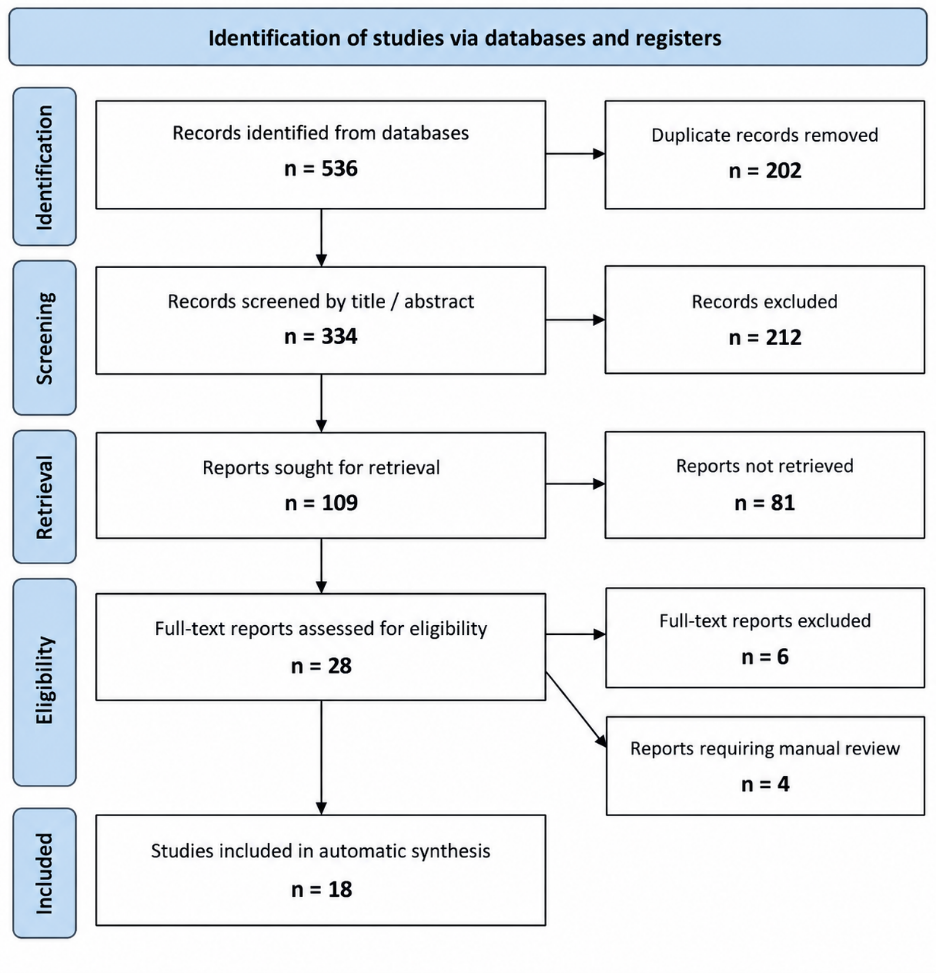
Objective: To systematically review peer-reviewed studies that integrate computational methods with netnographic or digital ethnographic interpretation, and to derive a methodological framework that preserves thick description and cultural sensitivity at computational scale. Methods: We searched Scopus, Web of Science, and Semantic Scholar (2020–2026) using multilingual queries combining netnographic and digital-ethnographic terms with computational-method terms; the same query set was run against OpenAlex, which returned no standard-search records and contributed enrichment records only. After deduplication, 334 unique records were screened at title and abstract, 109 were sought for retrieval, 28 were assessed at full text, and 18 studies met all eligibility criteria and were synthesized. Quality appraisal addressed research-question clarity, data-collection adequacy, pipeline transparency, ethnographic immersion, reflexivity, ethical safeguards, and reporting of limitations; appraisal outcomes are summarized in the evidence synthesis. Results: The 18 included studies span health, political communication, cultural heritage, fan and gaming communities, journalism, archaeology, and methodological/clinical contexts. Three integration archetypes recurred: sequential designs in which computational mapping precedes or follows immersion; convergent designs in which computational and ethnographic strands are conducted in parallel and triangulated; and embedded designs in which computational outputs feed directly into interpretive work. A fourth pattern, tool-testing, recurred as a validation configuration in which computational tools are benchmarked within a netnographic frame. Validation was most credible when computational outputs were cross-checked against human coding or contextual knowledge; member feedback was rarely reported. Reporting of reflexivity and situated researcher involvement was uneven, and ethical safeguards were rarely reported in operational detail. We propose the SCRIPTS framework (Scope, Compute, Reflect, Interpret, Position, Test, Situate) as a heuristic for configuring computationally assisted netnography. Conclusions: Computational netnography is an emerging but heterogeneous methodological space rather than a settled paradigm. Its credibility depends on deliberate articulation between algorithmic scale and interpretive depth, sustained researcher involvement, transparent pipelines, and explicit ethical reasoning. Evidence remains limited to 18 studies, so the framework is offered as a provisional synthesis of current practice and a research agenda, not a prescriptive standard.
Keywords
netnography, digital ethnography, natural language processing, large language models, qualitative validation, computational social science
INTRODUCTION
Netnography and related digital-ethnographic traditions are characterized by interpretive commitments: sustained immersion, attention to participant meaning, contextualization of cultural practices, and thick description.(1) Digital and virtual ethnography extended this project to platforms, apps, and data infrastructures, while retaining the premise that understanding culture online requires more than counting what is visible.(2) The premise is increasingly contested by the sheer volume and heterogeneity of digital traces, which invite automation as a practical necessity rather than a theoretical preference.
The tension between scale and depth is the central methodological problem of this review. Computational methods promise breadth, consistency, and reproducibility; ethnographic interpretation promises context, reflexivity, and sensitivity to meaning. Treating these as alternatives produces two failure modes. Purely computational social-media mining yields patterns without cultural interpretation, while purely manual netnography faces practical limits when digital traces reach millions of items (3) or hundreds of thousands.(4) The review question is therefore integration-focused rather than tool-focused: How do studies from 2020 to 2026 integrate computational methods with netnographic or digital ethnographic immersion, contextual interpretation, participant meaning, reflexivity, and qualitative validation?
This review contributes to that question in three ways. First, it maps the empirical and methodological literature from 2020 to 2026 that explicitly positions itself within netnographic or digital-ethnographic traditions while deploying at least one computational method. Second, it compares data pipelines, integration mechanisms, validation procedures, researcher involvement, and ethical safeguards across studies. Third, it derives a framework for preserving thick description and cultural sensitivity at computational scale, while stating its evidentiary boundaries plainly.
The review is reported as a systematic, matrix-first synthesis. It distinguishes core included studies from supporting literature, uses tables to hold dense evidence, and keeps prose interpretive rather than repeating table cells. Its claims are bounded by the 18-study core and by the unequal retrieval reported in the Methods.
METHODS
The review followed a systematic protocol operationalized in the review workflow; no external registration number was assigned for this run. Reporting below distinguishes successful database searches from manual bibliographic imports; no manual RIS imports occurred in this run. Publication language was unrestricted, and no language-based eligibility exclusion was applied.
Eligibility, screening, and quality appraisal
Eligible studies were peer-reviewed empirical or methodological works published between 2020 and 2026 that explicitly used netnography, digital ethnography, virtual ethnography, online ethnography, cyberethnography, or a closely equivalent term, combined with at least one computational method, and that showed evidence of articulating computational scale with ethnographic interpretation.
Pure computational social-media mining, purely conceptual netnographic work, dashboard analytics without cultural interpretation, tool-development studies without ethnographic application, editorials, non-peer-reviewed preprints, standalone reviews, and inaccessible full texts were excluded. Screening proceeded from 334 title and abstract records to 212 exclusions, 13 uncertain records resolved at a second pass, 109 reports sought for retrieval, 81 not retrieved, 28 assessed at full text, 6 excluded at full text, 4 flagged uncertain, and 18 studies assessed and included. Manual bibliographic imports contributed zero records.
Each included study was appraised against seven criteria adapted for methodological reviews: clarity of the research question, adequacy of data collection, transparency of the computational pipeline, evidence of ethnographic immersion, reflexivity, ethical safeguards, and reporting of limitations. Appraisal informed the Limitations Matrix and the confidence ratings reported in the core library.
The appraisal was used to weight claims, not to exclude studies, because heterogeneity in reporting made binary quality thresholds inappropriate. Appraisal outcomes are summarized by criterion in the Results rather than collapsed into a single quality score.
RESULTS
Descriptive overview
The 18 included studies were published between 2021 and 2026 and span health and mental health, political communication, cultural heritage and tourism, fan and gaming communities, journalism studies, archaeology, clinical psychiatry, and methodological reflection. Study designs ranged from single-case comparative designs and protocols to sequential explanatory mixed-methods designs and methodological proposals illustrated with empirical findings. Computational methods included Latent Dirichlet Allocation,(4-7) BERTopic transformer-embedding topic modeling,(8) transformer-based sentiment models such as BERT/ALBERT and RoBERTa,(8,9) social network analysis,(3,10-13) computer vision,(14) supervised machine learning,(6,15) and semantic tagging.(14) Studies in the table below are ordered by year of publication.
Appraisal outcomes across the 18 studies were uneven by criterion. Research-question clarity was consistently adequate. Data-collection adequacy varied with corpus size and access, from 47 tweets (14) to millions of posts.(3) Pipeline transparency was strongest where model parameters, thresholds, and validation statistics were reported.(5,8,15) Ethnographic immersion ranged from extended participant observation (2,13) to non-participatory archival observation.(8) Reflexivity was explicit in some studies (5,11,16) and implicit or absent in others. Ethical safeguards were reported in operational detail in a minority.(5,12,17) Limitations reporting was present in most studies but absent or thin in a minority. No study was excluded on appraisal grounds.
Study | Year | Design | Computational methods | Data sources / sample | Computational validation | Reflexivity reported | Ethical safeguards |
|---|---|---|---|---|---|---|---|
Brandt (4) | 2024 | Computational ethnography / cultural analysis | SNA, weighted log odds, LDA | 1,025–752,815 tweets; 395–455,344 actors | Asymmetric small-vs-large comparison | Yes; local meaning sensibility | Not detailed |
De La Fuente Prieto & Perez Herranz (17) | 2026 | Comparative mixed methods | Content-flow analysis, thematic patterns | TikTok (6 profiles) and Nostr (6 users); Jan–Jun 2025 | Manual validation of heuristics | Stated limitations | Ethics committee approval; AoIR 3.0 |
Delatin Rodrigues et al.(10) | 2026 | Single-case comparative study | Event-based SNA (UCINET) | 8 interviews; two contentious periods; Civitavecchia | Qualitative triangulation of relational evidence | Acknowledged limitations | Not detailed |
Fan & Kawashima (8) | 2026 | Mixed methods: digital ethnography + NLP | BERTopic, RoBERTa sentiment, engagement metric | 5,626 posts; 114,019 comments; 166 threads | Cohen's kappa (0.752 humans; 0.653/0.641 model–human) | Non-participatory observation described | Platform-based |
Flores-Merida et al.(3) | 2026 | SNA + data mining + digital ethnography | SNA, k-core filtering | 2.5 million tweets; 66,984 nodes; 127,126 edges | Manual coding of top-1,000 hashtags | Implicit | Public platform data |
Gibson et al.(16) | 2024 | Grounded theory + netnographic NLP | LIWC-22 automated content analysis | 570 FB practitioners; 12 focus groups; 20 interviews | Kruskal-Wallis tests; qualitative constant comparison | Yes; pragmatic dialectical pluralism | AoIR-informed; ethics debate acknowledged |
Ginzarly et al.(15) | 2022 | Mixed-method digital ethnography + ML | Text mining, autocoding, Random Forest | 2,230 TripAdvisor reviews (Byblos, Baalbek) | 25% manual coding to train autocoder; 88% model accuracy; SMOTE | Not detailed | Anonymization by prefix codes |
Hardy (12) | 2021 | Netnographic OSINT + SNA | Open-source intelligence queries, coding | 243 artefact-hunters in region; 84 communities; 41 external hunters | Manual validation of heuristics; anonymization | Implicit in methodological caution | Anonymization of identities; image adaptation |
Jatmika et al.(9) | 2026 | Sequential explanatory mixed methods | BERT/ALBERT sentiment, collocational analysis | 4,950 Instagram comments; April 2025 | Collocational correlation with sentiment (ρ = 0.94) | Limited | Public accounts only |
Jussila et al.(14) | 2021 | Case study: netnography + content + computational semantic analysis | ML-based computer vision, semantic tagging (Ontotext) | Twitter campaign; 47 tweets with photos | Accuracy benchmarks (images 96%, text 91%, Ontotext 50%) | Conflict of interest disclosed | Not reported |
Kavvadias et al.(5) | 2026 | Computational-qualitative mixed methods | LDA, VADER, NRC lexicons | 22,459 texts; 7,135 users; r/StopGaming | Two independent blinded researchers; coherence/perplexity | Yes; reflexive notes, peer debrief | AoIR 2019 guidelines; de-identification |
Li & Cassany (2) | 2023 | Virtual ethnography, mixed data collection | Web scraping, screencasts | 8 fans; NetEase Cloud Music; one in-depth case | Triangulation across interviews, scraping, chats, field notes | Positionality stated | Platform-based observation |
Reißmann et al.(11) | 2022 | Three-stage sequential mixed-methods proposal | SNA, standardized actor/practice coding | Twitter discourses (#systemrelevant, #CoronaEltern) | Integration of quantitative findings as elicitation material in interviews | Yes; high reflexivity demand stated | Not reported |
Schuler-Costa (13) | 2021 | Single-case digital ethnography (participant observation 2013–2015) | Data mining, SNA (Eigenvector centrality, modularity) | Twitter; 43 seed profiles: 23,573 nodes, 49,667 edges | Qualitative comparison of modularity output with ethnographic community knowledge | Yes; subjectivism of seed selection and community detection discussed | Not reported |
Sikstrom et al.(6) | 2023 | Protocol: computational ethnography | LDA, sentiment, transformers/LLMs, classifiers | EHR data; emergency psychiatry, CAMH Toronto | 10-fold cross-validation planned | Planned participant observation and interviews | Ethics protocol; bias focus |
Tang & Li (7) | 2026 | Mixed methods | LDA, correlation, five-point emotional coding | 25 interviewees; crawled comments | Perplexity, Topic_diversity@15, [email protected] | Partially stated | Not detailed |
Yuan et al.(19) | 2026 | Sequential explanatory mixed methods | PLS-SEM | Survey 607; interviews 30; 68 dialogues | Integration of survey, interview, ethnographic strands | Not detailed | Platform-based observations |
Трегубова et al.(18) | 2021 | Methodological reflection on multi-method project | Network analysis, content analysis | 23 VKontakte groups; six languages; 2019–2020 | Manual review of posts; comment-threshold filtering | Yes; division of labour between humans and algorithms | Not detailed |
Integration mechanisms and data pipelines
The included studies organize computational and ethnographic work in three recurring ways. Sequential designs order the strands so that one informs the other. Reißmann et al. formalize a three-stage sequence in which network analysis zooms out, standardized practice coding identifies supra-individual patterns, and qualitative case studies zoom in, with quantitative findings deliberately used as elicitation material in interviews.(11) Yuan et al. similarly cascade from survey modelling to interviews to digital ethnography, allowing naturalistic observation to contextualize and challenge statistical findings.(19) Brandt's asymmetric comparison design operates sequentially in a different register, comparing small and large datasets to preserve sensitivity to local meaning while scaling up.(4)
Convergent designs run strands in parallel and triangulate at interpretation. Delatin Rodrigues et al. treat event-based SNA as a structural map and qualitative materials as the interpretation of meaning, strategic intent, and mechanism, explicitly stating that SNA is not self-sufficient and that tie frequency is not equivalent to influence.(10) Gibson et al. combine grounded theory with netnographic NLP so that the constant-comparative qualitative analysis and LIWC-22 automated content analysis mutually inform each other.(16) Ginzarly et al. interleave digital ethnography with machine learning, using text mining to generate a codebook that is then manually anchored before automated coding is extended to the full corpus.(15)
Embedded designs put computational outputs inside the interpretive loop. Fan and Kawashima use BERTopic and RoBERTa sentiment to identify non-aesthetic themes whose "stickiness" is then explained through ethnographic attention to affective circulation and platform governance.(8) Kavvadias et al. map LDA topics to stages of change through blinded qualitative coding, so that the computational topic solution becomes an object of ethnographic and theoretical interpretation rather than a finding in itself.(5) Sikstrom et al. outline an embedded design in which machine-learning modelling of electronic health records is studied ethnographically, treating the model as a socio-technical object within clinical practice.(6)
Table 2 also includes a fourth pattern, tool-testing, which recurred in two studies.(9,14) We treat tool-testing as a validation configuration rather than an integration mechanism: in these studies, computational tools are benchmarked against accuracy or correlation criteria within a netnographic frame, but the ethnographic strand does not substantially reshape the computational pipeline.
Table 2. Evidence matrix of integration mechanisms and quality features
Integration archetype | Computational role | Ethnographic role | Validation logic | Principal strength | Principal weakness |
|---|---|---|---|---|---|
Sequential (4,11,19) | Mapping, zooming out, generating elicitation material | Zooming in, contextualizing, explaining | Quantitative findings recontextualized in interviews and cases | Clear division of labour; reflexive sequencing | Risk of treating one strand as merely preparatory |
Convergent (10,15,16) | Structural mapping, automated content coding | Meaning, intent, mechanism interpretation | Triangulation across strands; human coding anchors | Mutual correction of strands | Resource-intensive; integration rarely fully specified |
Embedded (5,6,8) | Topic discovery, sentiment, prediction | Interpretation of themes, model-as-object study | Human coding, kappa, blinded coding, theoretical mapping | Strong interpretive accountability | Depends on scarce dual competence |
Tool-testing (9,14) | Classification, semantic tagging, collocation | Netnographic framing of results | Accuracy benchmarks; correlation with sentiment | Transparent accuracy reporting | Small corpora; metaphor-level claims |
Immersion, validation, and ethics
Immersion was most credible where researchers described long-term engagement with the field rather than one-off scraping. Schuler-Costa's two-year participant observation on Twitter underpins the argument that the analysis is meaningful because of long-term qualitative engagement, and that the same computational output would be far less interpretable without it.(13) Li and Cassany similarly ground their computational data collection in extended virtual ethnography, using scraping, screencasts, and follow-up chats as complements to immersion rather than substitutes for it.(2) Hardy's netnographic open-source intelligence study codes 243 artefact-hunters and 84 communities within a broader interpretive frame about illicit markets and local political economy.(12)
Reflexivity was reported unevenly. Kavvadias et al. document blinded coding, reflexive notes, memoing, and peer debrief as instruments for keeping interpretation accountable.(5) Gibson et al. anchor the study in pragmatic dialectical pluralism and treat reflexivity as a philosophical commitment rather than a procedural box-tick.(16) Reißmann et al. state that combining fundamentally different methods demands high reflexivity across and within methods, and they build that demand into the design.(11) By contrast, several otherwise strong studies report reflexivity only implicitly, and some do not discuss the researcher's position at all.
Contextual interpretation frequently concerned what computation cannot see. Delatin Rodrigues et al. characterize relational evidence qualitatively after computing structural measures, precisely because centrality does not explain why deactivation succeeded when destabilization was brokered into institutional arenas.(10) Fan and Kawashima interpret thematic stickiness and affective circulation against platform-specific governance, noting that the platform's chronological bumping mechanism rather than an algorithmic feed governs visibility.(8) Flores-Merida et al. show that differential visibility of slain journalists in digital conversation tracks professional trajectory, national-media ties, and guild centrality, an interpretation that network structure alone would not supply.(3) Tang and Li note that many comment scores clustered at the midpoint of their scale, which narrows correlations and requires netnographic reading to explain.(7)
Four validation strategies recur. The first is human coding against computational output, most explicitly in Fan and Kawashima, who report a Cohen's kappa of 0.752 between two human coders and 0.653 and 0.641 between model and coders, making the gap between human agreement and model–human agreement a first-class result.(8) The second is theoretical mapping, as in Kavvadias et al.'s alignment of LDA topics with stages of change, which showed that topics bridged stages rather than locking onto them.(5) The third is triangulation across methods: Delatin Rodrigues et al. triangulate SNA with interviews, documentary sources, digital ethnography, and archives,(10) and Ginzarly et al. use manual coding to train an autocoder before extending it.(15) The fourth is statistical or benchmark validation of the computational step itself, as in Jussila et al.'s accuracy comparison of image analysis, text analysis, and semantic tagging (14) and Jatmika et al.'s correlation of collocational patterns with sentiment distributions.(9)
Trustworthiness was rarely addressed through the vocabulary of qualitative rigor. Where it appears, it is translated into concrete procedures: blinded coders, audit trails, de-identification, member-checking-like feedback, and explicit statements of arbitrariness. Schuler-Costa's insistence that using a computational method does not make analysis less subjective, and that community detection is inevitably arbitrary, is the sharpest statement of this position in the corpus.(13) Brandt similarly argues that qualitative ideas can be built into quantitative work to preserve local meaning in abstract datasets.(4)
Researcher involvement ranged from sustained participation to non-participatory observation at a distance. Li and Cassany describe prolonged immersion with a single participant studied in depth alongside eight interviewed fans.(2) Fan and Kawashima describe non-participatory digital ethnography with systematic archival capture over eight months.(8) Yuan et al. conduct digital ethnography of 68 patient–physician dialogues after a survey and interviews, positioning ethnography as the naturalistic stage that explains the quantitative and interview findings.(19) Sikstrom et al. position participant observation alongside model development so that the model itself is studied as an ethnographic object.(6)
Ethical reporting was the weakest area. De La Fuente Prieto and Perez Herranz report ethics committee approval and compliance with AoIR 3.0,(17) and Kavvadias et al. follow AoIR 2019 guidance with de-identification and an audit trail.(5) Gibson et al. explicitly discuss disagreement about Facebook research ethics, including ownership, traceability, informed consent, and non-consensual identity disclosure.(16) Hardy anonymizes and adapts images to obstruct reverse image searching.(12) Beyond these, however, most studies report no consent procedure, no data-minimization rationale, and no platform-governance considerations. Sikstrom et al. foreground bias and intersectional fairness in model design,(6) and Трегубова et al. theorize a division of labour between researchers and algorithms,(18) but these are exceptions in a corpus where the typical ethics statement is absent rather than incomplete.
Table 3. Limitations matrix by domain
Limitation domain | Frequently reported | Occasionally reported | Rarely or never reported |
|---|---|---|---|
Sampling and representativeness | Platform-specific samples (5,7-9); self-selection of vocal users (7); linguistic/cultural scope (7) | Underrepresentation of older or less digital users (19); keyword limitations (17) | Probability sampling in platform studies |
Computational pipeline | Simple or basic procedures used (4); arbitrariness of thresholds and seeds (13); ontology tagging failures (14) | Multilingual preprocessing difficulties (15); model bias (6) | Full pipeline reproducibility packages |
Interpretation and validation | Human–model agreement gaps (8); qualitative limits of comment data (7) | Conflicting mean vs. median interpretations (16) | Formal trustworthiness audits |
Temporality | Single-month snapshot (9); cross-sectional design (19); limited time frame (17) | No longitudinal validation of models (7) | Longitudinal computational-ethnographic designs |
Ethics and reflexivity | General ethics debate about platform data (16); anonymization (12) | Ethics approval and AoIR compliance (5,17) | Consent, data minimization, platform governance details |
DISCUSSION
The review's central finding is that integration is not achieved by adding a computational method to an ethnographic study or vice versa; it is achieved by configuring a division of interpretive labour in which each strand does work the other cannot. The clearest examples are explicit about this asymmetry. Delatin Rodrigues et al. state that SNA maps relational structure while qualitative materials interpret meaning and mechanism.(10) Schuler-Costa argues that computational methods are tools in a toolbox, meaningful only because of long-term qualitative engagement, and that neither approach is inherently superior.(13) This position is consistent with the supporting literature. Ophir et al. argue that unsupervised machine learning and grounded theory ethnography are epistemologically well-suited for collaboration, and that mutual reflexivity across computational and ethnographic researchers affects every stage of a study.(20) Barkhatova similarly proposes that computational analysis of digital traces complements qualitative understanding in online ethnography, with research questions as the point of intersection.(21)
The review also shows that validation is where integration most often fails. Reporting kappa coefficients for model–human agreement (8) is more informative than reporting accuracy alone, because it exposes the interpretive gap that remains after computation. Where studies validate only the computational step, as in accuracy benchmarks for image, text, and ontology tagging,(14) the reader learns about the tool but not about the cultural adequacy of the interpretation. The supporting literature reinforces this concern. Del Vecchio et al. propose an integrated netnography-plus-business-analytics framework that treats customer knowledge as knowledge for, from, and about customers, which is precisely a claim about interpretive categories rather than classifier performance.(22) Cheah's framework for AI-augmented netnography makes the same point normatively, arguing that AI-driven pattern recognition must be paired with human interpretive oversight to capture cultural nuances.(1) The core studies that come closest to this standard are those where human coding anchors or challenges the model rather than confirming it.(5,15)
A third pattern concerns platform mediation. Several studies show that computational results are shaped by platform affordances and governance as much as by the cultural phenomenon under study. De La Fuente Prieto and Perez Herranz demonstrate that differences between TikTok and Nostr are infrastructural, shaping what becomes visible and which forms of participation are possible.(17) Трегубова et al. describe a division of labour between humans and algorithms at every research stage and identify three types of algorithms according to their role.(18) Jatmika et al. find within-sentiment replies outnumbering cross-sentiment replies by 20 to 1, a structural feature of the platform conversation that constrains what any amount of sentiment classification can conclude about deliberation.(9) The supporting literature extends this to infrastructural meaning-making: Sacco and Graziano show how platform logics reshape symbolic hierarchies in a music subculture, and Venäläinen shows how machine-generated clusters participate in reframing aesthetic sensibilities.(23,24)
The review found limited evidence on large language models. Sikstrom et al. plan transformer-based large language models within a computational ethnography of psychiatric risk prediction,(6) and Kavvadias et al. recommend BERT or fine-tuned LLMs as a future direction for detecting subtler linguistic cues.(5) The supporting literature is similarly programmatic: Cheah's framework addresses AI-augmented netnography in general terms.(1) Within this corpus and the searches reported here, there is at present no core study that reports a full LLM-based netnographic pipeline with documented validation, which is a substantive gap rather than an omission of the review.
Ethical safeguards were the least developed area. Where they are reported, they tend to be procedural (ethics committee approval, AoIR compliance, de-identification) rather than substantive (consent models for semi-public communities, data minimization, platform governance, treatment of inferred sensitive attributes). Gibson et al. show that these are live disagreements rather than settled questions,(16) and Cheah's framework proposes consent, data minimization, bias mitigation, and accountability as core requirements.(1) The core corpus supports the diagnosis but does not yet supply the remedies.
From these patterns we derive a heuristic framework for computationally assisted netnography, summarized as SCRIPTS: Scope the field interpretively before computing; Compute with methods chosen for the interpretive question; Reflect on the division of labour between researchers and algorithms; Interpret computational outputs against contextual and participant meaning; Position the researcher and the platform in the account; Test computational outputs against human coding, member perspectives, or contextual knowledge; and Situate findings within platform governance and cultural specificity. The framework is a synthesis of practices observed in the included studies rather than an empirically validated instrument, and it should be treated as a research agenda.
CONCLUSIONS
Computational netnography is best understood as a configured practice rather than a method label. The studies show that scale and ethnographic depth can be articulated through sequential, convergent, or embedded designs, provided that the division of interpretive labour is explicit, that computational outputs are tested against human or contextual knowledge rather than assumed valid, that researchers remain accountable for positionality and platform mediation, and that ethics are addressed as substantive questions about consent, minimization, and governance. We offer the SCRIPTS heuristic as a provisional orientation for designing and appraising computational netnographic work. Its status is provisional: the evidence base is small, geographically and linguistically uneven, and thin on large language models and multimodal data. Future research should report model–human agreement alongside accuracy, document full pipelines and ethical reasoning, extend beyond single platforms and snapshots, and test the framework empirically rather than assuming it holds.
References
- 1 Cheah CW. AI-Augmented Netnography: Ethical and Methodological Frameworks for Responsible Digital Research. International Journal of Qualitative Methods. 2025;24. doi: 10.1177/16094069251338910..
- 2 Li YC, Cassany D. Informal learning of Spanish in a Chinese music fan community. El Profesional de la información. 2023. doi: 10.3145/epi.2023.nov.05..
- 3 Flores-Mérida A, Ramos-Rojas DN, Martínez-Mendoza S. Violencia contra periodistas en México y la conversación digital en Twitter/X: implicaciones para visibilizar la vulnerabilidad del ejercicio periodístico. Revista Latina de Comunicación Social. 2026. doi: 10.4185/rlcs-2026-2524..
- 4 Brandt P. Data science's cultural construction: qualitative ideas for quantitative work. Frontiers in Big Data. 2024;7. doi: 10.3389/fdata.2024.1287442..
- 5 Kavvadias S, Schivinski B, Arachchilage N, Brown T, Stavropoulos V. Language of change in online narratives of recovery from disordered gaming. Scientific Reports. 2026;16(1). doi: 10.1038/s41598-025-33991-8..
- 6 Sikstrom L, Maslej MM, Findlay Z, Strudwick G, Hui K, Zaheer J, et al. Predictive care: a protocol for a computational ethnographic approach to building fair models of inpatient violence in emergency psychiatry. BMJ Open. 2023;13(4):e069255. doi: 10.1136/bmjopen-2022-069255..
- 7 QinLi T, Li L. Exploring emotional experience and word-of-mouth mechanisms in male-oriented live-action interactive romance games: a mixed-methods empirical study. Frontiers in Psychology. 2026;17. doi: 10.3389/fpsyg.2026.1849923..
- 8 Fan S, Kawashima K. Becomings beyond the ideal: women's fitness and digital subjectivities in the Douban women's fitness community. Frontiers in Sports and Active Living. 2026;8. doi: 10.3389/fspor.2026.1786979..
- 9 Nurhadi J, Lushinta IP, Wulandari D, Tabga Y, Fitria S, Sudaryat Y. Cognitive, discursive mechanisms of digital democracy in Indonesia: from sentiment to ideology. Frontiers in Political Science. 2026;8. doi: 10.3389/fpos.2026.1721896..
- 10 Delatin Rodrigues D, Calignano G, Grasso M. From destabilisation to disruption: deactivation network dynamics in an Italian fossil infrastructure conflict. Geographica Helvetica. 2026;81(2):347-360. doi: 10.5194/gh-81-347-2026..
- 11 Reißmann W, Siemon M, Lünenborg M, Raetzsch C. Praxisprofile als mixed-methods Ansatz zur Analyse performativer Öffentlichkeiten: Vorschlag für eine relationale Journalismusforschung. Studies in Communication Sciences. 2022;22(1). doi: 10.24434/j.scoms.2022.01.3057..
- 12 Hardy SA. It Is Not against the Law, if No-One Can See You: Online Social Organisation of Artefact-Hunting in Former Yugoslavia. Journal of Computer Applications in Archaeology. 2021;4(1):169-187. doi: 10.5334/jcaa.76..
- 13 Schüler-Costa V. A case study on the usage of social network analysis to complement participant observation on Twitter. Simbiótica Revista Eletrônica. 2022;8(4):71-93. doi: 10.47456/simbitica.v8i4.37347..
- 14 Jussila J, Alkhammash E, Saleh Alghamdi N, Madhala P, Ayoub Khan M. A Netnographic-Based Semantic Analysis of Tweet Contents for Stress Management. Computers, Materials & Continua. 2022;70(1):1845-1856. doi: 10.32604/cmc.2022.017284..
- 15 Ginzarly M, Srour FJ, Roders AP. The Interplay of Context, Experience, and Emotion at World Heritage Sites: a Qualitative and Machine Learning Approach. Tourism Culture & Communication. 2022;22(4):321-340. doi: 10.3727/109830421x16345418234065..
- 16 Gibson J, Oxtoby C, Brennan ML, White K. Understanding veterinary practitioners’ responses to adverse events using a combined grounded theory and netnographic natural language processing approach. PLOS ONE. 2024;19(12):e0314081. doi: 10.1371/journal.pone.0314081..
- 17 de la Fuente Prieto J, Pérez Herranz C. Comparative analysis of digital practices related to cultural heritage on TikTok and Nostr. Frontiers in Computer Science. 2026;8. doi: 10.3389/fcomp.2026.1748070..
- 18 Трегубова, Ни, Китаева. Транснационализм в режиме онлайн: миграционные исследования в условиях искусственной социальности. The monitoring of public opinion economic&social changes. 2021. doi: 10.14515/monitoring.2021.1.1821..
- 19 Yuan X, Jin Q, Tang Y, Xu J. How Does Generative AI Reshape Chinese Patients’ Perceptions of Medical Authority?. Media and Communication. 2026;14. doi: 10.17645/mac.11485..
- 20 Ophir Y, Walter D, Marchant ER. A Collaborative Way of Knowing: Bridging Computational Communication Research and Grounded Theory Ethnography. Journal of Communication. 2020;70(3):447-472. doi: 10.1093/joc/jqaa013..
- 21 Barkhatova LA. The computational analysis of digital traces in ethnographic studies of online communities. Bulletin of Sociological Methodology/Bulletin de Méthodologie Sociologique. 2023;160(1):30-56. doi: 10.1177/07591063231196161..
- 22 Del Vecchio P, Mele G, Passiante G, Vrontis D, Fanuli C. Detecting customers knowledge from social media big data: toward an integrated methodological framework based on netnography and business analytics. Journal of Knowledge Management. 2020;24(4):799-821. doi: 10.1108/jkm-11-2019-0637..
- 23 Venäläinen J. Algorithmic Landscapes of Finnish Nature. Ethnologia Fennica. 2025;52(1):8-34. doi: 10.23991/ef.146712..
- 24 Sacco D, Graziano R. Thick description interpretation of cultures in music lyrics from the Italian outskirts. Quality & Quantity. 2026. doi: 10.1007/s11135-026-02830-x..
Declarations
Funding
This research received no specific grant from any funding agency in the public, commercial, or not-for-profit sectors.
Conflict of interest
The authors declare no conflict of interest.
Authorship contributions
Drafting – original draft: Rómulo Esteban Montilla.
Writing–review and editing: Rómulo Esteban Montilla.