

Abstract
Background: Netnography and digital ethnography increasingly unfold across public, semi-public, and private platform spaces whose affordances, terms of service, and algorithmic structures evolve rapidly. The growing use of AI-assisted analysis of human-generated digital data introduces additional ethical challenges related to privacy, consent, identifiability, and analytical transparency. Objective: To synthesise how netnographic and digital ethnographic studies published between 2020 and 2026 conceptualise, justify, and operationalise ethical decision-making, and to derive a cross-disciplinary decision framework. Methods: A systematic review of netnographic and digital ethnographic research was conducted using major multidisciplinary academic databases and scholarly discovery platforms. Eligible studies published between 2020 and 2026 were screened and assessed according to predefined criteria. Thirty-one studies were included in the final synthesis. Findings were synthesised by research subquestion and mapped across six dimensions: platform visibility, community expectation, data sensitivity, identifiability, researcher interaction, and analytical technology. Results: Ethical practice was predominantly processual and context-dependent rather than based on fixed rules. Consent was negotiated in different ways according to platform context and research design, while privacy was generally understood as a spectrum shaped by access barriers, community expectations, and the sensitivity of the data rather than as a simple public-private distinction. Anonymisation was consistently attempted but remained inherently limited: strategies such as paraphrasing, translation, composite accounts, and image transformation reduced, but did not eliminate, searchability and re-identification risks. Vulnerability and researcher visibility received comparatively explicit attention, whereas data storage, platform terms, and AI-assisted analysis were less consistently reported. In particular, disclosure of automated analytical procedures remained limited. Conclusions: The review proposes a layered framework that maps ethical obligations across platform visibility, community expectation, data sensitivity, identifiability, researcher interaction, and analytical technology. The framework is descriptive rather than validated, and the evidence supporting its automation-related dimension remains comparatively limited because of sparse procedural reporting. Overall, the principal gap identified concerns the consistent and transparent reporting of ethical practices rather than the absence of ethical principles.
Keywords
netnography, digital ethnography, research ethics, informed consent, anonymisation and re-identification, AI-assisted analysis
INTRODUCTION
Netnography and digital ethnography have moved from open forums and newsgroups into an environment of authenticated accounts, invitation-only groups, encrypted messaging, image-saturated platforms and recommender systems, and this relocation has unsettled the ethical common sense of the field.
Where an early generation of internet-research guidance could treat "publicly accessible" as a workable proxy for "ethically available", contemporary platform environments fragment visibility into graded conditions: searchability, algorithmic distribution, group membership rules, questionnaire-gated admission, and the persistence of deleted material in caches and third-party archives.
The data themselves have become more identifiably personal, since users increasingly post under real names and provide searchable, personally identifiable information, and reverse image searching and doxxing tools make almost anyone "unmaskable" online.(1) Research communities have responded with domain-specific guidance and with repeated calls for situated, context-sensitive judgement, but how contemporary studies actually decide, not merely what they declare, remains unevenly documented.
Existing scholarship already offers partial maps of this terrain, and the present review is designed to build on rather than duplicate them. Conceptual proposals such as the 4A model for netnographic ethics organise decisions around researcher disclosure, anonymity, consent and the nature of the online environment,(2) while broader digital-research ethics syntheses treat public–private boundaries, informed consent, anonymity and re-identification, data reuse and algorithmic accountability as an interconnected lifecycle rather than a sequence of separate approvals.(3)
Adjacent reviews have examined ethical practice in specific populations, and their findings differ in kind rather than converging on a single verdict. A scoping review of seven military online ethnographies found that most did not use sufficient ethical safeguards and did not document or transparently disclose the steps they took.(4)
A systematic review of 62 LGBTQ-focused online ethnographies maps informed consent, respect and trust, privacy and confidentiality, and data security and reuse as four ethical considerations, identifies gaps in current practice, and proposes a human-centred framework rather than reporting a finding of absent safeguards.(5) Work on digital ethnography with vulnerable consumers addresses the researcher role, data representation and the ethical considerations of researching vulnerable populations without making a claim about the presence or absence of safeguards.(6) Methodological work on AI-augmented netnography has begun to propose frameworks for responsible automation,(7) and on the public–private divide in closed, group-based or hidden spaces,(8) but these contributions are largely programmatic: they specify what ought to be done rather than reporting what netnographers do when consent cannot reach twenty thousand group members, when participants refuse the researcher's terms, or when transcription is delegated to a cloud service whose terms permit undisclosed reuse.
This review therefore asks how netnographic and digital ethnographic studies published between 2020 and 2026 conceptualise, justify and operationalise ethical decision-making in public, semi-public and private digital spaces, specifically regarding informed consent, contextual privacy, quotation and searchability, anonymisation and re-identification risk, platform terms, vulnerable groups, researcher participation, data storage and media reuse, and AI-assisted analysis of human-generated digital data.
The objective is threefold: to map how ethical requirements are reported across platform visibility, community expectation, data sensitivity, identifiability, researcher interaction and analytical technology; to document convergences, contradictions and silent gaps in current practice; and to produce a defensible cross-disciplinary decision framework for researchers, reviewers and ethics committees.
METHODS
The review followed a pre-specified protocol that fixed the review question, eligibility criteria, search concepts and planned synthesis approach before screening began. Eligibility was restricted, for the primary synthesis, to peer-reviewed journal articles, book chapters and full conference papers published between 2020 and 2026 that were netnographic, digital ethnographic, online ethnographic, virtual ethnographic or computational-ethnographic in design, or that explicitly theorised the ethics of such designs, and that addressed at least one ethical dimension in scope.
Studies were excluded from the primary synthesis if they were purely offline ethnographies, if they analysed digital data without ethnographic or interpretive engagement and without relevant ethical reflection, if ethics appeared only as a boilerplate approval statement, or if they were preprints, editorials or conference abstracts without full text. Pre-2020 seminal work and earlier domain-specific ethics reviews were used for framing only and are not counted in the synthesis. Publication language was unrestricted; methodological, regulatory and reflective papers directly informing netnographic ethical practice were eligible.
Search and study selection
Four databases were searched for the primary identification: Scopus, Web of Science, OpenAlex and Semantic Scholar. Eight concept-block queries combined method-tradition terms (netnography, digital ethnography, online ethnography, virtual ethnography, digital anthropology, online fieldwork) with ethics, consent, privacy, traceability, platform visibility, vulnerability and AI-automation blocks.
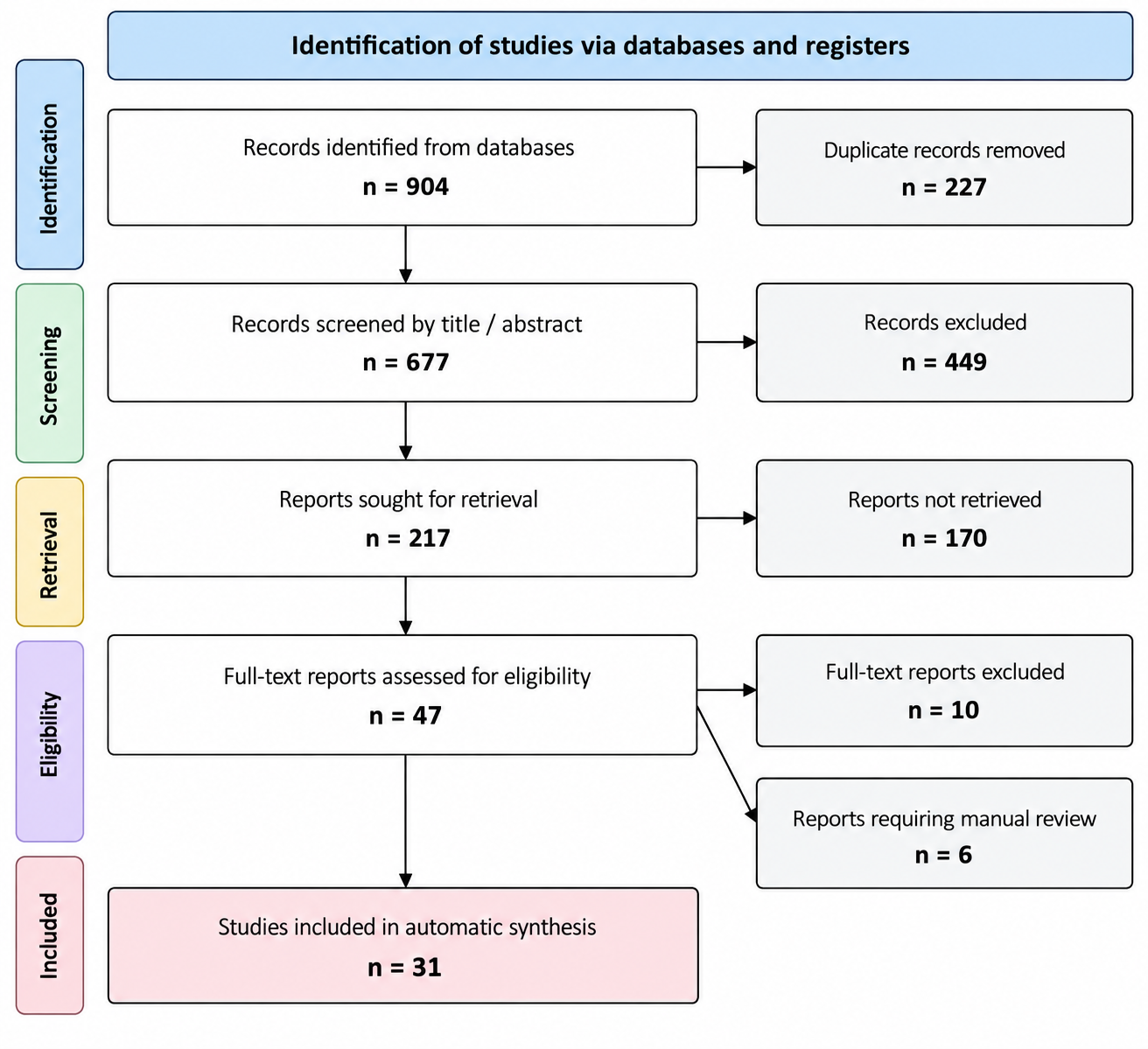
After deduplication, 677 records were screened at title and abstract, 449 were excluded at that stage, and 11 remained uncertain after a second pass. Two hundred and seventeen reports were sought for retrieval; 170 could not be obtained, most commonly because no open-access or otherwise obtainable full-text copy was available through the retrieval infrastructure, leaving 47 reports assessed for eligibility. Ten were excluded at full text and six remained uncertain after the first full-text assessment. All six uncertain reports were then resolved to exclusion on adjudication, because in each case the ethical content amounted to a boilerplate approval statement or fell outside the scope of reported ethical decision-making; no uncertain report was carried into the synthesis, so the final included set is 31 studies. All 31 were appraised from full text.
Appraisal, extraction and synthesis
Synthesis was organised by research subquestion rather than by theme list. Reported practices were coded first descriptively (consent architecture, visibility judgement, anonymisation techniques, vulnerability safeguards, participation mode, storage and platform handling, automation) and then mapped onto six analytic dimensions derived from the protocol: platform visibility and architecture; contextual integrity and context collapse; consent models; traceability and identifiability; vulnerability and power; and researcher positionality, participation and analytical technology.
Because every included study was qualitative, conceptual or methodological, no effect estimates were pooled and no quantitative meta-analysis was performed; where studies reported proportional findings from their own case material, these are attributed to the study rather than treated as pooled prevalence. The framework reported at the end of Results was constructed by comparing practices across these dimensions and should be read as an interpretive synthesis of reported decisions, not as an evaluation of their effectiveness.
RESULTS
The evidence base is methodologically homogeneous in one respect and heterogeneous in another: every study is qualitative, interpretive or conceptual, with no experimental, comparative-effectiveness or quantitative ethics designs, and yet the designs vary widely, comprising extended netnographies and digital ethnographies, reflexive and autoethnographic essays, methodological and framework papers, a narrative review of online ethnographies, a qualitative review of literature, case studies and ethics guidelines, an arts-based participatory study, and one methodological account of a computational research infrastructure. Table 1 summarises the characteristics and reported ethical dimensions of each included study.
Fieldwork durations, where reported, confirm that these are immersive rather than extractive engagements: fifteen months of online and offline fieldwork in two studies,(10,11) ten months of cross-platform participant observation,(12) six months of digital ethnographic observation,(13) four months on a single image board,(14) and two years of continuous observational netnography on a health platform.(15) Platform coverage is broad and skewed towards environments that resist automated collection: Instagram, YouTube, Facebook, WhatsApp, Telegram, TikTok, X/Twitter, an image board, and a suite of alternative platforms used by extremist communities, alongside one for-profit health platform and one podcast ecosystem. Geographic and linguistic concentration is also visible: Indonesia is the site of four studies,(13,16-18) Poland of two,(19,20) and the remainder are distributed across India, Egypt, Colombia, Cuba and its Miami diaspora, Saudi Arabia, Italy, the Netherlands, Brazil, Spain, Sri Lanka and the United States, with several conceptual or methodological papers not anchored to a single site.
Study / Year | Study design / setting | Reported ethical practices or dimensions |
|---|---|---|
Abidin & Seta (2020) (32) | Editorial/special issue introduction; confessional ethnography and self-reflection on ethnographic dilemmas Setting: Digital media and online environments; academic backchannels such as Twitter direct messages; digital ethnography field research contexts | Directly relevant: the editorial frames ethical dilemmas and discomforts of digital ethnography, discusses private messages/backchannels and confessional approaches to working through moral and ethical quandaries in digital research. |
Agudelo-Londono et al. (2024) (23) | Reflexive methodological and ethical case study of an ethnography for the Internet (digital ethnography), based on the authors' empirical research experience Setting: Digital spaces: Facebook (two closed rider groups of approximately 20,000 members each), WhatsApp, Twitter (now X), and Instagram; with complementary offline presence at rider gatherings and demonstrations in Bogotá, Colombia, during the COVID-19 pandemic (2020) | The paper directly addresses ethical decision-making in digital ethnographic research in public, semi-public and private digital spaces, reporting on informed consent procedures in closed Facebook and WhatsApp groups, non-participant observation (lurking), manual versus automated data collection constrained by platform terms, and the articulation between online and offline fieldwork. It offers reflexive evidence on contextual privacy and consent visibility that can inform a cross-disciplinary decision framework for netnographic and digital ethnographic ethics. |
Alghamdi (2021) (999) | Qualitative study using an online survey for recruitment and semi-structured interviews, with thematic analysis of interview transcripts Setting: Educational research involving social media as a data source; recruitment conducted online via the author's social networks (WhatsApp and Twitter) | The study directly addresses ethical decision-making in digital/social media research, including informed consent (obtaining consent from students and teachers), contextual privacy (distinguishing private data such as usernames, phone numbers and email addresses from open data such as public tweets or open YouTube comments; identifying type and level of privacy), platform terms/permissions (assumptions about permission to access open platform data versus formal permission from the learning group host or all members), vulnerable/gatekept groups (students and teachers in learning groups), researcher participation (outside observer versus involved researcher), data storage/collection and analysis practices (automated versus manual data collection, data cleaning, sampling interactions over one to three months, using private or secure spaces), and analysis of human-generated digital data including digital icons (emojis, capital letters, links) which relates to AI-assisted or tool-based analysis of human digital traces. |
AlThiyabi & Borthwick (2025) (12) | Estudio etnográfico interpretativo, cualitativo, de etnografía digital multiplataforma, con observación participante sostenida, entrevistas semiestructuradas y entrevistas de recuerdo estimulado; análisis temático guiado por los principios sociolingüísticos de Bucholtz y Hall (2005). Setting: Arabia Saudita; plataformas de redes sociales como LinkedIn, X (antes Twitter), YouTube, Instagram, TikTok, WhatsApp, Telegram, Jako y Threads. | El estudio aborda directamente las dimensiones éticas clave de la revisión: consentimiento informado iterativo, privacidad contextual, cotización y búsqueda, anonimización y riesgo de reidentificación, términos de plataforma, grupos vulnerables, participación del investigador, almacenamiento y reutilización de datos, y análisis asistido por IA de datos digitales humanos. Propone un marco de ética relacional con principios operativos para la toma de decisiones éticas en espacios digitales públicos, semipúblicos y privados en etnografía digital multiplataforma. |
Barkhatova (2021) (27) | Revisión narrativa de estudios de etnografía en línea (revisión metodológica de casos) Setting: Entornos en línea (comunidades, blogs, sitios web, redes sociales) y, en su caso, contextos fuera de línea; se incluyen ejemplos de estudios en Brasil, Reino Unido y Rusia. | El artículo aborda directamente la conceptualización y operacionalización de decisiones éticas en etnografía en línea (consentimiento informado, privacidad contextual, citas y rastreabilidad, anonimato y riesgo de reidentificación, grupos vulnerables y uso de datos), y ofrece una distinción metodológica (etnografía multimodal vs. digital) relevante para derivar un marco de decisión interdisciplinario. |
Burkell & Regan (2021) (25) | Conceptual/argumentative paper with illustrative case examples Setting: Online discussion groups and social media contexts (public, semi-public and private; moderated and unmoderated; open and registration-required), with reference to Canadian and US research ethics contexts. | Directly addresses ethical decision-making in public, semi-public and private digital spaces, including informed consent, contextual privacy, quotation and searchability, anonymisation and re-identification risk, platform terms, vulnerable groups (youth), researcher participation, and social justice considerations; provides best practices relevant to deriving a cross-disciplinary decision framework. |
Cearns (2022) (11) | Autoetnográfico / reflexivo, basado en la experiencia de trabajo de campo etnográfico de quince meses en línea y fuera de línea Setting: Cuba y la diáspora cubana en Miami; interacciones digitales a través de Facebook, Instagram, WhatsApp y Twitter; trabajo de campo de quince meses en línea y fuera de línea. | El artículo aborda directamente la etnografía digital y la toma de decisiones éticas en espacios digitales públicos, semipúblicos y privados (Facebook, Instagram, WhatsApp, Twitter) durante 2020-2022. Aunque no trata todos los ejes de la revisión (p. ej., IA, reidentificación, términos de plataforma), ofrece evidencia conceptual y práctica sobre consentimiento, privacidad contextual, anonimato, relación investigador-participante, participación del investigador y manejo de la distancia digital, lo que puede contribuir a un marco de decisiones éticas transdisciplinar. Su enfoque en comunidades vulnerables y contextos de ilegalidad/vigilancia estatal es especialmente relevante. |
Çebi (2025) (2) | Theoretical review with conceptual interpretation Setting: Online/digital research environments (netnography); the theoretical context of scholarly literature on netnographic ethics | The paper directly addresses the review's core question by proposing a cross-cutting ethical decision framework (the 4A Model) for netnographic and digital ethnographic research, covering researcher role disclosure, anonymity and re-identification risk, informed consent, contextual privacy and public/private/semi-public classification, platform terms and legal obligations, and vulnerable/restricted communities. It synthesises existing ethical discussions (including Kozinets and AoIR guidelines) into an integrated framework and provides a practical checklist for researchers and ethics committees. |
Cera (2023) (21) | Original digital ethnographic research on QAnon social media spaces, used as the basis for a conceptual/methodological discussion of ethical guidelines for digital ethnography Setting: Five social media platforms: Gab, Telegram, 4chan, 8kun, and MeWe; three groups selected within each platform based on size (excluding groups with fewer than 10,000 members), frequency of activity, and QAnon affiliation; digital ethnography conducted beginning January 2022 | The article directly addresses ethical decision-making in digital ethnography across public, semi-public and private digital spaces, covering informed consent, contextual privacy, lurking and researcher visibility, anonymity, searchability, platform terms and signals of privacy, vulnerable or extreme groups, researcher participation, data reconstruction and publication, and institutional review board processes. It proposes treating privacy as a spectrum based on barriers to access and advocates transparency, attention to context, use of real data, and open discussion of the research process rather than covert methods, making it directly relevant to deriving a cross-disciplinary decision framework for digital and netnographic ethics. |
Chojnicka (2024) (20) | Reflective methodological and ethical essay based on a review of literature and the author's own research project Setting: Polish social media, particularly YouTube; research project based in the UK (Cardiff University) with Polish participants; data subject to UK, US, and Polish legal frameworks. | Directly addresses ethical decision-making in digital spaces, including informed consent, contextual privacy, anonymisation, re-identification risk, platform terms, vulnerable groups, data storage and reuse, and the tension between ethics and FAIR principles, from a qualitative social media research perspective. |
Cooray (2026) (24) | Qualitative netnographic study within an interpretive/constructivist framework Setting: Publicly available YouTube family vlogging content observed from December 2024 to July 2025, situated in the Sri Lankan context. | Provides a netnographic account of ethical decision-making regarding informed consent, privacy, child visibility, monetisation and platform regulation in public digital family content, and proposes a child-centred digital ethics framework that can inform a cross-disciplinary decision framework. |
Dametto & Bonet-Marti (2024) (22) | Exploratory, interpretative qualitative study combining a scoping review of existing literature with a netnography of Instagram publications, followed by thematic analysis. Setting: Instagram, during the months of August and September 2022 (Brazilian election period), Brazil. | The study provides a full-text account of ethical decision-making in a netnography of Instagram, explicitly addressing private vs public, informed consent, anonymity, risk of harm, and use of public profiles without consent. It references AOIR, NESH and University of Barcelona guidelines, describes the impact of ethical constraints on sample size and data availability, and discusses researcher role and subjectivity, which directly informs the review's focus on ethical decision-making in digital spaces. |
Dwivedi (2026) (9) | Digital ethnography / qualitative multi-source analysis (legal and policy documents, media investigations, structured audit of publicly accessible online content) Setting: Andaman Islands, India, and online platforms (YouTube, WhatsApp, Telegram) and travel tourism websites | The paper reports ethical decisions in digital ethnographic research involving a vulnerable Indigenous community, including a do-no-harm approach, no contact with the Jarawa, avoiding amplification of harmful content, not reproducing Jarawa images, minimizing researcher-induced algorithmic signals by limiting watch-time, avoiding likes/comments/subscriptions, relying on cached transcripts/screenshots, omitting or anonymizing specific URLs or group names, and discussing limitations of surface-web analysis and platform governance. |
Forberg & Schilt (2023) (1) | Theoretical/conceptual article drawing on the authors' own fieldwork experiences (Forberg's digital ethnography of QAnon; Schilt's analog ethnography of support groups) and a selective overview of digital research in sociology and related disciplines. Setting: Digital and analog ethnographic field sites discussed by the authors, including Forberg's fieldwork following QAnon online communities (originating on 4chan and migrating across platforms such as Twitter) over four months, and Schilt's in-person ethnography with people undergoing major embodiment changes (e.g., weight-loss surgery) at conferences, instructional classes, and support groups. | The article engages with ethical decision-making in digital ethnographic research, particularly regarding researcher self-presentation, anonymity, informed co-presence, risk of doxxing and re-identification, platform norms, and vulnerable groups. It offers a reflexive, context-sensitive approach to ethical and efficacious data collection across public, semi-public, and private digital spaces, which can inform the cross-disciplinary decision framework sought by the review. |
Hakim & Rabeh (2026) (3) | Revisión conceptual y narrativa Setting: Entornos digitales de investigación científica (plataformas, comunidades en línea, datos digitales) | El artículo aborda directamente cómo se conceptualizan, justifican y operacionalizan las decisiones éticas en investigación digital, incluyendo consentimiento informado, privacidad contextual, citas y capacidad de búsqueda, anonimización y riesgo de reidentificación, términos de plataforma, grupos vulnerables, participación del investigador, almacenamiento y reutilización de datos, y análisis asistido por IA de datos digitales generados por humanos. Además, propone un marco ético contextual por etapas derivado de la literatura y las guías revisadas, lo que contribuye directamente a la pregunta de revisión sobre un marco de decisión transdisciplinario. |
Hidayati & Agoro (2024) (18) | Qualitative netnographic study with thematic analysis of Instagram comments Setting: Public Instagram posts and comment sections featuring Indonesian sad songs; Indonesia (collectivist cultural context). | The study reports ethical decision-making in netnographic research on Instagram: it obtained data only from public profiles and posts, anonymised user information by removing account names and replacing them with codes, and cites Kozinets (2015) and Kerley (2024) for ethical standards. It addresses informed consent and privacy considerations for publicly available digital data, and states that data collection was conducted without researcher intervention. These reported practices are relevant to the review's focus on ethical handling of public digital data, anonymisation, and researcher participation in netnographic studies. |
Kapoor (2023) (28) | Qualitative research based on review of academic literature, case studies, and ethical guidelines Setting: Social data research (social media, online forums, digital communication tools) | The paper addresses ethical decision-making in social data research, covering informed consent, privacy, anonymization and re-identification risk, algorithmic bias, and data misuse, which aligns with the review's focus on ethical practices in digital spaces. It proposes an ethical model and a quantitative ethical compliance formula (privacy, consent, fairness) relevant to deriving a cross-disciplinary decision framework. |
Kulsum et al. (2025) (17) | Comparative digital ethnography Setting: Indonesia - online networks and media communities based in Jakarta, Surabaya, and Yogyakarta; platforms including Twitter (2019), TikTok, Instagram, YouTube Shorts, Facebook, and WhatsApp; 2019 episode collected retrospectively from September 2019 to February 2020, 2025 phase conducted in real-time from August to November 2025 | The study is a comparative digital ethnography that reports ethical procedures relevant to digital research, including voluntary participation, informed consent for interviews and observations, anonymisation of participant identities, respect for participant privacy, avoidance of harm, and analysis restricted to publicly available materials or those obtained with explicit consent, with compliance to institutional research ethics protocols and Indonesian data protection guidelines. It does not report decision-making guidance on contextual privacy, quotation and searchability, re-identification risk, platform terms, vulnerable groups, researcher participation, data storage and media reuse, or AI-assisted analysis of human-generated digital data, and it does not derive a cross-disciplinary ethical decision framework. |
Li & Abramson (2023) (35) | Methodological chapter drawing on a growing body of scholarship and examples from several large projects | The chapter discusses ethical issues relevant to netnographic and digital ethnographic research, including confidentiality and privacy concerns with cloud-based machine-learning transcription services, undisclosed data reuse by companies, algorithmic biases in speech-to-text systems, privacy risks and human subject protection regulation violations from uploading confidential data to conversational AI, and the use of machine learning to aid in cleaning, de-identification, and curation of large data sets for data sharing, transparency, and replication. It also addresses the epistemic and technical barriers to combining computational tools with ethnographic research. |
Lorca et al. (2023) (14) | Etnografía digital (netnografía) triangulada con entrevistas cualitativas a expertas Setting: Hispasexy, un image board en línea en España, durante el primer semestre de 2023. El trabajo etnográfico digital fue realizado por un etnógrafo local durante cuatro meses, con evidencia recopilada en un diario de campo digital. | El estudio documenta prácticas etnográficas digitales en un espacio digital público y ofrece consideraciones éticas explícitas sobre acceso público, anonimato, confidencialidad y fabricación ética de datos, lo que aporta evidencia sobre cómo se conceptualiza y operacionaliza la ética en investigación netnográfica de comunidades misóginas. |
Ľudviková & Gabdulhakov (2026) (34) | Qualitative case study using netnography (critical discourse analysis of TOC's Instagram content combined with participant observation), event ethnography at two offline events, and nine semi-structured interviews, analysed through inductive thematic coding Setting: Netherlands; TOC's Instagram page (online field site) and two in-person TOC events (Utrecht and Amsterdam, 2024) | Provides a worked example of a netnographic and event-ethnographic study of a platform-dependent community, including reported ethical procedures: ticket purchase for access, handwritten note-taking to protect anonymity, pseudonymisation, signed informed consent, and secure data storage; the authors note unavailability of organiser interviews. |
Reschiglian & Scarcelli (2026) (31) | Conference paper reporting methodological reflections and empirical experiences from a doctoral study; qualitative, arts-based participatory methodology (zine-making workshops framed as Research Brave Spaces) Setting: Zine-making workshops conducted in Italy as part of a doctoral study on sexting practices among queer subjectivities | The paper directly addresses ethical decision-making in research on sensitive digital practices (digital sexual intimacies/sexting), proposing Research Brave Space and zine-making as a methodological rupture away from extractive, risk-centred and conventional qualitative methods toward creative, participatory, care-based approaches; it engages with ethics of care, contextual sensitivity, participant agency and representation of narratives, and it concerns marginalised queer young adults in Italy, though it does not systematically address specific procedural domains such as informed consent, contextual privacy, quotation and searchability, anonymisation and re-identification risk, platform terms, data storage and media reuse, or AI-assisted analysis. |
Ruest et al. (2026) (30) | Methodological/technical paper documenting the design, development and application of a feminist computational research infrastructure (ManoWhisper), situated within a feminist 'dwelling' methodology; includes conceptual/methodological discussion and accounts of peer-reviewed and public-facing research applications. No empirical primary study with participants. Setting: Digital media environment: podcast ecosystems circulating misogynistic and extremist ideologies (Intellectual Dark Web, conspiracy networks, QAnon circles, Alt-Right, White Supremacist movements, the manosphere, femosphere, incel communities), with collecting criteria situated within Canadian and transnational gender discourse ecosystems. SIGNAL Network research collaborations, including policy and government institutions. | The paper describes an infrastructural tool and feminist methodological framework rather than a netnographic or digital ethnographic study of ethical decision-making. Its coverage of ethics is largely aspirational and methodological (care, dwelling, reflexivity, emotional labour, avoiding extractive big-data use, positioning outputs as indicators). It does not report how consent, contextual privacy, anonymisation, re-identification risk, platform terms, vulnerable-group protection, media reuse, or AI-assisted analysis were operationalised in ethical decision-making. Therefore it offers limited direct evidence for the review's core question and only tangential relevance as an example of feminist computational infrastructure for studying harmful digital content. |
Seta (2020) (33) | Reflexive essay / autoethnographic and methodological essay Setting: Digital media research in China; author's doctoral fieldwork included eight Chinese cities, with extended online ethnography and six months of on-site fieldwork; author is a postdoctoral researcher at the University of Bergen, Norway. | The article contributes to discussions of ethical decision-making in digital ethnography by examining methodological illusions related to fieldwork, participation, representation, and the construction of fields and data, which intersect with concerns about informed consent, privacy, anonymisation, researcher participation and data handling in digital spaces. |
Skiba (2021) (19) | Badanie jakościowe oparte na autoetnografii, z wykorzystaniem netnografii, wywiadów pogłębionych oraz danych biograficznych (listy) Setting: Internetowa grupa wsparcia „Porcelanowe Aniołki” na Facebooku (grupa zamknięta i publiczna), istniejąca od końca 2017 roku, licząca ponad 1500 członków (stan na 6.04.2021) | Artykuł przedstawia praktyki etyczne i metodologiczne w badaniu internetowej grupy wsparcia na Facebooku, w tym uzyskiwanie zgody od administratorek, informowanie o roli badaczki, rezygnację z wykorzystywania intymnych treści oraz dylematy związane z prywatnością i cytowaniem postów. Dostarcza przykładu rozstrzygnięć etycznych w przestrzeniach półpublicznych i prywatnych oraz ilustruje wykorzystanie netnografii i autoetnografii w badaniu wrażliwej grupy (osoby z zaburzeniami psychicznymi). |
Sulistiyani et al. (2025) (13) | Qualitative phenomenological study employing in-depth interviews, photo-elicitation, and digital ethnographic observation over six months Setting: Post-disaster Palu, Indonesia, following the 2018 earthquake; online platforms (e.g., Telegram, BlueD, and Instagram) and secure, neutral physical spaces or encrypted digital platforms for interviews | The study reports ethical decision-making practices relevant to digital ethnography: ethical approval from the IRB of the Faculty of Public Health, Universitas Muhammadiyah Palu, following BPS and AAA ethical codes; verbal and written informed consent; use of pseudonyms; interviews held in secure, neutral spaces or encrypted digital platforms; adherence to international guidelines on anonymity, confidentiality, and digital safety; local NGO partners as ethical liaisons providing oversight and psychosocial support; participatory research principles including co-design of interview questions, validation of data collection strategies, and contribution to interpretation of themes. |
Taylor et al. (2023) (26) | Methodological and ethical reflection based on a larger ethnographic study (in-depth interviews, focus groups, and long-term participant observation) Setting: Social media platforms (Instagram, Snapchat, Twitter, Facebook); United States university context with Institutional Research Ethics Board (IRB) oversight | The paper directly addresses ethical decision-making in digital research, including informed consent, contextual privacy, anonymisation and re-identification risk, platform terms, vulnerable groups, researcher participation, data storage and media reuse, and AI-assisted analysis of human-generated digital data, within a specific internet research context of user-generated social media images obtained with informed consent. |
Uyuni et al. (2025) (16) | Qualitative study using digital ethnography and critical discourse analysis (CDA/CDS) Setting: Indonesia; online platforms including YouTube, Instagram, WhatsApp, Telegram, and TikTok | This study is digital ethnographic/netnographic research on public digital religious spaces and reports ethical decision-making regarding informed consent, confidentiality and anonymisation of adult participants, and institutional ethical review waiver. It provides evidence of how ethical issues such as informed consent, anonymisation, and public/private boundaries are operationalised in digital ethnography of religion, relevant to deriving a cross-disciplinary ethical decision framework for netnographic research. |
Vicdan et al. (2021) (15) | Estudio netnográfico observacional extendido (netnografía observacional de PatientsLikeMe) con inmersión prolongada, observación continua y triangulación durante un período de 2 años Setting: La plataforma de salud for-profit y sin publicidad PatientsLikeMe, incluyendo su blog comunitario público, foros de subcomunidades (MS y Mood), y datos de archivo de noticias y artículos sobre PatientsLikeMe en revistas de negocios (New York Times, Business 2.0, Forbes, Economist, Wall Street Journal y BusinessWeek), vídeos de YouTube, e investigación publicada por PatientsLikeMe y socios industriales en revistas científicas. | El estudio es relevante para la revisión porque emplea netnografía en una plataforma de salud, abordando consideraciones éticas en espacios digitales públicos y semipúblicos, incluyendo la divulgación de la presencia del investigador, el anonimato, la recolección de datos públicamente disponibles y las decisiones éticas en la investigación de comunidades en línea. Además, examina la vigilancia y la privacidad contextual en plataformas digitales, temas centrales para la conceptualización y operacionalización de la toma de decisiones éticas en entornos digitales. |
Vorhölter (2021) (29) | Reflective essay / autobiographical account of ethical dilemmas in ethnographic research, drawing on examples from the literature and the author's own fieldwork Setting: Anthropological and ethnographic research contexts, including fieldwork in rural Ghana (Van der Geest's Kwahu-Tafo research), Boston's North End (Whyte's Street Corner Society), South Sulawesi, Indonesia (Rössler and Röttger-Rössler), and contemporary digital/social media environments. | Directly addresses ethical decision-making in ethnographic research, including anonymisation, confidentiality, informed consent, contextual privacy, searchability, internal/external confidentiality, participant preferences, digital/social media challenges, and open science data management. Though the article is a reflective essay rather than a netnographic study, its discussion of pseudonyms and confidentiality in the internet era is highly relevant to the review's focus on ethical challenges in digital spaces. |
Zayed (2021) (10) | Methodological article drawing on 15 months of digital ethnographic fieldwork Setting: Digital transformation of Egyptian secondary education; WhatsApp groups (relatively public) used for learning, socializing and cheating; Global South context during Covid-19. | Directly relevant: the article analyses ethical decision-making in digital ethnographic research on WhatsApp, including situated ethics, informed consent, anonymity, avoiding direct quotes, vulnerable groups, and reflexivity, and discusses public/private dichotomies and research temporality in a Global South educational context. |
How consent, visibility and privacy are resolved in public, semi-public and private spaces
The dominant answer to the consent question is that consent is treated as a process, a negotiation or a context-dependent judgement rather than a single transactional event, and that visibility is treated as a graded property of a setting rather than a binary classification.
The clearest statement of the graded view comes from a digital ethnography of QAnon communities that argues public and private should be conceptualised as a spectrum defined by barriers to access: the broader the audience able to reach content, the further it falls on the public side, and the more barriers to entry, the further on the private side, with platforms themselves signalling different levels of privacy through group labels, searchability settings and administrator-screened admission questionnaires.(21)
This reasoning recurs across the corpus. Consent feasibility is reported to depend on group nature, function and size, interaction volume and speed, member turnover, participant anonymity, publicness, topic sensitivity, intended audience and intended data use, so that obtaining consent from every member becomes practically impossible in large, fast-moving, high-turnover groups while remaining feasible in smaller, stable ones.(10)
A framework proposal formalises the same logic by making "Area", the qualification of the online environment in terms of privacy, contextual factors and user expectations, one of four interconnected ethical dimensions, and by insisting that in closed groups permission from administrators alone is insufficient and should be supplemented by individual consent and a recognised right of withdrawal.(2)
Reported consent architectures nonetheless diverge sharply in how far individual consent is pursued. At one pole, a netnography of women's environmental cyberactivism on Instagram argues that ethically defensible work with information from public profiles is possible without informed consent provided total anonymity, privacy and security of participants are guaranteed, no commercial use is made, and recognised guidelines (AoIR 3.0, NESH, and a university research-integrity code) are followed.(22)
A netnography of Instagram comment threads on melancholic music similarly limited collection to public profiles and posts, anonymised users through codes, and collected data without researcher intervention.(18) At the other pole, several studies treat public availability as insufficient grounds for use.A digital ethnography of rider communities obtained consent only from the administrators and moderators of two closed Facebook groups of approximately 20,000 members each, reporting explicitly that the consent statement was read by gatekeepers but was invisible to ordinary members, so the researchers' presence went unnoticed by most participants.(23) A study of a Facebook depression support group obtained administrator consent but deliberately declined to use highly personal posts, quoting only repeated, non-identifying content.(19)
A cross-platform digital ethnography of Saudi English-medium-instruction academics replaced one-off consent with iterative consent, reopening the conversation whenever new, sensitive or unexpected data appeared.(12) A netnography of family vlogging argued that parental consent frameworks are structurally inadequate for children and proposed staged consent with content-removal rights exercisable in adulthood.(24) A digital ethnography of women-led religious study groups reported informed consent, confidentiality and anonymisation for adult participants alongside an institutional ethics review waiver,(16) while a comparative digital ethnography of Indonesian protest waves restricted analysis to publicly available materials or materials obtained with explicit consent.(17)
Three recurring tensions are visible in these accounts. The first is that overt, individualised consent can itself change the field: making research visible may undermine participation, representation and the perceived safety of online social spaces, particularly for marginalised youth whose conceptions of privacy and of the researcher role may differ from those of adult researchers.(25)
The second is the gatekeeper problem: gatekeeper consent is expedient but systematically leaves the researched unaware,(23) and frameworks that require individual consent in closed groups implicitly accept that some studies will become infeasible as a result.(2)
The third is that non-participant observation remains common even in studies that describe themselves as ethnographic: extended observational netnography on a health platform disclosed the researcher's presence fully while deliberately not interacting with members,(15) and a comparative digital ethnography combined retrospective archival observation with live observation and interviews, anonymising all material during transcription.(17)
Taken together, the visibility dimension in practice is resolved less by a rule about publicness than by a judgement about access barriers, topic sensitivity and community expectations,(10,21) a judgement that one framework paper argues must be made contextually rather than through strict public–private lines.(2)
Consistent with this, a netnography of WhatsApp educational groups reports that researching the platform problematises entrenched public–private dichotomies and even the category of participation itself.(10)
How traceability, vulnerability, positionality and automated analysis shape obligations
Every included study that reports anonymisation at all presents it as a risk-reduction strategy rather than a guarantee, and the most detailed accounts are precisely those that tested whether their own techniques worked.
The strongest single example is a methodological reflection on image data drawn from an ethnography of U.S. college students, which found that blurring faces and blacking out names and location tags were insufficient against facial recognition, reverse image search and machine-learning matching, that collaboration with a digital historian made identifiability of supposedly anonymised images obvious, and that moderate pixilation still revealed features, skin colour and expressions while heavy pixilation rendered images analytically useless; converting images into pencil sketches by altering every pixel was reported as the most feasible and effective strategy that retained the facial features and expressions needed for analysis.(26)
The same study describes an ongoing, collaborative consent process in which participants were re-contacted for permission to publish images, some preferring case-by-case decisions and a few declining altogether, and concludes that because digital images can be identified and data can be subpoenaed, future applications and harms are impossible to predict; for vulnerable populations it recommends print-only or access-restricted publication of sensitive visual material.(26)
Textual traceability is managed through a recognisable repertoire. Paraphrasing or composite "fabrication" that cannot be traced back to an original participant is the most frequently reported device,(10) and it is used alongside pseudonymisation and the removal of names, photographs and phone numbers.(10) A cross-platform digital ethnography of multilingual professionals extended the repertoire to include communicative translation from Arabic into English, paraphrase instead of direct quotation, descriptive summaries, and the decision not to quote non-participants directly at all, on the reasoning that unique phrases, images or emoji styles can make a participant identifiable even without a name.(12)
A netnography of child-inclusive family vlogs withheld channel names and video titles and paraphrased direct quotes from audience comments.(24) A digital ethnography of a misogynist image board reported that literal fragments were included only exceptionally and were modified through ethical fabrication.(14) A framework proposal recommends pseudonyms, reformulated quotations and the exclusion of images where necessary, explicitly because search engines enable re-identification.(2) A narrative review of online ethnographies of disability communities, a secondary synthesis of published studies rather than a primary netnographic investigation, named the underlying dilemma, that procedural ethics compliance is problematic because the anonymity of quoted material cannot be guaranteed once quotes are searchable, and described "medium concealment" as a strategy it recommends, in which sensitive topics are anonymised and direct quotations are used only if they cannot be located through search engines.(27) A conceptual synthesis of digital research ethics makes the same claim normatively, recommending data minimisation, avoidance of searchable direct quotations, paraphrasing of sensitive content, aggregation of results, exclusion of vulnerable groups where risk is high, and documentation of the reasoning behind each choice.(3)
One study, a qualitative review of literature, case studies and ethics guidelines rather than a scoping review of cases, reports that anonymisation techniques such as masking, pseudonymisation and aggregation do not reliably prevent re-identification, and reports re-identification risk as present in 49% of the cases it examined, within an overall pattern of privacy violations in 72%, absent or inadequate consent in 68%, data misuse in 55% and algorithmic bias in 61%. These percentages are the study's own findings from its review of generic "social data research" cases, not prevalence estimates for netnographic practice specifically, and they should not be read as describing the netnographic studies synthesised here.(28)
The costs of these safeguards are reported as well as their benefits, and they fall unevenly on the studies with the most vulnerable participants. Anonymisation is argued to be an absolute minimum yet is described as doing insufficient work in environments where a search engine can identify people and places, and the distinction between external confidentiality (protecting participants from outsiders) and internal confidentiality (preventing participants from identifying one another) is presented as a gap that ethical codes largely ignore.(29)
Protective anonymity may also conflict with participant preferences, since some participants do not wish to be anonymised and imposing it can constitute a form of ethical paternalism.(29) In disability communities, more intensive anonymisation is reported to risk losing information and reducing the dissemination of participants' own stories.(27)
Ethical constraints on identifiability are reported to have restricted one Instagram netnography's sample to verified accounts, representing under half of the study participants, and to have excluded comment threads that form an integral part of the digital narratives analysed.(22)
The tension between protection and the FAIR research principles that funders increasingly require is stated directly in a reflective account of research on online gender-transition narratives, alongside the observation that anonymised data falls outside GDPR while direct quotations can still identify speakers.(20) A digital ethnography of an Indigenous community addressed media reuse through non-contact: no images of community members were reproduced, specific URLs and group names were omitted or anonymised, and the researcher deliberately minimised algorithmic signals by limiting watch-time and avoiding likes, comments and subscriptions, relying instead on cached transcripts and screenshots.(9)
Studies that describe advanced automation report the least about anonymisation: a feminist computational infrastructure paper explicitly notes that it does not discuss informed consent, anonymisation, re-identification risk, platform terms or vulnerable-group protections.(30)
Vulnerability is the dimension on which the included studies are most explicit, and the most consistent finding is that vulnerability is treated as contextual, dynamic and partly produced by the research itself rather than as a fixed property of a population. A reflective essay on online gender-transition narratives defines a vulnerable community as one marginalised or at risk of discrimination online and offline, observes that a community may consider social media a safe space precisely because it is marginalised, and argues that increased visibility produced by research may threaten that space; it also notes that vulnerability can change over time, as when a participant comes out as trans during the study period, and situates the argument in a national context where the LGBTQ+ community scored 13% in a European ranking and 57% of trans respondents in a cited report avoided public restrooms despite needing them.(20)
Conceptual work on harvesting youth online discussions frames the tension as one between representing marginalised voices and respecting the autonomy and wellbeing of young people whose anonymity and re-identification risks can affect psychological and social development, future life options and personal safety, and warns against helicopter research in favour of reflexive engagement that lets research direction emerge from participant concerns.(25) A netnography of child-inclusive family vlogging argues that children cannot meaningfully consent to sustained digital exposure, that parental authority is a weak proxy in the presence of commercial and algorithmic incentives, and that platforms are structurally complicit through algorithmic amplification and monetisation while creators routinely reclassify child-inclusive content to circumvent child-directed protections.(24)
The narrative review of disability-community research likewise notes that risks to informants increase significantly with socially vulnerable groups, although as a secondary synthesis of others' studies it reports this as a pattern across the reviewed literature rather than as an observation from a single primary fieldwork project.(27)
Harm-mitigation practices in these settings are more procedural than the anonymisation repertoire. A digital ethnography of men who have sex with men in post-disaster Indonesia reports institutional review board approval, adherence to professional ethical codes, verbal and written informed consent, pseudonyms, interviews conducted in secure neutral spaces or encrypted digital platforms, and, distinctively, the involvement of local NGO partners as ethical liaisons providing oversight and psychosocial support, alongside participatory co-design of interview questions and validation of data-collection strategies.(13)
An autoethnographic account of fifteen months of fieldwork with marginalised communities in Cuba and its diaspora argues that digital mediation simultaneously affords presence and absence, and that this distance can level the researcher–participant relationship and constitute a more ethical mode of fieldwork: participants vetted the researcher online before deciding to collaborate, several preferred encrypted platforms and declined in-person meetings even at very short physical distances, and a two-hour interview conducted by WhatsApp audio messages became, in the researcher's assessment, one of the most successful and ethical encounters of the project, with participants rather than the researcher setting the terms and locations of engagement.(11) A digital ethnography of a misogynist image board describes analysing a space whose affordances facilitate harm while refraining from amplifying it, including the use of ethical fabrication to protect anonymity.(14) A study of an Indigenous community facing algorithmic "human safari" tourism formalises non-contact as an ethical position, declining any engagement with the community and extending do-no-harm reasoning to researcher-induced algorithmic signals.(9) An arts-based participatory study with queer young adults uses zine-making workshops framed as Research Brave Spaces to replace extractive or rigid data collection with care, adaptability and multimodal expression, reporting increased participant agency through self-curated representation and allowing ambivalence and contradiction to be expressed in ways conventional interviews struggle to capture; the paper engages ethics of care but does not report procedural detail on consent, privacy, re-identification or platform terms.(31) A netnography of a health platform, by contrast, reports that because observed conduct was commonly performed publicly and participants were anonymised, archival and observational data could be analysed without interaction, with the researcher's presence fully disclosed.(15)
Researcher participation and positionality are reported through two competing logics. The first logic recommends disclosure and co-presence: the QAnon ethnography chose to use a real name, photographs, real perspectives and an explicit researcher position despite the risk, on the grounds that participants should be able to decline and should be aware that their material is being shared, and that data should be used in original form under direct informed consent rather than reconstructed; the same study argues that institutional review boards should require internet-research training and tailor their questions to digital contexts, and that consent decisions are contextual and relational rather than a one-time checkbox.(21)
Conceptual work on what makes digital ethnography ethnographic argues that generating meaningful data requires reflexive decisions about participation and self-presentation, that sustained relational co-presence rather than platform use defines the ethnographic, that anonymity evaporates as soon as data are published, that fake personas should be avoided because they risk misrepresenting real people, and that ethnographers should be aware that publicly identifying as researchers can invite trolling or doxxing at a speed and volume unprecedented in analog research; it also notes that the most vulnerable people, including those who are incarcerated, elderly, unhoused or living in deep poverty, have difficulty maintaining a digital presence, which limits what digital ethnography can study.(1) The second logic treats lurking or limited visibility as a legitimate and sometimes preferable position: anonymous or low-visibility observation over time can function as a diagnostic tool to triangulate other data or as the main source of data about a community,(1) and several studies report non-participant observation as the primary mode.(15,23)
Reflexive reporting itself is presented as a site of ethical work rather than a formality: a confessional collection of digital ethnographers' accounts treats fieldwork about, on and through digital media as messy, personal and fraught with anxiety, and describes private backchannels as the place where moral and ethical quandaries are worked through,(32) while an essay on the "three lies" of digital ethnography identifies the networked field-weaver, the eager participant-lurker and the expert fabricator as archetypes that reveal how disconnection, non-participatory reading and data construction are concealed in methodological storytelling.(33) An autoethnographic study of a depression support group reports the mirror-image risk that becoming a full member of a group may render certain mechanisms invisible to the researcher, and that even with participants aware of the research role, intimate conversations were excluded from analysis.(19) A cross-platform ethnography institutionalised reflexivity through a reflective journal, platform-by-platform coding before cross-platform comparison, and member reflection in which emerging interpretations were shared with participants to check that analysis reflected their views.(12)
Platform terms, storage and retention are the thinnest part of the reported record. Where they appear, they appear as constraints on method rather than as documented governance: one ethnography reports that Facebook, WhatsApp and Instagram data had to be collected manually because those platforms do not permit automated harvesting, while Twitter data were collected through Gephi and MAXQDA, and its observation window ran from the first reported COVID-19 case in Colombia to a defined saturation point.(23) A framework proposal requires consideration of platform terms of use and legal regulations including GDPR and national data-protection law as part of the "Area" dimension.(2) A reflective account of research on gender-transition narratives notes that legal stipulations are complicated by uncertainty about which country's law applies, whether the project base, the platform base or the user base, and that platform fair-use terms and national fair-dealing exceptions must both be consulted, while legal compliance does not automatically satisfy ethical obligations.(20)
One study reports pseudonymisation and secure data storage alongside signed informed consent and handwritten note-taking chosen to protect anonymity,(34) and one conceptual synthesis recommends that ethics committees examine data sources, consent strategies, anonymisation limits, storage and sharing practices and withdrawal procedures, and that funders and editors require clear ethics statements, data-availability statements and disclosure of AI tool use.(3)
The qualitative review of literature, case studies and ethics guidelines argues that consent is frequently implied through acceptance of long and complex terms of service that users neither read nor understand, and proposes a composite ethical-compliance score combining privacy, consent and fairness scores.(28) Only one study discusses the future-application problem directly, observing that because images can be identified and data subpoenaed it is impossible to predict later uses and harms.(26)
Automated and AI-assisted analysis of human digital data is the least developed dimension in the corpus, and the two most relevant core studies approach it from opposite directions, one as a methodological warning, the other as an infrastructure proposal with explicit ethical limits.
The methodological chapter on ethnography and machine learning reports that cloud-based transcription services raise confidentiality and privacy concerns, that some companies claim rights over user-uploaded data and reuse it in undisclosed ways, that uploading confidential data to conversational AI systems may breach privacy and current human-subject protection regulations, and that off-the-shelf automated speech recognition exhibits racial bias, with average word error rates of 0.35 for English speech by African American speakers against 0.19 for White speakers; the same chapter notes that machine learning can reduce transcription time from five to eight hours per interview to between one and three and a half hours, and can assist cleaning, de-identification and curation of large datasets for sharing and replication.(35)
The feminist computational infrastructure paper documents a pipeline over more than 90,000 podcast episodes and over 100,000 hours of audio using Whisper transcription and hate-speech and misogyny classifiers, and is unusually candid about error: transcripts degrade with poor audio, heavy accents, overlapping speakers and technical jargon, summarisation can miss points or hallucinate, classifiers produce both false positives and false negatives, and classification scores are therefore treated as indicators for further investigation rather than standalone evidence of harm.
The authors state that the tool's architecture cannot enforce feminist commitments and could be used extractively without contextual reflection, that ethical grounding comes from the researcher rather than the software, and that the paper does not discuss specific ethical procedures such as informed consent, anonymisation, re-identification risk, platform terms or vulnerable-group protections; they also position the pipeline as a means of tracing how extremist transcripts may enter large language model training data.(30) Adjacent evidence suggests that AI is already present in the fields researchers study, not only in their toolchains: a digital ethnography of a misogynist image board reports that community members fabricate sexual images using artificial intelligence, raising data-provenance questions for researchers who collect such material.(14)
No included study reported a protocol-level consent, anonymisation or disclosure procedure specifically for large language model analysis of human digital data; the studies that discuss automation do so at the level of ethics principles and infrastructure design rather than research protocols.(3,28,30,35)
Synthesis: a dimension-based decision framework derived from reported practice
Read across the six analytic dimensions, the extracted practices form a layered decision framework in which obligations increase with the cumulative risk profile of a study rather than with a single property such as "publicness". Four tiers emerged from the reported decisions, and Table 2 maps each subquestion to the core studies that support it together with the dominant reported practice and the points of contradiction.
Table 2. Question-evidence matrix: core studies, dominant reported practice and points of contradiction
Review subquestion / dimension | Dominant reported practice | Points of contradiction / reporting gap |
|---|---|---|
Consent, visibility and contextual privacy (2, 10, 12, 18, 19, 21-24) | Consent is generally treated as processual and context-dependent. Public/private is treated as a spectrum shaped by access barriers, community expectations, sensitivity and intended use. In closed or moderated groups, gatekeeper permission is commonly combined with disclosure, individual consent where feasible, and withdrawal rights. | Practice diverges on whether public-profile data can be used without individual consent. Some studies permit this under strict anonymity and guideline conditions, while others treat public availability as insufficient. Gatekeeper-only consent can leave ordinary members unaware of the research. |
Traceability, quotation, images and re-identification (2, 10, 12, 14, 20, 24, 26-29) | Anonymisation is treated as risk reduction rather than a guarantee. Reported strategies include pseudonyms, removal of identifiers, paraphrase, composite fabrication, translation, withholding channel/video names, avoiding searchable direct quotations, image transformation, aggregation and selective exclusion of media. | Searchability can defeat textual anonymisation, and reverse image search/facial recognition can defeat visual masking. More aggressive disguise can reduce analytic value or participant voice. Some participants may not want anonymity, creating tension between protection and participant preference. |
Vulnerable groups, sensitive topics and harm mitigation (9, 11, 13, 14, 19, 20, 24, 25, 27, 31) | Vulnerability is reported as contextual, dynamic and partly produced by research visibility. Safeguards include staged/individual consent, encrypted channels or neutral spaces, community/NGO liaison, co-design, exclusion of intimate material, non-contact where engagement could cause harm, and self-curated or participatory representation. | Protective measures can conflict with representation, dissemination and participant agency. In child-inclusive content, parental consent is treated as structurally limited. In some settings, making the researcher or community more visible may itself increase risk. |
Researcher participation, positionality and reflexivity (1, 11, 12, 15, 19, 21, 23, 32, 33) | Two recurring approaches are reported: explicit disclosure/co-presence and limited-visibility or non-participant observation. Reflexive journals, platform-by-platform coding, member reflection and disclosure of the researcher role are used to make positional decisions visible. | Disclosure may alter participation or expose researchers to trolling/doxxing, while lurking can leave participants unaware. Full group membership can also reduce analytic visibility by normalising group mechanisms for the researcher. |
Platform terms, data storage, retention and secondary use (2, 3, 20, 23, 26, 28, 34) | Where reported, platform terms and legal rules are treated as methodological constraints. Practices include manual collection where automated harvesting is restricted, secure storage, pseudonymisation, data minimisation, attention to GDPR/national law, withdrawal procedures and disclosure/data-availability statements. | This is one of the thinnest reporting areas. Legal compliance does not automatically satisfy ethical obligations, jurisdiction can be unclear, and terms-of-service acceptance may not represent meaningful consent. Future uses and harms of retained identifiable media are difficult to predict. |
AI-assisted and automated análisis (3, 14, 28, 30, 35) | Reported guidance is mainly principle-level: disclose AI/tool use, minimise identifiable data, avoid uploading confidential material to services with reuse rights, verify automated outputs through close reading, consider differential error rates and document computational procedures. | No included study reports a protocol-level consent, anonymisation or disclosure procedure specifically for large-language-model analysis of human digital data. The manuscript therefore treats this as the least developed and least procedurally reported dimension, not as proof that such practices never occur. |
Layered decision framework derived from the review (2, 3, 9-13, 18-24, 28, 30, 35) | The manuscript derives four cumulative-risk tiers: (1) public/searchable, non-sensitive adult content with no interaction or automation; (2) semi-public/group-based/moderated spaces; (3) private/encrypted/sensitive/vulnerable settings; and (4) automated or AI-assisted analysis. Obligations increase with the cumulative risk profile rather than a single public/private label. | The framework is descriptive and has not been validated against outcomes. Its automation tier is the least directly supported because procedural reporting is sparse. |
The first tier covers studies of public, searchable content that is not sensitive and concerns non-vulnerable adults, with no researcher interaction and no automated analysis. Reported practice in this tier is contextual assessment rather than consent-by-default: even where studies concluded that public-profile data could be analysed without individual consent, they conditioned that conclusion on total anonymity, no commercial use, adherence to recognised guidelines, and awareness that content producers may not understand searchability.(18,21,22)
The second tier covers semi-public, group-based and moderated spaces, where reported practice converges on two moves: determining the group's position on the access-barrier spectrum rather than on a public–private label,(10,21) and treating gatekeeper permission as necessary but insufficient, supplemented by disclosure, by individual consent where feasible, and by a recognised right of withdrawal.(2,23)
The third tier covers private, encrypted, sensitive or vulnerable settings, where reported practice adds individualised or staged consent, encrypted channels and neutral venues, community liaison and oversight, refusal to use intimate content even when consent to observe has been given, non-contact where engagement itself would cause harm, and acceptance that exclusion of data, or of the study, may be the appropriate outcome when risk cannot be mitigated.(9,11,13,19,20,24)
The fourth tier covers studies that analyse human digital data with automated or AI-assisted tools, where reported practice is limited to principles: transparency about tool use, minimisation of identifiable data, refusal to upload confidential material to services that claim reuse rights, verification of computational outputs through close reading, attention to differential error rates across speakers and groups, and disclosure of AI use in publications and to review bodies.(3,28,30,35)
Two features of this framework should be stated plainly. First, it is descriptive before it is prescriptive: the tiers summarise what included studies reported doing and justifying, and the framework has not been validated against outcomes, because no included study measured whether any safeguard reduced harm. Second, the framework's weakest tier is the most consequential: the automation tier rests on a small number of conceptual and infrastructural sources that explicitly decline to specify procedural ethics, and on methodological findings about transcription bias and classifier error rather than on reported netnographic practice.(30,35) Consequently, the framework functions as a reporting scaffold for authors and reviewers, covering visibility and access barriers; community expectations and gatekeeper relationships; sensitivity and vulnerability; identifiability and traceability; interaction and disclosure; and analytical technology, rather than as a validated instrument.
DISCUSSION
The review's central answer is that contemporary netnographic and digital ethnographic ethics is practised as situated judgement with a stable procedural repertoire, and that its most consistent weakness is not disagreement about principles but the incompleteness and unevenness of reporting. On consent, the corpus converges on processual models, iterative, staged or community-mediated, and on the view that feasibility depends on group size, turnover, anonymity, topic sensitivity and intended use.(2,10,12,21) On privacy, the corpus has largely abandoned the public–private binary in favour of access barriers, platform signals and contextual expectations.(2,10,21)
On traceability, anonymisation is universally attempted and almost universally conceded to be partial.(20,26,27,29) On vulnerability, the corpus is explicit and reflexive, treating vulnerability as contextual, dynamic and partly research-produced.(20,24,25) On automation, however, procedural reporting is effectively absent, and this absence is stated by the most relevant study rather than merely inferred.(30,35)
This pattern aligns with, and in places sharpens, the supporting literature. Proposals for AI-augmented netnography already identify informed consent, data minimisation, bias mitigation and accountability as the core requirements for responsible automation,(7) but the present synthesis found no reported netnographic protocol in which these requirements were operationalised; because reporting across the corpus is demonstrably incomplete, this indicates an absence of documented operationalisation rather than proof that operationalisation has not occurred in practice, and the gap should be read as translational until such protocols are reported.
Work on the public–private divide in closed, group-based and hidden spaces argues for a structured yet situated assessment tool because researchers cannot rely either on big-data conventions or on established qualitative practice when access requires registration, invitation or gatekeeping;(8) the tiered framework derived here converges on that conclusion from a different evidence base and foregrounds automation as a distinct dimension. Whether the existing assessment tool addresses automation is not established by its published abstract, and no comparative claim about that tool is made here.
Evidence on the efficacy of disguise is directly relevant to the traceability dimension: a study of 22 Reddit research reports located all verbatim sources (3/3) and many reworded sources (11/19) using three search services, and interviewed authors about their sourcing practices, concluding that disguising sources works only if it is done and tested rigorously.(36)
This is an important external check on a practice that included studies adopt on principle: paraphrase and rewording, without site-specific testing, are not reliably protective, and the notable exception in the core set, the study that tested its own anonymisation against reverse image search and facial recognition and then adopted pixel-altering image transformation, illustrates what tested anonymisation looks like.(26)
Related work on pseudonymous social media users shows that pseudonymity complicates the very concept of personally identifiable data and has led ethics review boards to ask about changing notions of public and private, the identification of underage participants, revised consent processes, and risks to researchers themselves, with ongoing consent recommended across the life of a project.(37)
Systematic evidence from adjacent fields reinforces the reporting diagnosis: a scoping review of seven military online ethnographies found that most did not use sufficient ethical safeguards and did not document or transparently disclose the steps they took,(4) and a systematic review of 62 LGBTQ-focused online ethnographies organises ethical practice around informed consent, respect and trust, privacy and confidentiality, and data security and reuse before proposing a human-centred framework and identifying gaps in current practice.(5)
Where the core and supporting literatures diverge is in the weight given to formality versus relationality. Philosophical and methodological guidance for online ethnography builds an ethical framework from autonomy, non-maleficence, beneficence, justice and trust, and links each principle to concrete choices about site entry, communication with participants, data protection, exit strategy and dissemination.(38)
Feminist approaches to digital research in sport and physical culture similarly work across connecting with communities, conceptualising and managing data, the ethics of representation, and vulnerabilities and self-care.(39)
Work specifically on digital ethnography with vulnerable consumers addresses the role of the researcher, data representation and the ethical considerations of researching vulnerable populations.(6)
Affordances-driven work on mobile instant messaging argues that existing casuistic-heuristic models fall short in the sociotechnical dimension and need to account for group members' agency and platforms' enabling and constraining features.(40) Research on sensitive issues across platforms argues that whether public posts are best understood as private conversations occurring in public or as creative productions intended for wide circulation depends on platform affordances, norms and genre, and that researchers should familiarise themselves with a platform before judging.(41)
Insider research on a closed grief support group shows how researcher and participant roles can merge, making anonymity, consent and emotional labour simultaneously methodological and ethical problems that require case- and context-sensitive pluralism rather than a single protocol.(42) Work on rural social media groups addresses the gatekeeper-consent problem directly by developing guidelines collaboratively with group administrators.(43)
Taken together, this supporting literature is more prescriptive and more structurally oriented than the core studies, which mostly report what was decided in a specific field. Emergency-period guidance adds a further nuance relevant to the corpus's COVID-19-era studies, arguing that online methods are not unilaterally riskier than in-person collection but are not the same as it and require reflexive, deliberative mitigation of dynamically evolving risks, especially with marginalised populations.(44)
A small number of studies show that ethical transparency can itself close a field: a six-month digital ethnography of drug trade on a dating app with transparent research profiles established no contact with vendors and observed no explicit traces of illicit activity, prompting the argument that absence should be analysed as an epistemic consequence of platform affordances rather than treated as failure.(45)
This finding resonates with an included autoethnography in which participants reversed the panoptic relationship and vetted the researcher before collaborating, showing that transparency redistributes control rather than merely reducing risk.(11)
Four contradictions in the core evidence should be recorded rather than smoothed over. First, the consent-waiver controversy is unresolved in practice: some studies argue that public-profile data may be used without individual consent if anonymity is absolute and use non-commercial,(18,22) while framework and conceptual work holds that gatekeeper consent is insufficient in closed groups and that individual consent and withdrawal rights should be preserved.(2) Second, the corpus simultaneously treats anonymisation as an absolute minimum and as a practice that can harm participants and research: protective anonymity may override participant preferences,(29) may reduce the dissemination of participants' own stories,(27) and may shrink samples and exclude analytically important material.(22) Third, researcher visibility is prescribed and problematised in the same literature: disclosure is defended as an ethical default,(21) while the same evidence base recognises that disclosure can invite doxxing,(1) can close access to illicit or hidden fields,(45) and can alter the dynamics of the group being studied.(1) Fourth, the automation dimension is internally inconsistent: machine learning is presented as a means of improving de-identification, curation and replication,(35) while the same tools are reported to introduce differential error across speaker groups,(35) to be incapable of enforcing ethical commitments,(30) and to be used by the communities under study to fabricate harmful material.(14)
CONCLUSIONS
Reported practice is processual rather than rule-following: consent is negotiated iteratively, staged or mediated through gatekeepers; privacy is judged on a spectrum of access barriers rather than a public–private binary; and anonymisation is universally attempted yet generally conceded to be partial, with paraphrasing, translation, composite accounts and image transformation reducing but not eliminating searchability and re-identification. Vulnerability and researcher visibility attract the most explicit reflection, whereas data storage, platform terms and AI-assisted analysis are the least reported, and few studies disclose automated analysis procedures.
A layered framework derived from these reported decisions maps obligations to visibility, community expectation, sensitivity, identifiability, interaction and analytical technology, with obligations increasing as the cumulative risk profile of a study rises.
The framework is descriptive rather than validated and should not be read as a comprehensive or outcome-tested instrument: its automation tier in particular rests on the fewest direct observations and lacks procedural reporting, because the most relevant included studies decline to specify procedural ethics.
The principal gap identified is reporting practice rather than ethical principle, and the review's implications are that researchers, reviewers and ethics committees should treat transparency about consent architecture, visibility judgements, anonymisation limits, platform constraints and analytical technology as the core standard against which netnographic ethics is assessed.
References
- 1 Forberg P, Schilt K. What is ethnographic about digital ethnography? A sociological perspective. Frontiers in Sociology. 2023;8. doi: 10.3389/fsoc.2023.1156776..
- 2 Betül Çebi. Ethics from ethnography to netnography: a theoretical framework proposal based on the 4A model. DergiPark (Istanbul University). 2025.
- 3 Hakim B, Rabeh Z. Ethics of scientific research in the digital environment. Journal of Awareness. 2026;11:e3206. doi: 10.26809/joa.3206..
- 4 Schuman DL, Highfill C, Johnson A, Henderson S, Ognyanova P. Scoping Review: Ethical Considerations in Online Ethnographic Research With Military Populations. Journal of Empirical Research on Human Research Ethics. 2021;16(4):374-388. doi: 10.1177/15562646211038161..
- 5 Wang S, Wang NC, Lee WC. Methodological and Ethical Considerations in LGBTQ-Focused Online Ethnographic Research: A Systematic Review and a Human-Centered Framework. International Journal of Qualitative Methods. 2026;25. doi: 10.1177/16094069251411167..
- 6 Thompson A, Stringfellow L, Maclean M, Nazzal A. Ethical considerations and challenges for using digital ethnography to research vulnerable populations. Journal of Business Research. 2021;124:676-683. doi: 10.1016/j.jbusres.2020.02.025..
- 7 Cheah CW. AI-Augmented Netnography: Ethical and Methodological Frameworks for Responsible Digital Research. International Journal of Qualitative Methods. 2025;24. doi: 10.1177/16094069251338910..
- 8 Demant J, Moretti A. Intrusiveness and the Public-private Divide in Netnography: A Situated, Structured Approach for Ethical Research in the Context of Closed, Group-based, or Hidden Social Media Behaviour. International Journal of Qualitative Methods. 2024;23. doi: 10.1177/16094069241257937..
- 9 Dwivedi AV. Jarawa as Spectacle 2.0: Tropical Tourism’s Algorithmic “Human Safari” in the Andaman Islands. eTropic: electronic journal of studies in the Tropics. 2026;25(2):65-96. doi: 10.25120/etropic.25.2.2026.4267..
- 10 Zayed H. Researching Digital Sociality: Using WhatsApp to Study Educational Change. Journal of Digital Social Research. 2021;3(2):44-69. doi: 10.33621/jdsr.v3i2.80..
- 11 Cearns J. Social [Media] Distancing: on Digital Espionage, Ethnographic Method, and Ethics ‘in the Field’. Journal of Digital Social Research. 2023;4(4):76-88. doi: 10.33621/jdsr.v4i4.48..
- 12 AlThiyabi MS, Borthwick K. Cross platform digital ethnography: Ethical, methodological, and pedagogical insights. Advancing CALL: New research agendas - EUROCALL 2025 Short Papers. 2025. doi: 10.4995/eurocall2025.2025.21268..
- 13 Fitri Sulistiyani, Nurdin Rahman, I Made Tangkas, Ahmad Sinala. Between Stigma and Survival: The Role of Digital Backstage and Selective Disclosure in MSM Health Navigation in Palu, Indonesia. Media Publikasi Promosi Kesehatan Indonesia (MPPKI). 2025;8(11):1516-1526. doi: 10.56338/mppki.v8i11.8303..
- 14 Lorca JG, García-Mingo E. Busca, busca, perrita: comunidades digitales misóginas de difusión de imágenes sexuales sin consentimiento. ex aequo - Revista da Associação Portuguesa de Estudos sobre as Mulheres. 2023. doi: 10.22355/exaequo.2023.48.03..
- 15 Vicdan H, Pérezts M, Fırat AMF. License to Heal: Understanding a Healthcare Platform Organization as a Multi-Level Surveillant Assemblage. M@n@gement. 2021. doi: 10.37725/mgmt.v24.4586..
- 16 Uyuni B, Adnan M, Hadi A, Rodhiyana M, Anim S. Virtual Spaces of Islamic Preaching: Digital Majelis Taklim and the Changing Role of Women in Indonesia. Nature Anthropology. 2025;3(2):10005-10005. doi: 10.70322/natanthropol.2025.10005..
- 17 Kulsum NM, Selamat Ginting, Agus Salim. Revisiting the Public Sphere: Communication, Digital Mobilization, and Misinformation in Indonesia’s 2019 and 2025 Mass Demonstrations. Jurnal Komunikasi Ikatan Sarjana Komunikasi Indonesia. 2025;10(2):481-491. doi: 10.25008/jkiski.v10i2.1386..
- 18 Hidayati NN, Agoro S. Commodification of sadness in digital spaces: A study of women as emotional labourers on Instagram. An-Nisa Jurnal Kajian Perempuan dan Keislaman. 2024;17(2):77-90. doi: 10.35719/annisa.v17i2.290..
- 19 Skiba A. Internetowa grupa wsparcia jako przestrzeń na opowieść o depresji i innych zaburzeniach psychicznych. Przypadek grupy „Porcelanowe Aniołki”. Przegląd Socjologii Jakościowej. 2021;17(2):110-131. doi: 10.18778/1733-8069.17.2.06..
- 20 Chojnicka J. Transitioning (on the) Internet: Shifting Challenges and Contradictions of Ethics of Studying Online Gender Transition Narratives. Qualitative Sociology Review. 2024;20(1):60-80. doi: 10.18778/1733-8077.20.1.05..
- 21 Cera M. Digital ethnography: ethics through the case of QAnon. Frontiers in Sociology. 2023;8. doi: 10.3389/fsoc.2023.1119531..
- 22 Cibele Dametto, Jordi Bonet-Mart. Netnography of Women´s Cyberactivism Against Environmental Denialism on Instagram. Profesional de la información. 2024;33(1). doi: 10.3145/epi.2024.0011..
- 23 Agudelo-Londoño SM, Suárez-Morales ZB, Hernández Díaz MR, Mantilla-León LC. Entre plataformas de reparto y redes de repartidores: reflexiones desde una etnografía para Internet durante la pandemia de COVID-19. Revista de Antropología Social. 2024;33(1):1-13. doi: 10.5209/raso.95176..
- 24 Cooray NHK. The Commodification of Family Life: Child Protection and Ethical Dilemmas in Content Marketing. Journal of Business and Technology. 2026;10(2):91-109. doi: 10.4038/jbt.v10i2.250..
- 25 Burkell J, Regan P. Expression in the Virtual Public: Social Justice Considerations in Harvesting Youth Online Discussions for Research Purposes. Studies in Social Justice. 2021;15(3):397-413. doi: 10.26522/ssj.v15i3.2536..
- 26 Taylor N, Valencia-García LD, VandenBroek A, Stinnett A, Allen A. Ethics and images in social media research. First Monday. 2023. doi: 10.5210/fm.v28i4.12680..
- 27 Бархатова. Обзор онлайн-этнографических исследований сообществ людей с инвалидностью. The Journal of Social Policy Studies. 2021;19(4):715-726. doi: 10.17323/727-0634-2021-19-4-715-726..
- 28 Kapoor P. Ethical Challenges of Using Social Data for Research. International Journal of Innovative Research in Humanities & Technology. 2023;6:01-13. doi: 10.67228/3071561x/ijirht-2023pi1n1a..
- 29 Vorhölter J. Anthropology Anonymous? Pseudonyms and Confidentiality as Challenges for Ethnography in the Twenty-first Century. Ethnoscripts. 2021;23(1). doi: 10.15460/ethnoscripts.2021.23.1.1652..
- 30 Ruest N, Wiens BI, Padda KK, MacDonald S. Infrastructures of Listening: The ManoWhisper Podcast Analysis Pipeline. Digital Humanities Quarterly. 2026;20(1). doi: 10.63744/egsbwnv6t5c6..
- 31 Reschiglian R, Scarcelli CM. Research brave spaces and zine-making: disruptive tools for exploring digital sexual intimacies. AoIR Selected Papers of Internet Research. 2026. doi: 10.5210/spir.v2024i0.15294..
- 32 Abidin C, De Seta G. Private messages from the field: Confessions on digital ethnography and its discomforts. Journal of Digital Social Research. 2020;2(1):1-19. doi: 10.33621/jdsr.v2i1.35..
- 33 De Seta G. Three lies of digital ethnography. Journal of Digital Social Research. 2020;2(1):77-97. doi: 10.33621/jdsr.v2i1.24..
- 34 Ľudviková Z, Gabdulhakov R. To Scenes Through Screens? A Study of The Offline Club Digital Detox Community. Media and Communication. 2026;14. doi: 10.17645/mac.11395..
- 35 Li Z, Abramson CM. Ethnography and Machine Learning. The Oxford Handbook of the Sociology of Machine Learning. 2023. doi: 10.1093/oxfordhb/9780197653609.013.36..
- 36 Reagle J. Disguising Reddit sources and the efficacy of ethical research. Ethics and Information Technology. 2022;24(3). doi: 10.1007/s10676-022-09663-w..
- 37 Gerrard Y. What’s in a (pseudo)name? Ethical conundrums for the principles of anonymisation in social media research. Qualitative Research. 2020;21(5):686-702. doi: 10.1177/1468794120922070..
- 38 Hair N, Akdevelioglu D, Clark M. The philosophical and methodological guidelines for ethical online ethnography. International Journal of Market Research. 2022;65(1):12-28. doi: 10.1177/14707853221137459..
- 39 Toffoletti K, Olive R, Thorpe H, Pavlidis A. Doing feminist physical cultural research in digital spaces: reflections, learnings and ways forward. Qualitative Research in Sport, Exercise and Health. 2020;13(1):11-25. doi: 10.1080/2159676x.2020.1836513..
- 40 Herrada Hidalgo N, Santos M, Barbosa S. Affordances-driven ethics for research on mobile instant messaging: Notes from the Global South. Mobile Media & Communication. 2024;12(3):475-498. doi: 10.1177/20501579241247994..
- 41 Harrington C. Making ethical judgement calls about qualitative social media research on sensitive issues. International Journal of Social Research Methodology. 2024;28(4):397-409. doi: 10.1080/13645579.2024.2393796..
- 42 Hård af Segerstad Y. On the complexities of studying sensitive communities online as a researcher–participant. Journal of Information, Communication and Ethics in Society. 2021;19(3):409-423. doi: 10.1108/jices-01-2021-0011..
- 43 Mayne A, Noble C, Duffy P, Gow K, Glasgow A, O’Neill K, et al. Navigating Digital Ethics for Rural Research: Guidelines and recommendations for researchers and administrators of social media groups. 2023. doi: 10.57064/2164/22326..
- 44 Newman PA, Guta A, Black T. Ethical Considerations for Qualitative Research Methods During the COVID-19 Pandemic and Other Emergency Situations: Navigating the Virtual Field. International Journal of Qualitative Methods. 2021;20. doi: 10.1177/16094069211047823..
- 45 Siuda P. Ghosted by the drug trade: A digital ethnography of absence, ethics, and epistemic friction on Tinder. Crime, Media, Culture: An International Journal. 2025. doi: 10.1177/17416590251406464..
Declarations
Funding
No financing.
Conflict of interest
None.
Authorship contributions
Drafting – original draft: Rómulo Esteban Montilla.
Writing–review and editing: Rómulo Esteban Montilla.