
Abstract
The growing entanglement of digital and physical settings in everyday social life has challenged conventional definitions of the ethnographic field. This systematic review examines how ethnographic studies integrate online and offline environments in digitally mediated social contexts and under which conditions postdigital, hybrid, cross-media, or digitally mediated designs provide analytical value. A systematic review of ethnographic research published between 2021 and 2026 was conducted using major multidisciplinary academic databases and scholarly discovery platforms. Eighteen core studies met the eligibility criteria and were included in the synthesis. The analysis focused on how studies conceptualised the field, connected online and offline settings, followed participants and artefacts across platforms, and organised researcher presence across different temporal and spatial contexts. The findings indicate a progressive shift from pragmatic forms of hybridity, initially shaped by restrictions on physical access, toward more conceptually integrated postdigital designs in which digital and physical environments are treated as interconnected components of a single field. Recurring mechanisms of integration include boundary work that redefines the field as a configuration of settings, participant-driven cross-platform following, artefact-mediated connections between different forms of data, and temporally layered researcher presence before, during, and after physical co-presence. Hybrid designs appear particularly useful when physical access is constrained, participant populations are geographically dispersed, or the practices under study are themselves mediated by digital platforms. Their analytical value is more limited when researchers have access only to decontextualised digital text without sufficient social, spatial, or interactional context. Ethical practice remains one of the least standardised dimensions of hybrid ethnographic research. The review proposes a five-step integration model for designing ethnographic studies that move across online and offline environments while preserving contextual depth, methodological coherence, and interpretive continuity.
Keywords
postdigital ethnography, hybrid ethnography, online-offline integration, digital traces, multi-sited fieldwork, research ethics
INTRODUCTION
Ethnographic research has long been organised around the assumption that a field can be located, entered and inhabited, but the conditions under which social life is actually conducted now cut across that assumption. Contemporary scholarship frames this as a postdigital condition in which the virtual and the physical mediate each other to form hybrid spaces that transcend the online/offline distinction, so that language learning, political action, care work or community ritual are neither simply online nor simply offline activities.(1)
Methodologically, this has produced a family of proposals rather than a settled canon. Bluteau argues that online and offline fieldsites can be treated as parts of a larger blended field, and that immersive cohabitation across both permits a shift from participant observation towards work as an observing participant in the virtual.(2) Zani demonstrates through fieldwork on WeChat with Chinese migrant women in Taiwan that virtual ethnography cannot be exclusive, and must be designed in dialogue with physical observation.(3) Luhtakallio and Meriluoto propose snap-along ethnography, in which participant observation is conducted simultaneously offline and online and analytical attention falls on the act of taking, sharing and commenting on images as much as on their content.(4) Liu distils hybrid ethnography into three transferable tools, multi-access, multi-positionality and online–offline data assembly, for environments where digital and physical landscapes touch, overlap and blend.(5) Stæhr adds a necessary corrective from linguistic ethnography: post-digital perspectives can overemphasise naturalised entanglement and overlook how people themselves treat online and offline activities as separate and disconnected, with consequences for access, consent and field roles.(6) Decuypere and colleagues push the argument further by treating hybridity as mediated through data infrastructures, which shape how events unfold over space and time and how researchers are themselves presented.(7) Together these contributions suggest that the relevant question is no longer whether the field is digital or physical, but how integration is accomplished, in what sequence, and with what evidentiary consequences.
That question has been answered unevenly. Methodological reflection has proliferated across subfields. Organisational ethnography has examined digital artefacts as archive and as process, and the relational shifts that occur when smartphones and messaging applications become part of the field (8,9); criminology has explored the fusion of urban ethnography with netnography among criminally involved groups (10); migration research has shown that participants may follow researchers as much as researchers follow participants (11); conflict-affected settings have prompted accounts of digital ethnography as both tool and space when travel is impossible (12); and education research has applied hybrid designs to policies experienced across separated families and institutions.(13)
Yet the field remains fragmented by vocabulary (postdigital, hybrid, blended, multi-sited, connective, cyberfield) and by the absence of a shared account of what integration actually does analytically. Heyd has identified an ethics gap in digital ethnography as one consequence of this fragmentation, and visual-protest research has begun to theorise how bodies move from the street to the internet and back through ritualised offline–online performances.(14,15)
What is missing is a synthesis that reads these proposals together, distinguishes the conditions under which integration is warranted from those under which it merely displaces the field, and converts accumulated practice into a transferable design logic.
This review addresses that gap by systematically identifying peer-reviewed literature on ethnographic designs that explicitly combine online and offline observation or reconceptualise the field as postdigital, hybrid, cross-media or digitally mediated. It asks how such studies methodologically integrate online and offline fields, and under which conditions integration adds analytical value. The synthesis proceeds chronologically across three phases and thematically across nine dimensions (field-boundary decisions, participant observation, mobile and cross-platform following, triangulation, temporality, researcher presence, reflexivity, ethics, and the treatment of digital traces) before proposing a methodological model for studying social life that moves continuously between online and offline environments.
METHODS
This systematic review examined how postdigital and hybrid ethnographic studies integrate online and offline fields in digitally mediated social contexts. The literature search covered major multidisciplinary academic databases and scholarly discovery platforms (Scopus, Web of Science, SciELO, Google Scholar) and focused on studies published between 2021 and 2026. Records were screened according to predefined inclusion and exclusion criteria addressing study design, ethnographic orientation, integration of digital and physical settings, and relevance to the review questions.
A total of 442 records were identified. After removing 104 duplicates, 338 records underwent title and abstract screening. Potentially relevant reports were then retrieved for full-text assessment. Of the 126 reports sought, 27 were available and assessed in full text. Six reports were excluded because they did not meet the eligibility criteria, and three required additional manual review. Eighteen studies met the final inclusion criteria and formed the core evidence base for the synthesis.
Data extraction focused on the methodological relationship between online and offline settings, including how the field was defined, how participants were followed across contexts and platforms, how digital and physical data were connected, how researcher presence was organised, and how ethical issues were addressed. The included studies were compared across these dimensions to identify recurring forms of methodological integration and the conditions under which hybrid or postdigital approaches provided analytical value.
The synthesis was qualitative and thematic. Rather than treating online and offline components as separate methodological domains, the analysis examined the mechanisms through which studies connected them within a broader ethnographic field. Particular attention was given to boundary construction, cross-platform participant following, artefact-mediated connections, temporal continuity of field presence, and the role of digital mediation in shaping ethnographic access and interpretation.
Study selection
The study selection process followed the predefined eligibility criteria and is presented in the PRISMA flow diagram (Figure 1). The search identified 442 records. After removing 104 duplicates, 338 records remained for title and abstract screening. Potentially relevant records were then advanced to the retrieval stage, resulting in 126 reports sought for full-text access. Of these, 99 could not be retrieved and 27 were assessed in full text. Six reports were excluded at the eligibility stage, and three required additional manual review before a final decision. Eighteen studies satisfied the inclusion criteria and were included in the qualitative synthesis.
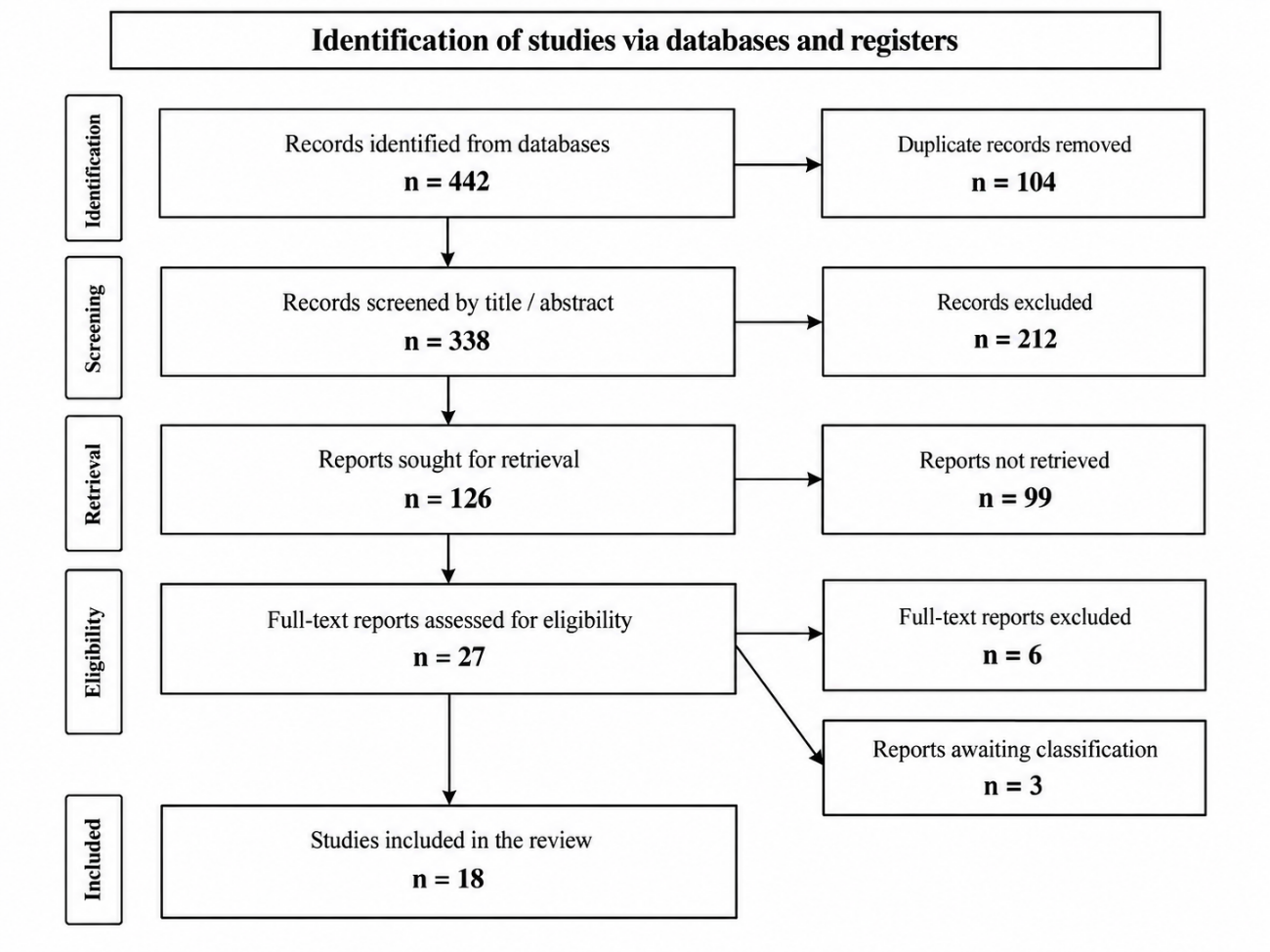
Figure 1. PRISMA flow diagram.
RESULTS
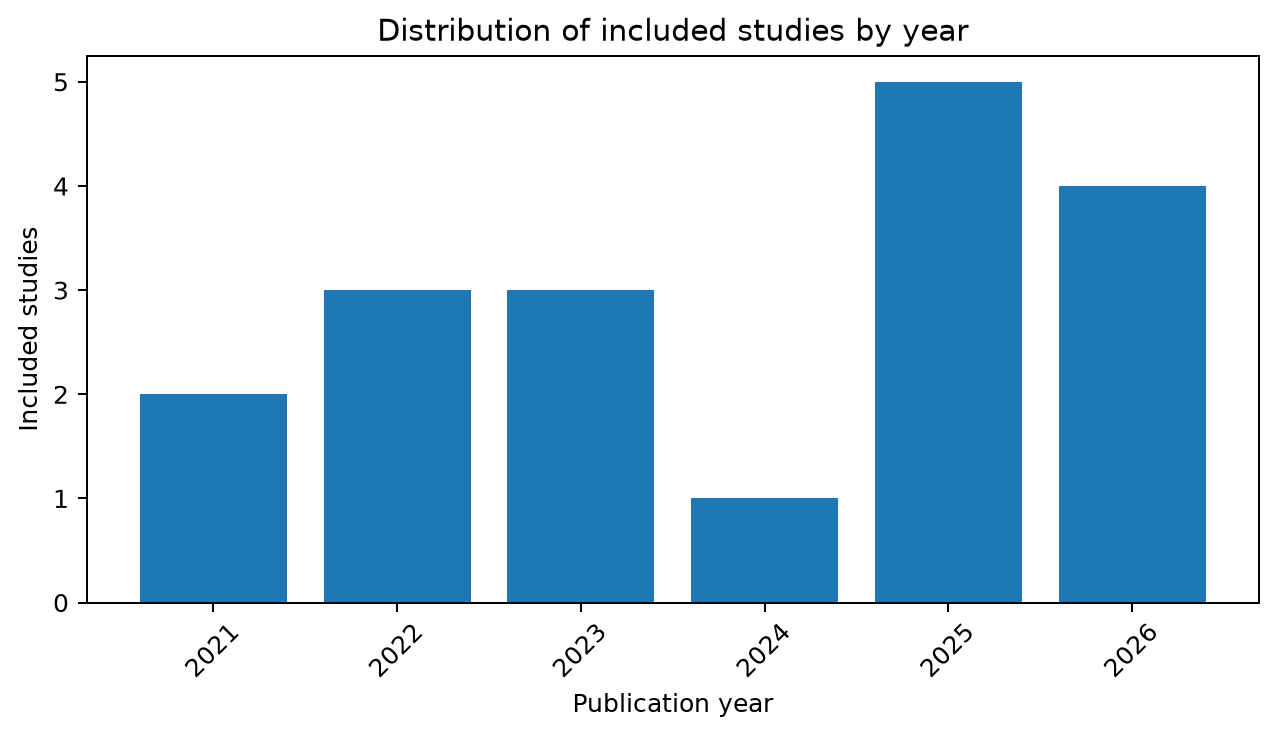
The 18 included core studies were published between 2021 and 2026, with publication accelerating towards the end of the window: two studies in 2021, three in 2022, three in 2023, one in 2024, five in 2025 and four in 2026. The distribution is shown in Figure 1, and the descriptive profile of each study (field, design label and the mechanism through which online and offline registers were linked) is summarised in Table 1. Fields ranged from newsrooms, classrooms and health-promotion settings to transnational families, diaspora communities, ethnic minority networks, activist campaigns, influencer fandoms, disinformation ecologies and a single online forum, across Europe, Asia, Latin America and the Caribbean. Designs were similarly varied: six studies were primarily methodological or conceptual in orientation, including a comparison of digital and analog ethnographic epistemology, a reflection on hybrid newsroom ethnography, a framework for the cyberfield, a combined digital-and-conventional folklore design, an account of integrating digital and on-site fieldwork under limited access, and a digital and visual ethnography of a food community, while the remainder were empirical ethnographies whose methodological reasoning was embedded in substantive findings. Materials reported by individual studies ranged from five interviews in one offline expedition to 260 or more shared humorous items, roughly 300 archived visual posts, 200 or more discussion threads, 93 questionnaire respondents, 113 school students and a five-year attack cycle traced across platforms and news media.
Core study | Field and setting | Design label used | Mechanism linking online and offline |
|---|---|---|---|
Belorussova et al.(29) | Indigenous minorities of Russia, multiple platforms | Cyberfield methodology combining physical and virtual observation | Long-term physical fieldwork paired with posting, commenting and private messaging, plus a 93-respondent questionnaire |
Braybrooke et al.(23) | Urban–rural Living Labs, China and Germany | Two-phase postdigital ethnographic method | WeChat photo-exchange group and guided theme calls creating a liminal virtual space when physical co-location was impossible |
Broer & Schmidt (18) | Science media newsroom, Germany | Hybrid editorial ethnography | Participant observation, interviews, double diary-keeping and vignettes across alternating physical and virtual presence |
Cearns (20) | Cuban diaspora, Cuba and Miami | Autoethnographic digital ethnography across online and offline fieldwork | Public multilingual social-media profile; participant-initiated contact; a two-hour WhatsApp audio interview conducted metres from the participant's window |
Cernison (26) | Water referendum campaign, Italy | Digital ethnography with network analysis and daily notification analysis | Web network analysis and daily Facebook notifications combined with ethnographic observation and 42 interviews |
Fiadotava (27) | Digital family humour, Belarus | Combined digital and conventional fieldwork | Two rounds linking 60 oral interviews with an online survey that collected over 260 shared humorous items |
Forberg & Schilt (21) | QAnon and body-change support groups, United States | Conceptual comparison of digital and analog ethnography | Shared epistemology of relational co-presence and reflexive self-presentation; single-mode or hybrid design fitted to context |
Haddad (30) | Hijabi fashion creators, Germany | Discourse ethnography | Named research account on Instagram, around 300 saved posts, guided interviews, community-event observation and go-alongs |
Lamas-Abraira (22) | Transnational Chinese families, Zhejiang and Spain | Multi-sited ethnography followed by virtual ethnography | WeChat conversations and participant observation in WeChat and Weibo forums after on-site fieldwork, extended by an online questionnaire |
Leaha & Canals (24) | Electoral disinformation, Rio de Janeiro and São Paulo, Brazil | Multimodal hybrid ethnography | Online observation and following across X, Instagram, Facebook, WhatsApp and Telegram, image archiving, fact-checker tracking and ethnographic cinema |
Lee (33) | LIHKG forum, Hong Kong | Critical discourse-oriented online–offline nexus ethnography | Forum observation and interviews traced through mainstream news and the target's own social-media posts across a five-year attack cycle |
Lope-García & Camacho Miñano (31) | Physical education and Strava, Spain | Digital and on-site ethnography with mixed participant observation | Physical presence in school combined with virtual participation in the Strava challenge; fieldnotes, screenshots and a final online form |
Maretina (28) | Seto community on VK, Russia and Estonia | Multi-sited ethnography | Content analysis of eight VK profile pages, active listening in comment threads and two offline expeditions with five interviews |
Rahmat et al.(32) | Youth tourism content, Padang, Indonesia | Blended ethnography | Beach participant observation, 42 public Instagram and TikTok posts, interviews, triangulated fieldnotes and digital artefacts |
Seras (19) | Influencer fandom, Lima, Peru | Digital and remote ethnography with prior on-site fieldwork | Remote interviews by WhatsApp or Instagram and analysis of follower interactions, complementing seven months of earlier on-site fieldwork |
Truong (25) | Social movement and NGO activists, Vietnam and Malaysia | Integration of digital and on-site fieldwork | Online interviews before, during and after a short on-site visit, enabling preparation, adaptation and continuation of data collection |
Varella & Machado (17) | Living Food community, Rio de Janeiro, Brazil | Digital and visual ethnography | Participant observation with illustrated field diary and photo-elicitation interviews using social-media images, plus hashtag and geolocation collection on Instagram |
Wiśniewski & Pol (16) | Local-government cultural centres, Poland | Hybrid ethnography (diary method) | Seven-day structured multimedia diaries with Google Maps geolocation and photo/video upload to an online platform, followed by face-to-face interviews |
Pandemic-era pragmatism
The earliest phase in the evidence base was shaped by restricted physical access. Broer and Schmidt had planned two one-month stays in a German science media newsroom, but the second stay was converted into a hybrid ethnography combining spatial and virtual presence, a change the authors describe as forcing sustained engagement with alternating modalities of being there.(18)
Seras had already completed seven months of on-site fieldwork with Peruvian influencer fans before confinement made further face-to-face interviews impossible, and resumed with six months of digital and remote ethnography, eleven interviews by WhatsApp or Instagram, one written interview and continued analysis of follower interactions, concluding that the field had been constructed in a porous space between the digital and the presential.(19)
In the same period, Cearns reported fifteen months of fieldwork conducted both online and offline with marginalised groups in Cuba and its Miami diaspora, using a public multilingual social-media profile and engagement through Facebook, Instagram, Twitter and WhatsApp.(20)
Integration in this phase was frequently assembled at the level of instruments rather than announced as an ontology. Varella and Machado state that the division between online and offline fieldwork was used didactically to organise research instruments, chosen according to what the field presented, and that online and offline tools were applied in a complementary and simultaneous rather than sequential manner; photo-elicitation interviews using social-media images functioned explicitly as a bridge between registers, allowing access to the motivations and subjectivities behind publications.(17)
Wiśniewski and Pol embedded a seven-day structured diary in a wider project on Polish local culture animators, in which participants described the previous day, plotted their location on Google Maps and uploaded short essays, pictures and video clips to an internet platform, subsequently discussed in one-to-one interviews; the multimedia structure gave participants freedom over time, place and breadth of disclosure, and the precision of geolocation indications was treated by the authors as evidence of engagement.(16)
Three features of this phase matter for the review's question. First, boundary decisions were often reactive but explicitly justified, as in Seras's account of hybridity as a validated response to the impossibility of on-site work and in Broer and Schmidt's reflection on being foreign in the newsroom yet at home in digital work, which they identify as a risk to analytic distance.(18,19)
Second, researcher presence was renegotiated by participants rather than controlled by researchers. Cearns reports that her public profile led participants to investigate her in advance, generating up to thirty direct messages per day at one point, that most of her closest relationships began with participants who had first checked her out online, and that in several cases trust was premised on the absence of face-to-face interaction.(20)
Third, the epistemic limits of each register were named: Broer and Schmidt note that private messages between editorial staff remained inaccessible,(18) while Wiśniewski and Pol document diary reactivity, unsystematic reporting and the difficulty of verifying conscientiousness.(16)
Ethics in this phase were handled through formal approval and procedural care. The food ethnography reports approval by a university research ethics committee, and the influencer study records the need for parental authorisation in the case of two minor participants, but cross-context ethical governance was not yet theorised.(17,19)
Conceptual consolidation
The middle phase shifted from repairing designs to explaining them. Forberg and Schilt argue that digital and analog ethnographies share an epistemology distinct from non-participatory qualitative digital research, because researchers must relationally gather data from a field site over an extended period, and that co-presence and exposure to a social world make a project ethnographic whether contact occurs in physical space, through screens or both.(21)
They treat digital and analog as heuristics while acknowledging the impossibility of a firm distinction in many contexts, warn against fabricated personas when the aim is to understand real people, and argue that self-presentation should be decided on grounds of what is ethical and efficacious rather than merely possible.
Crucially, they also identify a boundary condition for integration: the most vulnerable groups, including people who are incarcerated, elderly, unhoused or living in deep poverty, have difficulty maintaining a digital presence, which makes digital forms of research less applicable to substantial parts of the social world.(21)
Two studies in this phase demonstrate how integration is achieved when distance is structural rather than incidental. Lamas-Abraira combined a multi-sited ethnography carried out between 2016 and 2019 with three generations of transnational Chinese families between Zhejiang and Spain, followed by a virtual ethnography from March 2020 to March 2022 built on WeChat conversations and participant observation in WeChat and Weibo forums, alongside a questionnaire that yielded 35 responses of which 30 complete cases were used.(22)
The virtual phase captured hyperconnection and the redistribution of care through video calls and multimodal intergenerational contact, and the author explicitly calls for longitudinal work to determine whether pandemic-era reconfigurations constitute a break or a temporary adjustment.
Braybrooke, Xiao and Lynam designed a purpose-built two-phase postdigital ethnographic method, curation through themed photo calls followed by guided theme calls in a WeChat photo-exchange group, with Living Labs in China and Germany when physical co-location was impossible.(23) They describe the group as becoming its own kind of liminal Living Lab and as an efficient means of building rapport and gathering ephemeral data on socio-spatial practices, while listing difficulties in forging trust, language barriers, biases in image sharing between familiarity and anonymity, spurious interpretations of images without dialogue, and ethical concerns about inequality and power; their distilled design principles are to build trust first, recognise bias, give clear direction and find a common language.(23)
The most ambitious integration of this phase came from Leaha and Canals, whose multimodal hybrid ethnography of visual disinformation during the 2022 Brazilian elections deliberately dissolved online and offline distinctions and followed images rather than sites: online observation of circulation across X, Instagram, Facebook, WhatsApp and Telegram, tracking of politicians, campaign managers and influencers across television, YouTube and podcasts, archiving and visual analysis of disinformative images, engagement with fact-checking divisions and independent agencies, and ethnographic cinema with observational and participatory filming of street interventions and gatherings in Rio de Janeiro and São Paulo, culminating in a research film.(24)
Their analytic claim is that the falsity of an image is not a property of the image but of a relational, multimodal and contextual network, and that resistance operates through public demonstrations, artistic interventions and fact-checking, each with its own modes of visual assessment.(24)
The phase thus moved the unit of analysis from the site to the trajectory, of images in this case, and made temporality a design feature rather than a background condition, since both the Chinese transnational study and the disinformation ethnography rely on multi-year arcs in which online and offline materials are collected in different periods and later assembled.(22,24)
Routinisation and procedural formalisation
The most recent phase is characterised by designs that presuppose rather than justify integration, and by a marked increase in procedural specification. Truong shows how digital fieldwork can prepare, accompany and extend on-site work in Vietnam and Malaysia, using online interviews before entering the field, maintaining contact during a compressed two-week on-site visit, and continuing data collection afterwards; the conditions she identifies as warranting such integration include limited access to the field, care responsibilities, funding constraints, disabilities, pandemics, political conflict, natural disasters, resurgent authoritarianism and publication pressure.(25)
She also documents the epistemic gains and costs of the digital register: pilot interviews improved conversational style, tolerance of silences and sensitivity to non-verbal signals, and revealed that terms such as social activists had become sensitive in Vietnam, while online work may capture only part of field realities, complicates compensation and ethical handling, and creates quality inconsistencies.(25)
Several studies in this phase formalise the field itself as an object of methodological definition. Belorussova, Maretina and Komova systematise the cyberfield through long-term research with minor Indigenous peoples of Russia, combining physical and virtual observation with posting, commenting and private messaging, and a questionnaire completed by 93 people.(29) They report that nearly half of respondents prefer the online format, that a prominent wish was nonetheless for live contact such as trips and expeditions, and that observing only the virtual environment makes it difficult to grasp contemporary cultural values, distinctive features and nuances; they conclude that digital and physical fields are increasingly intertwined and that their combination enables a more comprehensive approach rich in context, while warning that passive observation cannot continue indefinitely without making participants feel spied upon.(29)
Maretina operationalises this in a multi-sited design on the VK network, analysing eight profile pages alongside two expeditions to the Pechory district and five semi-structured interviews, using anonymisation and selecting only accounts open under privacy settings, and treating comment threads through active listening; the digital territory connected Setos divided by distance and borders, yet the highly segmented cyberfield restricted access, and Orthodox Christianity, a significant offline practice, was less visible online.(28)
Other studies in this phase foreground reflection on self-presentation and on the mediated nature of participation. Haddad created an Instagram account under her full name and institutional affiliation, began theoretical sampling from around eighty accounts collected through snowballing and narrowed them using situational maps, saved and analysed around 300 posts, and combined guided interviews with participant observation of community events, go-alongs and online fieldnotes under situational and visual discourse analysis.(30)
Lope-García and Camacho Miñano describe a dual participant observation in a Spanish school in which the researcher acted as a trainee teacher present physically in the school while participating virtually in a ten-week Strava challenge with 113 students, archiving screenshots of activity posts and interactions alongside fieldnotes from the classroom and other school spaces, and conceiving the digital ethnography as an analytical continuum with what happened in the school.(31) Their findings show the two registers reconfiguring each other: geolocation features encouraged new routes and produced spatial memories, metrics reorganised times and bodies, unforeseen uses such as counting shop-to-shop kilometres or registering part of a car journey extended what counted as registrable, and digital mediation activated face-to-face encounters that were later reinscribed on the platform.
Rahmat and colleagues similarly describe blended ethnography in Padang, triangulating participant observation at coastal tourism sites, analysis of 42 public Instagram and TikTok posts and ten semi-structured interviews over three months, and conclude that online interaction extended existing offline relationships rather than displacing them.(32)
The phase also registers the costs of not integrating. Lee's critical discourse-oriented online–offline nexus ethnography of misogynistic aggression on the Hong Kong forum LIHKG analysed more than 200 threads, long-term forum observation and semi-structured interviews, tracing a five-year attack cycle in which forum discourse produced offline reputational damage that recursively triggered further online attacks, and showing how platform affordances were appropriated to normalise aggression.(33) The author nonetheless notes that the study focused on mediated representation and did not directly observe offline triggering events, and argues that including direct observation of offline interaction in a hybrid, multi-sited design would enrich the field.
Cernison's monograph models a different combination: social network analysis of the web accompanies digital ethnography, 42 interviews and daily analysis of Facebook notifications from around 200 water groups and activists, supported by custom keyword-detection software, in a campaign in which roughly 25 million citizens voted.(26) The publication year of this monograph sits in the recent phase, but its fieldwork concerns the 2011 Italian referendum campaign, which is why its methodological synthesis should be read as a retrospective account rather than as a design produced under current conditions; its central methodological claim is nonetheless contemporary in spirit, namely that standard methods are inadequate for analysing interaction between online and offline plans, and that divergent tactics and loose coordination produced phenomena that were difficult to capture with conventional tools.(26)
Fiadotava, working with Belarusian family humour, provides the clearest statement of complementarity across the whole corpus: digital fieldwork gives access to large quantities of digital folklore but not to the offline contexts in which material circulates, and technical, social and cultural limitations include incomplete indexing by search engines, algorithmic filtering and echo effects, difficulties in establishing participants' identities, the presence of bots and a public/private boundary that is vague and in constant flux; her conclusion is that the defining feature of face-to-face fieldwork is not physical co-presence but the participatory nature of interaction, since digital fieldwork is less personally engaging and more asynchronous.(27)
Table 2. Turning points in the methodological integration of online and offline fields, 2021–2026
Phase | Dominant driver or constraint | Methodological response | Emblematic core studies |
|---|---|---|---|
2021–2022 | Pandemic restrictions and abrupt loss of physical access | Pragmatic grafting of digital instruments onto existing designs; integration at the level of instruments | Wiśniewski & Pol (16); Varella & Machado (17); Broer & Schmidt (18); Seras (19); Cearns (20) |
2023–2024 | Need to justify and theorise what the pandemic had made routine | Explicit conceptualisation of the online–offline relation; purpose-built postdigital methods and trajectory-based units of analysis | Forberg & Schilt (21); Lamas-Abraira (22); Braybrooke et al.(23); Leaha & Canals (24) |
2025–2026 | Normalisation of mediated fieldwork and demand for repeatable procedures | Formalised designs with named integration mechanisms, fuller ethics reporting and explicit boundary reflection | Truong (25); Cernison (26); Fiadotava (27); Maretina (28); Belorussova et al.(29); Haddad (30); Lope-García & Camacho Miñano (31); Rahmat et al.(32); Lee (33) |
Across all three phases, four integration mechanisms recur and are visible in Table 1:
The first is boundary work: the field is redefined as a configuration of settings rather than a container, whether as a porous space between the digital and the presential, a liminal space created for exchange, a digital territory connected to expeditions, a cyberfield entwined with physical observation, or an analytical continuum between what happens on a platform and what happens in a school.(19,23,28,29,31)
The second is participant-driven following, in which researchers track people, images, threads or practices across platforms, media and physical sites, and in which participants themselves determine the terms of digital engagement.(20,24,33)
The third is artefact-mediated connection between registers, achieved through photo-elicitation interviews, geolocated and illustrated diaries, archived screenshots and image sets used as bridges to motivation and subjectivity.(16,17,31)
The fourth is temporally layered presence, in which online contact precedes, accompanies and follows physical co-presence, and in which the analytical yield of a short on-site period is amplified by preparation and continuation at a distance.(22,25,29)
DISCUSSION
The reviewed studies converge on a set of conditions under which a postdigital, hybrid or digitally mediated design adds analytical value, and on a further set under which it does not. Integration added most value when physical access was blocked or rationed, a condition documented in newsroom, fandom, family, Living Lab and activist research alike, and which Truong generalises into a broad catalogue of access constraints including care responsibilities, funding limits, disabilities, pandemics, conflict and resurgent authoritarianism.(18,19,22,23,25)
External scholarship reaches the same conclusion for conflict-affected settings, where embracing the digital as both tool and space allows fieldwork to continue when travel is impossible, and Liu's notion of multi-access as the renegotiation of blocked access formalises precisely this move.(5,12)
Integration also added value where populations were dispersed across borders or distances, as with Seto communities on VK and Chinese transnational families whose care circulation became hyperconnected; here the digital register was not a substitute for proximity but the medium through which the social unit existed at all.(22,28) A third condition is that the practice under study is itself platform-mediated, as with Strava-based activity, influencer fandom or youth tourism content, where the platform is part of the practice rather than a record of it.(30-32) A fourth condition is that the phenomenon circulates across registers by design, which is why image-following and discourse-following designs yielded findings that single-register work could not have produced.(24,33)
Finally, Cearns's account of distance as an ethical and productive affordance, a form of social distancing that levelled researcher and participant relations and enabled access to a community otherwise difficult to reach, points to a condition in which mediated contact is preferable rather than merely available, a logic echoed in migration research where participants themselves follow and contact researchers.(11,20)
The evidence is equally informative about when integration adds little. Fiadotava's conclusion that many digital fieldwork sites give access to texts but not to their contexts identifies the clearest failure mode, and Belorussova and colleagues' warning that observing only the virtual environment struggles to capture contemporary cultural values and nuance is the same argument in another key.(27,29)
Stæhr's insistence that people themselves experience online and offline activities as separate and disconnected qualifies the post-digital claim from the opposite direction: if participants treat registers as distinct, a design that assumes entanglement may misread the field.(6) Forberg and Schilt identify a structural limit, since populations without sustained digital presence remain less reachable through digitally mediated designs, and Lee's stated limitation shows that tracing mediated representation is not the same as observing the offline trigger.(21,33)
Risks also scale with vulnerability: research with criminally involved groups has documented the hazards of drawing on social media in urban ethnography, and the reviewed studies that worked with minors, marginalised communities or politically sensitive actors all treated cross-context ethics as the hardest problem rather than the last one.(10,20,25,31)
Read as an evolution, the corpus shows a sequence of three shifts. The first is from instrument to ontology: early studies assembled digital tools within existing designs, whereas later studies treat the field as constituted by movement between registers, a shift that mirrors the transition from blended fields and immersive cohabitation towards toolkits of multi-access, multi-positionality and online–offline data assembly.(2,5)
The second is from site to trajectory: following images, threads and practices across platforms, media and streets turns temporality into a design variable, which is consistent with proposals that treat simultaneous offline and online observation and the act of posting as the analytical object, and with ritualised offline–online performance analyses that track bodies from the street to the internet and back.(4,15)
The third is from presence to infrastructure: the most recent accounts recognise that platforms, algorithms, notification systems, geolocation and search indexing shape what can be seen and when, which aligns with arguments that hybridity is mediated through data infrastructures and with the observation that the smartphone has become a key fieldwork instrument whose dual role remains under-theorised.(6,7)
Three gaps persist. First, triangulation is practised more than it is specified: studies describe assembling screenshots, hashtags, forum comments, geolocated diaries, film and interviews, but few state the decision rules by which conflicting or non-overlapping evidence is adjudicated, and in several cases the online and offline samples overlapped only partly. Second, terminology remains unstable, since hybrid, blended, postdigital, multi-sited, cyberfield and nexus ethnography name overlapping practices with different epistemologies, a fragmentation already flagged in applied linguistics and World Englishes scholarship.(1,14)
Third, ethics is the least standardised dimension: formal approval and platform hygiene are widely reported, but consent that remains valid as sites and audiences shift, the treatment of technically public data, and the governance of researcher self-presentation across contexts are still handled case by case.(6)
Related domains have generated concepts that the reviewed literature has not yet systematically absorbed: organisational ethnography where messaging applications enter the field and relational boundaries between professional and personal, participation and observation blur,(8,9) and hybrid designs in education and hybrid team ethnography in education-technology research raise adjacent questions about institutional and infrastructural framing that remain marginal in the present corpus.(7,13)
From these patterns the review derives a five-step integration model, offered as a synthesised methodological proposal rather than as an empirically validated instrument. First, specify the field as a configuration of settings rather than a container, naming every register in which the unit of analysis appears and the access points available in each, since blocked access in one register can be renegotiated in another.(5,22) Second, establish presence in more than one register while allowing participants to set the terms of digital engagement, because contact initiated by participants shaped access, trust and the direction of the research relationship in several included studies.(20,30) Third, layer contact temporally by sequencing online preparation, co-present observation and later online continuation, so that a short physical stay is embedded in a longer mediated relationship.(25,29) Fourth, assemble evidence through explicit bridging artefacts (photo-elicitation, illustrated and geolocated diaries, archived screenshots, hashtag and geolocation queries, traced comment threads) and record how each artefact connects a physical situation to a mediated one, with attention to the reflexive effects that recording devices have on the practices they capture.(16,17,28,31) Fifth, govern ethics continuously and contextually, revisiting consent as sites, audiences and visibility settings change, protecting minors and vulnerable groups across registers, and recognising that some material remains inaccessible in ways that must be reported rather than concealed.(6,18,31)
The model's implicit proposition is that the field is better defined by trajectories than by locations, and that its evidentiary strength depends less on the number of registers covered than on the transparency with which their connection is documented.
Limitations
This review has several limitations. First, the evidence base was relatively small and heterogeneous, with 18 studies differing in design, disciplinary context, and reporting depth. Second, a substantial proportion of potentially relevant reports could not be retrieved in full text, which may have introduced retrieval bias and reduced the representativeness of the final corpus. The search was also concentrated in major multidisciplinary databases, so relevant studies indexed elsewhere or published in less visible channels may have been missed.
Although no language restriction was applied, the included literature was predominantly in English, and some geographic regions were poorly represented. Methodological quality was assessed through a structured review process rather than with a validated appraisal instrument, which may limit comparability with other systematic reviews. In addition, the synthesis was qualitative and based on heterogeneous evidence, so the patterns identified should be interpreted as analytical tendencies rather than established effects. Finally, because the search was completed before the end of 2026, evidence from the final months of the eligibility period may be incomplete.
CONCLUSIONS
This systematic review shows that the methodological integration of online and offline ethnographic fields depends less on labelling a study as hybrid or postdigital than on how researchers connect settings, participants, artefacts, and forms of presence across contexts. Across the included studies, four recurring strategies were identified: redefining the field as a configuration of interconnected settings, following participants and digital traces across platforms, linking different forms of evidence through bridging artefacts, and extending researcher presence across digital and physical encounters.
These approaches appear particularly valuable when access to physical settings is limited, participants are geographically dispersed, or the social practices under study are strongly mediated by digital platforms. However, hybrid integration also introduces methodological and ethical challenges, especially when evidence from different settings is inconsistent, when contextual information is limited, or when digitally visible activity does not adequately represent offline social life.
The five-step integration model proposed in this review should therefore be understood as a transferable methodological framework rather than a validated instrument. Further research is needed to strengthen ethical guidance, improve transparency in how evidence from different settings is combined, develop more consistent terminology, and evaluate hybrid ethnographic designs across longer time periods and more diverse contexts.
References
- 1 Wang C, Canagarajah S. Postdigital ethnography in applied linguistics: Beyond the online and offline in language learning. Research Methods in Applied Linguistics. 2024;3(2):100111. doi: 10.1016/j.rmal.2024.100111..
- 2 Bluteau JM. Legitimising digital anthropology through immersive cohabitation: Becoming an observing participant in a blended digital landscape. Ethnography. 2019;22(2):267-285. doi: 10.1177/1466138119881165..
- 3 Zani B. Shall WeChat? Switching between online and offline ethnography. Bulletin of Sociological Methodology/Bulletin de Méthodologie Sociologique. 2021;152(1):52-75. doi: 10.1177/07591063211040229..
- 4 Luhtakallio E, Meriluoto T. Snap-along ethnography: Studying visual politicization in the social media age. Ethnography. 2022;27(1):66-86. doi: 10.1177/14661381221115800..
- 5 Liu RF. Hybrid ethnography: Access, positioning, and data assembly. Ethnography. 2022;27(1):215-232. doi: 10.1177/14661381221145451..
- 6 Stæhr AC. Linguistic ethnography in post-digital field sites – methodological challenges of bridging online and offline contexts. Research Methods in Applied Linguistics. 2026;5(3):100343. doi: 10.1016/j.rmal.2026.100343..
- 7 Decuypere M, Brandau N, Hartong S, Joecks L, Ortegon C, Loft-Akhoondi A, et al. Tracing the infrastructural unfolding of (edtech) events through hybrid team ethnography. Learning, Media and Technology. 2025;51(2):345-359. doi: 10.1080/17439884.2025.2458667..
- 8 Akemu O, Abdelnour S. Confronting the Digital: Doing Ethnography in Modern Organizational Settings. Organizational Research Methods. 2018;23(2):296-321. doi: 10.1177/1094428118791018..
- 9 Alcadipani R, Cunliffe AL. The Shifting Nature of Relationality in the Blurred Boundaries of Hybrid Organizational Ethnography. British Journal of Management. 2023;35(2):679-691. doi: 10.1111/1467-8551.12728..
- 10 Urbanik MM, Roks RA. GangstaLife: Fusing Urban Ethnography with Netnography in Gang Studies. Qualitative Sociology. 2020;43(2):213-233. doi: 10.1007/s11133-020-09445-0..
- 11 Winters N. Following, Othering, Taking Over. Social Analysis. 2021;65(1):133-142. doi: 10.3167/sa.2021.650109..
- 12 Schoorel E, Luitjens M. Collecting Rich Data from Afar. Journal of Digital Social Research. 2025;7(3):1-17. doi: 10.33621/jdsr.v7i340711..
- 13 Yang Q. Education as a ‘gift’: a qualitative study of Tibetan students in <i>Neidi Ban</i>. British Journal of Sociology of Education. 2025;47(1):121-138. doi: 10.1080/01425692.2025.2584176..
- 14 Heyd T. Complicating the <i>field</i>. Varieties of English Around the World. 2023. doi: 10.1075/veaw.g68.12hey..
- 15 Malafaia C, Kettunen J, Luhtakallio E. Visual bodies, ritualised performances: an offline-online analysis of Extinction Rebellion’s protests in Finland and Portugal. Visual Studies. 2024;40(2):371-384. doi: 10.1080/1472586x.2023.2292620..
- 16 Wiśniewski R, Pol GY. Acting for the Local Community: Hybrid Ethnography in the Careers of Local Culture Animators. Przegląd Socjologii Jakościowej. 2021;17(3):164-183. doi: 10.18778/1733-8069.17.3.09..
- 17 Varella H, Machado M. Etnografia digital da alimentação viva: uma abordagem metodológica no campo online e offline. Athenea Digital. Revista de pensamiento e investigación social. 2021;21(1). doi: 10.5565/rev/athenea.2502..
- 18 Broer I, Schmidt JH. „Dasein“: Die Integration kulturanthropologischer Konzepte in die Journalismusforschung. Medien & Kommunikationswissenschaft. 2022;70(1-2):79-96. doi: 10.5771/1615-634x-2022-1-2-79..
- 19 Félix Seras D. #Instagrameable. Prácticas y rutinas de un grupo de fans de las social media influencers Katy Esquivel y Tana Rendón y la construcción de su capital cultural y narrativas femeninas. Desde el Sur. 2022;14(2):e0019. doi: 10.21142/des-1401-2022-0019..
- 20 Cearns J. Social [Media] Distancing: on Digital Espionage, Ethnographic Method, and Ethics ‘in the Field’. Journal of Digital Social Research. 2023;4(4):76-88. doi: 10.33621/jdsr.v4i4.48..
- 21 Forberg P, Schilt K. What is ethnographic about digital ethnography? A sociological perspective. Frontiers in Sociology. 2023;8. doi: 10.3389/fsoc.2023.1156776..
- 22 Lamas-Abraira L. Re-circular el cuidado en (post)pandemia: (in)movilidad e hiperconexión en las familias transnacionales chinas entre Zhejiang y España. Latinoamericana de Estudios de Familia. 2023;15(2):15-36. doi: 10.17151/rlef.2023.15.2.2..
- 23 Braybrooke K, Xiao G, Lynam A. Living Lab, interrupted? Exploring new methods for postdigital exchange on WeChat with urban-rural Living Labs in China and Germany during COVID-19. Journal of Science Communication. 2023;22(03). doi: 10.22323/2.22030204..
- 24 Leaha MA, Canals R. Resisting Alternative Images: An Ethnography of Visual Disinformation in Brazil. Cultural Anthropology. 2024;39(4). doi: 10.14506/ca39.4.03..
- 25 Truong M. Integrating Digital and On-Site Fieldwork: Practical Solutions for Scholars with Limited On-Site Access. PS: Political Science & Politics. 2025;58(4):670-677. doi: 10.1017/s1049096525000216..
- 26 Cernison M. Social Media Activism. Social Media Activism Water as A Common Good. 2025. doi: 10.5117/9789462980068..
- 27 Fiadotava A. Digital Folklore and Digital Fieldwork: Researching Online Humour with Its Offline Context in Mind. Traditiones. 2025;54(2). doi: 10.3986/traditio2025540205..
- 28 Maretina KA. Navigating Digital Borders: Seto Community in the Virtual Territory of the VK Social Network. Changing Societies & Personalities. 2025;9(1):67-83. doi: 10.15826/csp.2025.9.1.318..
- 29 Belorussova SY, Maretina KA, Komova EA. Cyberfield: Theory, Methodology, and Practice. Changing Societies & Personalities. 2025;9(1):11-28. doi: 10.15826/csp.2025.9.1.315..
- 30 Haddad L. Hijabi fashion creators in Germany – between influencer marketing and diverse digital activisms. Feminist Encounters: A Journal of Critical Studies in Culture and Politics. 2026;10(1):7. doi: 10.20897/femenc/17888..
- 31 Lope-García P, Camacho-Miñano MJ. Promoción de la salud digitalizada en Educación Física. Movimento. 2026. doi: 10.22456/1982-8918.152368..
- 32 Rahmat W, Tiawati RL, Tatalia RG, Azri H. Pragmatic communication and social media use in tourism promotion: A study of young people in Padang city. Multidisciplinary Science Journal. 2026;8(11):2026733. doi: 10.31893/multiscience.2026733..
- 33 Lee C. Affordances-in-practice and misogynistic discourse: A post-digital discourse analysis of memetic verbal aggression in Hong Kong. Annual Review of Applied Linguistics. 2026. doi: 10.1017/s0267190526100300..
Declarations
Funding
No financing.
Conflict of interest
None.
Authorship contributions
Drafting – original draft: Yolier Izquierdo Cuellar.
Writing–review and editing: Yolier Izquierdo Cuellar.