

Abstract
Background. Gaming communities, social virtual reality (VR), and persistent virtual worlds have become established settings of digital social life, but ethnographic practice in immersive, avatar-mediated, and platform-governed environments remains methodologically uneven. Objective. To examine how netnographic and digital ethnographic studies investigate gaming communities, social VR, and persistent virtual worlds, with emphasis on methodological adaptation, ethics, identity, embodiment, governance, and digital culture. Methods. A systematic review of peer-reviewed qualitative research published between 2020 and 2026 was conducted across major academic databases and scholarly discovery platforms. Studies were screened using predefined eligibility criteria, and 31 studies were included. Data were synthesised thematically across methodological, ethical, and substantive domains. Results. The included studies cover MMORPGs, VRChat, Second Life, IMVU, Twitch, Discord, Roblox, Reddit, and gaming forums. Reported adaptations include play-along and go-along approaches, in-platform interviews, screen-shared observation, multimodal and computational traces, team-based multiverse ethnography, and VR focus groups. Ethical practice centred on pseudonymisation, protection of community identity, disclosure, and negotiated consent in semi-public spaces. Across the reviewed studies, avatars functioned as important carriers of identity, while voice, technical literacy, moderation, conflict, labour, and cultural production shaped participation and belonging. Conclusions. Research in immersive gaming environments is increasingly hybrid and multimodal, but methodological reporting remains uneven, particularly for ethics, embodiment, and platform governance. More consistent documentation of researcher presence, consent, and cross-platform field construction would strengthen the comparability of future studies.
Keywords
netnography, digital ethnography, social VR, virtual worlds, gaming communities, avatar identity
INTRODUCTION
Netnography and its sibling traditions (virtual ethnography, cyberethnography and digital ethnography) were developed to study communities whose sociality is conducted through networked media without requiring physical co-presence. Over three decades these approaches have moved from text-heavy forums and newsgroups into platform ecologies in which interaction is voice-based, avatar-mediated, algorithmically ordered and commercially governed. Kozinets's proposal of immersive netnography marks an explicit attempt to adapt the method to augmented reality, virtual reality and metaverse contexts, arguing that immersive technologies alter the data, ethics and representational practices that qualitative researchers must adopt.(1) That proposal, however, was formulated as methodological logic and argumentation, not a synthesis of what researchers studying games and virtual worlds actually do in the field.
Gaming communities are a demanding test case for such guidance. Massively multiplayer online games, persistent sandbox worlds, social VR platforms and streaming-adjacent spaces such as Discord combine long-term membership, embodied avatars, real-time voice, in-world economies and active platform moderation. Their boundaries rarely coincide with a single platform, and their members move routinely between an avatar-mediated world and the out-of-world channels where coordination, gossip and community maintenance occur. Studies of AltspaceVR and its relationship to Discord have described this arrangement as a tightly coupled communicative ecology in which one platform operates as a backstage "theater" and the other as a high-intensity "stage".(2) Studying such arrangements requires decisions about where to observe, how to be present, what counts as consent, and how to represent participants who are simultaneously avatars, accounts and persons.(3) Immersive embodiment compounds these decisions, because presence, corporeality and sensory mismatch become part of the field instead of remaining background assumptions.(4)
The analysis compares how recent studies define immersive fields, establish researcher presence, negotiate access and consent, and interpret identity, embodiment, governance, conflict, labour, and cultural production across gaming and social virtual environments. It also identifies methodological and geographic gaps in the available evidence.
METHODS
We reviewed qualitative empirical studies of gaming communities, social VR, and persistent virtual worlds. The analysis covered methodological adaptation, ethical practice, identity and embodiment, community governance, conflict, labour, and cultural production. Because the evidence was predominantly qualitative and heterogeneous, synthesis was thematic; no statistical pooling was attempted.
Search strategy and study selection
Database retrieval covered Scopus, Web of Science, OpenAlex, and Semantic Scholar. Search terms combined netnography and related digital ethnographic approaches with gaming, MMORPGs, social VR, virtual worlds, avatar-based platforms, Discord, Twitch, identity, embodiment, governance, belonging, conflict, labour, culture, ethics, and methodology. The search focused on 2020–2026 and did not exclude records on the basis of language.
Eligible studies were peer-reviewed empirical investigations using netnographic, virtual ethnographic, digital ethnographic, or closely related qualitative approaches in gaming communities, persistent virtual worlds, social VR, or adjacent community spaces. Studies without a qualitative or observational component, technical work without social or cultural analysis, and publications outside the substantive scope of the review were excluded. Contextual literature was used for interpretation but was not treated as part of the included evidence.
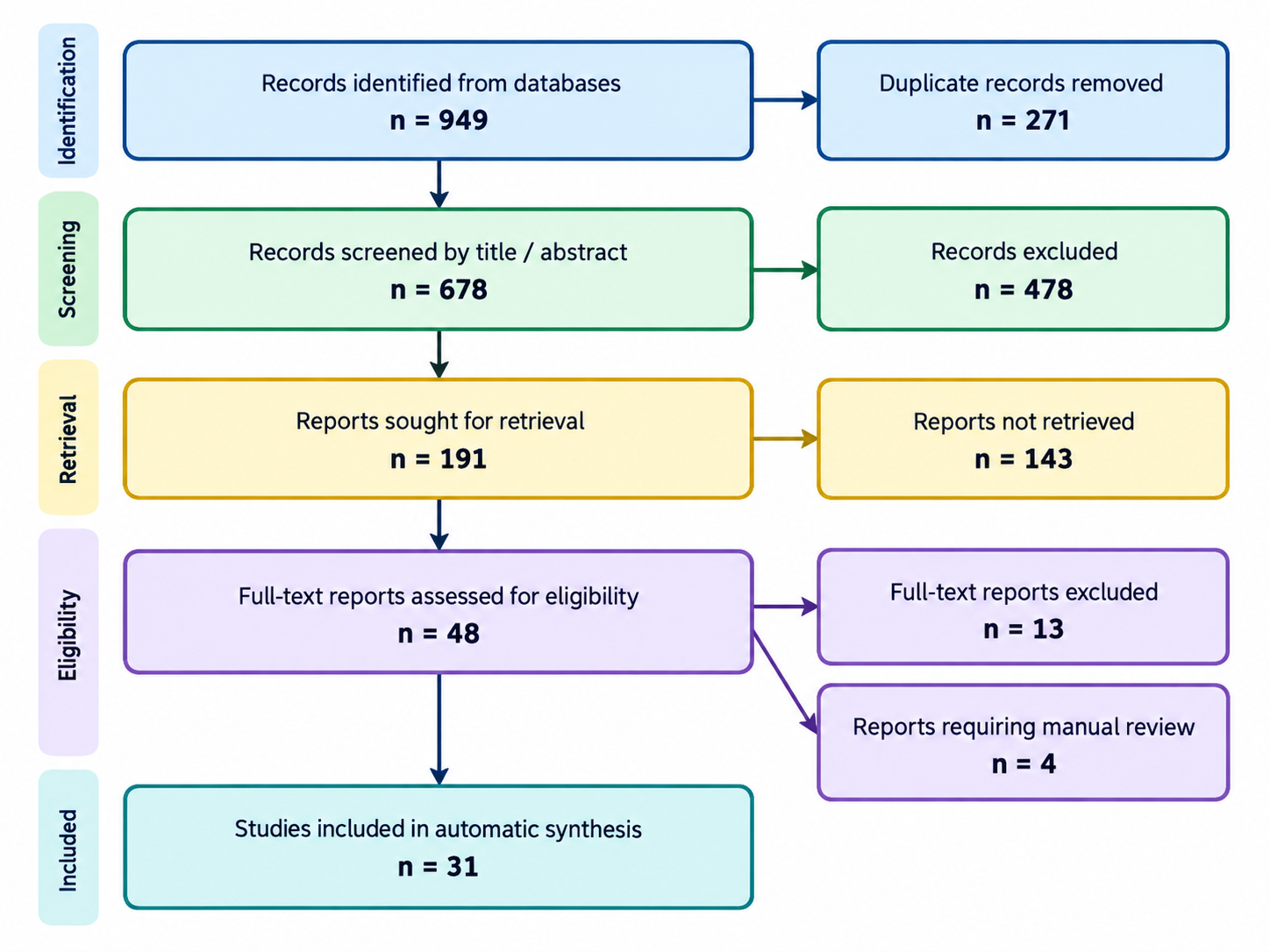
Database retrieval yielded 949 records. Deduplication left 678 for title-and-abstract screening, after which potentially eligible reports were examined in full text. Forty-eight full-text reports were evaluated and 31 studies met the eligibility criteria for inclusion. The study-selection process is summarised in Figure 1.
Data extraction and synthesis
Data extraction covered study design, methodological label, platform or setting, population, sampling, data sources, analytical procedures, ethical arrangements, reported limitations, and findings relevant to the review questions. Methodological appraisal focused on the clarity and transparency of field construction, sampling, researcher presence, ethics, and analytical reporting without reducing quality to a single numerical score.
The synthesis was organised thematically across methodological adaptation, ethics and access, identity and embodiment, belonging and norms, governance and moderation, conflict and harm, labour and economies, and cultural production. Convergent findings were reported alongside contrasting or less frequently observed approaches when these added methodological value.
RESULTS
Characteristics and internal structure of the included studies
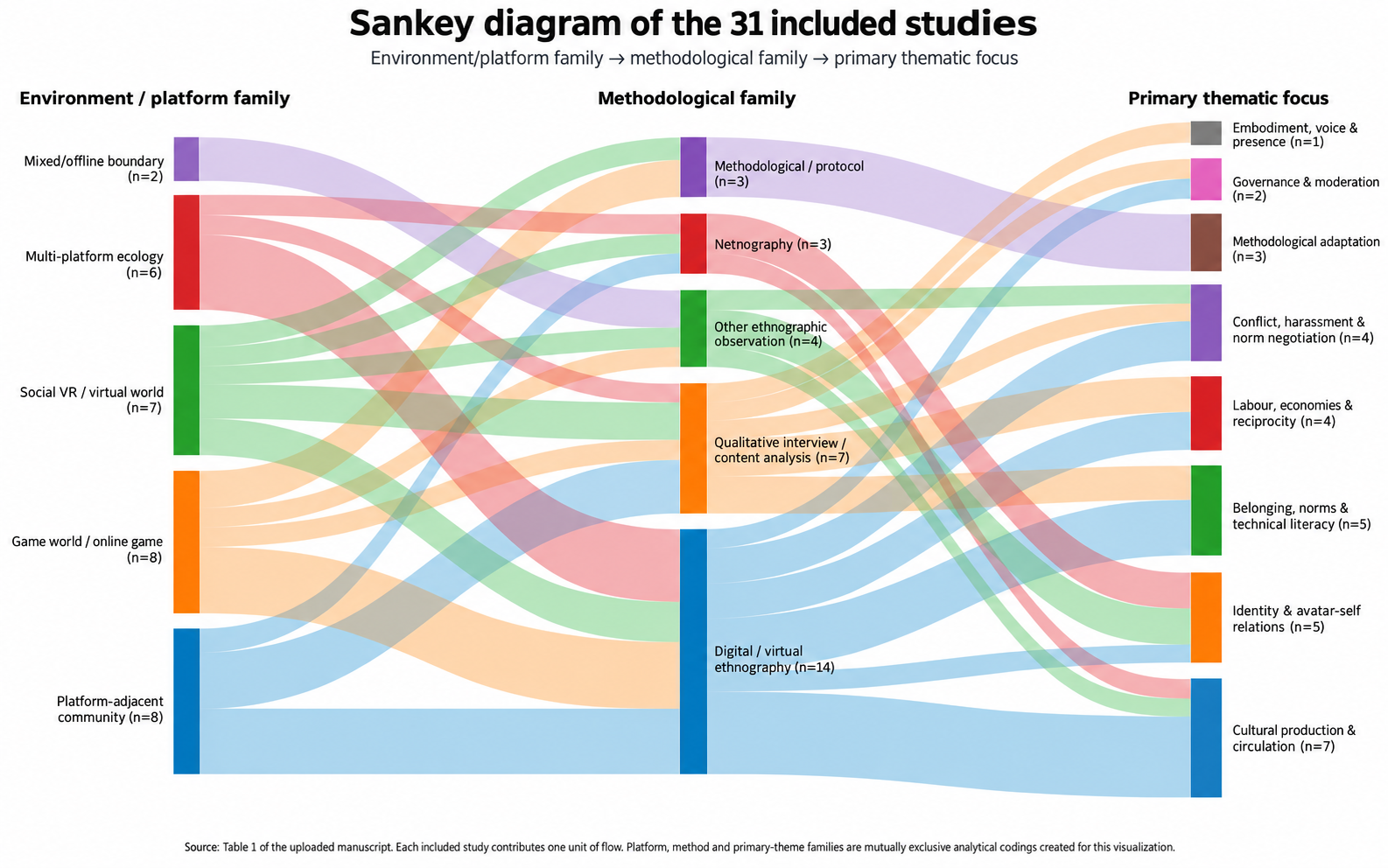
To synthesize the internal organization of the included studies, a Sankey diagram was constructed linking environment/platform family, methodological family, and primary thematic focus (Figure 2). The diagram shows that the reviewed literature is distributed across platform-adjacent communities, game worlds or online games, social VR or virtual worlds, and multi-platform ecologies, with only a small number of studies located at mixed or offline boundaries. Methodologically, digital or virtual ethnography constitutes the most prominent approach, while netnography, other ethnographic observation, qualitative interview or content analysis, and methodological or protocol-oriented studies are also represented. Thematically, the literature clusters around cultural production and circulation, identity and avatar–self relations, belonging and technical literacy, labour and reciprocity, and conflict or norm negotiation. Overall, the Sankey diagram suggests that the field is organized through recurring links among research setting, methodological orientation, and thematic focus, rather than through a single dominant line of inquiry.
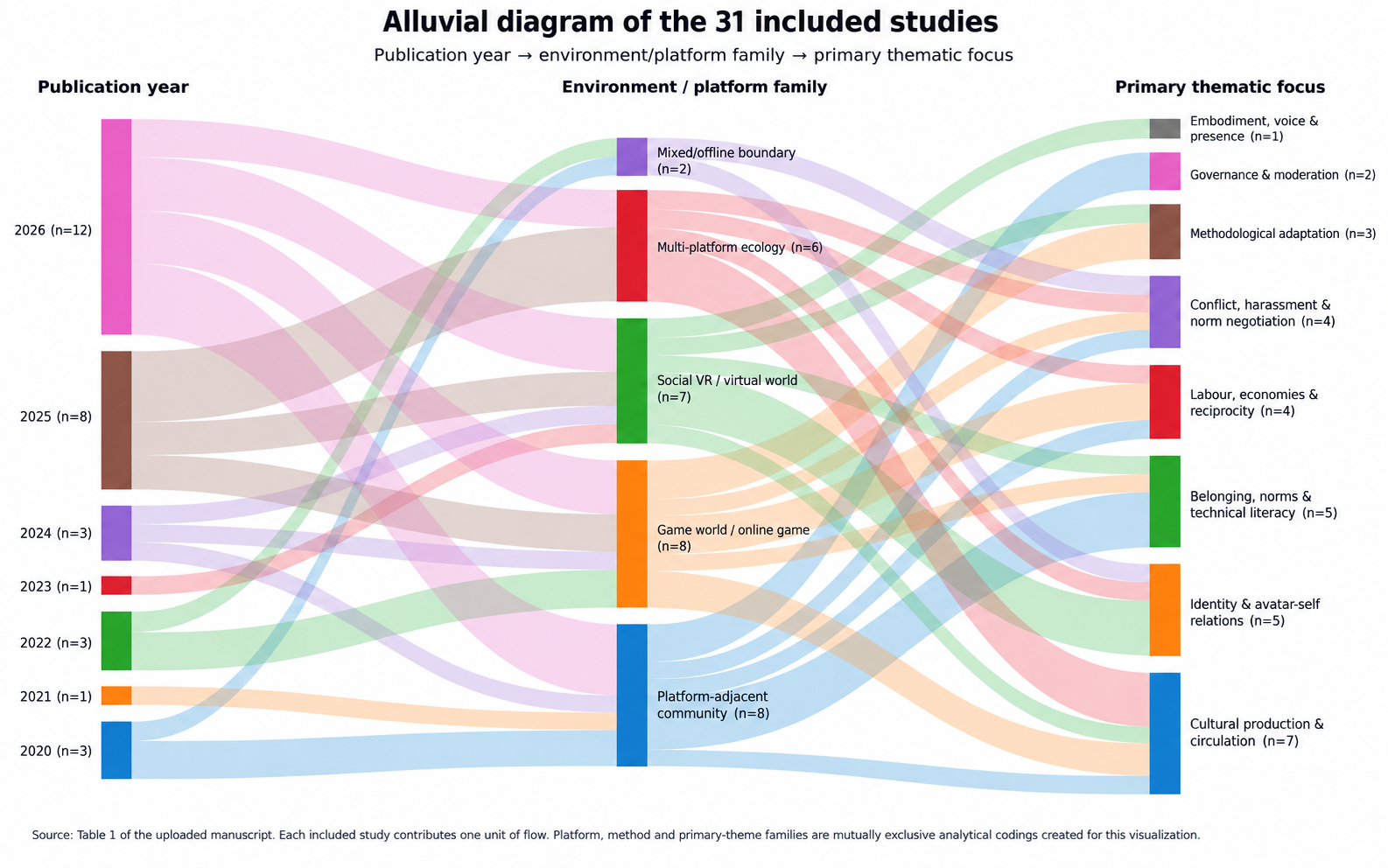
The temporal distribution of these relationships is further illustrated in the alluvial diagram (Figure 3), which links publication year, environment/platform family, and primary thematic focus. The diagram indicates that the literature spans 2020 to 2026, with a greater concentration of included studies in 2025 and 2026. Across these years, research settings become increasingly diverse, while the principal thematic concerns remain relatively stable. In particular, platform-adjacent communities, game-related environments, and social VR spaces continue to be associated with recurring concerns related to identity, cultural production, community norms, and patterns of participation. Taken together, the alluvial flows suggest both consolidation and diversification in the development of the field over time.
The settings represented span the principal forms of the phenomenon under review. Massively multiplayer and persistent worlds include World of Warcraft, a Chinese lineage-style MMORPG, Justice Online, Second Life, IMVU and VRChat. Livestreaming and platform-adjacent spaces include Twitch, Discord servers, Roblox and gaming-adjacent forum and social platforms. Community spaces outside the game client include Reddit subreddits, dedicated gaming forums, closed Facebook communities and YouTube and Facebook pages. Several studies deliberately worked across in-world and out-of-world sites, treating a Facebook group, a Discord server or a Reddit subreddit as part of the same community, not as a separate object.
Design labels vary considerably. Netnography, named explicitly after Kozinets, appears in studies of a Brazilian World of Warcraft community (5) and a Second Life group.(6) Virtual ethnography, often citing Hine, appears in studies of Mobile Legends (7) and a women-only Brazilian Facebook gaming community.(8) Digital, cybercultural or reflexive ethnographic labels appear in work on Twitch,(9) IMVU,(10) Call of Duty: Warzone,(11) a Discord youth centre,(12) VRChat language learning,(13) Roblox and Discord religious community practice,(14) Genshin Impact (15) and a three-part study of AI and marginalised players.(16) Three studies are primarily methodological: a team-based multiverse ethnography tested on two games,(17) a play-along method derived from go-along and walkthrough traditions,(18) and a protocol for focus groups inside a custom VRChat world.(19)
Samples range from a single key informant in a digital ethnographic study of Indonesian in-game language (20) to a closed community of 9,944 members,(8) approximately 280 streamers observed over a year (21) and 38 ethnographers contributing roughly 1,140 hours of fieldwork.(17) Interview-based studies typically involved 11 to 32 participants,(9,22-24) with smaller interview components in multimodal designs.(25) The geographical spread is wide: Brazil, Indonesia, Malaysia, China, South Korea, Finland, Italy, France, Germany, Uruguay and multi-country online populations are represented.
Two boundary decisions should be recorded. One included study is an overt, non-participant ethnography of an offline video game workshop for adults over 60 in France; it examines age and gender norms in gaming culture but does not study an online community, and the review records this as a scope boundary instead of treating it as a digital ethnography.(26) One ethnography of emotional practices in video game violence works primarily with online Let's Play material, game magazines and interviews, not with a community of practice, and is retained for its contribution to the ethnography of gaming culture.(27) Two studies report work in progress or a protocol with no findings.(11,19) Table 1 details all included studies.
Study | Platform or setting | Design | Data and sample | Primary focus |
|---|---|---|---|---|
Maiello & Giungato (2026) (28) | Three Skyrim subreddits (Reddit) | Netnographic observation, interviews, Communalytic quantitative analysis | Interview participants; Reddit discourse | Lore as narrative infrastructure; discourse migration |
Silva et al. (2025) (5) | World of Warcraft; Brazilian Facebook community | Netnography; content analysis (Bardin) | 99 responses; 382 interactions | Avatar–self relations; archetypes; motivations |
Ferrer (2026) (9) | Twitch.tv | Digital ethnography plus semi-structured interviews | Two streams over one month; 11 interviews | Cyborgification; belonging; technical literacy |
Sousa & Neves (2026) (10) | IMVU (Brazil) | Cyberculture ethnography; participant observation; snowball sampling; Atlas.ti | 23 women interviewed of 36 contacted | Gender and sexuality experimentation; refuge |
Muminin et al. (2025) (25) | Free Fire; YouTube and Facebook (Indonesia) | Virtual ethnography; thinking-aloud; associative concept network analysis | Four students; 16 min 22 s of gameplay; 37 nouns | Latent messages; fandom; parasocial relations |
Moura & Messias (2026) (8) | Closed women-only Facebook gaming community (Brazil) | Virtual ethnography with multi-sited principles | Community of 9,944 members | Support networks; rules; resistance |
Boldi et al. (2022) (11) | Call of Duty: Warzone (Italy) | Reflexive digital ethnography; autoethnographic diary; in progress | 128-member regiment; planned interviews | Organisational behaviour; work–play boundaries |
Steinnes et al. (2026) (18) | Online games across three projects | Play-along method (methodological) | Up to 60 informants aged 10–24 | Method: ecological validity; ethics of access |
Hu et al. (2026) (29) | MMORPGs, notably JX3 (China) | Interpretive qualitative; interviews and observation | Sample size not reported | Gifting; anti-gift; reciprocity |
Mohd Yusof & Wan Ariffin (2023) (6) | Second Life (Malaysia) | Netnography; in-platform interviews; Atlas.ti | Six informants (>8 h/day) | ePersonality; identity exploration |
Lavenir (2022) (26) | Offline video game workshop (France) | Overt non-participant observation; biographical interviews | 15 participants; 17 interviews | Age and gender norms; 'silver gamer' category (scope boundary) |
Bareither (2020) (27) | Germany; Let's Play videos; game magazines | Ethnography of emotional practices | Online and print materials; interviews | Pleasure in playful virtual violence |
Navarrete Vega & Zermeño Flores (2026) (30) | Twitch channel of an older streamer (Uruguay) | Exploratory case study; content analysis | One streamer; one session (May 2024) | Epistemic justice; moderation; community |
Anhar et al. (2025) (20) | Popular online games (Indonesia) | Digital ethnography; observation; in-depth interview | One key informant | Language practices; community norms |
Solihin (2024) (7) | Mobile Legends (Indonesia) | Virtual ethnography (Hine); participant observation; content analysis | Screenshots; researcher as active player | Trash-talk; cyberbullying |
Cote (2021) (31) | Two gaming forums (>100,000 members) | Comparative qualitative content analysis; NVivo | 600 posts across three search terms | Feminist organising; support dynamics |
Kang & Yun (2026) (16) | Justice Online; AI Dungeon; Sea of Thieves; modding Discord | Digital ethnography; bias audit; controlled experiment | 16 players; 547 narratives; 112 participants; 200+ modders; 2,317 posts | AI; marginalised players; community action |
Roxo (2026) (32) | VRChat | Digital and media ethnography; content analysis; interviews | Selected queer media productions | Queer worldmaking; visibility |
Povinelli & Zhao (2024) (33) | VRChat | Qualitative interview study | 13 transgender and gender-nonconforming users | Voice changers; gender euphoria |
Milik et al. (2025) (19) | Custom VRChat world | Methodological protocol for VR focus groups | Upcoming; no results reported | Method: avatars; group interaction |
Sparrow et al. (2020) (34) | VR subreddits (Reddit) | Thematic plus quantitative content analysis | 339 comments from 203 commenters | Boundary-work; ethics of VR groping |
Lee & Park (2025) (22) | Korean gamer forums, Discord, Twitter, YouTube | Semi-structured interviews; thematic analysis | 17 participants; ~30 h of transcripts | Gamer-consumer identity; activism |
Chen et al. (2026) (24) | VRChat | Semi-structured interviews; reflexive thematic analysis | 24 users | Newcomer persistence; acculturation |
Wang (2026) (15) | Genshin Impact global communities | Digital ethnographic content analysis; participant observation | Reviews and fan discourse | Cultural hybridisation; localisation |
Karhulahti et al. (2022) (17) | Cyberpunk 2077; Among Us | Multiverse ethnography (preregistered; team-based) | 38 ethnographers; ~1,140 h | Method: team ethnography; exchange coding |
Phelps & Consalvo (2020) (21) | Twitch Art channel | Observational digital ethnography | ~280 streamers observed | Platformised labour |
Hakim & Irmayani (2025) (13) | VRChat | Virtual ethnography; multimodal analysis | 12 learners; ~90 h observation | Informal language learning; identity |
Jannah & Rahmah (2025) (14) | Roblox and Discord (Indonesia) | Digital ethnography; participant observation | ~4 months, 4–5 sessions weekly | Religious knowledge circulation |
Bah et al. (2026) (23) | Multiplayer games, streaming, Discord (Indonesia) | Digital ethnography; discourse analysis | 32 participants; 1,482 chat excerpts; 76 voice segments | Incidental language acquisition |
Santosa & Pratama (2025) (35) | International games; Airaworlf community (Indonesia) | Field observation; voice chat and chat log analysis; interviews | Sample size not reported | Fluency; hybrid linguistic identity |
Rusk et al. (2024) (12) | Discord youth centre (Finland) | Digital ethnography; interviews; digital walk-along | Six youth workers; 14 months of fieldwork | Moderation; equitable participation |
Methodological and ethical adaptations.
The studies reveal a methodological repertoire that has expanded along four axes: where researchers are present, how they interview, what counts as data, and how ethical boundaries are drawn.
Presence is achieved in markedly different ways. Several studies place the researcher inside the game as a player-participant. A World of Warcraft netnography combined participant observation by a researcher who was also a player with three open questions posted to a community of more than 50,000 members, producing 99 answers and 382 interactions analysed through staged content analysis.(5) An ethnography of an Italian Call of Duty: Warzone community reports the first author joining a regiment of about 128 members and maintaining a daily autoethnographic diary of observations and reflections since May 2021.(11) A study of a Roblox and Discord religious community reports approximately four months of participant observation with attendance four to five times per week, recorded through digital field notes.(14) A study of Mobile Legends trash-talk is explicit that the author participated as an active player, a decision acknowledged as a potential source of subjectivity bias.(7) Intensity of presence therefore varies from occasional observation to sustained membership, and the reviewed studies generally treat this variation as a design choice, not a validity problem.
Interviewing is increasingly conducted inside the platform being studied, with consequences documented within the studies themselves. A Malaysian Second Life netnography interviewed informants through the platform's chatbox function, supplementing in-world interviews with pilot testing of the protocol and inter-rater reliability assessment.(6) A VRChat study of informal language learning collected twelve semi-structured interviews of 30 to 45 minutes through in-game voice chat, alongside roughly 90 hours of participant observation, voice logs, screenshots and archival artefacts such as event announcements.(13) The most instructive case is a study of LBTQIAP+ women in IMVU that conducted 20 interviews by videoconference, two through Discord and one through the game's own chat: the authors report that these channels produced different communicative dynamics, with videoconference interviews longer and in-game chat interviews more fragmented.(10) Platform choice at the interview stage is thus a substantive methodological variable, not a logistical detail.
Data collection has become multimodal and partly computational. Annotated screenshots, timestamps and reflective notes served as the evidentiary base for an ethnography of Twitch, complemented by 11 interviews recruited through public Discord servers and Twitch chat.(9) A Genshin Impact study combined participant observation and textual analysis with digital ethnographic content analysis of reviews and social media discourse.(15) The most computationally intensive design in the included set tripartitely combined a three-month digital ethnography of an international modding Discord (about 450 hours of observational fieldwork and 2,317 posts analysed through critical discourse analysis) with a computational bias audit of AI-generated narratives and a controlled team experiment using voice-chat sociolinguistic analysis.(16)
Digital traces were also assembled at scale from public discussion: 339 comments from 203 commenters were scraped with a browser-based data-mining tool, usernames were anonymised after being counted, and nine frequent commenters were identified as "superposters" whose repeated advocacy may have overrepresented particular positions.(34) A comparative forum study analysed 600 posts coded in qualitative analysis software and deliberately avoided naming the forums or quoting participants.(31) Coding and analytic tools across the corpus include Atlas.ti in two studies,(6,10) NVivo,(31,34) Pajek for network centrality (25) and spreadsheet-based category systems.(30)
Two studies move beyond single-researcher designs. Multiverse ethnography assigns multiple ethnographers to the same artefact, requires each to spend a minimum of 30 hours and keep a fieldwork journal, exchanges and codes those journals, and completes analysis collectively; tested on Cyberpunk 2077 and Among Us with 38 ethnographers and roughly 1,140 hours of fieldwork, it produced thematic categories that did not overlap between the two games and surfaced limitations including journals ranging from 2 to 58 pages and a bias towards the early portions of a long game.(17) The play-along method instead brings the researcher into the informant's own gaming environment: informants share their screens and play a game of their choice while the researcher observes and plays along, across individual and group interviews with up to 60 young informants aged 10 to 24 in three projects.(18) A third design transfers the focus group itself into VR, using a custom VRChat world in which participants choose among 16 avatars varying in outfit, skin colour and gender presentation, complete a collaborative task, present an outcome to an invisible observer, and are subsequently interviewed about their reasoning.(19)
Ethical practice is varied and often improvised. Pseudonymisation and the protection of community identity recur: an IMVU study used pseudonyms and obtained ethics committee approval (10); a study of a women-only Facebook community limited retained material to information essential for describing the community and disclosed neither its name nor its members (8); a forum study avoided direct quotes and forum identification in line with contemporary internet research ethics guidance.(31) Public-space reasoning was used to justify observation without individual consent in a Roblox and Discord religious community, a decision the authors themselves list as a limitation,(14) and an observational Twitch study reported that institutional review was deemed inapplicable because only publicly available streams were watched and no streamers or audience members were contacted.(21)
Conversely, some studies report explicit consent procedures, including informed consent and digital data security measures in a 32-participant digital ethnography,(23) while a Twitch case study states that no ethics approval was sought because the data did not involve sensitive information or human intervention.(30) Studies of vulnerable or marginalised participants add further safeguards; interviews with 13 transgender and gender-nonconforming VRChat users are reported with attention to the limits of qualitative recall,(33) and a play-along study identifies access to informants' personal digital spaces as a core ethical challenge alongside data privacy and technical interference.(18)
Researcher position and disclosure are treated unevenly. An ethnography of older players describes overt non-participant observation in which the researcher introduced herself and her project at the start of the fieldwork and before each interview and obtained permission before sitting with participants.(26) A Twitch study explicitly adopts a reflexive stance as a long-term viewer of the platform.(9) Recruitment routes also vary: through the platform itself,(10) through public Discord servers and chat communities,(9) through researcher networks, online forums and snowball sampling,(24) and through gamer web forums and social media.(22)
Substantive findings: identity, embodiment, governance and digital culture.
Findings across the study set converge on four substantive areas: avatar-mediated identity and embodiment; belonging, norms and technical literacy; governance, moderation and conflict; and labour, economies and cultural production.
Identity work in persistent worlds is consistently described as continuous with, not separate from, the player's biography. A Brazilian World of Warcraft netnography found that archetypes both constrain and guarantee involvement, that the extended self is realised through the avatar, and that the strongest motivations reported were the search for relationships and escapism.(5) An IMVU ethnography of 23 LBTQIAP+ women found the platform functioning simultaneously as a space of sociability, of identity experimentation and of refuge from offline violence and silencing; most participants entered the world in early adolescence, 47.8% reported more than ten years on the platform, and many described entering believing themselves heterosexual before coming to identify as LBTQIAP+.(10)
The study also reports intersectional vulnerabilities in which non-heterosexual Black women were more exposed to gendered violence, homophobia, racism and classism, and it emphasises that the Covid-19 pandemic increased the attractiveness of virtual spaces for sustained stay.(10) A Second Life netnography of Malaysian university students describes a different configuration: informants distanced themselves from real-world beliefs, culture and norms, and the analysis identifies subthemes of false identity, dual personality, exploration of personal desires, expression of a hidden self, creation of fantasy characters and avoidance of religion, formalised in a proposed "fantasised ePersonality" model.(6)
Embodied dimensions of identity are most visible where voice and avatar intersect. Interviews with 13 transgender and gender-nonconforming VRChat users found that using a voice changer reduced voice-related harassment, enabled experiences of gender euphoria through hearing one's modified voice and others' reactions, motivated pursuit of voice training and medication, and could function as a springboard, a roadblock or a crutch for voice training; technical barriers included complex settings, AI performance problems, paywalls and voices that remained recognisable as modified.(33) Avatar-mediated presence also features as a facilitator of participation: in a VRChat language-learning ethnography, avatars and spatial cues were reported to reduce speaking anxiety and encourage risk-taking.(13)
Queer media production in VRChat shows identity work becoming cultural documentation, with creators producing films, documentaries and erotic media that preserve LGBTQIA+ experiences in digital space, disrupt dominant narratives and expand understandings of queer identity, while the platform itself operates as a refuge with emotional backing and affirming opportunities for expression.(32) Identity is also shaped by platform visibility and celebrity: a Free Fire study using associative concept network analysis found the concept of "friend" as the central node of a streamer's verbal network, linked to emotional closeness and parasocial relations, with students' admiration reinforcing fandom behaviour and influencing their aspirations and social relationships.(25)
Age and gender intersect with gamer identity in studies of older players: an analysis of an older Uruguayan streamer's channel describes a community built on affection and cooperation more than on technical skill, a moderator team drawn from followers, evidence of epistemic gains in being recognised as a gamer, and the persistence of ageist and gendered framing in public recognition (30); an offline workshop ethnography documents how older women position themselves against the figure of the "gamer" and negotiate the "silver gamer" category as both resource and constraint.(26) Representation politics also enter identity work from the production side, where Genshin Impact's localisation controversies over race, cultural representation and translation produced debates over Indigenous representation and skin-tone stereotyping, with hashtags shifting from boycott calls to demands for more sensitive representation.(15)
Belonging is repeatedly shown to depend on technical literacy and learned etiquette, not on formal membership. An ethnography of Twitch describes how a new viewer lacking third-party extensions could not decode emote meanings and was effectively excluded from the interaction, concluding that social presence on the platform requires technical fluency, rhythm, timing and shared understanding of the tools in play.(9) A study of VRChat newcomer persistence with 24 interviewees reports barriers including unfamiliar interfaces, unstated social norms, overwhelming sensory input and VR sickness, and describes newcomers relying on trial and error, external tutorials, quiet observation and imitation of veterans to internalise etiquette; the authors propose a three-stage temporal framework of acclimatisation, acculturation and embedding.(24)
The same dependence on technical competence appears on the governance side of a Discord youth centre, where participation required more than basic technological knowledge from both youth workers and youth.(12) Community rules and rituals formalise belonging explicitly in several studies: a women-only Facebook gaming community enforced a "girls only" rule, rejected fake or photo-less profiles, and organised itself through four administrators and six moderators (8); a Roblox religious community built mosque-like environments, separated genders and maintained etiquette in voice channels (14); and language-learning communities sustained regular rituals such as storytelling nights and team quests that generated continuous peer feedback.(13)
Governance emerges as largely infrastructural and often invisible. An analysis of an older streamer's Twitch channel documents a moderator team formed from followers who closely monitor chat, a protective tone that may itself reflect assumptions about older adults needing protection, and intergenerational interactions that combine collaboration with subtle power dynamics and invisible hierarchies around gaming expertise.(30) A digital ethnography of a Discord youth centre found that moderation was largely invisible and frictionless, became an intricate part of the platform's infrastructure and socialisation, and required technical, pedagogical and psychological competence; youth workers innovatively used platform parameters to create opening hours, reintroducing temporal boundaries that networked culture had sought to remove.(12)
The same study warns that hosting a youth service on a gaming-adjacent platform risks importing values and norms associated with gaming as a gendered activity.(12) Comparative analysis of two large gaming forums provides quantified evidence that governance operates through culture more than through formal rules: the female-oriented forum produced more relevant posts on toxicity, harassment and bullying (276 of 300) than the general forum (184 of 300), showed more consistent engagement and a higher like-to-comment ratio, and concentrated on personal experience, naming sexism and coping mechanisms, whereas the general forum favoured news, memes and abstract discussion.(31) The author reads the female-oriented forum's higher support as a foundation for collective networking and consciousness-raising.(31)
Conflict, harassment and norm negotiation are documented as patterned, not incidental. An ethnographic content analysis of trash-talk in Mobile Legends identifies six categories (animal mockery, sexuality, belittlement, verbs and nouns, intellectuality and threats), argues that such talk violates principles of effective communication and falls within cyberbullying classifications, and reports significant negative effects on players' mental wellbeing.(7) A digital ethnography of Indonesian in-game language similarly finds non-standard registers, slang, abbreviations, code-mixing and the normalisation of aggressive verbal behaviour, alongside mutual support, cooperation and team solidarity expressed through encouragement and polite strategy talk; the authors note that negative vocabulary can migrate into everyday speech and that slang and game-specific expressions become part of player identity.(20)
A thematic and quantitative analysis of 339 Reddit comments on a case of groping in a VR game identified four discussion themes (conceptualisation, ethics, action and vision) and found that most comments expressing an opinion held that VR groping does not constitute sexual assault while a smaller majority held that it does constitute sexual harassment; ethical debate was largely consequentialist and pivoted on immersiveness and harm, and the authors interpret the disagreement as unresolved boundary-work over in-game rules and ethics.(34) Institutionalised harm also appears in the AI study, which reports that AI-generated narratives with female-coded protagonists were more likely to involve passivity or rescue tropes, that characters with names associated with specific ethnic minorities were strongly correlated with exoticism or aggression descriptors and underrepresented in authority roles, that teams using an AI assistant scored lower on social connection and shared accomplishment, and that sociolinguistic analysis confirmed a reduction in non-instrumental social-affective communication.(16)
Labour, economies and cultural production form the fourth cluster. An observational digital ethnography of approximately 280 art streamers on Twitch's Art channel found that labour practices in art streaming closely resemble those in game streaming, that play and labour are intermingled and increasingly platformised, that platforms push conformity among labouring individuals, and that the vast majority of observed streams had audiences of fewer than five viewers; motivations included forcing daily practice, learning through feedback, watching peers and participating in a community that partly mimics studio culture, while community members reported that the restructuring of Twitch's Creative channels had damaged their general audience.(21)
A study of MMORPG gifting argues that gifting between human actors and digital beings reconfigures classical notions of reciprocity, obligation and sociality; that anti-gift and malicious reciprocity are patterned practices in which conflict-driven exchanges generate both solidarity and harm; that avatars become durable carriers of identity and reputation to which gifts accrue narrative and emotional weight; that non-player characters, scripted events and seasonal festivals embed gifting into the temporal structure of the world and turn transfers into recurring rituals; and that microtransactions and real-money trading push virtual items towards commodity status and produce hybrid reciprocity in which altruistic and strategic motives coexist.(29)
Gamer activism in South Korea shows economies of affect translating into collective action: shared anger and distrust over the fluctuating value of in-game items, time invested and social capital motivated review bombing, boycotting, crowdfunding and truck protests, participants constructed an identity as "gamer-consumers" that also fostered divisions and discrimination towards casual players and gender minorities, and the actions contributed to legislative amendment mandating loot box probability disclosure enacted in March 2024.(22) Community labour also appears as unpaid infrastructural work in the AI study, where more than 200 modders in an international Discord community fine-tuned open-source speech synthesis models, built pronunciation libraries and shared knowledge repositories, motivated primarily by filling accessibility voids and resisting algorithmic paternalism.(16)
Cultural production and circulation complete the picture. An analysis of Norse mythology in Skyrim concludes that mythological elements function chiefly as an open narrative infrastructure for constructing the game's possible worlds, finds no direct correlation between lore motifs and debates about contemporary social conflicts, and identifies a pattern consistent with an echo chamber model in which topics reach audiences in separate performative contexts, with game lore influencing ideology indirectly through discourse migration between online scenes.(28) A Genshin Impact study describes deliberate fusion of Chinese motifs with anime aesthetics, global mythologies and hybrid monetisation in support of cultural and economic contra-flow, and reads localisation controversies as tensions between commercial ambition and cultural sensitivity.(15)
Religious knowledge circulation in a Roblox and Discord community shows platforms operating as socio-religious spaces where knowledge is produced, practised and circulated, with young people engaging through familiar participatory patterns and adults using the space for flexible access to materials, alongside challenges of religious authority, authenticity and platform distraction.(14) Finally, language itself is treated as cultural production: gamers acquired functional vocabulary, gaming terminology and pragmatic expressions predominantly through peer interaction, task collaboration and meaning negotiation, with voice communication yielding higher acquisition of functional phrases than asynchronous chat, code-switching occurring at an average of 31 switches per interaction episode, and moderate positive correlations between weekly interaction hours and both vocabulary diversity and pragmatic expression use (23); related work reports hybrid linguistic identities merging global English with local expressions, digital politeness norms and increasing language ownership.(35) Table 2 summarises these themes.
Theme | Studies | Principal pattern |
|---|---|---|
Methodological adaptation (play-along, multiverse, VR focus groups, in-platform interviews) | 25+ | Presence, interviewing and evidence collection are adapted to platform affordances rather than standardised |
Ethics, consent and community protection | 20+ | Pseudonymisation, non-identification, public-space reasoning, negotiated consent and vulnerable-population safeguards coexist without a shared standard |
Identity and avatar–self relations | 20+ | Avatars operate as extended selves, durable reputational carriers and sites of identity experimentation and refuge |
Embodiment, voice and presence | 8 | Voice modulation, avatar selection and sensory acclimatisation shape comfort, recognition and inclusion |
Belonging, norms and technical literacy | 12 | Belonging requires decoding platform-specific objects, etiquette and rhythm, and is learned by observation and imitation |
Governance and moderation | 8 | Moderation is largely invisible, infrastructural, labour-intensive and sometimes deliberately temporalised |
Conflict, harassment and norm negotiation | 9 | Harassment, trash-talk and contested ethics are patterned and negotiated through unresolved boundary-work |
Labour, economies and reciprocity | 6 | Play and labour are entangled; gifting, gamer-consumer activism and unpaid modding constitute community economies |
Cultural production and circulation | 10 | Lore, localisation, religious knowledge, memory and language circulate between in-world and out-of-world spaces |
DISCUSSION
The visual synthesis provided by the Sankey and alluvial diagrams suggests that the field is consolidating around a recognizable set of environments, methods, and thematic concerns. Although the reviewed studies are distributed across gaming platforms, adjacent communities, and immersive virtual settings, they repeatedly return to questions of identity, community norms, participation, labour, and cultural production. This indicates that the field is not merely technologically driven; rather, it is concerned with how social life is mediated, negotiated, and transformed within digitally persistent environments. At the same time, the prominence of digital and virtual ethnographic approaches highlights the need for methods capable of capturing multimodal interaction, embodied presence, and platform-specific social practices. The temporal increase in studies during the most recent years further suggests that this area is moving from a fragmented set of case studies toward a more coherent line of qualitative digital research.
A central finding is that netnography of games, social VR and persistent virtual worlds has developed into a hybrid practice, not a single method. Researchers now combine sustained in-world presence with out-of-world community observation, in-platform interviewing, screen-based and voice-based traces, and in some cases computational analysis and controlled experiments. Ethical practice, by contrast, has not consolidated: the evidence includes studies with formal ethics review,(10) studies that reason from the public availability of content,(21) studies that adopt protective anonymity,(8) and studies that explicitly note the absence of ethical review.(30) Substantively, the included studies show avatars operating as durable carriers of identity, belonging depending on technical literacy, moderation operating as invisible infrastructure, and cultural production flowing between game worlds and their surrounding platforms.
Methodological adaptations for immersive and persistent environments.
The adaptations identified here converge with the methodological agenda set out for immersive netnography, which proposes a distinct set of data collection, analytical, ethical and representational practices for virtual, augmented and metaverse environments and identifies rapidly changing contexts, scarce time and narrow researcher skillsets as the main practical obstacles.(1) The reviewed cases give those proposals empirical texture. Rapidly changing contexts are visible in accounts of platform restructuring damaging streamers' audiences (21) and in the observation that findings capture a specific moment in MMORPG development.(29) Scarce time appears in the trade-off between depth and breadth in team-based designs, where 30 hours per ethnographer was insufficient to complete a long narrative game.(17)
Narrow skillsets appear where moderation of a platform community demands technical, pedagogical and psychological competence from practitioners.(12) What these cases add is that researchers often arrive at these adaptations without naming them as netnographic innovations; the play-along design, for instance, is presented as a method derived from go-along and walkthrough traditions, not as a variant of immersive netnography.(18) Comparable reasoning is evident in the use of go-along interviews as a preservation methodology in a persistent sandbox world, where the researcher walks a familiar online place with a participant instead of observing from outside.(36) The methodological vocabulary of immersive ethnography therefore lags behind practice in this field, which is a problem for cumulative methodological development.
Embodiment is the area in which the primary evidence set is thinnest relative to the contextual literature. Studies of long-term social VR users describe perceptual and behavioural traits as acculturated, not predetermined, with experienced users teaching peers to emphasise intercorporeality when embodying avatars and collectively mitigating sensory mismatch and phantom sensations.(4) Interactionist work on VRChat goes further, arguing that shared immersive media enable intense, delocalised co-presence in which synchronised bodies support intimate corporeal practices such as cuddling, dancing and cybersex.(3) An ethnography of avatar relations in VRChat describes avatars becoming a "second skin" that augments physical, individual and social capacities and can serve as a means of engaging with an intimate self experienced as unified and authentic.(37)
The primary evidence set captures voice as an embodied boundary (33) and avatar choice as an identity signal,(19) and it reports sensory barriers to newcomer persistence,(24) but it rarely documents sustained corporeal intimacy, sensory mismatch or the material work of avatar acquisition. The gap is wider still for racialised embodiment: research on Black users in social VR documents embodied glitches, navigation of racialised encounters with avatar creators, do-it-yourself avatar production and conscious consideration of the marginalisation of Black virtual bodies, with avatar discrepancy negatively correlated with spatial presence.(38) Core studies report intersectional vulnerability in IMVU (10) and representation controversies around Genshin Impact,(15) but no included study examines racialised avatar labour in social VR directly, which is a material omission given how much of the reviewed identity work passes through avatar customisation.
The relationship between in-world and out-of-world spaces is a further area where the primary evidence set provides evidence without theorising it fully. The stage-and-theater model derived from AltspaceVR and Discord describes a tightly coupled communicative ecology in which one platform hosts preparation, coordination and casual bonding while the other hosts ephemeral but high-value shared experiences.(2) Work on a Japanese Splatoon Discord community shows how such a server can become a third place offering social interaction and emotional support beyond gameplay improvement.(39)
Core studies supply parallel cases: interviews distributed across videoconference, Discord and in-game chat with measurably different interactional dynamics (10); religious practice distributed across Roblox and Discord (14); activism coordinated across game forums, Discord, Twitter and YouTube (22); and a youth service hosted on Discord with moderation practices built from platform parameters.(12) Taken together, these suggest that the unit of ethnographic analysis in this field is rarely a single platform. Yet only a minority of core studies conceptualise the coupling explicitly, and several treat the out-of-world space as recruitment terrain, not as a site of cultural production in its own right.
The identity findings align closely with adjacent work while diverging in emphasis. Digital ethnographic research on gender swapping in Chinese MMORPGs distinguishes in-game performance, in which players swap gender instrumentally or to avoid harassment, from in-game performance of performativity, in which lesbian and gay players enact nonconforming identities, and it shows how censorship constrains the latter.(40) Netnographic research on World of Warcraft in Brazil documents how a dominant male share of players enforces sexism and male concepts onto female players, shaping their choices and behaviours.(41)
Limitations
The review draws on a relatively small and methodologically heterogeneous study set. Full-text retrieval was incomplete, and the distribution of studies across platforms, geographic settings, and research traditions was uneven. Relevant work published in less visible or differently indexed venues may therefore be under-represented.
The synthesis is qualitative and depends on the level of methodological detail reported by the original studies. Differences in terminology, field-site construction, and ethical reporting limit direct comparison across settings. The findings should therefore be interpreted as recurring patterns in the available literature, not as estimates of prevalence or universally applicable methodological standards.
CONCLUSIONS
Digital ethnography in gaming communities and social virtual worlds increasingly relies on hybrid, multimodal, and platform-sensitive research designs. Across the reviewed studies, methodological choices were closely linked to the ways participants moved between avatars, voice channels, game environments, streaming spaces, and community platforms.
The evidence also shows that researcher presence, consent, embodiment, moderation, and platform governance require more explicit reporting. These dimensions shape not only access to the field but also the interpretation of identity, belonging, conflict, labour, and cultural production.
Future research would benefit from clearer cross-platform field definitions, more consistent ethical documentation, and comparative designs that examine how different technical and social infrastructures shape ethnographic knowledge.
References
- 1 Kozinets RV. Immersive netnography: a novel method for service experience research in virtual reality, augmented reality and metaverse contexts. Journal of Service Management. 2022;34(1):100-125. doi: 10.1108/josm-12-2021-0481..
- 2 Alcala K, D'Achille A, Bruckman A. The Stage and the Theatre: AltspaceVR and its Relationship to Discord. Proceedings of the ACM on Human-Computer Interaction. 2023;7(CSCW1):1-21. doi: 10.1145/3579529..
- 3 Krell F, Wettmann N. Corporeal Interactions in<scp>VRChat</scp>: Situational Intensity and Body Synchronization. Symbolic Interaction. 2023;46(2):159-181. doi: 10.1002/symb.629..
- 4 Krell F. Becoming a Social VR User Acculturated Perception and Social Behavior in Long-Term VRChat Communities. PRESENCE: Virtual and Augmented Reality. 2026. doi: 10.1162/pres.a.439..
- 5 Silva JPN, Assis FAA, Pedrosa G, Grützmann A, Rezende DCD. The Experiences of Self-Extension, Archetypes, and Motivations in MMORPG Online Games: An Analysis of Brazilian World of Warcraft Context. BAR - Brazilian Administration Review. 2024;21(suppl 1). doi: 10.1590/1807-7692bar2024240110..
- 6 Mohd Yusof N, Wan Ariffin WNJ. From Avatars to E-Personalities: Understanding the Social Dynamics and Identity Exploration in Virtual World Platforms among University Students. International Journal of Academic Research in Business and Social Sciences. 2023;13(7). doi: 10.6007/ijarbss/v13-i7/17501..
- 7 Sulton Solihin. Analisis Perilaku Trash-Talk Dalam Komunikasi Virtual Pada Game Online Mobile Legends. Jurnal Ilmu Komunikasi Dan Sosial Politik. 2024;2(2):146-160. doi: 10.62379/jiksp.v2i2.1658..
- 8 Moura C, Messias J. Women in control: a study on body and gender from a brazilian gamer community. AoIR Selected Papers of Internet Research. 2026. doi: 10.5210/spir.v2024i0.15259..
- 9 Ferrer YJ. Cyborgs in the chat: Technological objects and sociotechnical interaction on Twitch.tv. First Monday. 2026. doi: 10.5210/fm.v31i3.14408..
- 10 Sousa ADL, Neves ALMD. “Somos quem podemos ser”: mulheres lésbicas, bissexuais e pansexuais no jogo virtual imvu. Psicologia & Sociedade. 2026;38. doi: 10.1590/1807-0310/2026v38296781..
- 11 Boldi A, Rapp A, Tirassa M. Professionals, streamers and amateur players: an ethnography for exploring organizational behaviours in different work-play conditions. Psychological Applications and Trends. 2022;5:410-414. doi: 10.36315/2022inpact093..
- 12 Rusk F, Ståhl M, Nyman I. Equitable forms of participation on a gaming-adjacent platform. Eludamos: Journal for Computer Game Culture. 2024;15(1):225-241. doi: 10.7557/23.7744..
- 13 Arif rahman hakim, Irmayani. Digital Tribes: An Ethnographic Study of English Learning in Virtual Reality Gaming Communities. English Language Teaching Journal. 2025;5(2):108-119. doi: 10.35897/eltj.v5i2.2001..
- 14 Miftahul Jannah, Miftahur Rahmah. Digital Da’wah Beyond Social Media: Islamic Knowledge Circulation and Youth Engagement in Roblox and Discord Gaming Communities. MUHARRIK: Jurnal Dakwah dan Sosial. 2025;8(2):402-416. doi: 10.37680/muharrik.v8i2.9595..
- 15 Wang Y. Genshin Impact: Cultural hybridisation, localisation and contra-flow of cultural production in China's open-world role-playing game. DiGRA Digital Library. 2026. doi: 10.26503/dl.v2026i3.2818..
- 16 Kang X, Yun Y. When AI Promises to 'Cure' You: Individual Experiences, Systemic Biases, and Community Action for Marginalized Players in Video Games. DiGRA Digital Library. 2026. doi: 10.26503/dl.v2026i4.3105..
- 17 Karhulahti VM, Kauraoja V, Ouninkorpi O, Perttu S, Perälä J, Toivanen V, et al. Multiverse ethnography: A qualitative method for gaming and technology use research. Journal of Gaming & Virtual Worlds. 2022;14(1):85-110. doi: 10.1386/jgvw_00053_1..
- 18 Steinnes KK, Maunsah H, Reich CJ. The play-along method: An ethnographic approach to analyze video game culture. AoIR Selected Papers of Internet Research. 2026. doi: 10.5210/spir.v2024i0.15330..
- 19 Milik OT, Jang D, Foxman M, Klebig B, Beyea D, Leith A, et al. FOCUSING ON VIRTUAL GROUPS: A METHOD FOR FOCUS GROUP INTERVIEWS IN XR/VR GROUP SETTINGS. AoIR Selected Papers of Internet Research. 2025. doi: 10.5210/spir.v2024i0.14002..
- 20 Anhar A, Donita W EC, Muliadi F, Valent J, Hamidah ZG. Analisis Penggunaan Bahasa Indonesia dalam Komunikasi Pemain Online Game: Studi Pengaruh Sosial. Indo-MathEdu Intellectuals Journal. 2025;6(7):11155-11163. doi: 10.54373/imeij.v6i7.4558..
- 21 Phelps A, Consalvo M. Laboring Artists: Art Streaming on the Videogame Platform Twitch. Proceedings of the Annual Hawaii International Conference on System Sciences. 2020. doi: 10.24251/hicss.2020.326..
- 22 Lee Y, Park S. The Rise of Gamer-Consumers: Anger, Protests, and Divisions in South Korean Gamer Activism. DiGRA Digital Library. 2025. doi: 10.26503/dl.v2025i2.2481..
- 23 Bah M, Mohammed S, Hendriks M. “Accidental” Language Acquisition: A Study of Indonesian Youth Learning English Informally through Online Gaming and Streaming Culture. International Journal of Language and Ubiquitous Learning. 2026;3(5):226-236. doi: 10.70177/ijlul.v3i5.3005..
- 24 Qijia Chen, Andrea Bellucci, Giulio Jacucci. Understanding Newcomer Persistence in Social VR: A Case Study of VRChat. arXiv (Cornell University). 2026.
- 25 Mu'minin A, Rahmi A, Mutiaz IR. Latent Message Playing the Game Free Fire As a Celebrity Factor and Fan Among Students. Journal of Visual Art and Design. 2025;17(2):144-158. doi: 10.5614/j.vad.2025.17.2.2..
- 26 Lavenir G. Beyond the silver gamer: The compromises and strategies of older video game players. International Journal of Ageing and Later Life. 2022;15(2):155-179. doi: 10.3384/ijal.1652-8670.3530..
- 27 Bareither C. Playful Virtual Violence. Cambridge University Press eBooks. 2020. doi: 10.1017/9781108873079..
- 28 Maiello G, Giungato L. Nekoneční hrdinové a výpravy Skyrimu: Severská mytologie jako narativní infrastruktura digitálního folkloru. Národopisná revue. 2026;36(1):19. doi: 10.62800/nr.2026.1.02..
- 29 Feihong Hu, Xin Zhao, Eman Gadalla. Gift and Anti-gift : The Dynamics of Relationships in MMORPGs. Lancaster EPrints (Lancaster University). 2026.
- 30 Navarrete Vega MA, Zermeño Flores AI. Playing forever: exploring the world of older women video game streamers. International Journal of Ageing and Later Life. 2026. doi: 10.3384/ijal.1652-8670.5897..
- 31 Cote AC. THE PROS AND PERILS OF INTERDEPENDENCE: FEMINIST ORGANIZING IN ONLINE GAME FORUMS. AoIR Selected Papers of Internet Research. 2021. doi: 10.5210/spir.v2021i0.11890..
- 32 Arriaga Cunha Galvão Roxo S. QUEER MEDIA PRODUCTIONS IN SOCIAL VR: SELF-EXPRESSION, DOCUMENTATION AND RESISTANCE THROUGH VRCHAT. AoIR Selected Papers of Internet Research. 2026. doi: 10.5210/spir.v2024i0.15056..
- 33 Povinelli KC, Zhao Y. Springboard, Roadblock or “Crutch”?: How Transgender Users Leverage Voice Changers for Gender Presentation in Social Virtual Reality. 2024 IEEE Conference Virtual Reality and 3D User Interfaces (VR). 2024. doi: 10.1109/vr58804.2024.00057..
- 34 Sparrow LA, Antonellos M, Gibbs M, Arnold M. From ‘Silly’ to ‘Scumbag’: Reddit Discussion of a Case of Groping in a Virtual Reality Game. DiGRA Digital Library. 2020. doi: 10.26503/dl.v2020i1.1244..
- 35 Santosa R, Pratama MR. Digital Gaming and Informal English Language Acquisition: Identity, Interaction, and Fluency Development among Indonesian Youth. Jurnal Tahuri. 2025;22(2):83-101. doi: 10.30598/tahurivol22issue2page83-101..
- 36 Smith Nicholls F, Cook M. How To Save A World: The Go-Along Interview as Game Preservation Methodology in Wurm Online. Proceedings of the 19th International Conference on the Foundations of Digital Games. 2024. doi: 10.1145/3649921.3650017..
- 37 Berliner D, Erofeeva M. Becoming otter: Avatars and the crafting of the self in social virtual reality. Journal of Material Culture. 2025;30(4):414-438. doi: 10.1177/13591835251377583..
- 38 DeVeaux C, Han E, Hudson Z, Egelman J, Landay JA, Bailenson JN. Black immersive virtuality: Racialized experiences of avatar embodiment and customization among Black users in social VR. Computers in Human Behavior. 2025;168:108639. doi: 10.1016/j.chb.2025.108639..
- 39 van Ommen M, Yahanashi G. Finding Belonging in Competitive Play: How a Japanese <i>Splatoon</i> Discord Community Functions as a Third Place. Social Media + Society. 2025;11(4). doi: 10.1177/20563051251399015..
- 40 Huang Y, Liu T, Chen Y. The (unlocated) in-game gender performativity in contemporary China: exploring gender swapping practices in the online game sphere. Feminist Media Studies. 2023;24(7):1617-1634. doi: 10.1080/14680777.2023.2258296..
- 41 Silva JPN, Valadares GC, Pedrosa G, Rezende DC, Cappelle MCA, Assis FAA. Gender imbalance in MMORPG: the case of World of Warcraft in Brazil. Feminist Media Studies. 2021;23(1):289-305. doi: 10.1080/14680777.2021.1973060..
Declarations
Funding
No financing.
Conflict of interest
None.
Authorship contributions
Drafting – original draft: Verenice Sánchez-Castillo, Tulio Andrés Clavijo Gallego.
Writing–review and editing: Verenice Sánchez-Castillo, Tulio Andrés Clavijo Gallego.