

Abstract
Background. TikTok, Douyin, and comparable short-video platforms have become important sites of cultural production and community interaction, but personalised recommendation systems complicate conventional assumptions about stable and bounded ethnographic fields. Objective. To examine how digital ethnographic studies construct field sites, sample communities and trends, interpret algorithmic curation, analyse audiovisual participation and identity, and address ethics, consent, traceability, and reproducibility on algorithmically curated short-video platforms. Methods. A systematic review of peer-reviewed empirical and methodological literature published between 2020 and 2026 was conducted using major academic databases and scholarly discovery platforms. Predefined eligibility criteria were applied, and 32 studies were included in the final synthesis. Findings were compared across field-site construction, sampling, algorithmic interpretation, audiovisual participation, identity, ethics, and traceability. Results. Field sites were commonly assembled through personalised feeds, hashtag- or audio-defined datasets, account-based communities, live events, and multi-sited platform comparison. Algorithmic curation was usually reconstructed inferentially from visible content or from the researcher's own feed. Sampling remained largely hashtag- and account-centred, while network-based approaches were uncommon. Ethics and reproducibility were unevenly documented: anonymisation was frequent, consent practices varied, and feed instability, language differences, and metadata gaps complicated traceability. Conclusions. Digital ethnography on short-video platforms has developed a diverse methodological repertoire, but shared standards for documenting personalisation, algorithmic inference, consent, and traceability remain limited. Comparative, multi-sited, and network-based designs offer important directions for future research.
Keywords
digital ethnography, netnography, TikTok, short-video platforms, algorithmic curation, research ethics
INTRODUCTION
TikTok, Douyin, Kuaishou, Instagram Reels and YouTube Shorts have become ordinary environments in which cultural practices are produced, circulated and contested; they now function as field sites in their own right, not only as research topics. Between 2020 and 2026, a growing qualitative literature has taken these environments as the object of sustained interpretive observation rather than of effects measurement.(1,2) What distinguishes this literature from earlier social-media ethnography is the organising role of recommendation: relevance is assembled per user, so the environment that a researcher observes is partly an artefact of that researcher's own prior activity.(3)
Studies report encountering feeds that are "close to home", recommendations described as "scarily precise", and accounts that creators treat as capital in a visibility economy.(2,3) At the same time, the platforms are treated by their users as arenas of identity work, community formation and cultural affirmation, from BookTok reading communities to religious pedagogy, linguistic glocalisation and transnational music scenes.(4-7) The methodological question that follows is uncomfortable but unavoidable: how can fieldwork be conducted when the field is continuously reconstituted by an opaque recommender system and differently constituted for every observer?
The intellectual resources available to address that question are heterogeneous. Digital ethnography has been framed as a research approach, not a fixed set of techniques, which licenses methodological improvisation but complicates cumulative appraisal.(8) Netnographic work has long combined textual and visual data with varying degrees of participation, and the short-video literature inherits that inheritance in uneven ways.(9,10) Alongside this ethnographic lineage sits work on affordances and platform imaginaries, in which users are understood to develop stories about algorithms that shape how they act and what they expect (11,12); on algorithm-oriented ethnographic design, including strategies such as deliberately cultivating a niche recommendation profile to observe invisibilisation and bypass (13); and on the tactics through which marginalised creators negotiate normativity on platform infrastructures.(14)
Community- and identity-focused studies have shown that short-video platforms can function as supportive spaces for gender and sexual minority youth and as sites of autistic self-advocacy and collective discourse.(15,16) Read together, these strands suggest that the methodological problem is not simply access or ethics but the construction of a defensible observational stance inside a system that responds to the observer. Throughout this manuscript, studies in the core evidence library are cited as included evidence; works from the supporting library are cited in the Introduction and Discussion only, and are identified as such where they are compared.
We examine that problem through a systematic review. Its research question is: how do netnographic and digital ethnographic studies of TikTok and comparable algorithmic short-video environments (2020–2026) construct field sites, sample communities and trends, interpret algorithmic curation, analyse audiovisual participation and identity, and address ethics, consent, traceability and reproducibility? The review is organised comparatively, on the premise that the most informative contrasts lie between methodological choices rather than between substantive topics. It reports the search and screening process transparently and then presents findings along comparative axes spanning field-site construction, sampling, algorithmic inference, audiovisual participation and identity, and ethical and reproducibility practices; and it discusses best practices and unresolved problems in relation to supporting literature before drawing conclusions about what the current evidence base can and cannot sustain.
METHODS
We reviewed peer-reviewed empirical and methodological research on TikTok, Douyin, and comparable algorithmically curated short-video platforms. The analysis covered field-site construction, sampling, algorithmic curation, participation and identity, audiovisual analysis, ethics, consent, traceability, and reproducibility.
Eligibility and search strategy
Eligible publications were journal articles, scholarly book chapters, and conference papers published primarily between 2020 and 2026 that used netnography, digital ethnography, virtual or online ethnography, digital anthropology, or a closely related qualitative approach. Studies without an interpretive ethnographic component, work focused on unrelated platforms, and non-peer-reviewed publications were excluded from the core synthesis.
Scopus, OpenAlex, and Semantic Scholar were searched using combinations of terms related to short-video platforms, digital ethnographic methods, algorithmic recommendation, participation, identity, research methods, and ethics. Multilingual variants broadened retrieval, and language was not used as an exclusion criterion.
Study selection and data analysis
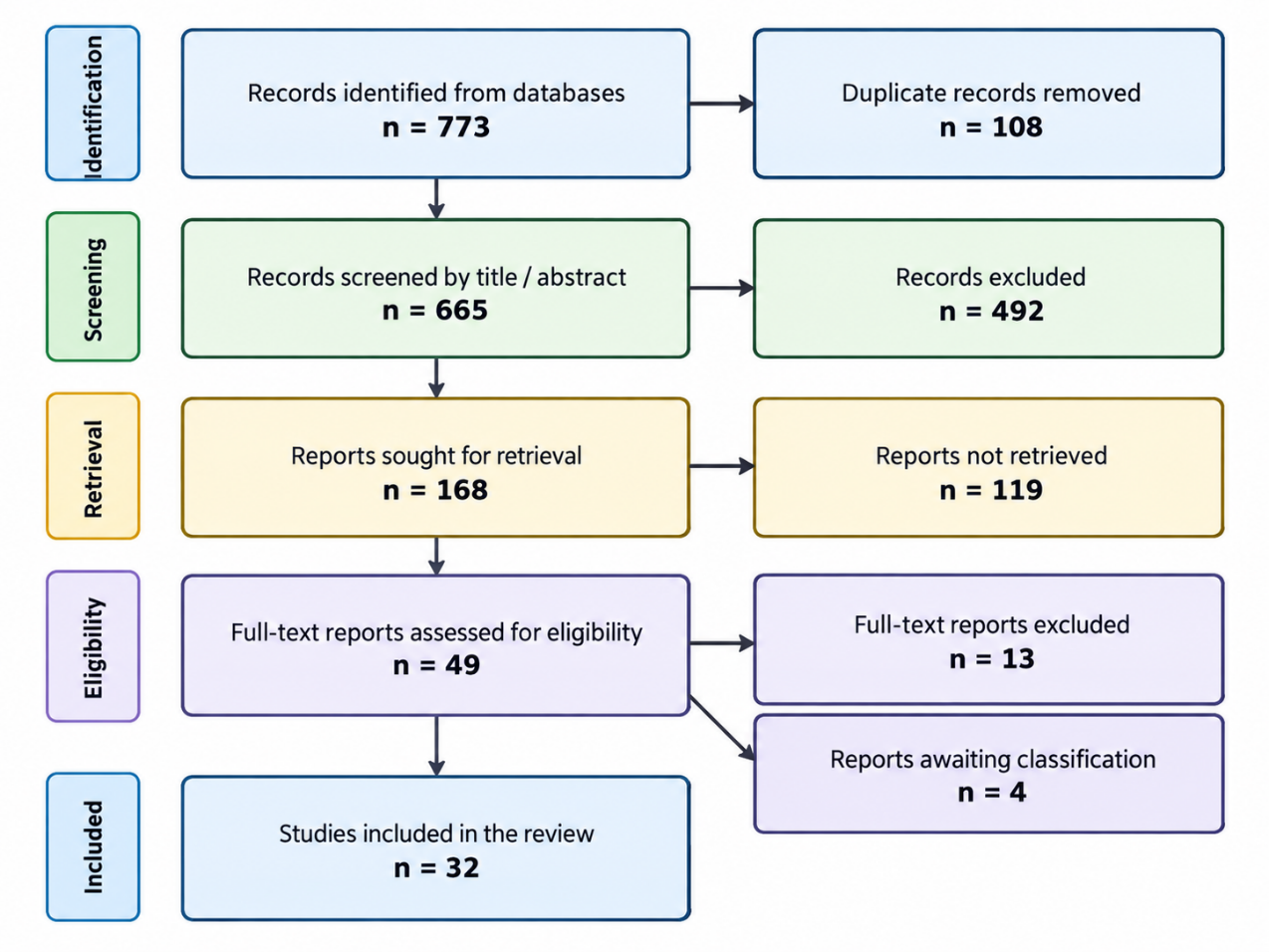
Retrieval produced 773 records. After 108 duplicate or truncated records were removed, 665 remained for title-and-abstract screening. Full texts were sought for potentially relevant reports, 49 were assessed for eligibility, and 32 studies met the inclusion criteria. The study-selection process is presented in Figure 1.
Data extraction covered platform, geographic and linguistic context, study design, field-site definition, sampling route, data types, treatment of feeds and algorithms, hashtags and sounds, researcher positionality, audiovisual and identity analysis, cross-platform comparison, ethics, consent, traceability, reproducibility, and reported limitations. Methodological appraisal focused on transparency of design, sampling rationale, treatment of algorithmic curation, ethical reporting, and acknowledgement of limitations.
Synthesis was thematic and comparative; no statistical pooling was attempted. Findings were organised around field-site anchoring and sampling, algorithmic inference and audiovisual participation, and ethics and traceability. Additional sources informed interpretation but were excluded from the included result set.
RESULTS
Characteristics and internal structure of the included studies
Field-site anchor | How the site is constituted | Typical sampling route | Illustrative included studies | Principal advantage | Characteristic constraint |
|---|---|---|---|---|---|
Feed-anchored (algorithmic) | The researcher's own feed or For You Page becomes the observational site, sometimes through a newly created account | Sustained immersion, field diary, inductive grouping of observed material | Schellewald (2021) (1); Abidin (2020) (2); Castaldi (2025) (18); Pauló (2025) (19); Hou (2022) (20) | Observes the platform as experienced and makes curation itself an object of analysis | Personalised and unstable; observation is difficult to reproduce |
Hashtag-, keyword- or audio-anchored corpus | The site is bounded by hashtags, keywords, audio repositories or sounds | Platform search, search-bar suggestions, audio-version mapping | Rascati and Grantham (2025) (4); Akib et al. (2025) (5); Backes (2026) (21) | Provides an explicit, reportable inclusion rule that limits reliance on the personalised feed | Excludes content that does not carry the marker and admits unrelated posts |
Account- or profile-anchored community | The site is bounded by a defined set of creators or accounts, identified either through platform suggestions, prior datasets, or an initial keyword search followed by community invitation | Snowball sampling, platform suggestions, follower or engagement thresholds, monitoring datasets, proactive community identification and consent | El Sayed and Hotait (2024) (22); Asrie and Priatna (2025) (23); Fan (2025) (24); Medeiros (2026) (7); Fatimatuzzahro and Achmad (2022) (hybrid keyword search plus community invitation) (25) | Enables community-level comparison and, in several designs, interviews | Bound to visible, often larger accounts, leaving peripheral participation out |
Live-event anchored | The site is bounded by live sessions and their interaction economies | Observation of sessions over weeks or months, sometimes combined with interviews | Cristea (2024) (8); Permatasari et al. (2026) (26); Xue (2025) (27) | Captures synchronous interaction, gifting, moderation and ranking pressure | Ephemeral and rarely archived; anonymisation and consent are difficult |
Multi-sited and cross-platform | The site is assembled across two or more platforms or comparable short-video systems | Parallel sampling per platform, with comparison criteria defined in advance | de la Fuente Prieto and Pérez Herranz (2026) (28); Fan (2025) (24); Xue (2025) (27); Pamungkas et al. (2026) (29); Purnomo et al. (2026) (30) | Enables infrastructural comparison of visibility, persistence and governance | Metadata asymmetries across platforms weaken comparability |
Study | Platform(s) | Context | Design | Data and sample | Key methodological feature |
|---|---|---|---|---|---|
de la Fuente Prieto and Pérez Herranz (2026) (28) | TikTok; Nostr | Spain-based team; content January–June 2025 | Content analysis plus digital ethnography | Six TikTok creator profiles and six Nostr user profiles; publicly available content | Predefined comparability criteria (visibility, engagement, reach, persistence); compliance with GDPR and AoIR guidelines; consent waived |
Ismail (2025) (17) | TikTok; YouTube | Papua and Maluku, Indonesia | Interpretive analytical essay, explicitly non-ethnographic | Purposive selection of viral songs and videos | Boundary case showing algorithmic visibility claims advanced without an ethnographic protocol |
Backes (2026) (21) | TikTok | Posts sampled from English- and German-language material; exploratory search conducted 3 July 2025 | Exploratory case study with platform-native search and computational collection | 72 audio versions identified; 10 selected; 500 posts; composite memetic exchanges as unit of analysis | Audio-repository mapping; no consent sought under national legislation; no usernames or screenshots published |
El Sayed and Hotait (2024) (22) | TikTok | Germany | Qualitative content analysis | 32 accounts; 320 videos | Snowball sampling of public accounts; automated scraping with manual transcription; data withheld to protect anonymity |
Schellewald (2021) (1) | TikTok | Researcher's For You Page; January–June 2020 | Digital ethnography with consolidating content analysis | 700 videos in 96 clusters | Spreadsheet field diary; navigation strategies against feedback loops; no downloading or storage |
Abidin (2020) (2) | TikTok; Douyin | Seven Asian countries; industry sites in five cities | Digital ethnography with participant observation and interviews | 23 interviewees from 14 agencies or firms and five influencer profiles | Sustained immersion, walkthrough of both apps, post-based virality and visibility labour |
Schellewald (2021, AoIR) (3) | TikTok | Greater London | Digital ethnography of the app with semi-structured interviews | 30 young adults; fieldwork of roughly one and a half years | Feed as field site; passive consumption; accounts of adjusting behaviour to be "seen" |
Locke (2023) (31) | TikTok | Online and offline settings | Ethnographic fieldwork with netnographic engagement | ADHD-related content and comment threads; no fixed sample reported | Vernacular anthropology framing; anonymised reproduction of user comments |
Rascati and Grantham (2025) (4) | TikTok (#BookTok) | United States; predominantly English | Mixed-methods digital ethnography with content analysis | 200 videos; crosstabulations and chi-square tests | Hashtag-bounded sample with explicit discussion of hashtag bias and exclusion |
Hewlett-Hall (2023) (32) | TikTok | United Kingdom; COVID-19 period | Autoethnography | Author's own use and participation in a research collective | Reflective account; a collective treated as fieldwork infrastructure |
Asrie and Priatna (2025) (23) | TikTok | Indonesia | Digital ethnography with qualitative content analysis | 10 accounts observed over three months | Purposive sampling with follower and engagement thresholds; method triangulation |
Akib et al. (2025) (5) | TikTok; Instagram Reels; YouTube Shorts | Indonesia; January–June 2024 | Digital discourse analysis and virtual ethnography | 300 videos from 30 accounts | Hashtag-based purposeful sampling; multimodal critical analysis |
Purnomo et al. (2026) (30) | TikTok; Instagram Reels | Indonesia | Phenomenological study with virtual ethnography | 34 students; interviews and observation | Cyber-Tabayyun framing; algorithmic curation as "spiritual curator" |
Pamungkas et al. (2026) (29) | TikTok; YouTube | Indonesia | Virtual ethnography with content analysis | Observation of accounts and comment threads | Digital trace documentation; algorithmic dynamics of FYP and recommendations |
Holroyd (2025) (33) | TikTok | United States | 18-month digital ethnography with multimodal and techno-cultural critical discourse analysis | ADHD TikTok videos and comments | Techno-cultural authority framework; platform affordances as non-human actor |
Muhsyanur et al. (2025) (6) | TikTok | Indonesia; March–October 2024 | Digital ethnography, multimodal discourse analysis, interviews | 75 videos from 25 creators; 15 interviews | Purposive sampling via trending hashtags and FYP; member-checking |
Fan (2025) (24) | TikTok; Douyin | Cross-cultural | Qualitative netnographic comparative case study | Five food creator accounts; video, caption and comment analysis | ATLAS.ti coding; comparative platform analysis |
Razemi et al. (2026) (34) | TikTok | Malaysia | Phenomenological study with digital ethnographic observation | 12 informants; interviews and online observation | NVivo 14 coding; overt and covert observation of public content |
Cristea (2024) (8) | TikTok | Romania and Germany | Digital ethnography with semi-structured interviews | Three influencers; six months of observation | Participatory, non-participatory and undercover observation of live sessions |
Castaldi (2025) (18) | TikTok | Multi-language corpus | Digital ethnography | Approximately 40 videos across four datasets | New account created to avoid prior algorithm influence; hashtag and search-bar sampling |
Ismail et al. (2025) (9) | TikTok; Instagram; Kitabisa | Indonesia | Digital ethnography with semi-structured interviews | Fifteen viral philanthropic campaigns; donor interviews | Thematic analysis; platform capitalism and moral giving framing |
Miliana (2026) (35) | TikTok | Indonesia | Digital anthropology with observation and interviews | Five active users aged 18–24 | Algorithmic personalisation and digital status symbols |
Permatasari et al. (2026) (26) | TikTok Live | Indonesia; March–May 2025 | Virtual ethnography with thematic content analysis | One focal case; 40+ livestream sessions | Theoretical sampling; anonymisation; no written informed consent |
Xue (2025) (27) | Douyin; Bilibili; Kuaishou | China; January 2022–June 2024 | Digital ethnography, interviews, content and discourse analysis | 180+ videos and livestreams; 20 interviews | Purposive sampling; metadata documentation; screenshots and transcripts |
Pauló (2025) (19) | TikTok | Hungary | Qualitative content analysis with Goffmanian dramaturgy | 25 creators; 1,221 videos | New account to reduce bias; age verification; usernames not disclosed |
Nainggolan et al. (2026) (36) | TikTok | Indonesia | Qualitative interpretative case study | 12 participants; observation and interviews | Multimodal critical discourse analysis; NVivo 14; trustworthiness criteria |
Martínez-Borda et al. (2026) (37) | TikTok | Spain-based team | Exploratory mixed-methods with scraping and multimodal narrative analysis | 1,497 videos initially extracted | Apify scraping; hashtag co-occurrence in Tableau; Transana analysis |
De Leyn et al. (2021) (38) | TikTok | Flanders, Belgium | Qualitative interview study with media go-along | 20 interviews across 10 households; 12 tweens and 13 parents | Informed consent from children and parents; ethics committee approval |
Fatimatuzzahro and Achmad (2022) (25) | TikTok | Indonesia; 18 provinces | Virtual ethnography | Eight TikTok users; interviews and observation | Five-stage virtual ethnography; community identified through TikTok search and then invited; multimodal text as unit of analysis |
Medeiros (2026) (7) | TikTok | Argentina, Brazil, Chile, Colombia, Mexico | Ethnographic and observational study with critical audiovisual analysis | 20 creators; 130 videos initially; 40 analysed | Ongoing ethnography; asynchronous multimedia observation |
Nurhayati and Putri (2024) (10) | TikTok | Indonesia | Virtual ethnography with four levels of cyber media analysis | Observation over two to three months; virtual interviews | Source triangulation with language experts |
Hou (2022) (20) | Kwai | Rural China; September 2021 | Digital ethnography with digital discourse analysis | 50 influencers initially; 10 selected; 72 videos for thematic analysis | New account; algorithmic curation relied upon; screenshots and downloads to secure drive |
Field-site anchoring and sampling
Across the 32 included studies, field sites were actively assembled. Five recurring anchors organised this work, and Table 1 sets out their comparative properties. Feed-anchored designs treated the researcher's own For You Page as the observational site, sometimes through a newly created account intended to reduce prior algorithmic influence.(1,18,19) Schellewald's six-month fieldwork kept a spreadsheet field diary and used deliberate navigation strategies to avoid feedback loops, treating the feed itself as the object of analysis.(1) Abidin combined sustained immersion with a walkthrough of TikTok and Douyin, situating the feed within a broader attention economy.(2) Castaldi created a new account specifically to avoid the influence of an existing one, and Pauló did the same to reduce bias from prior browsing history.(18,19) Hou relied on algorithmic curation to recommend similar videos after an initial keyword search, narrowing a group of 50 influencers to 10 cooperating with a single beauty brand.(20)
Hashtag-, keyword- and audio-anchored corpora provided an explicit and reportable inclusion rule that limited reliance on the personalised feed.(4,5,21) Backes mapped 72 distinct audio versions of a single song through platform-native search and selected ten for computational collection, treating composite memetic exchanges rather than individual posts as the unit of analysis.(21) Rascati and Grantham bounded their sample to the first posts under #BookTok and discussed the resulting hashtag bias explicitly.(4) Akib et al. used main hashtags to purposively sample 300 videos from 30 accounts across three short-video platforms.(5)
Account- and profile-anchored communities bounded the site by a defined set of creators, using snowball sampling, platform suggestions, follower or engagement thresholds, prior monitoring datasets, or a hybrid route in which the community was first identified through platform search and its members then invited to participate.(7,22-25) El Sayed and Hotait snowballed 32 public accounts and scraped 320 videos.(22) Asrie and Priatna required a minimum of 10,000 followers and an engagement rate of at least 2% for inclusion.(23) Fan selected five food creator accounts spanning a wide follower range for cross-platform comparison.(24) Medeiros analysed 40 videos from 20 creators across five Latin American countries.(7) Fatimatuzzahro and Achmad identified their community proactively through TikTok search before obtaining permission and inviting informants, so that keyword search functioned as an entry point to an account-based community without making keyword search the boundary of the study material itself.(25)
Live-event-anchored designs bounded the site by live sessions and their interaction economies.(8,26,27) Cristea observed live sessions for six months while using the app for roughly two hours daily, combining participatory, non-participatory and undercover observation with interviews.(8) Permatasari et al. documented more than 40 livestreaming sessions in field notes and selected a single information-rich case through theoretical sampling.(26) Xue observed Buddhist ritual content across three Chinese platforms over two and a half years, documenting metadata, screenshots and transcripts.(27)
Multi-sited and cross-platform designs assembled the site across two or more platforms or comparable short-video systems, with comparison criteria defined in advance.(24,27-30) De la Fuente Prieto and Pérez Herranz operationalised comparability through four criteria—visibility, engagement, reach and persistence—and compared TikTok with the decentralised protocol Nostr.(28) Xue compared Douyin, Bilibili and Kuaishou, noting how each platform's affordances shaped ritual content differently.(27) Pamungkas et al. and Purnomo et al. each combined TikTok with a second platform to examine religious content and digital literacy respectively.(29,30)
Sampling within these anchors remained predominantly hashtag- and account-centric. Network-based strategies were rare, and this is recorded as a coded extraction result: no included study reported co-hashtag network analysis as a sampling strategy, and the core studies relied overwhelmingly on purposive, snowball or threshold-based selection.(6,22,23) Muhsyanur et al. sampled 25 creators through trending hashtags and the For You algorithm, then selected three viral videos per creator exceeding 500,000 views.(6) Razemi et al. reached informants through TikTok itself and combined overt and covert observation of publicly available content.(34) Several studies reported explicit thresholds: minimum follower counts, minimum engagement rates, or minimum view counts.(6,23) Others relied on platform suggestions and snowballing from initial seeds.(22,23) The consequence, acknowledged across multiple studies, is that peripheral, low-engagement and non-hashtagged participation is systematically under-represented.(4,19,21)
Algorithmic curation, participation and identity
Algorithmic curation was almost always reconstructed inferentially from visible artifacts or from the researcher's own feed. No included study accessed proprietary recommendation systems. Instead, studies inferred curation from ranking pressure, gift prompts, PK battles, search-bar suggestions, co-occurrence patterns, or the researcher's own experience of personalisation.(3,18,26,37) Schellewald's interview study documented participants describing recommendations as "scarily precise" and adjusting their behaviour to be "seen" more easily by the algorithm, revealing a tension between pleasure and surveillance.(3) Permatasari et al. analysed only visible artifacts of platform logic—ranking pressure, PK competition, gift-giving prompts, recurring content formats—rather than the proprietary algorithm itself.(26)
Martínez-Borda et al. combined scraping, hashtag co-occurrence analysis and engagement metrics with multimodal narrative analysis, finding that the relationship between number of hashtags and engagement is non-linear and that reach depends on relevance and combination strategy not sheer volume.(37) De la Fuente Prieto and Pérez Herranz framed differences between TikTok and Nostr as infrastructural, shaping what becomes visible, how meanings are negotiated and which forms of participation are possible.(28) Several studies treated algorithmic curation as a condition to be navigated rather than a mechanism to be exposed, using concepts such as "infrastructure of feeling", "algorithmic agency" and "spiritual curators".(21,30,31)
Audiovisual participation and identity were analysed through multimodal, memetic and performative lenses. Backes identified four recurring affective registers through which a single song was taken up and made meaningful, treating audio memes as affective repertoires that render feminist meanings recognizable, repeatable and economically legible.(21) Abidin showed that fame and virality on TikTok tend to be based on the performance of individual posts rather than a coherent persona, with audio memes as the driving template and transitions as markers of technical expertise.(2) El Sayed and Hotait found that Muslim women creatively used TikTok's functionalities, with the hijab emerging as a unique issue framed within both political and fashion discourses, and TikTok functioning as a "third space".(22)
Muhsyanur et al. identified four linguistic identity negotiation strategies—strategic multilingualism, cultural-linguistic hybridization, performative authenticity and audience-adaptive communication—evident in 68% of videos for multilingualism and 55% for hybridized constructions.(6) Medeiros found that metaltok communities were shaped by the videos produced, published, shared and reacted to, with taste disputes and gender negotiation unfolding through comedic language and audiovisual contrast.(7) Permatasari et al. showed how femininity was produced through repeated, culturally legible acts combining domestic clothing, makeup, beauty filters, soft speech and affective responsiveness, with modesty becoming part of the frame that made sexualized attention more acceptable.(26) Xue documented how Buddhist rituals were visually re-encoded, temporally fragmented and sonically enhanced, with lay users gaining ritual legitimacy through media fluency and follower metrics rather than institutional lineage.(27) Pauló identified five distinct online personas among Hungarian-speaking creators over sixty, with gender differences in content focus and class position inferable from technical solutions, clothing and setting.(19)
Ethics, consent, traceability and reproducibility.
Ethics were unevenly documented. Anonymisation was common: studies removed usernames, paraphrased quotes, avoided embedding screenshots, or withheld transcriptions to protect anonymity.(19,21,22,26) Consent was frequently waived or absent. De la Fuente Prieto and Pérez Herranz stated that consent was waived under national legislation and institutional requirements, relying on publicly available data, anonymisation and GDPR compliance.(28) Backes stated that no informed consent was obtained because it was not required under national legislation and institutional requirements, and avoided reproducing identifiable content.(21) Permatasari et al. explicitly noted that no written informed consent was obtained, while also noting that public availability of content does not remove ethical responsibility.(26)
De Leyn et al. obtained written informed consent from both children and parents and secured ethics committee approval, providing a contrast to the waiver-based approaches.(38) Razemi et al. used both overt (consented) and covert (publicly accessible data) techniques and acknowledged that covert observation raises questions about privacy and informed consent.(34) Cristea reported ethical concerns due to the researcher's unseen presence during live streams and noted difficulty maintaining total anonymity because the app allows personal characteristics to form the core of one's virtual identity.(8)
Traceability and reproducibility were constrained by feed instability, language asymmetries and metadata gaps. De la Fuente Prieto and Pérez Herranz noted structural asymmetry in metadata: TikTok offers detailed engagement metrics while Nostr lacks homogeneous reach indicators, so comparison focused on content and authorship structures instead of performance metrics.(28) Backes noted that the sampling strategy entails the possibility that some high-engagement posts were not encountered due to opaque curation logics, and that the affective registers identified are historically contingent.(21) El Sayed and Hotait stated that text data such as transcriptions and video descriptions would not be shared to preserve anonymity, limiting reproducibility.(22) Pauló noted that the classification reflects the researcher's reading of patterns and that it is unclear whether other researchers would apply the typology similarly.(19) Martínez-Borda et al. described phases and tools but did not report traceability or reproducibility protocols beyond that.(37) Several studies acknowledged that a different sampling strategy—foregrounding low-engagement posts, further languages, or marginal uses—would likely surface alternative findings.(4,19,21)
DISCUSSION
The analysis examined how netnographic and digital ethnographic studies of TikTok and comparable algorithmic short-video environments construct field sites, sample communities and trends, interpret algorithmic curation, analyse audiovisual participation and identity, and address ethics, consent, traceability and reproducibility. The findings show a literature that has matured methodologically but lacks shared reporting standards for personalisation, algorithmic inference and consent. The discussion below compares these core findings with supporting literature and identifies unresolved problems.
The finding that field sites are actively assembled resonates with supporting work on researcher positionality and experimental digital ethnography. Zhao's account of creating 50 TikTok videos as a content creator in Uzbekistan describes a dual role as agent and object of observation, challenging conventional research gazes and relationships.(39) This parallels the core studies' use of newly created accounts to reduce prior algorithmic influence (18,19) and extends the logic further: if the researcher's own activity shapes the field, then the researcher's activity can itself become a deliberate methodological instrument. The supporting literature on algorithmic imaginaries similarly shows that users develop stories about algorithms that shape how they act and what they expect,(11,12) and core studies document this sense-making in practice.(3,31) The implication is that field-site construction in algorithmic environments is more than a matter of access; it is also a question of positioning: the researcher must decide whether to observe the feed as a user, to cultivate a niche profile deliberately, or to bound the site through external markers such as hashtags or accounts.
Three of the supporting records are not external context in the usual sense but are themselves digital ethnographies of TikTok or TikTok-adjacent platforms: Zhao's experimental digital ethnography conducted in the role of a TikTok content creator,(39) Grison's digital ethnography of algorithmic bypass on "gay TikTok",(13) and Shi's ethnography of LGBTQ+ content creators on Bilibili, Douyin and Xiaohongshu.(14) Because they are held in the supporting library and not in the core evidence library, the comparison in this review is between core findings and directly comparable designs that were not carried into the included set. This is a reporting boundary of the present review rather than a claim that the supporting studies are substantively different in kind, and it means that the prevalence claims made in the Results rest on a core set that omits some directly relevant digital ethnographies of the same platform family.
The finding that sampling remains hashtag- and account-centric, with network-based strategies rare, is thrown into relief by supporting work that uses co-hashtag networks to augment netnography. Wang and Ringland analysed hashtag use in 3,752 publicly available TikTok videos from 41 autistic creators and conducted in-depth analysis of 55 videos, demonstrating how co-hashtag networks can provide a broader perspective on online discourse while depicting detailed contexts.(16) This approach addresses a limitation acknowledged across core studies: that hashtag-bounded samples exclude content that does not carry the marker and admit unrelated posts.(4,21) Network-based sampling also offers a route to capturing peripheral participation that threshold-based and account-anchored designs systematically miss.(6,23) The core literature's reliance on purposive and snowball sampling is understandable given the opacity of platform populations, but the supporting literature suggests that network-based strategies are feasible and underused.
The finding that algorithmic curation is almost always reconstructed inferentially from visible artifacts or from the researcher's own feed is consistent with supporting work on algorithmic bypass and platform affordances. Grison's digital ethnography of the "gay TikTok" used a method of "growing a niche algorithm" to study content recommendation and invisibilisation, proposing a typology of platform affordances through sound, text and image.(13) Shi's study of LGBTQ+ content creators in China identified three strategies—camouflaging, filtering and verticalizing—through which creators navigate digital normativity, introducing "workarounds" as a framework that transcends binary perspectives of conformity and resistance.(14) These supporting studies show that algorithmic inference can be systematised through deliberate experimental manipulation of the researcher's own feed, a strategy that core studies mention but rarely formalise.(18,19) The core literature's inferential approach is not a weakness per se—proprietary systems are not accessible—but the absence of shared protocols for documenting and reporting algorithmic inference limits cumulative appraisal.
The finding that audiovisual participation and identity are analysed through multimodal, memetic and performative lenses aligns with supporting work on virality and embodied participation. Fatmawati et al. proposed "choreographies of contagion" as a framework for analysing viral dance challenges as structured, distributed performances, using kinesic analysis and reflexive thematic analysis of 500 videos and 20,000 comments.(40) This framework moves beyond treating trends as mere content, examining the interplay between movement, affect and algorithmic architecture—an approach that resonates with Backes's analysis of affective registers and Abidin's account of audio memes as organising principles.(2,21) The supporting literature on BookTok reading communities similarly shows how young people use TikTok to connect around books, blending analog and digital media tools to make reading social and fun.(41) These studies suggest that the core literature's focus on identity and participation could be enriched by greater attention to the embodied and affective dimensions of platformed practice.
The finding that ethics are unevenly documented, with anonymisation common and consent frequently waived or absent, is contextualised by supporting work on the methodological and ethical implications of experimental digital ethnography. Zhao's account delves into ethical implications revolving around potential physical and mental risks to researchers, challenges related to the re-definition of research participation, and issues pertaining to obtaining informed consent.(39) The supporting literature on trans TikTok research used a digital ethnographic methodology in which the research team created an account and curated the For You Page by engaging in trans-related content, collecting the first 150 videos that appeared.(42) This approach raises questions about consent and traceability that core studies also confront.(8,34) The core literature's reliance on consent waivers is often justified by national legislation and institutional requirements,(21,28) but the supporting literature indicates that covert observation and research with marginalised communities are precisely the settings in which consent and traceability reporting is least settled.(14,34)
The finding that reproducibility is constrained by feed instability, language asymmetries and metadata gaps is echoed in supporting work on platform-specific dynamics. Li's multi-sited digital ethnography on Douyin across five Chinese cities shows how algorithmic curation governs city visibility and how users develop tactics and literacy that shape everyday citymaking.(43) Sun and Ding's study of herstory content on Douyin develops the concept of "popular resistance" to capture how feminist expression gains visibility while remaining entangled with algorithmic, commercial and political infrastructures.(44) Li and Jiang's study of feminist livestreaming on Douyin analyses 30 hours of livestreams and 150 clipped videos, showing how fan-operated "clipped accounts" preserved and recirculated content after platform deletion.(45) These supporting studies demonstrate that reproducibility challenges are not unique to TikTok but characterise algorithmic short-video environments more broadly, and that distributed preservation and tactical remixing can partially mitigate them.
Future research should address the gaps identified by these findings. Comparative, multi-sited and network-based designs remain the least developed approaches. Studies that deliberately cultivate niche recommendation profiles, that use co-hashtag networks to capture peripheral participation, and that formalise protocols for documenting algorithmic inference would strengthen the evidence base. Research with marginalised communities should report consent, anonymisation and traceability procedures explicitly, building on the examples provided by studies that obtained informed consent from children and parents (38) and by supporting work that reflects on researcher positionality and risk.(39) Longitudinal designs would help assess the persistence of tactics and the stability of findings over time.(37) Cross-platform comparison would benefit from shared reporting standards for metadata asymmetries and from explicit criteria for comparability.(28)
Limitations
Full-text retrieval was incomplete, and a substantial proportion of potentially relevant reports could not be assessed in full. This may have introduced availability bias and limits the extent to which the included studies represent all digital ethnographic research on short-video platforms. Coverage was also dependent on the databases and discovery sources used, and the linguistic composition of the included literature was not systematically quantified.
The included studies were methodologically heterogeneous and often relied on platform-specific, hashtag-based, or account-based sampling. Network-based and cross-platform designs were less common, which limits comparisons across different forms of platform participation. Methodological appraisal used domains instead of a single appraisal instrument, so the synthesis is best interpreted as a comparison of reported practices and recurring gaps, not as a formal estimate of study quality.
CONCLUSIONS
Digital ethnography on algorithmic short-video platforms shows that the field is actively constructed through feeds, hashtags, sounds, accounts, live events, and cross-platform connections and is not encountered as a stable bounded community. Personalised recommendation systems also make the researcher's own account history and interaction patterns part of the conditions under which the field becomes visible.
Across the literature, sampling and interpretation are more developed than the reporting of algorithmic inference, consent, and traceability. Hashtag- and account-centred designs remain common, while network-based, comparative, and explicitly multi-sited approaches are less established.
Future studies would benefit from clearer documentation of feed personalisation, sampling decisions, researcher positionality, consent procedures, and the limits of reproducibility in dynamic platform environments. These practices would strengthen methodological transparency without assuming that algorithmic systems can be fully observed or reproduced.
References
- 1 Andreas Schellewald. Communicative Forms on TikTok: Perspectives From Digital Ethnography. Goldsmiths (University of London). 2021.
- 2 Abidin C. Mapping Internet Celebrity on TikTok: Exploring Attention Economies and Visibility Labours. Cultural Science Journal. 2020;12(1):77-103. doi: 10.5334/csci.140..
- 3 Schellewald A. On getting carried away by the tiktok algorithm. AoIR Selected Papers of Internet Research. 2021. doi: 10.5210/spir.v2021i0.12039..
- 4 Rascati D, Grantham S. Bestseller best Practices: A digital ethnography of #BookTok content on TikTok. Journal of Social Media Research. 2025;2(2):139-154. doi: 10.29329/jsomer.26..
- 5 Akib M, Fauziyah NN, Hasanah I. Digital authority under algorithmic control. TAJDID: Jurnal Ilmu Ushuluddin. 2025;24(2):705-738. doi: 10.30631/tjd.v24i2.5245..
- 6 Muhsyanur M, Sudikan SY, Murugesa M. Linguistic identity negotiation on tiktok: glocal practices of indonesian content creators. LiNGUA: Jurnal Ilmu Bahasa dan Sastra. 2025;20(2):85-97. doi: 10.18860/ling.v20i2.32574..
- 7 Medeiros B. Entering the metal(tok) scene: community, cultural identity, and latin american creators. AoIR Selected Papers of Internet Research. 2026. doi: 10.5210/spir.v2024i0.15247..
- 8 Cristea CO. The Political Economy of the Gifts on Tiktok. Sociologie Romaneasca. 2024;22(2):29-50. doi: 10.33788/sr.22.2.2..
- 9 Ismail M, Asrori S, Ahmad Shabbir. Commodified Compassion: Platform Capitalism and Moral Giving in Indonesian Digital Philanthropy. Dialog. 2025;48(2):299-313. doi: 10.47655/dialog.v48i2.1210..
- 10 Nurhayati IK, Putri AR. Exploring Cyberculture: A Virtual Ethnographic Perspective on Generation Z Slang on TikTok. Jurnal Sosioteknologi. 2024;23(3):400-415. doi: 10.5614/sostek.itbj.2024.23.3.8..
- 11 Schellewald A. Theorizing “Stories About Algorithms” as a Mechanism in the Formation and Maintenance of Algorithmic Imaginaries. Social Media + Society. 2022;8(1). doi: 10.1177/20563051221077025..
- 12 Schellewald A. Understanding the popularity and affordances of TikTok through user experiences. Media, Culture & Society. 2023;45(8):1568-1582. doi: 10.1177/01634437221144562..
- 13 Grison T. Playing Hide and Seek with Algorithms in the “Gay TikTok”: From Shadowbanning to Platform Affordances. Online Virality. 2024. doi: 10.1515/9783111311371-013..
- 14 Shi J. Queering algorithms: LGBTQ+ content creators’ non-conforming and non-confronting workarounds to digital normativity in China. Convergence: The International Journal of Research into New Media Technologies. 2024;31(3):728-751. doi: 10.1177/13548565241299281..
- 15 Hiebert A, Kortes-Miller K. Finding home in online community: exploring TikTok as a support for gender and sexual minority youth throughout COVID-19. Journal of LGBT Youth. 2021;20(4):800-817. doi: 10.1080/19361653.2021.2009953..
- 16 Wang Y, Ringland KE. Weaving Autistic Voices on TikTok: Utilizing Co-Hashtag Networks for Netnography. Computer Supported Cooperative Work and Social Computing. 2023. doi: 10.1145/3584931.3606995..
- 17 Ismail A. Sounding identity in the digital age: Eastern Indonesia’s musical voices on Tiktok. Frontiers in Communication. 2025;10. doi: 10.3389/fcomm.2025.1651788..
- 18 Castaldi M. TikTok narratives of global social anxieties: FoMO, FoBO and fear of being seen. Journal of Social Media Research. 2025;2(5):435-443. doi: 10.29329/jsomer.66..
- 19 Pauló E. Older TikTokers in Digital Capitalism. Persona Studies. 2025;11. doi: 10.21153/psj2025vol11noart2177..
- 20 Hou M. Beauty Influencers on Short Video Platform Kwai: The Postfeminist Media Culture in Rural China. European Conference on Social Media. 2022;9(1):65-73. doi: 10.34190/ecsm.9.1.146..
- 21 Backes A. From embodied dissent to commodified affect: an audio meme as feminist affective repertoire on TikTok. Frontiers in Computer Science. 2026;8. doi: 10.3389/fcomp.2026.1724158..
- 22 El Sayed F, Hotait N. Exploring the role of TikTok for intersectionality marginalized groups: the case of Muslim female content creators in Germany. Frontiers in Political Science. 2024;6. doi: 10.3389/fpos.2024.1496833..
- 23 Asrie RAM, Priatna WB. Digital Communication Strategies of Homeless Accounts In Building Engagement on Tiktok Platform. Communica: Journal of Communication. 2025;4(1):1-11. doi: 10.61978/communica.v4i1.1179..
- 24 Fan P. From Consumers to Pro-sumers: Understanding Cross-Cultural Content Creation and Value Production on TikTok and Douyin. Communications in Humanities Research. 2025;61(1):85-93. doi: 10.54254/2753-7064/2025.21364..
- 25 Fatimatuzzahro F, Achmad ZA. What If It Was You (#WIIWY) digital activism on TikTok to fight gender-based violence online and cyberbullying. Masyarakat, Kebudayaan dan Politik. 2022;35(4):450-465. doi: 10.20473/mkp.v35i42022.450-465..
- 26 Delmarrich Bilga Ayu Permatasari, Subiakto H, Wahyudi I. Commodifying Femininity: Gender Performativity of Female Host on TikTok Live Indonesia. MEDIASI Jurnal Kajian dan Terapan Media, Bahasa, Komunikasi. 2026;7(2):126-134. doi: 10.46961/mediasi.v7i2.2021..
- 27 Xue X. The Digital Reproduction Mechanisms of Buddhist Rituals in Mobile Media Environments. Studies on Religion and Philosophy. 2025;1(2):46-62. doi: 10.71204/ftq1ev54..
- 28 de la Fuente Prieto J, Pérez Herranz C. Comparative analysis of digital practices related to cultural heritage on TikTok and Nostr. Frontiers in Computer Science. 2026;8. doi: 10.3389/fcomp.2026.1748070..
- 29 Pamungkas J, Azis Prastica, Imam Sholikhuddin. Ruang Keagamaan Digital: Persepsi Pengguna TikTok dan Youtube terhadap Konten Gus Baha. RISOMA : Jurnal Riset Sosial Humaniora dan Pendidikan. 2026;4(2):105-125. doi: 10.62383/risoma.v4i2.1577..
- 30 Purnomo D, Utaberta N, Ali M, Hidayat A. Digital literacy of vocational school students in cyber tabayyun on TikTok and Instagram dakwah content. Tawazun: Jurnal Pendidikan Islam. 2026;19(2):467-388. doi: 10.32832/tawazun.v19i2.23705..
- 31 Austin Locke T. In the Cracks of Attention: ADHD, Vernacular Anthropologies and Communities of Care on TikTok. Teaching Anthropology. 2023;12(1):23-35. doi: 10.22582/ta.v12i1.683..
- 32 Hewlett-Hall J. Folklore, Storytelling and Coping with the Internet on TikTok. Teaching Anthropology. 2023;12(1):48-60. doi: 10.22582/ta.v12i1.680..
- 33 Holroyd D. Content creators vs the healthcare industry: a case study of the techno-cultural authority of adhd tiktok. AoIR Selected Papers of Internet Research. 2025. doi: 10.5210/spir.v2024i0.13962..
- 34 Razemi MS, Mahamad TET, Yassin YM. Understanding escapism as a key motivation behind generation z’s engagement in tiktok hashtag trends. Quantum Journal of Social Sciences and Humanities. 2026;7(SI1):82-93. doi: 10.55197/qjssh.v7si1.1193..
- 35 Afina Fahru Miliana. When Algorithms Drive Your Life : TikTok, Identitas, dan Simbol Status dalam Perspektif Antropologi. Harmoni: Jurnal Ilmu Komunikasi dan Sosial. 2026;4(1):71-81. doi: 10.59581/harmoni-widyakarya.v4i1.6099..
- 36 Salsah Br Nainggolan, Yosi Evelyn Tondang, Putri Naira, Joice Stefanie Ginting, Dinda Rahmadani, Muhammad Natsir. Multimodal Critical Discourse Analysis of Educational TikTok Content: Knowledge Representation in the Short Video Era. International Journal of Education and Literature. 2026;5(1):171-179. doi: 10.55606/ijel.v5i1.361..
- 37 Martínez-Borda R, Rubio-López N, Infante-Pineda S, Lacasa P. Hashtags and resistance on TikTok: cultural, discursive, and algorithmic dimensions. Frontiers in Communication. 2026;11. doi: 10.3389/fcomm.2026.1687271..
- 38 De Leyn T, De Wolf R, Vanden Abeele M, De Marez L. In-between child’s play and teenage pop culture: tweens, TikTok & privacy. Journal of Youth Studies. 2021;25(8):1108-1125. doi: 10.1080/13676261.2021.1939286..
- 39 Zhao Y. TikTok and Researcher Positionality: Considering the Methodological and Ethical Implications of an Experimental Digital Ethnography. International Journal of Qualitative Methods. 2024;23. doi: 10.1177/16094069231221374..
- 40 Anies Fatmawati, Henrietta Noir, Shasa Indriyani, Jujuk Maryati, Fakhrul Setiobudi. Choreographies of Contagion: Mapping Virality and Performative Identity on TikTok. Enigma in Cultural. 2025;3(1):1-14. doi: 10.61996/cultural.v3i1.100..
- 41 Martens M, Balling G, Higgason KA. #BookTokMadeMeReadIt: young adult reading communities across an international, sociotechnical landscape. Information and Learning Sciences. 2022;123(11/12):705-722. doi: 10.1108/ils-07-2022-0086..
- 42 Paciente R, Kouznetsova E, Shrimali T, Strauss P, Lombardi K, Woolard A. #TransTok: A digital ethnographic study using content analysis to investigate transgender and gender diverse ‘for you page’ content on TikTok that may affect mental health. International Journal of Transgender Health. 2025;27(2):957-972. doi: 10.1080/26895269.2025.2492613..
- 43 Li X. Manufacturing the influencity: short-form video and the politics of visibility in China’s new first-tier cities. Geoforum. 2025;167:104481. doi: 10.1016/j.geoforum.2025.104481..
- 44 Sun Q, Ding R. When Herstory Goes Viral: Popular Resistance in the State-Platform Nexus in China. Social Media + Society. 2026;12(3). doi: 10.1177/20563051261472347..
- 45 Li S, Jiang Y. Digital sisterhood: Live streaming feminism and network resilience in China. Women's Studies International Forum. 2026;116:103302. doi: 10.1016/j.wsif.2026.103302..
Declarations
Funding
No financing.
Conflict of interest
None.
Authorship contributions
Drafting – original draft: Carlos Alberto Gómez Cano, Verenice Sánchez Castillo.
Writing–review and editing: Carlos Alberto Gómez Cano, Verenice Sánchez Castillo.