
Abstract
This article describes some of the infra-political practices and discourses of the metal community in the Facebook group Mundo Rock Cubano (Cuban Rock World) in the context of the multidimensional crisis in Cuba (2020-2024). In a context marked by historical censorship and state regulation of cultural otherness, the article explores the subtle, everyday, and non-confrontational ways in which this virtual community negotiates its symbolic space and reaffirms its cultural identity in the digital environment. The research is based on a qualitative methodology that combines digital ethnography with non-directive interviews with active members of the group. This approach allows us to capture the communicative dynamics and strategies of symbolic resistance that manifest infrapolitics as a form of cultural resistance. Thus, we identify everyday practices that are expressed through discourses, symbols, codes, and narratives that creatively and discreetly challenge official cultural restrictions and policies. In addition, it examines how digital platforms, particularly Facebook, enable spaces for culturally marginalized communities to meet and express themselves, promoting the circulation of ideas and the construction of alternative identities in authoritarian contexts. Ultimately, it provides a greater understanding of cultural resistance in digital spaces and contributes to studies on infrapolitics in contexts of high political and cultural regulation.
Keywords
Heavy Metal, Infrapolitics, Cuban Rock Scene, Digital Ethnography, Cultural Resistance
INTRODUCTION
This research aims to understand how the metal community of the Facebook group Mundo Rock Cubano negotiates and resists, through infrapolitical practices, the forms of cultural regulation imposed by the State within the framework of the Cuban multidimensional crisis (2020-2024).
To situate this scenario, it is necessary to remember that Cuban cultural institutionalization, although it guaranteed broad achievements in terms of access and artistic promotion, has also been sustained by policies of censorship and marginalization toward expressions considered alien to the revolutionary narrative and its values. Thus, during the decades of 1960 and 1970, rock and later metal were stigmatized as symbols of imperialist influence; and their followers faced school and workplace expulsions, forced haircuts, police harassment, censorship, concert cancellations, and public discrediting campaigns.(1,2,3)
Despite this, the community did not cease in its efforts, and given the cultural boom of the 90s, the authorities opted for the path of institutionalization through the Agencia Cubana de Rock, created in 2007 as an artistic representation company. This opening, however, became a double-edged sword: it provided resources and spaces for bands, but at the same time limited cultural autonomy and called into question the transgressive, contestatory, and underground essence of metal. With the recent crisis, tensions between the scene and institutional structures have intensified: resources are reduced, pressures regarding profitability grow, and metal is displaced from the soundscape.
In this context, virtuality can be understood as a crucial space for symbolic negotiation and cultural resistance. Founded in 2019, the Facebook group Mundo Rock Cubano brings together more than 10,000 members and functions as a space for expression, debate, and identity articulation. Through posts, comments, and interactions, its members deploy discourses, symbols, and narratives that, without direct confrontation, creatively and on an everyday basis challenge the State's cultural policies and regulatory mechanisms.
It should be noted that despite the expansion of metal studies in Latin America, Cuban academia has paid little attention to the topic. Most texts produced on the Island equate rock and metal, and rarely address their political dimension. In cases where they do—such as Remón et al.(4), Manduley López (5), Cardona et al.(6) and Hernández Castro (7)—historical-descriptive accounts of censorship or the recovery of those memories predominate. To date, there are almost no approaches that inquire into the current conflicts of the metal community in its interaction with the State, and even less into its deployment within virtuality.
Considering that “social media are a privileged site for analyzing the images we construct of the culturally different other,”(8) we understand Mundo Rock Cubano as a space managed by the community itself that reflects its internal dynamics and its relationship with other actors. In a country that recently gained access to the Internet (2018) and where censorship and cultural regulation persist, analyzing these virtual practices allows us to understand infrapolitics as an underground resistance and provides a novel perspective on the processes of adaptation and negotiation of cultural alterities in present-day Cuba.
The infrapolitics of the subalterns
In his work dedicated to political anthropology, Scott(9,10) demonstrates that the simplifications, restrictions, and regulations of dominant powers in a society often create fertile ground for subaltern subjects to develop subtle and adaptive forms of resistance.
For his text Domination and the Arts of Resistance, the author delves into this idea through the concept of infrapolitics, understood as “a great variety of very discreet forms of resistance that resort to indirect forms of expression.”(10) The prefix “infra-” before the category “politics” denotes political action that occurs below the visible level of formal politics, reflecting power dynamics that are hidden or not easily observable. Likewise, it is posited as “infra” insofar as it contains “a large part of the cultural and structured foundations of visible political action”.
Scott's theory posits that if we restrict the idea of politics to visible and defined moments of political action (such as a strike), we run the risk of simplifying the reality of subalterns and assuming that nothing is happening when in fact, that is not the case. Therefore, he identifies three major levels of infrapolitics, which I will briefly describe, but which can be expanded from empirical information.
To begin with, Scott argues that subaltern groups develop a key skill: managing their appearances through a public transcript and a hidden transcript. The former refers to the forms adopted in the presence of power holders, while the latter is defined as those expressions used outside the direct reach of the powerful, confirming or contradicting the public transcript. Scott also argues that elites create public transcripts that legitimize their dominance, but these same narratives can generate fissures that subordinates exploit to negotiate improvements without directly challenging the power structure. In this negotiation based on discourse—the second form of infrapolitics—subalterns manage to lodge demands that appeal to compliance with the values that official discourse itself promotes, using the other's weapons to their advantage.
On the other hand, the author also describes a politics of disguise and anonymity that includes practices such as gossip, rumors, songs, sarcasm, euphemisms, and jokes (often with anonymous authors), which allow subversive messages to be disseminated ambiguously. Likewise, he refers to more elaborate forms of political disguise, such as collective representations in which a set of codes understandable to certain groups but incomprehensible to those intended to be excluded is introduced into public spaces and rituals. The same occurs when symbols are inverted or resignified, generating an ambiguity that prevents the authorities from clearly identifying whether an act is subversive or not.
In short, infrapolitics does not destabilize a system per se; its challenge to power is not frontal, and its impact is limited. However, as the author concludes, “Under the conditions of tyranny and persecution in which the majority of historical subjects live, infrapolitics is political life”.(10)
Infrapolitics in Digital Environments
Digital media represent a crucial space where power dynamics and resistance manifest in diverse forms and can offer new forms of expression and infrapolitical articulation. The use of digital platforms can allow subaltern communities to negotiate and resist forms of state regulation more flexibly and with less exposure to censorship and repression.
According to Shohat and Stam, cited by Ardévol (8), the media are a privileged space for analyzing how images of the culturally different “other” are constructed and how these differences are hierarchized into social inequalities. In this sense, they allow us to observe how imposed narratives and representations can be challenged in the creation and dissemination of cultural content.
Media anthropology, as pointed out by Grau and Ardévol, cited in Ardévol (8), focuses on the relationship between cultural production and systems of social communication. In this way, the media should not be studied in isolation or abstractly, but should be situated in specific social, historical, and cultural contexts and understood as a space where resistance practices are articulated through the production and circulation of textual and audiovisual content. Thus, the production, circulation, and consumption of content can be understood as cultural acts, but also political ones. Ardévol(8,11) emphasizes the importance of understanding the media in their social context, recognizing that the representations circulating within them are the product of complex power relations. In practice, digital communities may adopt a “politics of disguise” and a hidden discourse, where messages are encoded in memes, images, and sarcastic phrases that, although they may not appear subversive at first glance, can contain critiques.
However, as Pink et al. (12) point out, the media should not be treated as autonomous entities, but rather as interdependent with the social and material infrastructures that sustain them. Thus, in highly regulated contexts, such as the Cuban context, limited access to technology and political culture itself condition how people participate in these media and, consequently, how they articulate their forms of infrapolitics.
METHODS
The complexities described in the previous section demand a methodological approach that captures the dynamics of digital interaction and the subjective strategies of the actors involved. To this end, this study combined 2 central tools: digital ethnography and the non-directive interview.
Digital ethnography made it possible to observe and participate in how everyday practices of resistance and negotiation unfold, adapt, and are resignified in the virtual environment. As Ardévol et al. (11) point out, it is not a matter of studying technology as an isolated phenomenon, but of integrating it as part of subjects' lives: “the virtual does not replace the real, but represents it.”(13) In the case of Mundo Rock Cubano, this approach is vital, given that material and symbolic conditions in Cuba have shifted many interactions from physical space to digital space.
These digital interactions, in turn, must be understood both in relation to discourses—what is said and the meanings attributed to what is said—and in relation to practices—the routine and automatic activities on the platform.(14) Taking these ideas into account, I analyzed 3 publications that included keywords such as “Agencia Cubana de Rock” and “Maxim Rock,” as state institutions/spaces, and that had a considerable number of interactions (more than 100 between reactions and comments). In these publications, I focused on the following points of analysis: themes, tones, and approaches, visual resources, interactions, key actors, and infrapolitical manifestations.
In addition, I conducted 2 non-directive interviews with members of the group: a troll and an amateur musician (not affiliated with the institutions). These interviews allowed for a deeper exploration of the participants' individual perceptions of state regulation, their experiences within the community, and their views on the role of the digital in their resistance strategies. The selection of interviewees was based on their level of participation within the group, their relevance within the scene, and their willingness to collaborate with the study.
The topics included their perceptions of the state's cultural institutions, the difficulties the community faces in this interaction, and how digital platforms have allowed them to maintain a cultural identity in the face of regulation. Regarding ethical considerations, I guaranteed anonymity through the use of labels based on their role (professional musician, amateur musician, emigrated musician, fan, promoter, troll), unless they agreed to share their data.
RESULTS AND DISCUSSION
Main Themes of Publications
In the three publications analyzed, the central theme is the growing marginalization of rock and metal and the insufficient management of the Cuban Rock Agency (hereinafter ACR), in the face of the rise of electronic music and other more profitable and less subversive genres. Many users perceive this action as a process that dilutes the essence of the space that was originally intended for rock and metal bands. In turn, there is constant criticism of the lack of interest and commitment of the institutions (particularly the Agency) to promote rock in its entirety. The posts mention the lack of investment and the lack of concern for offering diverse programming that covers all genres of rock and metal.
On the other hand, while some users suggest that this is a historical strategy of the State, others believe that the shift toward electronic music is motivated by economic reasons. They consider that the administration of Maxim Rock prioritizes immediate profitability to the detriment of the quality and authenticity of the rock and metal space; therefore, there is also a constant lament over the loss of Maxim's identity:
Fan: What is worrying here is that now some unscrupulous people are trying to apply to metal the same perverse and simplistic recipe that was formerly applied to rock: 'it is not profitable, alternatives must be sought', and here electronics appears as the supposed great savior of the situation. […]
Fan: […] If it is Maxim Rock, its name already says it. Rock and Metal are what they should have reopened with, and not electronic music. Why don't they make a Maxim Electro agency? I bet if they do, then they won't put Metal on us, come on […]
In the publications, the Agency and its directors are explicitly mentioned as the main parties responsible for the degradation of the cultural space. However, there is no direct mention of the State or the government (there is in the comments), although discontent is linked to cultural policies. The omission could be interpreted as a self-preservation strategy by those who write, understanding that their publication can go viral and they do not want to be exposed. Those who comment, on the other hand, may either be more direct, thinking that their comment will not have negative repercussions, or because they are certain that, in the sea of opinions, theirs will be just another and could go unnoticed by a potential censor.
Continuing with the themes and messages, it is worth highlighting that the Agency is seen as an institution that, although it was created to support the scene, is now perceived as complicit in the displacement of rock and metal. Likewise, the term censorship is barely mentioned, but it is suggested that administrative decisions are affecting the freedom of the bands. By prioritizing a particular genre, the musical diversity that used to exist at Maxim Rock is being symbolically censored.
Fan: Neither rock nor metal has died. Unscrupulous people who have “taken over” the Maxim intend to kill them, thinking more about their own benefit than the development of that music. The paradox is that they are attacking their own reason for being […]
Fan: [...] But as long as corruption in the Agency, favoritism, interest, cronyism continue, and I could go on mentioning thousands of other issues, Maxim will continue declining every day until the day when nobody goes anymore. That is without counting the terrible (not to say nonexistent) work done by those who run the Agency, which in the end is for their own interest and not for that of the bands and the public (sic).
As can be observed in the comments, the intention of resistance is evident insofar as users insist on the need to keep their culture alive and on the fact that the Maxim should return to its roots. There is a clear critique of the commercialization of cultural spaces and of the fact that rock and metal are relegated to the background. A struggle for the authenticity of the space is perceived, a desire to resist the cultural “transformation” that is occurring in favor of electronic music. Simultaneously, the fact that blame is centered on the Agency and its directors can have two readings: by criticizing those actors, they are in fact questioning the broader decisions of the State regarding the administration of culture in Cuba; and two: the criticism is focused on recovering the space, not on directly challenging the authorities, such that it is an attempt at strategic persuasion/negotiation: criticism is used with the intention that something changes for the benefit of the community, without confronting the dominant power.
In turn, the broader context of all these discussions is that of the multidimensional crisis, which has led to the precariousness of cultural spaces. It is perceived that the current economic situation is affecting the Agency's decisions, since profitability is prioritized to the detriment of support for “minority” genres:
Professional musician: I would like to be optimistic, but a systemic crisis cannot help but be reflected in all sectors of a country's life, and the outlook outside the geek community, Maxim, and the Agency is no more encouraging, and there is no prospect whatsoever that it will be. […] I will not even speak about the Agency's role, out of pure professional ethics and because I have nothing positive to argue in that regard. We have no choice but to keep believing and working, because maybe... maybe... a miracle may come down... to here.
Tone, discursive approaches, interactions, and visual resources
In the publications studied, the predominant tone is critical, though not always confrontational. The users who create the publications, in this case, a fan and a journalist, express a deep discontent, but they do so in a way that seeks to reflect on the problem, rather than to attack. In turn, there is a constant nostalgia and an appeal to a better past, which fuels criticisms of the present.
Interaction among group members ranges from direct responses to the topics raised to opinions and comments that reinforce the points of view expressed by others. Users tend to participate actively when the topic relates to the Agencia and Maxim, which indicates a high level of identification with these topics. The most common reaction is to share personal experiences or perceptions about how institutions have failed or moved away from the community's original interests.
The level of interaction is quite high, especially in the form of comments and likes. Although shares are limited by the privacy of the group, and more than 50 posts are shared per day, the average reactions to posts concerning conflicts with institutions exceed 300, and comments exceed 200, which suggests that users find in these topics an opportunity to debate, vent, and share points of view. In addition, topics of resistance and regulation of cultural spaces generate an active and committed response from group members, which is why they have become ritualized within the group due to the repetitive nature of their presence. A pattern thus emerges: an event or situation from in-person life is transferred to virtuality as a complaint or analysis; frustration is expressed; experiences are shared or initial criticisms are reinforced; and, finally, the interaction concludes with a demand for recognition or change.
Thus, comments range from constructive and reflective approaches to direct, biting opinions, at times with humorous nuances. In many cases, they suggest disappointment with the direction the institution has taken, and blame is placed directly on state centralization, the Cuban political system, and its leaders.
Ernesto Riol, vocalist of the band Helgrind (amateur): Logically, the first problem is dependence on a state facility or institution for artistic development in general […]
Fan: The question of why [the Maxim] doesn't fill up is very obvious.... That place is a reflection of this dictatorship.
Fan: […] It is clear that part of the solution lies in an independent movement, but who puts the bell on the cat? These things are prohibited in Cyprus...
Emigrated musician: Are these the owners of the Maxim… [insert photo of Raúl Castro and Miguel Díaz-Canel]? Do you now understand why it doesn't work and won't work?
Amateur musician: My God, you're still eating shit with Maxim, you crazy people. Get it into your heads for good: Maxim is not yours; it belongs to Raúl and Canelo, and they decide what goes there or not. Worry about serious matters and your own life […]
Another pattern is the tendency for users to reinforce the opinions expressed by others with additional comments, creating a “feedback” effect in which complaints or frustrations are mutually reinforced. This type of interaction strengthens the idea of the group as a safe space to express concerns that, outside the digital sphere, might be riskier to voice.
On the other hand, posts usually consist of text messages, and images (videos are not used) complement them. In comments, however, images are used more frequently, whether to illustrate an opinion or as a message in themselves, in the form of GIFs or memes (Illustration 1). These are usually shared by trolls and anonymous profiles, who tend to satirize the Agency's directors and musicians aligned with the institution. According to a troll user:
“I use memes to make fun of everything. To make people laugh and to make the purists angry, because they take social media as something personal when they are just groups for posting and debating” (interview via Messenger, October 25, 2024).
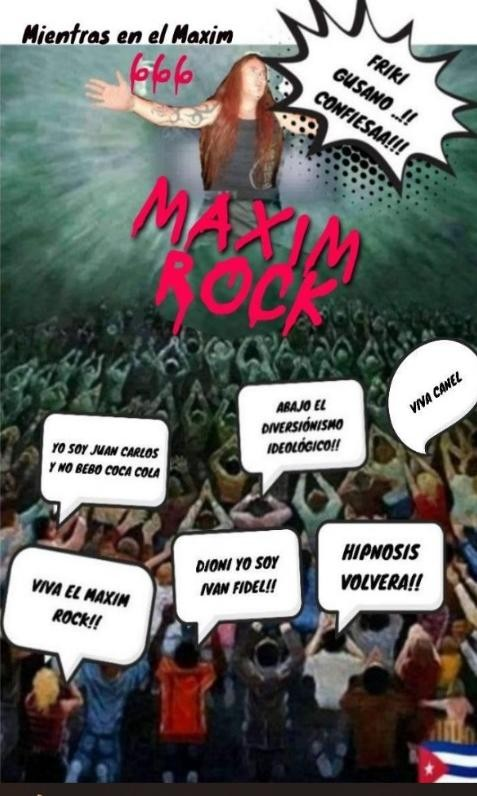
In the example I share, the singer Dionisio Arce, current director of the Agency, appears at the top shouting: “Freak Worm, Confess!!!” In official political discourse, opponents have been called “worms,” while freak refers to rockers and metalheads. “Confiesa,” on the other hand, is among the most iconic songs by Dionisio's band, Zeus, so its message is resignified to represent the singer as an ally of power.
Likewise, in the audience, various messages and slogans from the official discourse have been placed or referenced, or these slogans have been mixed with actors from the scene itself (for example, the band Hipnosis migrated to the U.S., and the idea that "They will return" is played with, a slogan referring to the government campaign for the return of the five Cuban anti-terrorist spies, "the five").
The use of this satirical resource by several members, as well as comments that differentiate between the community and the “others” (the authorities, electronic music, reggaeton), also points to the construction of the Facebook group's collective identity as a “tribe” in opposition to those “others,” insofar as “it is indispensable that there be a we and a they. The others are fundamental when it comes to founding and consolidating the we; that is, they are a constitutive part of the we”.(15)
Key actors, censorship, and self-censorship
In the publications analyzed, the most active actors are mainly fans, amateur and emigrant musicians, and trolls. In general, two main patterns are observed in participation: those of the aforementioned actors, who frequently share sharper and more confrontational criticism toward cultural and political institutions, and those of professional musicians, whose participation tends to be lower and whose tone is more moderate and reflective.
The key actors who stand out tend to position themselves as members committed to preserving the cultural space that the Maxim represents, whether through subtle or explicit complaints toward the authorities. Although some members maintain a critical stance toward institutions, others are observed to make an effort to avoid direct confrontations. Regarding this passivity among some users and the reason for the participation of amateur bands, an amateur musician and a troll comment:
Nowadays, there is too much alienation in the scene regarding everything that happens. And of course, those [amateur] bands participate more and complain more, because they are not going to go to the Instituto Cubano de la Música. They have to complain in a medium where everyone can see their criterion, and professional musicians do not use that criterion. Only when it affects them directly, for example, when amateur bands do not want to play with them. Ahhhh! That is when things are at risk; that is when it turned bad (Ernesto, interview via WhatsApp, October 25, 2024).
The critical aspect you must take into account is that many of the Agency's current bands have direct or indirect links to institutions, or family ties. That is why they try to be politically correct, or they address utterly unserious topics so as not to take a stance… social awareness does not exist (Troll, interview via Messenger, October 25, 2024).
In addition to this behavior of professional bands toward criticism, which suggests an instinct for self-preservation over commitment to the rest of the scene, there is both subtle and direct evidence of self-censorship and careful management of language on the part of some participants. These participants tend to use moderate language and, instead of criticizing directly, choose indirect phrases, irony, or general allusions. This moderation suggests that they are aware of the limits on what they can say without exposing themselves to possible retaliation. Some opinions even indicate or promote silences, both because of group rules and because of the actors' own self-preservation:
Amateur musician: There are always people who take advantage of any topic to talk about politics. Anyway, I am not even going to mention it; I have seen brothers talking about the system, communism, etc. and etc., and in part they are right and I respect their comment, but here we are talking about why the Maxim does not fill up, not about political topics.
Fan: I'd better not even speak, because there are things sooo strong that could hurt susceptibilities.
On the other hand, there is also censorship by administrators of political posts and some memes. In an interview, a troll user states that he has been sanctioned several times and that his posts have been deleted because they were offensive or subversive (interview via Messenger, October 25, 2024).
Following the notions of Scott (10) on infrapolitics, public discourse within the group is observed to be more moderate and controlled, probably so that posts are not censored, as has happened to the troll user. Meanwhile, in interactions within the comments, some users display a franker and more critical tone.(16,17,18) This suggests that —even within what could be understood as a hidden discourse for in-person contexts but public in virtuality— there is a division between what is expressed openly in posts and what is discussed in smaller spaces or subgroups (the comments).(19,20)
Thus, infrapolitics in Mundo Rock Cubano manifests itself, above all, in veiled critiques and allusions to institutionality, bureaucracy, and the lack of support; in subversive humor through memes and mockery that undermine authority; in the use of memory about censorship as an interpretive framework for the present; and in the discursive declaration of no longer participating in institutionality (in the case of the audience and some bands).(21,22) This latter point is particularly interesting, since even when the digital space fails to articulate a considerable movement of protest or collective action, it does influence micro-decisions such as the refusal to participate in and attend concerts in state spaces and the search for alternatives beyond regulatory frameworks.
CONCLUSIONS
The analysis of the group Mundo Rock Cubano shows that, even in a context of crisis and cultural regulation, the metal community deploys a digital infrapolitics that guarantees its identity continuity. Far from constituting an open confrontation with the State, these practices function as forms of negotiation and symbolic resistance that allow subjects to maintain spaces of agency amid material precariousness and surveillance.
In this case, infrapolitics arises from the displacement of metal from face-to-face settings to virtual spaces, driven by the effects of the crisis, an institutional order perceived as failed, erratic cultural policies, and a power asymmetry in which subaltern subjects understand that there is probably not much to be done through official channels. In response, they migrate to the digital space, where they can at least express creativity, catharsis, and community cohesion.
It is important to highlight that this infrapolitics does not respond to a specific agenda or a particular political stance, but rather is configured as a set of reactive and circumstantial ways of confronting an adverse context and circumventing the existing limitations surrounding political activity and dissent. Thus, it is an eminently pragmatic practice, which seeks to sustain cultural and community life in the face of precariousness and surveillance.
The findings allow us to add nuance to and expand the levels of infrapolitics described by Scott. Within the group, hidden transcripts can be identified in veiled critiques of institutional structures and cultural bureaucracy that avoid naming the State directly but point to its structural responsibility for the precariousness of the metal scene. Similarly, practices of discursive negotiation are identified, in which users demand changes by appealing to the official discourse itself, as when they recall that the Agencia Cubana de Rock should respond to its founding mission in accordance with cultural policy.
As for the politics of disguise, it manifests in the widespread use of memes, irony, and resignifications of official symbols, which allow questioning without direct self-exposure. Within this same logic, troll and anonymous profiles gain relevance, operating as digital masks to channel more incisive criticisms, parodic exaggerations, or mockery that could hardly be expressed under a recognizable identity. In this way, comicality, dark humor, and ambiguity function as safeguards against surveillance and as catalysts for collective critique.
A practice of internal risk management is added to these 3 classic levels of infrapolitics, manifested in administrators' own censorship of content or users that could endanger the existence of the collective. This finding suggests that, in contexts of high surveillance, infrapolitics is not only oriented outward — against the dominant power — but also inward, as a strategy of containment and self-protection that guarantees the continuity of the common space.
From a broader perspective, the case of Mundo Rock Cubano shows that digital spaces in Cuba are not mere extensions of the offline world but rather scenarios that influence, albeit with limitations, other forms of cultural resistance. This experience suggests that infrapolitics transcends the idea of a residue of formal politics to become a mode of action that ensures the reproduction of subaltern worlds with a certain distance from state power.
Note:
This article is the result of ongoing research for the master's thesis Whispers in the Silence. The Infrapolitics of Metal Bands in the Face of State Regulation (2020-2025), supervised by Alfredo Santillán at FLACSO Ecuador. The text expands on some aspects not developed in the main manuscript.
References
- 1 Castro F. Palabras a los intelectuales [discurso]. La Habana: Biblioteca Nacional de Cuba; 1961.
- 2 Castro F. Discurso pronunciado en el Primer Congreso Nacional de Educación y Cultura. La Habana: Teatro de la Central de Trabajadores de Cuba; 1971.
- 3 Castellanos EJ. El diversionismo ideológico del rock, la moda y los enfermitos. In: La política cultural de la Revolución Cubana: Memoria y reflexión (Ciclo de conferencias convocado por el Centro Teórico-Cultural Criterios). La Habana; 2007.
- 4 Remón A, González E. Saliendo a flote: aproximaciones al rock cubano entre 1990 y 2009 [undergraduate thesis]. Universidad de La Habana; 2010.
- 5 Manduley López H. Hierba mala: una historia del rock en Cuba. Holguín: Ediciones La Luz; 2015.
- 6 Cardona R, Hernández Z. Escaleras al cielo: el rock en Holguín. Holguín: Ediciones La Luz; 2017.
- 7 Hernández Castro JA. Los rockeros van al infierno. El avatar del rock y metal en La Habana entre 1986 y 2007: un acercamiento desde el periodismo [undergraduate thesis]. La Habana: Facultad de Comunicación, Universidad de La Habana; 2020.
- 8 Ardévol E. Antropología de los medios de comunicación social. In: Conversaciones antropológicas. Valencia: Universitat de València; 2013. p.153–65.
- 9 Scott J. Seeing like a state: how certain schemes to improve the human condition have failed. New Haven (CT): Yale University Press; 1998.
- 10 Scott J. Los dominados y el arte de la resistencia: discursos ocultos. Ciudad de México: Ediciones Era; 2004.
- 11 Ardévol E, Lanzeni D. Visualidades y materialidades de lo digital: caminos desde la antropología. Anthropologica. 2014;32(33):11–38.
- 12 Pink S, Heather H. Etnografía digital. Madrid: Ediciones Morata; 2019.
- 13 Albornoz MB. Cibercultura y las nuevas nociones de privacidad. Nómadas. 2008;(28):44–50.
- 14 Couldry N. Theorising media as practice. Soc Semiotics. 2004;14(2):115–32.
- 15 Winocur R. La tribu de los memes: un territorio virtual de inclusión-exclusión entre los adolescentes. Comun Soc. 2019:1–22.
- 16 Scorer J. Comics, contagion, and the undead. In: Latin American Comics in the Twenty-First Century: Transgressing the Frame. Austin (TX): University of Texas Press; 2024. p.157–84.
- 17 Vilarós TM. «Adéu-siau bressol de ma infantesa»: Catalonia and the Anthropocene. MLN. 2025;140:315–30.
- 18 Harrison FV. Racialization, criminalization, and the articulation of multiple alterities: a perspective on the United States. In: Visibilities and Invisibilities of Race and Racism. London: Routledge; 2025.
- 19 Eslava L, Rafael L. A historical, cultural, and political analysis of oppression and resistance: the case of the Emberá Chamí community in Colombia. 2024.
- 20 Derby L. Stealing the Citadel. 2024. https://doi.org/10.1163/22134360-bja10029..
- 21 Bahi A. Heritage and transformation of an African popular music. Elements in Critical Heritage Studies. 2024. https://doi.org/10.1017/9781009469159..
- 22 Eslava L, Rafael L. A historical, cultural, and political analysis of oppression and resistance: the case of the Emberá Chamí community in Colombia. 2024.
- 23 CONFLICTO DE INTERESES
- 24 None.
Declarations
Funding
None.
Conflict of interest
None.
Authorship contributions
Conceptualization: Junior Hernández Castro.
Investigation: Junior Hernández Castro.
Writing – original draft: Junior Hernández Castro.
Writing – review and editing: Junior Hernández Castro.