
Abstract
The school has the responsibility to receive and host students by developing competencies for knowing, knowing how to do, knowing how to be and learning how to learn the contents of the secondary level, betting on an inclusion with knowledge. The new and old models are presented as contrasting and are not in schools in a pure state, however, reading and interpreting what happens in the classroom coexists with an epistemological attitude that teachers must conquer. Under the thematic line educational ecosystems and inclusion, this work proposes a situated teacher training, for the management team and teachers of the basic cycle of I.P.E.M. Nº 193, in the use of social network applications participating and elaborating interdisciplinary projects, since diverse experiences show that the methodological proposal of interdisciplinarity can summon several subjects in a related way, carrying out at the same time a formative evaluation. The results are satisfactory to strengthen school trajectories, favoring continuity and promotion, in spite of the difficulties that may arise in practice. This methodology stimulates the creativity of teachers and students when facing new ways of teaching and appropriating the contents, understanding that humanity inevitably advances towards the solution of problems in an integral way.
Keywords
Inclusion, Social Networks, Interdisciplinary Projects, Formative Evaluation
INTRODUCTION
The topic that we will develop in the intervention plan aims to strengthen school trajectories for continuity and promotion of the secondary level, and it will be carried out at I.P.E.M. Nº 193 “José María Paz” in the town of Saldán, province of Córdoba.
To achieve this, we intend to offer situated teacher training for the management team and teachers of the basic cycle at I.P.E.M. No. 193 in the use of social media applications for participation in and development of interdisciplinary projects and didactic sequences, aimed at students with pending subjects.
This work is framed within the thematic line Educational ecosystems and inclusion, which, in order to discuss the educational ecosystem, requires a complex analysis of the whole, including the integral interpretation and understanding of all its components, as argued by Tessier cited in Choque Larrauri (1):
“The educational ecosystem is based on the ecological paradigm composed of a living environment that involves living organisms and objects that influence each other and in which there is a dynamic character where each element is at the same time origin and object of influence through reciprocity.”
Through this approach, the educational system as a whole is made up of subsystems that must necessarily be related and interconnected to achieve educational purposes. An educational ecosystem is built, strengthened, and evolves with collective participation, social innovation, and government educational policies. They are dynamic, changing, adaptable, and innovative. The microsystem, which corresponds to educational institutions, shares vital spaces, and thus they build their own learning ecosystems. And it is there where the opportunity for action lies for the training team made up of a Graduate in Education, a Graduate in Communication, and a Community Manager.
From the analysis carried out on the inquiry, the problem in the basic cycle is identified: first, the number of students who failed the colloquia exceeds those who passed and equals those who were absent; second, the recurring subjects are Language, Geography, Art, Mathematics, and English, impacting the fragmentation of student enrollment. Of three sections that begin in 1st year, upon finishing secondary school in 6th year, there is only 1 section. In relation to the problem perceived by teachers, they state that young people have no interest, that they have carried out some team projects and these have yielded positive results, but daily practices at school do not coincide with the new inclusion paradigm, although they identify themselves as an inclusive school.
The presence of a hidden curriculum and data that are not a cold statistic—and we refer to male and female students as subjects with full rights within the constitutional framework—places us within educational inclusion in terms of a new inclusive paradigm, where we speak not only of inclusion in the face of needs arising from disability, but also of generating spaces, encounters, and ways for young people to be received and to inhabit the school in their diversity and otherness.
Thus, the idea arises of generating multimedia content for the social media platforms Facebook, Instagram, and Tik Tok during an academic year, providing situated teacher training.
The computer room is organized together with the Management Team as the space for the meetings and the available resources of the institution.
The total duration of the training is 9 months and is divided into 2 stages. In the first, teachers must choose a single social network from among the 3 selected: Facebook, Instagram, or Tik Tok, choose a topic or problem organized into an interdisciplinary project, and upload content aimed at the young people of Saldán. According to Fiallo as cited in Llano Arana et al.(2), interdisciplinarity offers advantages for the teaching and learning process, motivates students by enabling them to apply knowledge from different subjects, saves time and avoids repetitions, develops skills and values simultaneously from the different disciplines, and shows the complexity of the phenomena of society as they occur in reality. Simultaneously, the management team, together with the social media coordinator, addresses the improvement of the website and the institutional social media.
In the second stage, they must replicate the task with the students and design an interdisciplinary teaching sequence with content for a social network, for students who have pending subjects. Simultaneously, the management team together with the trainer will plan classroom supervisions. To do so, they will begin a theoretical and then practical review of each of the stages. The composition of the work teams will be according to the objective of each meeting. The arrangement of the student groups will be strategic, since students will be considered individually, so that a student who has more than a single pending subject can carry out a project and thus achieve accreditation in more than a single subject; for example, a student who has language, music, and geography as pending subjects can carry out a project that provides a grade and accreditation for the three disciplines.
This phase is accompanied by classroom supervisions conducted by the school's leadership team and agreed upon with the teachers, regarding the objectives of the observations, with support and feedback aimed at improving teachers' practices and students' learning.
A formative evaluation is maintained during the training on three aspects: the percentage of teachers who supported the proposal, the percentage of students who passed subjects, and the competencies of the trainers.
The offering aimed at creating inclusive classrooms mediated by ICTs for students with pending subjects is conceived in terms of positive environments, deploying interdisciplinary projects that take all students into account, that address and understand school trajectories in their development and subjectivity, and that involve students as active participants in a full school life, providing the opportunity to advance and remain successfully at the level.
Presentation of the Thematic Line: Educational Ecosystems and Inclusion
For the selection of the thematic line of educational ecosystems and inclusion, it is necessary to define the conceptions upheld in this work. Bronfenbrenner, as cited in Choque Larrauri (1), recognizes educational ecosystems as “the set of people and organizations constituting the microsystem, the mesosystem, the exosystem, and the macrosystem that, in an interrelated manner, interact with the purpose of achieving educational objectives in a given social context.” In this sense, it is pertinent to understand that the success or failure of educational work does not depend solely on the microsystem as something natural, but also on the educational policy adopted by a country as part of the macrosystem.
Hence, the principle of Inclusive Education as a State policy, guaranteed by National Education Law No. 26206, was of great significance because it made it possible to undertake systemic, progressive, and gradual changes in the educational structure, creating innovative ecosystems aimed at achieving greater educational and social justice. From this perspective, the school presents itself to us as a whole to be approached through renewed configurations. This is a broad view that can host everyone, others, any given other, any other.(3)
Inclusive Education as a Right
We can approach the concept of inclusion in schools and communities as an inalienable right obtained through universal policies and pedagogical and resource allocation strategies that give priority to the most disadvantaged sectors. This ensures conditions of equality while respecting differences among people and without allowing gender discrimination or discrimination of any other kind. It also recognizes respect for the rights of children and adolescents in the educational sphere, guarantees access for all and the conditions for retention and completion of the different levels of the educational system, and ensures free-of-charge state-managed services at all levels and modalities.
The conception of educational inclusion can only be understood in terms of school trajectories. It is therefore worth asking: what are school trajectories? Terigi (4) refers to school trajectories by outlining the young person's passage as a student within the education system, distinguishing between the theoretical trajectory applied by institutions and the actual trajectory. The former, for its part, refers to those defined by the education system on the basis of their organization, expressing a linear progression foreseen by the system: an adolescent who is twelve or thirteen years old must attend the first or second year of the basic cycle of secondary school. However, “by analyzing the actual trajectories of subjects, itineraries can be recognized, coinciding with or close to the theoretical trajectories, ‘itineraries that do not follow that channel, “non-channeled trajectories”’”.(4) The author also points out that a large portion of young people experience their schooling in heterogeneous, variable, and contingent ways.
The institutional, in this sense, houses the legitimate figure of teachers and the ways of inhabiting the school in everyday life in order to earn that legitimization offered by the institution, conceiving itineraries from and for the subjects, taking into account their experiences, interests, and activities.
Perrenoud (5) argues that: (...) if the teacher does not always manage to mobilize attention and energies, if the activities he or she proposes are not as meaningful as he or she would wish, it is not because children and adolescents are apathetic and not interested in anything. It is because other challenges, other projects mobilize them much more and seem more meaningful to them than the mathematics exercises or the composition proposed to them (…).
Ecosystems, Inclusion and ICTs
“While the school curriculum maintains the traces of the foundational moment (homogeneity, systematicity, continuity, coherence, unique order and sequence, etc.), the new generations are bearers of diverse, fragmented, open, flexible, mobile, unstable cultures, etc.”
The educational proposal must break with traditional teaching positions and bring about meaningful learning, that is, learning with meaning. Information and Communication Technologies (ICTs) present three characteristics in the new knowledge and information society: first, a quantitative and qualitative change in the first three decades of the information and communication technology revolution, where we have observed the expansive and self-generating capacity of new technologies to process information. The second is that digital technologies are also characterized by recurrent and interactive communication. And the third characteristic is their flexibility, which allows the distribution of processing capacity across different contexts and applications, such as commercial enterprises, military units, media, public services, political activity, and personal interaction.
This characterization of ICTs opens a new horizon and comes to transform all spheres of education, incorporating tools and techniques that are not only innovative and original but also, and above all, have a meaning and a significance in the subjects. Vinasco et al.(6) attempts to address the relationships among communicative ecosystems, young people's meaningful learning processes, information, and communication. In this sense, they state:
Transformations in the educational field reveal new relationships between subjects and their connection with more visual and auditory ecosystems, as an opportunity for interaction with information (…) those that young people configure through new technological repertoires (…) through the modification of writings and communication channels in the global world, where the emergence of writing reappears through the use of digital technologies in Web 2.0 spaces.
The school is the privileged institution, given its organization, structure, mission, and ethics, capable of addressing diversity, difference, receptivity, and hospitality. It must be a collaborative construction achieved through inclusion, with learning based on integrating/being integrated, lodging oneself, understanding/being understood, loving oneself, involving/being involved, inhabiting/being inhabited; hosting everyone from a full integrality of rights; in a world in constant change that, traversed by information and communication, transforms and creates new modes of writing and of sound and image expression, but at the same time operates with profound social inequalities, generating exclusion.(3)
Synthesis of the Organization
The I.P.E.M. No. 193 José María Paz
The Provincial Institute of Secondary Education No. 193 is located at 600 Vélez Sarsfield Street, in the town of Saldán, Colón Department, in the Province of Córdoba.
CUE (Unique Establishment Code): 142233-0 EE 03107070.
Postal address: Vélez Sarsfield No. 647. Locality: Saldán.
Department: Colón. Province: Córdoba.
Email: [email protected].
History and Context
The population of Saldán reaches 10 600 inhabitants. Its diverse origin was the product of foreign immigration until the decade of the 50s and, later, internal migration. I.P.E.M. No. 193 was founded with the mission and vision of educating for the world of work and the pursuit of higher education, the origin from which the orientations derive: Economics and Management, and Tourism. The dream of having its own secondary school in the town was an initiative of local residents, and through a joint effort of the State and the community, over time the only secondary school in the town was established; its inhabitants, more than 50 years after its creation, remember and yearn for that time they experienced.(7)
A high percentage of the families that make up the educational community do not have stable employment, and their income comes from various occupations. Being a dormitory town means that many heads of household live in Saldán but work outside the city. These are large family groups, with many children, stepchildren, siblings, parents, parents-in-law, or other relatives living together within the same household. In addition, they tend to have low incomes and lack health coverage.
The institution has an approximate enrollment of 644 students, 115 teachers, and 5 education assistants. It works in a network with various plans and programs at the national, provincial, and municipal levels, with diverse purposes, aimed at ensuring the school inclusion of students at socio-pedagogical risk and those with special educational needs.
The I.P.E.M. No. 193 also has a common secondary school oriented toward Agro-environment, the El Diquecito – La Calera annex. It has a population of 77 students who attend only the morning shift, as does the rest of the staff, made up of 25 teachers and 12; the 3 members of the administrative staff (2 preceptors and 1 coordinator).
Other levels, such as primary and secondary education for adults, also use the building during the afternoon shift, both publicly managed (C.E.N.P.A and C.E.N.M.A N° 216, respectively), with which it maintains a relationship of coexistence, but not of articulation.
Mission and Vision of I.P.E.M. N° 193
The mission is to provide its students with a comprehensive and ongoing education, equipping them with tools to develop critical thinking and problem-solving skills in a space of exchange framed within values education that fosters personal fulfillment in general and, in particular, integration into sociocultural life and the world of work, as well as continuity in higher education.
The vision is to promote students' school continuity and to train them for employment as support staff for commercial and service activities in the locality, as well as to consolidate relevant knowledge for the formation of a citizen based on a culture of learning, effort, and personal commitment to their growth and lifelong education for the benefit of their individual and social dignity.
Graduate Profile of I.P.E.M. N° 193
The institution facilitates the graduate's acquisition of relevant knowledge for the formation of a citizen based on a culture of learning, effort, and
personal commitment to their growth and lifelong education for the benefit of their individual and social dignity. The aim is to strengthen social commitment and the understanding of concepts applied to daily life and its problems, so that they recognize universal values applied in social reality, addressed in an interdisciplinary manner.
The School Coexistence Agreement
The importance of agreements is based on the educational community's recognition of them as a space conducive to the development of interpersonal relationships. Therefore, knowing and discussing them, reformulating and sustaining such agreements will allow their members to interact better, listen to each other, respect each other, and commit themselves further to a communicative dynamic of permanent construction.
The following are proposed as principles and criteria guiding this agreement:
To guide the actions of institutional actors in the educational community toward unrestricted respect for the dignity and privacy of the person, the non-violent resolution of conflicts, and the acceptance of sociocultural differences.
Reject all forms of discrimination, harassment, violence, and exclusion in daily interactions.
Promote the formation and functioning of bodies for participation, dialogue, negotiation, mediation, and consultation in the resolution of conflicts within the institution
Promote activities that create bonds of commitment among all institutional stakeholders with the purpose of caring for the school building, its equipment, and common-use materials.
To be able to diagnose possible risk situations at school in order to prevent them.
Promote reflective and critical participation to develop citizens who are aware of their rights and obligations, in order to confront conflictive situations and work toward overcoming them and achieving harmonious coexistence.
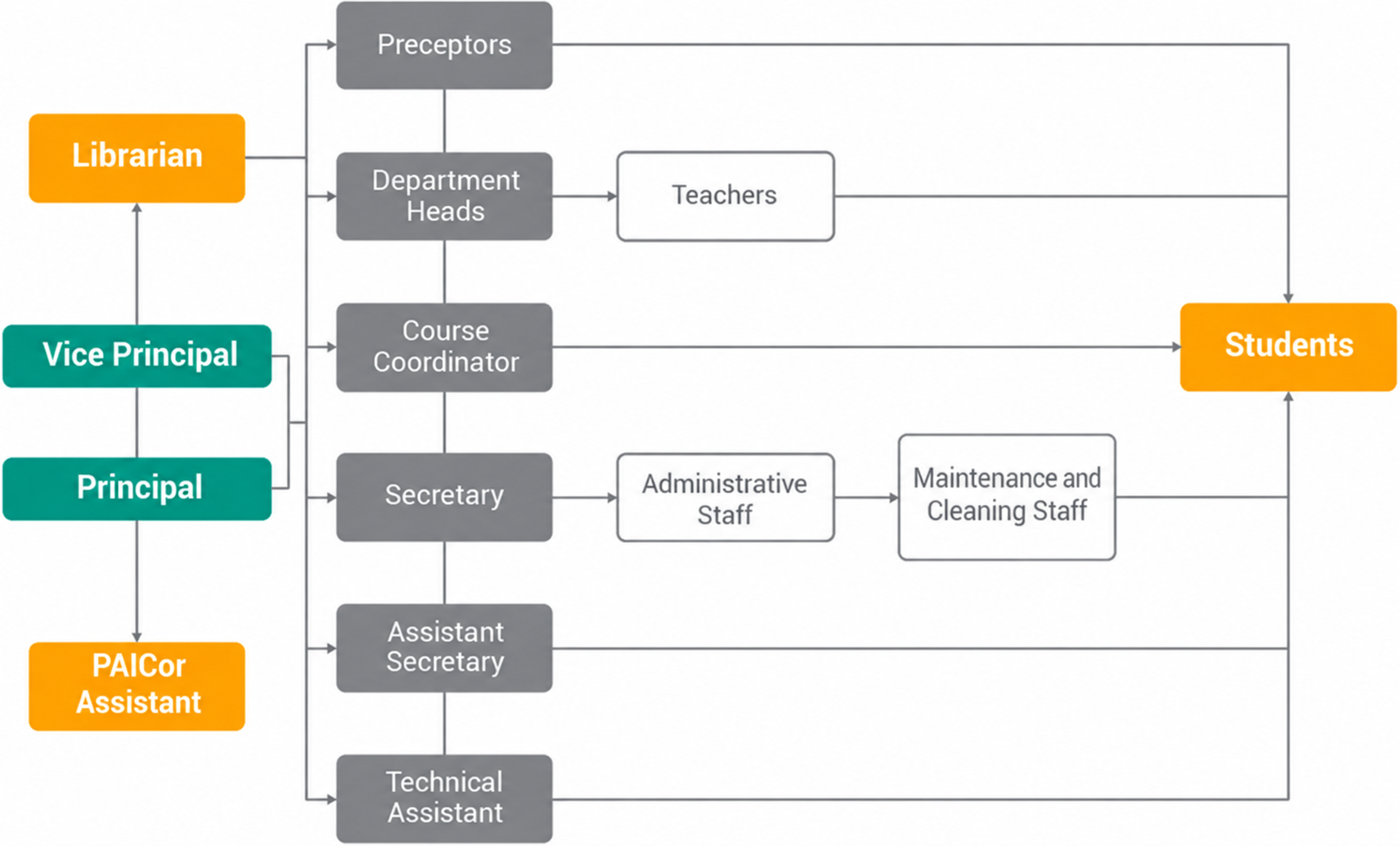
The Structure of I.P.E.M No. 193
The building has: 12 classrooms, 2 bathroom blocks for students, 2 restrooms for teaching and non-teaching staff, 1 accessible restroom, 1 partitioned room where the administration, vice-administration, secretariat, archive, and reception operate, 1 multimedia room, 1 computer and natural sciences laboratory room, 1 library, 1 office for the coordinator, 1 teachers' room, 1 dining hall, 1 kitchen, 1 preceptors' room, 1 room for physical education equipment, 1 courtyard, 2 sports courts, and 1 designated parking area.
Among the material resources are 4 45-inch smart TVs, 12 laptops, books (700), heaters, fans, maps, physical education equipment, partial internet connection, chalkboards and whiteboards, musical instruments, music equipment, speakers, microphones, printer, photocopier and kiosk service.
The Number of Divisions per Course
In the morning shift, in 1st year there are 3 divisions, from 2nd year to 4th year there are 2 divisions, and in 5th and 6th years there is 1 division. In the afternoon shift, from 1st to 5th years there are 2 divisions, and in 6th year there is 1 division.
Contributions of the Institutional Educational Project (PEI)
In the definition of the PEI and in the conception of the curriculum and assessment, it is expressed that teachers will carry out annual plans (open and flexible). They will be supported by the provincial curriculum designs, and the modes of learning, objectives, and assessment criteria are agreed upon. In this sense, the organization of classes will appear in varied formats: subject, workshop, project, seminar, laboratory, athenaeum, observatory, field work, module. The objectives and assessment criteria are organized by Departments: Language, Mathematics, Natural Sciences, Social Sciences, Orientations.
The planning formats for the classes will be freely determined by the teacher, who will define the form and the workspace.
The 2017 Management Plan
In the 2017 evaluation, there is a slight 3% decrease in the percentage of repeaters (31 students). However, the final situation of repeaters for the school year is summarized as follows: 14 students request a transfer, 14 students repeat again, 35 students drop out, and 59 students are promoted, out of a total of 122 repeater students. Nevertheless, there is a considerable increase of 13% in dropout in the 2017 school year (81 students), where the causes are recorded, but not the interventions or follow-up data of the students who remain outside the level.
In November 2018, 64 students were lost with transfer, free, and dropout status; the number is significant, but it is lower than in other years. The causes stem from students being older than the expected age, problematic substance use, repeated grade repetition, family situations, and problems in classroom coexistence: bullying.
It is noteworthy that 98% of the students with a third subject (105 of 107) completed the submission of the first and second practical assignments, and the 12% increase in the percentage of students passing the colloquium.
Interviews with Teachers
From the interview with the director Susana Giojalas and the cycle coordinator, aspects to consider regarding the institution's teachers emerge, as well as conceptions and perspectives toward students that are interesting when discerning the paradigm that the institution is traversing in its practice and the emergence of a hidden curriculum that sustains practices that do not coincide with the discourse, revealing the meanings and practices of the school organization.
Delimitation of the Problem
In the school management plan, emphasis is placed on the submission of practical assignments and the pass rate in the third subject, along with the importance of the coordinator's role in achieving this; however, when analyzing the basic cycle, which is the age group of interest, out of a total of 1031 students, 348 passed (34 %), 350 failed (34 %), and 333 were absent (32 %). In 2nd year, a high absenteeism rate is observed (41 %) and, in contrast, only 26 % of the oral exams were passed. Likewise, 2nd year has the highest percentage with CB oral exams, at 36 %. In curricular terms, the subjects with the highest enrollment for oral exams are: in 1st year: language (74 students), English (54 students), geography (48 students), and biology (42 students). In 2nd year: artistic education: music (56 students), language (54 students), mathematics (47 students), and English (40 students). In 3rd year: language (52 students), chemistry (42 students), mathematics (38 students), and technological education (33) students. It is also relevant to visualize the number of students with pending subjects, by subject: in the total school enrollment, in mathematics and language (both) with a total of 114 students, followed by geography and English with 59 and 55 students, respectively. In third place is history with 42 students. In the CB: mathematics 89 students, language 95 students, geography 48 students, English 55 students, history 24 students.
From the data listed, we ask ourselves: what happens with the students who do not attend? And with those who fail? What are the practical assignments they must submit like? Is there a practical assignment for each subject? Who collaborates with the coordinator? How are the practical assignments evaluated? Do students know the evaluation criteria of the subjects?
The principal Susana Giojalas, in the interview, states that “(…) it is an inclusive school”, but “the problem with our young people is the lack of interest (…) it is as if what they can get from a cell phone is more important than the teacher’s own word”. Referring to the teaching staff, she states: “(…) we are teachers who are almost at the beginning of the founding of this school (…) we have made an amalgam of people in which we are committed to teaching work (…) I believe in this entire team that works at this school (…) what concerns me (…) is the training of all teachers because there are people (…) who are just starting out and lack daily classroom practice (…)”. In the same vein, the coordinator and teacher Juan Rojas states:
“(…) the daily practices of teachers and also the institutional logic, at times, do not coincide with this paradigm of inclusion”.
The data yielded by the school students' trajectories, the reflections of the principal and the coordinator, support us in moving toward situated teacher training that addresses the institution's teaching trajectories and in being able to begin a path to respond to a question that challenges us as teachers: how should teaching proposals be conceived so that students want to learn?, and to disbelieve the “it is already known,” in order to find the meaning of an exploration.(3)
It is pertinent to make adjustments, modifications, and adaptations that can reverse the school failure of those students with greater problems in their school performance, students who are failed and excluded from the educational system. In response to the needs and interests of students, it is essential to guide professionalizing training for administrators, professors, and teachers of I.P.E.M. No. 193, so that they become facilitators, tutors, and companions in the learning processes, opening debate to the development of ideas and proposals in accordance with new educational paradigms.
OBJECTIVES
General Objective
To offer situated teacher training for the management team and teachers of the basic cycle at I.P.E.M. Nº 193 in the use of social media applications for participation and the development of interdisciplinary projects and didactic sequences, aimed at students with pending subjects.
Specific Objectives
Work on the ideas of the conceptual framework of training.
Recognize the use of selected social networks for the proposal: Instagram, Tik, Tok, Facebook.
Create multimedia content through an interdisciplinary project for a network among the networks, aimed at the young people of Saldán.
Replicate the proposal in a classroom didactic sequence for students who have pending subjects.
Implement a formative evaluation of the process and impact of the training.
Justification
The school must be a harmonious place, where students are happy; a space that represents a qualitative leap in life and allows dreaming of a future, because it is also a subjective space. The teacher's imprint is central with respect to the ways of inhabiting the school for that to happen. In this sense, change must generate profound transformations to reverse teaching practices and assessment practices using information and communication technology tools on Web 2.0.
Other ways of communicating, connecting, scaffolding, merging with knowledge and the new and different ways that inhabit a momentary, changing, and in a certain sense sinister world; which is also stalked by dangers (wars, pandemics, pollution) that increasingly compromise coexistence on the planet. This complex web runs through us, and we teachers are the ones who today have the opportunity to act to improve. Young people entering secondary school have, during a school year, the opportunity to learn, and teachers, the opportunity to teach. The following year is already a new and distant horizon.
The proposal of situated training opens the possibility for knowledge and know-how, affirming professional competencies and at the same time being able to improve the educational trajectories of students in the basic cycle of E.P.E.M. No. 193. Enabling spaces for teachers to become facilitators, tutors, and companions in learning processes is the sense that this new proposal for addressing knowledge acquires. The opening of debate for the development of ideas in accordance with new educational paradigms is significant for responding to access to a fairer, more equitable, democratic, and quality education, resorting to ICT as a pedagogical tool.
The challenge will then be to organize an interdisciplinary planning with multimedia content for a social network, in the format of a didactic sequence, on a topic, content or problem, that reflects in its implementation the paradigm of constructivism and inclusion with academic knowledge.
THEORETICAL FRAMEWORK
The school of modernity was born with a homogenizing imprint. This mandate has left and continues to leave many students outside. There was a process and a historical framework that gradually provided us with tools to think about how discontinuous trajectories were addressed, what place disability had, and how difference was approached. From the conception of a distinct other, which situates the other in what they do not have and should be, the difference between normal and abnormal, difference according to closeness to or distance from norms and rules, and the consequent processes of institutionalization of these approaches—confinement, segregation, discrimination, differences, relegation, deficit—the path was gradually opened toward the construction of a positive knowledge of differences.
In this sense, we propose thinking about educational inclusion in terms of a new inclusive paradigm, where we speak not only of inclusion in the face of needs derived from disability, but also of generating spaces, encounters, and ways of receiving and inhabiting the inclusion of young people in their diversity and otherness.
UNESCO understands that inclusion is, therefore, a new vision of education based on diversity, in which four fundamental elements are highlighted:
Inclusion is a process, a permanent search for the best way to respond to differences.
Inclusion seeks to identify and remove barriers, remain attentive to obstacles to learning and participation, and find the best way to eliminate them.
Inclusion refers to both presence and participation and achievement of all students.
Inclusion places special emphasis on those groups of students at greater risk of being marginalized, excluded, or achieving lower-than-expected performance.
In terms of genuine educational inclusion, we address situated teacher training by arguing two issues: that teachers have the possibility of participating in the elaboration of the curricular project makes it possible to avoid falling into stereotyped and decontextualized practices of what happens in the classroom. Among the fundamental decisions to be agreed upon, we can mention: what, when and how to teach, what, when and how to evaluate, and strategies for attention to diversity. And on the other hand, Ander Egg (8) draws on Porlan, who states that the process of pedagogical style must be systemic, ecological and investigative; in other words, an action strategy that develops consistent interdisciplinary projects to study reality, problems and solutions, within the class, workshop or seminar as an ecosystem (learning group) that helps the development of competencies, the capacity for expression, having constructive attitudes, receiving criticism and self-criticizing, being tolerant and knowing how to assume frustrations, assuming a scientific predisposition, solving, questioning, seeking alternative answers to problems that interpellate us, awakening an insatiable curiosity.
Every curricular approach must be based on an educational model. In this sense, the pedagogical stance is constructivism, which does not have one single conception. Piaget, Vigotsky, Ausubel, Bruner, Coll, Porlan, etc., have theorized basic notions about this model: an active student, a subject full of rights and complete with their subjectivity, with their historical and social world, and with whom learning is a process based on prior ideas that enable the anchoring of new concepts; where space is provided to learn to learn and acquire cognitive strategies for problem solving; with a psychosocial perspective in which our students, while learning, constitute themselves as pupils, students, learners, with desires, dreams, frustrations, and needs. Based on this thinking, we can add that school is a place where not only meaningful knowledge is transmitted, but meanings are also constructed.
Returning to the idea of the meeting with administrators and teachers in a situated learning space, the idea germinates of recovering and agreeing on what we mean when we speak of interdisciplinary projects and the importance of planning in didactic sequences. These projects respond to one new paradigm of teaching, where the student is the center and the organization of the educational proposal is conceived, designed, and put into practice by a group of teachers from different areas or disciplines. Although the task may seem simple, agreements regarding what, how, and when to teach are essential, as are the contributions that each teacher makes from their discipline to solve a real-world problem or produce a product, so that it is interesting and worthwhile to learn from the student's perspective.
Interdisciplinarity emerged as fundamental for the development of scientific knowledge; the watertight compartments of specialists in the disciplines were insufficient to solve complex problems given the era in which we live.(2)
Previous approaches to disciplinary education, in the face of the demands of the contemporary scientific paradigm that favors interdisciplinary links, lead us to ask ourselves: How can we prepare new generations to interact with the demands and the accelerated changes of knowledge that are constantly produced?
Throughout their article, Llano Arana et al.(2) provide a review of background and research that helps us understand how, at present, the relationships that exist among various subjects enable a better understanding and assimilation of social and natural phenomena. They present the consensus among authors that this is currently a didactic method that teachers and students should adopt to improve learning. We can affirm that a fundamental element of education during planning is interdisciplinarity: organizing a teaching plan based on the interrelations that exist among all phenomena as they occur in an integrated manner in real life, not in a fragmented manner.
At present, the changing nature of knowledge and the complexity of the problems to be solved mean that the concept of discipline with which problems have been analyzed must be changed, and that new concepts such as interdisciplinarity, multidisciplinarity, and transdisciplinarity must emerge.(9,10,11)
Pérez et al.(9) recover the following definition from Piaget: the “difference between: Multidisciplinarity: understood as the lower level in relations among disciplines. In it, only exchanges of information occur for the purpose of solving specific problems. Interdisciplinarity: defined as the interaction that produces mutually enriching exchanges insofar as the interacting disciplines are gradually transformed. Transdisciplinarity: constitutes the maximum level that seeks to place links in a total system, without stable boundaries between disciplines”.
Didactic sequences, in turn, are didactic programs within more comprehensive educational planning (annual, semiannual, quarterly, etc.), comprising a set of activities for students that are spiraled and linked and meaningful in themselves for the teaching of knowledge, procedures, and attitudes; they are related to curriculum design and respond to the purposes of a level within an educational system.(12,13)
Teamwork is essential for this realization. Likewise, there is a predisposition and an opportunity to broaden professional competencies and to learn from the other and with the other in a dialogue mediated by didactics and our vocation as teachers. Reaffirming the previous thought, Frigerio (3) maintains that we should not omit, in the description of what is complex, that knowledge that does not circulate sufficiently is the pedagogical knowledge produced by the educators themselves. Teachers in training need pedagogical knowledge produced by educators, and they require the theoretical instruments to produce, in their practices, their own knowledge, overcoming the fictitious dichotomy between theories and practices.
It is pertinent to clarify that, although reality is presented as a framework that attempts to solve or seek answers from various sciences and disciplines, it must also be borne in mind that not all disciplines always converge, nor are the same ones always involved in relation to a topic, content, or problem to be studied. The delimitation carried out by the teacher working in collaboration with colleagues will be more accurate and complete and will favor the selection of tools for its development and implementation.(14,15)
Lizcano et al.(10), in their article, identify theoretical, procedural, and technological contributions associated with collaborative learning; that is, they cease to view ICTs as instruments and take them as a mechanism for educational development, favoring the interaction of knowledge and know-how. The authors state:
We should stop viewing ICT as exclusively instrumental objects, given that the pedagogical constructs that sustain collaborative work are oriented toward constructivism; therefore, ICT are nested within a scaffolding of educational techniques, resources, and strategies. In these scenarios, the use of educational technology tools contributes to the generation of significant learning events only when they are supported by methodologies that favor the development of group activities by offering spaces for the deployment and convergence of opinions, in addition to didactically enhancing classrooms. Here, the use of digital media is a commitment to building a digital society from the links among learners that establish interpersonal communication, which can be enhanced for the configuration of research competencies and knowledge management through the application of protocols or pathways to foster critical thinking.(16,17,18)
In this line of thinking, it is imperative in current times to propose working with Web 2.0 applications such as social networks. To do so, we will first define what a social network is and with which of them we will work.
The actions and activities involving teachers, along with the rationale for their selection, will also be delimited.
A social network is a term used to describe a variety of platforms, applications, and technologies that allow people to interact socially with others through the web. Examples of social media sites and applications include Facebook, YouTube, Twitter, Instagram, blogs, and other sites with content based on user participation and user-created content.(11) In this proposal, we will work with 3 social networks: Instagram, Tik Tok, and Facebook. Below, we explain each of them.
It is a free online photo-sharing application and social networking platform that Facebook acquired in 2012, but that had already been launched in 2010. Instagram allows users to edit and upload photos and short videos through a mobile application. Users can add a caption to each of their posts and use tags, hashtags, and location-based geotags to index these posts and make them searchable by other users within the application. Each user's post appears in the Instagram feeds of their followers and can also be viewed by the public when tagged using a hashtag or geotags. Users also have the option to make their profile private so that only their followers can see their posts. After the great success of TikTok, in 2019 Instagram incorporated the famous “Reels,” short videos between 15 and 30 seconds (later their maximum duration was extended, currently reaching 90 seconds), to which speed can be added or reduced, and to which text, music, sounds, filters, or effects can be added.(19,20)
Tik Tok
Known in China as Douyin, it is a short-video sharing application very famous among adolescents worldwide. Users use this app mainly to record themselves lip-syncing a song and moving their fingers in a very particular way called finger dance. The operation of Tik Tok is similar to that of other social networks. To create a profile and start sharing videos, it is enough to have a Gmail account. Videos can be up to 10 seconds long and it is possible to record them in several takes. In this way, recording only occurs while the button is held down and there is the possibility of making a small edit afterward. It is possible to slow down, speed up, and modify videos with filters after recording. Another Tik Tok option is to see users' reactions while they watch another person's video in a small window. Users can follow each other, like videos and even comment live. A main criticism of TikTok, besides the young age of its users, is that it does not allow partial privacy settings. Profiles must necessarily be either fully public or fully private. Most people record themselves making a kind of music video, with background music that they have previously chosen from the extensive song bank of all genres offered by the application.(21,22)
It is a social network whose objective is to connect people with people: friends, family members, coworkers or people with common hobbies. It is among the social networks with the most users, with close to 2200 million registered people. On Facebook users can interact through comments, private messages, participation in groups and pages and even with live video broadcasts through Facebook Live. Among the functionalities we can highlight: friend search, chat, pages, groups, biographies, reaction button, games.(23,24)
Role of Networks in Learning
The selection of these applications is not arbitrary. During the preventive and mandatory lockdown of the COVID 19 pandemic, Tik Tok and Instagram have become the most popular networks with the greatest user growth. In Argentina, 79,3 % (36 million users) actively use social networks such as Facebook, Tik Tok, Instagram, YouTube. Between 2020 and 2021, their use grew by 5,9 %, representing 2 million new users. Age ranges from 16 to 64 years, and 98,4 % connect through mobile phones. Another interesting data point is the average time spent on digital platforms and devices, reaching a total of 9 hours and 39 minutes of internet connections and 3 hours and 22 minutes specifically using social networks.(13) On the other hand, Tik Tok is the network most followed by adolescents and young people aged 10 to 29 years and is active in more than 150 countries and 75 languages.(12) Facebook was selected because I.P.E.M. Nº193 already has a profile22, but it does not fulfill the objective or scope that a social network should provide, considering that it has the largest number of users in the world.
There are multiple research studies in the educational field and ICTs, which link the strengthening of autonomous learning with the use of social networks as
Facebook, Tik Tok and YouTube. Through the use of techniques and instruments related to new technologies, the landscape of traditional education has shifted toward more free and informal training, creating collaborative learning.(14) ICTs are not content to be taught in themselves, although there is a need to learn how to use them. They are tools for knowing, knowing how to do, knowing how to be, and learning to learn the curricular contents of the level. Like any resource, it presents its advantages and disadvantages. Regarding the advantages, we have already discussed them previously in the foundations of this work: now it is necessary to present some problems or issues to rethink.
In their work, Torres et al.(12) present an interesting and recommended discussion paper to prevent the recurrence of setbacks in future crises. The emerging platform Tik Tok received during the pandemic an unexpected boost in the number of users and frequency of use. It has more than 2 billion downloads and more than a billion active users worldwide. However, it presents vulnerabilities, threats, and problems such as misinformation, intoxication, and the emergence of fake news.
Interdisciplinary Projects and ICTs
Through interdisciplinary projects, we know that searching for information goes beyond the use of current technologies and mastery of computer tools; developing critical thinking implies a learning that is taught, regarding the information we gather and the development of interpretive capacity across cultural borders, empowering the student with a more planetary vision of humanity (25).
The first aspect is to define the information need and ensure the success of the search by asking ourselves: what am I looking for and why? And what do I need it for? Another aspect is the variety of information formats, respecting students' preferences in data collection. As Majó Masferrer et al.(15) state, “currently there is the Network (Internet), where information is easily accessible, but it is abundant and has not been structured under any known prior criterion, yet it is indeed ‘alive’, understood as active and dynamic”. Along these lines, the global, multifaceted, and multicultural vision of the study topic will depend on the diversity and appraisal of the sources consulted. During the process, it is essential to inquire within each group about the information and data for an interdisciplinary project in order to advance collaboratively. The process can be structured, according to Durban, cited by Majó Masferrer et al.(15), into framing the information, determining the information sources, finding the information, assessing the information, adjusting the information, and applying the information. But in addition to the importance of data and information, the interdisciplinary project must lead students to acquire and apply knowledge, skills, and values in an integrated manner, relating the different contents and areas of knowledge in order to find answers to different types of purposes. It must also be based on a problem situation or multiple problem situations, a theme, or a generative question, which provokes in students curiosity and interest in discovering, seeking information, and finding answers. Finally, evaluation must serve to demonstrate to students themselves what they are learning through evidence of their progress, which should lead them to make decisions to improve their educational trajectory.
Activities
Organizational or Preliminary Activities
Organize, together with the Director, the cycle coordinator, and the network administrator, the spaces, days, schedules, and resources for the meetings. The start date will be the first week of March, on Tuesdays during the alternate shift. The frequency will be 2 3-hour meetings per month, organized into 2 in-person hours and 1 virtual hour. The resources are specified in the corresponding section.
The space will be agreed with the management team; the computer room and/or the art room are proposed.
The team of trainers and the network administrator will organize the digital resources to develop the sessions; the material will also be prepared in paper format for teachers who do not have a device, so that everyone can have the complete material upon completion. A digital game for the entire training pathway will be delivered to the school library.
At the beginning of each meeting, the team of trainers will inform participants of the topics and objectives of the meeting.
The team of trainers will organize the refreshments.
Presentation of the Work Proposal
The total time is 9 months and is divided into 2 stages. In the first stage, teachers must choose a social network from among the 3 selected: Facebook, Instagram, or TikTok, choose a topic or problem organized into an interdisciplinary project, and upload content aimed at the young people of Saldán. In the second stage, they must replicate the task with the students and design an interdisciplinary didactic sequence with content for a social network, for students who have pending subjects. Simultaneously, the management team, together with the social media coordinator, addresses the improvement of the website and institutional social media. To do so, they will begin a theoretical and then a practical journey through each of the stages. The formation of work teams will be based on the objective of each meeting. The arrangement of student groups will be strategic, since students will be considered individually, so that a student who has more than a single pending subject can carry out a project and thus achieve accreditation in more than a single subject; for example, a student who has pending Language, Music, and Geography can carry out a project that provides a grade and accreditation for the 3 disciplines. To carry out the grouping, teachers are provided with the table of students' pending subjects and information from the preceptors and the management team, in order to identify the students by name. It is time to reflect that here the numerical representation is a student and a right; therefore, the data provided by the institution make it possible to seek a strategy that connects us with the young people of Saldán, who are inside, on the edge, or outside the school, and to invite them to a meeting where they will be interpreters of their own learning.(26,27)
This segment is accompanied by classroom supervisions conducted by the school's leadership team and agreed upon with the teachers regarding the objectives of the observations, with support and feedback aimed at improving teachers' practices and student learning. The process of analyzing classroom observations will be carried out with the trainer.
The proposed activities respond to the paradigm of constructivism, and a permanent activity to be developed is presented (Digital Glossary).
As a closing activity of the training, the impact on 3 aspects will be evaluated: the percentage of teachers who supported the proposal, the percentage of students who passed subjects, and the competencies of the trainers.
Work Plan
Stage I.
Meeting No. 1 “We agree on theoretical ideas.”
Topics: inclusion, use of ICT, theoretical framework.
Objectives: to understand the work proposal; to rewrite ideas from the conceptual framework of the training; to produce a virtual glossary.
Development of the activity | Grouping | Time | Time | Resources | Responsible parties | Budget 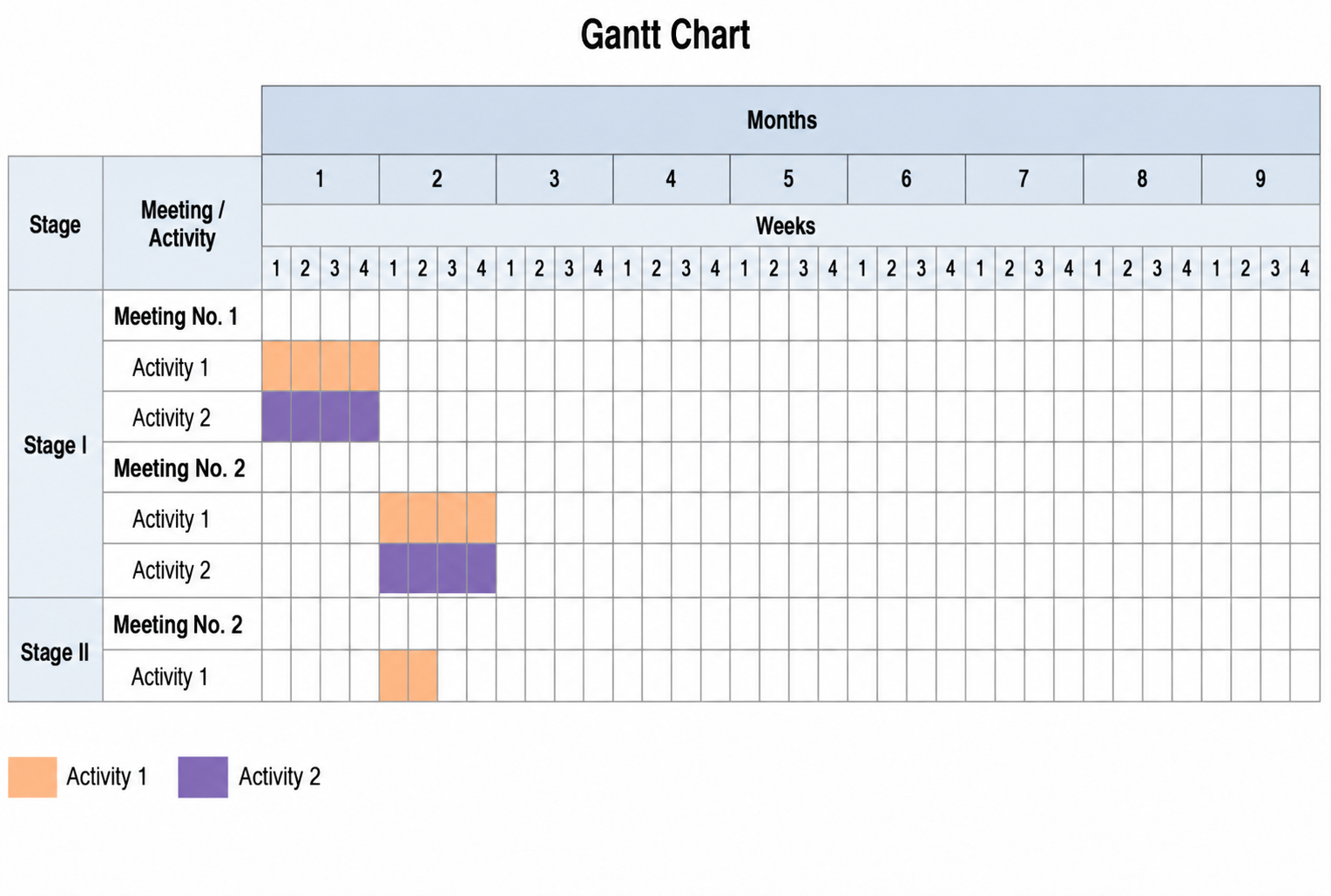 | Evaluation |
|---|---|---|---|---|---|---|---|
Activity 1, in-person modality | Activity 1, in-person modality | Activity 1, in-person modality | Activity 1, in-person modality | Activity 1, in-person modality | Activity 1, in-person modality | Activity 1, in-person modality | Activity 1, in-person modality |
Welcome: team activity, “Things in common” Please complete the attendance and data collection form. Presentation of the training. | Quartets. Class group | 1st week of March, Tuesday in the opposite shift, 2 hours | 1st week of March, Tuesday in the opposite shift, 2 hours | Sheets, pens. Keep. YouTube videos 2 school TVs Mobile phones | Bachelor's degree in Education, Bachelor's degree in Communication, Community Manager. | Electricity and internet connection at the school. Refreshments. Photocopy of attendance. | Attendance. Interaction data from the dialogues. Cooperation in the work team. |
Presentation and discussion of concepts through the video by Graciela Frigerio. Proposal to build a virtual glossary in Keep. Communication via WhatsApp. | Quartets. | [empty cell] | [empty cell] | WhatsApp Web on the school notebook. Teachers' devices. HDMI cable. | [empty cell] | Snack. | Individual production of the glossary. |
Activity 2, virtual modality | Activity 2, virtual modality | Activity 2, virtual modality | Activity 2, virtual modality | Activity 2, virtual modality | Activity 2, virtual modality | Activity 2, virtual modality | Activity 2, virtual modality |
The video by Manuel Castells is shared. Presentation of Keep. | Individual. | Individual. | 3rd week of March, Tuesday in the opposite shift, 1 hour | Meet, Classroom. YouTube video. Keep. | Bachelor of Education. | In charge of teachers and trainers. | Attendance. Glossary. |
Meeting No. 2 “Formative assessment: new paradigm of assessment”.
Topics: formative assessment and rubrics.
Objective: to frequently use assessment modes and tools consistent with the new paradigm.
Development of the activity | Grouping | Grouping | Time | Resources | Responsible parties | Budget | Evaluation | Evaluation |
|---|---|---|---|---|---|---|---|---|
Activity 3, in-person modality | Activity 3, in-person modality | Activity 3, in-person modality | Activity 3, in-person modality | Activity 3, in-person modality | Activity 3, in-person modality | Activity 3, in-person modality | Activity 3, in-person modality | Activity 3, in-person modality |
Continue with the digital glossary. First, in groups, and then in the plenary session, they will give a collective presentation of Rebeca Anijovich's video in Jamboard. | Quartets. | Quartets. | 1st week of April. Tuesday during the counter-shift, 2 hours. | Google Jamboard YouTube video 2 school TVs, cell phones, and school laptops. | Bachelor's degree in Education. | Electricity and internet connection at the school. Snack. | Attendance. Participation in the team. Group discussion. Preparation of the presentation. | Attendance. Participation in the team. Group discussion. Preparation of the presentation. |
[empty cell] | [empty cell] | [empty cell] | [empty cell] | HDMI cable. | [empty cell] | [empty cell] | [empty cell] | [empty cell] |
Activity 4, virtual modality | Activity 4, virtual modality | Activity 4, virtual modality | Activity 4, virtual modality | Activity 4, virtual modality | Activity 4, virtual modality | Activity 4, virtual modality | Activity 4, virtual modality | Activity 4, virtual modality |
Rubrics: presentation prepared by the trainer. A rubric is proposed for students concerning a project they are developing in the classrooms. | Individual. | 3rd week of April. Tuesday during the counter-shift, 1 hour. | 3rd week of April. Tuesday during the counter-shift, 1 hour. | Meet. PowerPoint Word | Bachelor's degree in Education. | Under the responsibility of teachers and trainers. | Under the responsibility of teachers and trainers. | Attendance. Rubric sent by email to the trainer in Word format. Glossary. |
Session No. 3 “We learn to operate on a social network”.
Topic: social networks, selection criteria, main platforms, examples of use.
Objectives: to recognize the use of selected social networks for the proposal: Instagram, Tik, Tok, Facebook; to differentiate the communication purpose, text, image, video, audio, and target audience of the selected networks.
Development of the activity | Grouping | Time | Resources | Responsible parties | Budget | Evaluation |
|---|---|---|---|---|---|---|
Activity 5, in-person modality | Activity 5, in-person modality | Activity 5, in-person modality | Activity 5, in-person modality | Activity 5, in-person modality | Activity 5, in-person modality | Activity 5, in-person modality |
Survey A. Creation of profiles on social networks. Multimedia content provided by the specialists. Digital glossary. | Interdisciplinary. Two work teams will be formed: institutional and curricular. The institutional team would be composed of the director, deputy director, secretary, and a librarian. The curricular team would be composed of teachers, technicians, a network administrator, a librarian, a course coordinator, and preceptors. | 1st week of May. Tuesday during the counter-shift, 2 hours. | Teachers' and school devices. Survey A Digital platforms: WhatsApp Web, by teams. | Bachelor's degree in Education; Bachelor's degree in Communication; Community Manager. | Electricity and internet provided by the school. Snack. | Attendance. Survey: participation, willingness, and openness. Formation of work teams. Interaction with the selected social network. Continuity of permanent activity. |
Activity 6, virtual modality | Activity 6, virtual modality | Activity 6, virtual modality | Activity 6, virtual modality | Activity 6, virtual modality | Activity 6, virtual modality | Activity 6, virtual modality |
Multimedia content. Development by the specialists. | Individual | 3rd week of May. Tuesday in the opposite shift, 1 hour. | Meet, Classroom, Jamboard | Bachelor's degree in Communication. Community manager. | Under the responsibility of the teachers and trainers. | Attendance. Record of topics in Jamboard. |
Meeting No. 4 “Creation of teaching scenarios”.
Topics: tools, language, scientific rigor, interdisciplinarity.
Objectives: to build multimedia content through an interdisciplinary project for a social network, aimed at young people from Saldán during a school year; to improve the institution's social networks and create profiles on other networks.
Development of the activity | Grouping | Time | Resources | Responsible parties | Budget | Evaluation |
|---|---|---|---|---|---|---|
Activity 7, in-person modality | Activity 7, in-person modality | Activity 7, in-person modality | Activity 7, in-person modality | Activity 7, in-person modality | Activity 7, in-person modality | Activity 7, in-person modality |
Formation of work teams. The topic or problem will be chosen and must respond to an interdisciplinary project of the institutional curricular project, taking into account the dynamics and problems of the school; for example: school agreement. | Institutional team. Interdisciplinary teams. | First week of June. Tuesday in the opposite shift, 2 hours. | Devices belonging to teachers and the school. Marker board | Bachelor's degree in Education, Bachelor's degree in Communication, Community manager. | Electricity and internet connection provided by the school. Snack. | Attendance. Send drafts of the publications to the specialists, edit, and publish. Record of interactions with users. Choice of topic. |
of coexistence, rights and obligations of children and young people, right to education, universal values, gender-based violence, coexistence, participation, diversity, inclusion, discrimination, bullying, etc. Bloom's taxonomy for the digital age is provided for writing objectives. They will agree on the components of a project: digital collaborative work. Digital texts for reading: contributions from the school's PEI, planning. 8 questions about interdisciplinary projects and 8 key ideas to answer them. Digital glossary. | [empty cell] | [empty cell] | [empty cell] | [empty cell] | [empty cell] | Improvement of the school's social media. |
of coexistence, rights and obligations of children and young people, right to education, universal values, gender-based violence, coexistence, participation, diversity, inclusion, discrimination, bullying, etc. Bloom's taxonomy for the digital age is provided for writing objectives. They will agree on the components of a project: digital collaborative work. Digital texts for reading: contributions from the school's PEI, planning. 8 questions about interdisciplinary projects and 8 key ideas to answer them. Digital glossary. | [empty cell] | [empty cell] | [empty cell] | [empty cell] | [empty cell] | [empty cell] |
Activity 8, virtual modality | Activity 8, virtual modality | Activity 8, virtual modality | Activity 8, virtual modality | Activity 8, virtual modality | Activity 8, virtual modality | Activity 8, virtual modality |
Deepening of key ideas 6 and 7. Opening to questions and doubts. Epistemological rigor of the disciplines. | Interdisciplinary teams | Third week of June, Tuesday, in the opposite shift, 1 hour. | Meet Classroom | Bachelor's degree in Education; Bachelor's degree in Communication; Community manager. | Under the teachers' responsibility | Attendance |
Stage II.
Meeting No. 5 “Creation of learning scenarios”.
Topic: didactic sequence.
Objective: to replicate the proposal in an interdisciplinary classroom didactic sequence for students who have pending subjects.
Development of the activity | Grouping | Time | Resources | Responsible parties | Budget | Evaluation |
|---|---|---|---|---|---|---|
Activity 9, in-person modality | Activity 9, in-person modality | Activity 9, in-person modality | Activity 9, in-person modality | Activity 9, in-person modality | Activity 9, in-person modality | Activity 9, in-person modality |
Digital glossary Presentation of the concept, didactic sequence: PowerPoint prepared by the trainer. The concept of evaluation addressed in the 2nd meeting is revisited. Stages of formative assessment. | Class group Quartets | First week of July. Tuesday, opposite shift, 2 hours | School and teacher devices. PowerPoint HDMI cable | Bachelor of Education. Bachelor's degree in Communication. Community manager. | Electricity and internet connection provided by the school. Snack. | Attendance. Sharing Group contributions Class. Strategy designed by the professors To propose groupings to the students. |
Sequence assessment rubric. Strategic grouping of students into quartets: table of students' prior subjects. | [empty cell] | [empty cell] | 2 school TVs | [empty cell] | [empty cell] | [empty cell] |
Virtual Activity 10 | Virtual Activity 10 | Virtual Activity 10 | Virtual Activity 10 | Virtual Activity 10 | Virtual Activity 10 | Virtual Activity 10 |
Deepening of PowerPoint on activities and assessment. Draft of ideas for the development of sequences in Keep. | Individual | First week of August, Tuesday, in the opposite shift. 1 hour | Meet Keep | Bachelor of Education | By the teachers | Keep Attendance |
Meeting No. 6 “Classroom observations: a strategy for improving teaching”.
Topic: didactic sequences, class observation records.
Objectives: to design the didactic sequences; to draw up, with the management team, one record of classroom observations.
Development of the activity | Grouping | Time | Resources | Responsible parties | Budget | Evaluation |
|---|---|---|---|---|---|---|
Activity 11 in-person modality | Activity 11 in-person modality | Activity 11 in-person modality | Activity 11 in-person modality | Activity 11 in-person modality | Activity 11 in-person modality | Activity 11 in-person modality |
Digital glossary. The evaluation rubric for the didactic sequences will be presented to the management team to prepare the class record. Agreements for classroom observations. | Management team Curriculum team | Third week of August, Tuesday, in the opposite shift, 2 hours | Teachers' and school devices. | Bachelor's degree in Education Bachelor's degree in Communication Community Manager | Electricity and internet connection covered by the school | Attendance. The management team will send the prepared class record to the trainer. The teacher teams will send the sequences by email |
Reading of the sequences prepared by the teachers. Reference: Pérez et al. (9) Interdisciplinarity, social discourses, and teaching Mean. Cuadernos de la Facultad de Humanidades y Ciencias Sociales. Universidad Nacional de Jujuy, (15) 323-340 (see References) | [empty cell] | [empty cell] | [empty cell] | [empty cell] | [empty cell] | [empty cell] |
Activity 12 virtual modality | Activity 12 virtual modality | Activity 12 virtual modality | Activity 12 virtual modality | Activity 12 virtual modality | Activity 12 virtual modality | Activity 12 virtual modality |
Observation log of classes, monitoring, and feedback to teachers. | Management team. | Third week of September, | Meet, Mail | Bachelor's degree in Education | Under the responsibility of the teachers | Attendance. |
The observations focus on the types of activities and modes of evaluation. | [empty cell] | Tuesday, after-school session, 1 hour | [empty cell] | Bachelor's degree in Communication, Community Manager | [empty cell] | Organization of the management team for supplies. Organization, presentation, and development of the didactic sequences. |
Meeting No. 7: “Closing of the training”.
Topic: evaluation of the formative trajectory.
Objectives: to evaluate the impact of training.
Development of the activity | Grouping | Time | Resources | Responsible parties | Budget | Evaluation |
|---|---|---|---|---|---|---|
Activity 13, in-person modality | Activity 13, in-person modality | Activity 13, in-person modality | Activity 13, in-person modality | Activity 13, in-person modality | Activity 13, in-person modality | Activity 13, in-person modality |
Impact on the learning of students with previous subjects: Proposed evaluation and grading table Closing of the training | Individual | Second week of November. Tuesday, alternate shift, 2 hours. | Teachers' and school devices. 2 smart TVs, HDMI cable, and school sound system. | Bachelor's degree in Education. Bachelor's degree in Communication; Community Manager | Electricity and internet connection provided by the school. Snack. | Attendance. Presentation of the glossary. |
Meeting No. 8: “Sharing creative scenarios”
Topic: training evaluation.
Objective: to provide a space to present teachers' productions; To offer feedback that feeds back into the projects.
Development of the activity | Development of the activity | Grouping | Time | Resources | Responsible parties | Budget | Evaluation |
|---|---|---|---|---|---|---|---|
Activity 14, in-person modality | Activity 14, in-person modality | Activity 14, in-person modality | Activity 14, in-person modality | Activity 14, in-person modality | Activity 14, in-person modality | Activity 14, in-person modality | Activity 14, in-person modality |
Curricular teams will design a presentation of their interdisciplinary work experience. The team of trainers will provide oral feedback on each presentation. Background music will be organized for the presentations. Closing: group photo to be shared on social media. | Management Team; Curricular Team | Management Team; Curricular Team | Second week of November; Thursday, opposite shift. 2 hours | Teachers' and school devices. 2 smart TVs, HDMI cable, and school sound system. Topics selected for the presentations | Bachelor's degree in Education. Bachelor's degree in Communication; Community Manager | Electricity and connection at the school's expense. Snack. | Design and originality of the presentation. Capacity for synthesis. Digital tool used. |
Resources
Human Resources
Bachelor's degree in Communication.
Community Manager.
Bachelor's degree in Education.
Principal, Vice-Principal, Secretary, and Cycle Coordinator.
Basic cycle teachers: technicians, preceptors, librarians, network administrator, professors.
Material Resources
Computer room.
Music equipment.
12 laptops, photocopier, 2 45” Smart TVs.
HDMI cable.
Teachers' cell phones and devices.
Sheets, pens, markers.
Chalkboards, chalk, and markers.
Content Resources
Survey.
Assessment rubrics.
Attendance record.
Record of classroom observations.
Meet, WhatsApp groups, WhatsApp Web, PowerPoint presentations, Jamboard, TikTok, Facebook, Instagram, YouTube, Keep, Word.
Evaluation
“A competent student will be the individual who has achieved mastery of knowledge (contents of a discipline), of know-how (skills), of knowing how to be (attitudes and values), and of learning to learn (learning strategies)”.(16)
Within the extensive literature on the assessment of learning, we will focus on competency-based learning development, and accordingly, reference will be made to a diagnostic assessment that is not limited only to initial assessment, but rather to continuous assessment in order to redesign the teaching proposal. A formative assessment that allows the student to regulate their learning processes through self-assessment and co-assessment, and a summative assessment that offers the possibility of articulating, relating, and integrating learning throughout the entire process, as expressed by Rebeca Anijovich.(17)
Formative assessment is a continuous and systematic process that makes it possible to demonstrate learning and the level students reach in their performances, in real and concrete learning situations. In this process, students take on an active and leading role that constantly mobilizes them, since the resolution of the situations posed by the teacher and the feedback provided after each activity carried out lead students to reflect on their progress. The teacher guides, orients, and facilitates this process with teaching strategies planned for each of his or her students.
The importance of formative assessment lies in showing and assessing learning processes, that is, making students' knowledge visible. For this to happen, there is a development to be followed that allows us to visualize improvements and difficulties in the learning process. First, formative feedback; second, assessment criteria must be public and transparent; and finally, different assessment tools and instruments must be used.
According to Anijovich (17), the first function of formative assessment is feedback, which consists of a way of dialoguing that manifests itself in offering suggestions, questions, and assessments of their productions. Here, the teacher suggests and proposes communication and interaction to the student in a meaningful way, managing to have an impact on improvements in school practices. At the same time, the teacher must encourage feedback on their work or product, addressing demands and interpellations, so that the function of formative assessment tends to improve learning and help overcome difficulties. Anijovich states that the requirements for feedback require it to: be focused; be timely in time and form; offer questions while avoiding answers, inviting reflection, and opening the conversation.
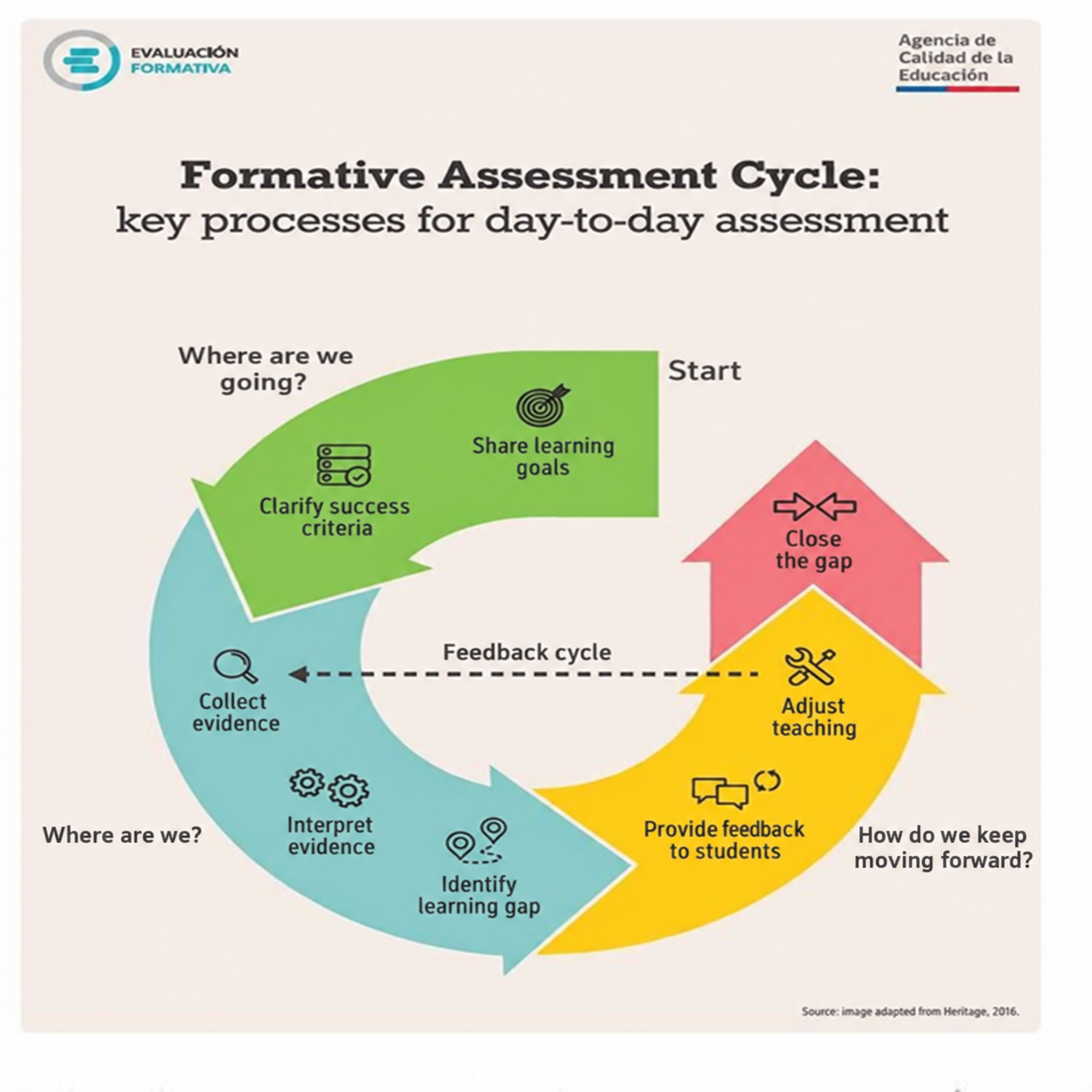
Source: graph prepared by the Education Quality Agency, included in The Evaluation of Competencies (18).
The instruments are facilitators that favor communication, interaction, and feedback processes; thus, we can suggest questionnaires, forums, oral presentations and submission of assignments, glossaries, wikis, video conferences, individual and group tasks, case analysis and case simulation, and recording of professional practices in the areas of professional development (18).
In accordance with the new evaluation paradigm, the assessment instruments that will be developed during the training are presented.
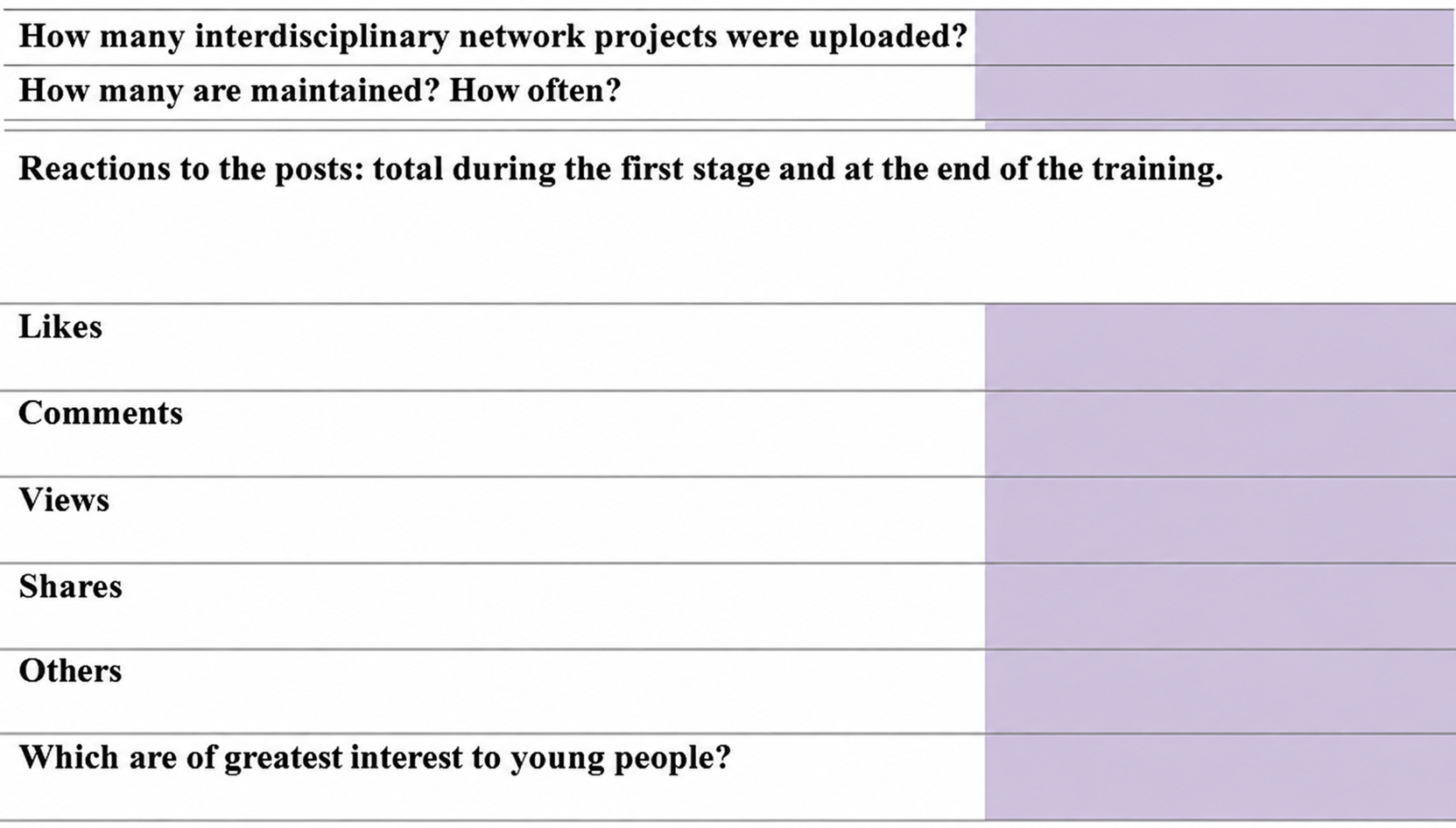
Table 9. Contributions to the assessment and grading of students
Assessment and Grading of Students | Assessment and Grading of Students | Assessment and Grading of Students | Assessment and Grading of Students |
|---|---|---|---|
What is evaluated? | (objectives) | (objectives) | (objectives) |
[empty cell] | [empty cell] | [empty cell] | [empty cell] |
Criteria | [empty cell] | [empty cell] | [empty cell] |
Indicators | [empty cell] | [empty cell] | [empty cell] |
Activities | Activity 1 | Activity 2 | Activity 3 |
Evidence | [empty cell] | [empty cell] | [empty cell] |
Rating | [empty cell] | [empty cell] | [empty cell] |
Table 10. Rubric for the evaluation of didactic sequences
Endpoints | Quality | Quality | Quality | Quality | Quality |
|---|---|---|---|---|---|
Endpoints | Very good | Good | Regular | Regular | Not achieved |
Topic and objectives | The sequence informs about and describes the topic and objectives, and explains others. | The sequence informs about and describes the topic and objectives | The sequence reports on the topic | The sequence reports on the topic | The sequence does not refer to the topic and objectives |
Actions and development of the sequence | Explains the key actions, the possibilities of the product, and its different objectives | Explains and details the actions and the product | Details some actions and the product | Details some actions and the product | Does not detail the actions and the product |
[empty cell] | Explains the key actions, the possibilities of the product, and its different objectives | [empty cell] | [empty cell] | [empty cell] | [empty cell] |
Relationships | Establishes relationships between the topic, the objectives, the actions, and the development | Establishes relationships between the topic and the product | Establishes some relationships | Does not establish relationships | Does not establish relationships |
Resources | Details the resources, explains their uses, and evaluates the impact | Details the resources | Mentions resources | Does not detail the resources | Does not detail the resources |
Formative assessment | Details strengths and weaknesses, suggests how to improve it, and provides tools | Details strengths and weaknesses and mentions tools | Details some strengths and weaknesses | Does not detail strengths and weaknesses or mention tools | Does not detail strengths and weaknesses or mention tools |
Table 11. Training evaluation rubric
Scale | Scale | Scale | |
|---|---|---|---|
Quality criteria | Good | Regular | Bad |
How was the course content for your development? Professional? | [empty cell] | [empty cell] | [empty cell] |
How did the learning activities turn out? | [empty cell] | [empty cell] | [empty cell] |
How do you evaluate the trainer's explanations? | [empty cell] | [empty cell] | [empty cell] |
How did you find the didactics implemented by the trainer? | [empty cell] | [empty cell] | [empty cell] |
How were the specialists' contributions? | [empty cell] | [empty cell] | [empty cell] |
In general, the trainer's work seemed to me... | [empty cell] | [empty cell] | [empty cell] |
I consider that the spaces for reflection were… | [empty cell] | [empty cell] | [empty cell] |
Figure 3. Evaluation of participation and sustainability of the proposal (for teachers)
Table 12. Assessment of student participation and learning
How many students participated in the proposal? | |
|---|---|
How many completed? | [empty cell] |
What techniques and instruments were used for assessing competencies? | [empty cell] |
How many passed the qualification? | [empty cell] |
How many passed the prerequisite course? | [empty cell] |
How many did not attend the proposal? | [empty cell] |
Of the total approved | Of the total approved |
How many were repeaters? | [empty cell] |
How many had abandoned? | [empty cell] |
Budget
Table 13. Cost by item
Concept | Quantity | Unit price | Total |
|---|---|---|---|
Bachelor's Degree in Education | 24 hours | $3500 | $84 000 |
Bachelor's Degree in Communication | 22 hours | $3200 | $70 400 |
Community Manager | 22 hours | $3200 | $70 400 |
Snack | 28 per encounter | $100 | $2800 |
Photocopies | 30 | $10 | $300 |
Markers | 5 | $500 | $2 500 |
Total | [empty cell] | [empty cell] | $230 400 |
RESULTS
It is widely agreed that secondary-level students must follow a successful school trajectory; this means entering the level and obtaining their qualification. However, when trajectories are interrupted or not guided, it becomes necessary to think about itineraries from and for students, observing institutional functioning, the role of teachers, and the ways of inhabiting the school. During the development of the training, the conceptual framework is addressed with the intention of establishing agreements that support pedagogical work and providing a space for reflection to understand that inclusion is also related to the opportunities for school success offered to students. We can also state that we rely on constructivism as an educational model, interdisciplinary strategic planning as a didactic practice, and formative assessment within the new assessment paradigm.
Incorporating ICTs as tools, specifically the social networks Facebook, Instagram, and Tik Tok, and recognizing their use, will favor participation, attendance, and the possible achievement of passing pending subjects in the basic cycle through an interdisciplinary methodology that helps in the understanding of changing knowledge and the complexity involved in solving problems; on the other hand, it will strengthen personal trajectories while at the same time reducing the fragmentation of enrollment in the orientation cycle within the institution.
The activities proposed to administrators and teachers to build content on social media will seek to organize interdisciplinary projects to address the issues and needs of young people from Saldán; organized in this way, teachers from different disciplines will assume the responsibility of connecting a priori disconnected ideas, in an organized action charged with creativity.
The development of interdisciplinary didactic sequences using technological tools will benefit collaborative learning, open spaces for opinions, and enhance classrooms, contributing to the construction of a digital society. The application of this type of planning will allow teachers to work as a team, presenting content as a corpus to be solved, researched, or problematized in reality, and also to meet students in another space, generating a different language and communication, in order to advance in the academic content proposed by the level.
These methodological and didactic proposals will have the intention of keeping the student in school and reducing repetition and dropout, due to failing the colloquium of previous subjects or due to non-attendance at them.
The rubrics developed by the trainer on three aspects: the percentage of teachers who supported the proposal, the percentage of students who passed subjects, and the trainers' competencies make it possible to evaluate the impact of the training segment, while gathering valuable information for feedback during the process, and facilitate the path to learning how to create them.
CONCLUSIONS
Taking as a starting point the problem addressed and the methodologies used throughout the plan, it is essential to mention that the proposed objectives can be achieved, since they will make it possible to retain a large part of the student body within the institution by passing pending subjects and favoring the continuity of their studies, driving the desire to finish secondary school. It should be noted that the project is not exempt from modifications, since depending on the context, it may present certain weaknesses, such as: that teaching teams do not want to participate, or find it difficult due to their teaching load at other institutions; in this sense, asynchronous communication will be reinforced; that they need more time to handle digital devices and tools; that more time is needed for agreement between disciplines in light of epistemological vigilance. For this, the Gantt chart can be modified and the second stage can be carried out, for example, in the following school year, and the activities of the first stage can be deepened. As for the students, they may not find the offer interesting, it may not invite them to surpass themselves but merely to comply, they may be unable to express their ideas, or their proposals may not be heard. Addressing the school's coexistence agreement allows delving into these aforementioned issues, through the functioning of the bodies already created by the institution, recognizing participation, dialogue, negotiation, and mediation.
Regarding strengths, the continuity of the meetings is important, since it allows creating a habit among teachers and helping them understand the importance of responsibility and collaborative teamwork within the institution. Moreover, it reinforces or creates bonds among peers and develops creativity. It can also be extended to all courses and/or to the orienting cycle.
Similarly, it can be modified by taking on other issues to work on, which allows opening the doors to future interventions, such as violence, sexuality training, discrimination, addictions, among others. As it is an open plan, workshops can also be included with openness to families and the community, opening the doors to knowledge (online or in person) that will later allow a favorable employment outcome for students and their families, carrying out publications, contacts, studies, training, etc. on social media.
As a corollary, returning to one study, schools seek to recreate the opportunity to interact with information with new technological repertoires that young people know and handle, in the use of digital technologies in Web 2.0 spaces.
References
- 1 Choque Larrauri R. Ecosistema educativo y fracaso escolar. Rev Iberoam Educ. 2009;49(4):1–9. https://doi.org/10.35362/rie4942086
- 2 Llano Arana L, Gutiérrez Escobar M, Stable Rodríguez A, Núñez Martínez M, Masó Rivero R, Rojas Rivero B. La interdisciplinariedad: una necesidad contemporánea para favorecer el proceso de enseñanza-aprendizaje. MediSur. 2016;14(3):320–7. http://scielo.sld.cu/scielo.php?script=sci_arttext&pid=S1727-897X2016000300015&lng=es&tlng=es
- 3 Frigerio G. Curioseando (Saberes e ignorancias). Rev Educ Ciudad. 2015;(22):81–102. https://doi.org/10.36737/01230425.n22.89
- 4 Terigi F. Trayectorias escolares e inclusión educativa: del enfoque individual al desafío para las políticas educativas. En: Marchesi A, Blanco R, Hernández L, coordinadores. Avances y desafíos de la educación inclusiva en Iberoamérica. Madrid: Organización de Estados Iberoamericanos para la Educación, la Ciencia y la Cultura; 2014. p. 71–81.
- 5 Perrenoud P. El oficio de alumno y el sentido del trabajo escolar. Madrid: Editorial Popular; 2006.
- 6 Vinasco-Zapata DC, Arias-Castellanos JE, Moncada-Tarazona JA, Rendón-Arroyave E, Palacio-Bernal JC. Ecosistemas comunicativos tecnomediados en educación: un camino por explorar en el ámbito escolar. Tecné Episteme Didaxis: TED. 2017;(42):143–58.
- 7 Archivo Prisma. “Historias de la Argentina secreta”: Saldán, un canto que brota del futuro, 1989 (fragmento). 2017 jun 21. https://www.youtube.com/watch?v=YPOfcl78mhQ
- 8 Ander-Egg E. La planificación educativa. Conceptos, métodos, estrategias y técnicas para educadores. 1993. https://trabajosocialsantafe.org/wp-content/uploads/2019/02/Ander-Egg-El-proyecto-curricular-en-las-instituciones-educativas.pdf
- 9 Pérez M, Astorga J, Bustamante P, Castillo S. Interdisciplinariedad, discursos sociales y enseñanza media. Cuadernos Fac Humanid Cienc Soc Univ Nac Jujuy. 2000;(15):323–40.
- 10 Lizcano-Dallos AR, Barbosa-Chacón JW, Villamizar-Escobar JD. Aprendizaje colaborativo con apoyo en TIC: concepto, metodología y recursos. Magis Rev Int Investig Educ. 2019;12(24):5–24. doi:10.11144/Javeriana.m12-25.acat
- 11 Arimetrics. ¿Qué es red social? 2022. https://www.arimetrics.com/glosario-digital/red-social
- 12 Torres-Toukoumidis A, De-Santis A, Vintimilla-León D, Espinoza-Beltrán I, Pérez-Pérez F, Suqui-Chimbo E, et al. TikTok: Más allá de la hipermedialidad. Cuenca: Universidad Politécnica Salesiana; 2021. https://dspace.ups.edu.ec/handle/123456789/21375
- 13 Alvino C. Estadísticas de la situación digital en Argentina. Argentina en el 2020-2021. Branch; 2021 abr 15. https://branch.com.co/marketing-digital/estadisticas-de-la-situacion-digital-de-argentina-en-el-2020-2021/
- 14 Melo Córdova JS. Educación conectivista y su relación con el aprendizaje autónomo dentro de redes sociales como: Facebook, TikTok y YouTube. Quito: Universidad Central del Ecuador; 2021. http://www.dspace.uce.edu.ec/handle/25000/24120
- 15 Majó Masferrer F, Baqueró Alòs M. 8 ideas claves. Los proyectos interdisciplinarios. Barcelona: Editorial Graó; 2014.
- 16 Castillo Arredondo S, Cabrerizo Diago J. Evaluación educativa de aprendizajes y competencias. Unidad didáctica II. Madrid: Prentice Hall Pearson; 2009.
- 17 Instituto Nacional de Formación Docente. Rebeca Anijovich - Evaluación. 2018 sep 27. https://www.youtube.com/watch?v=guIAN3J8piY
- 18 Universidad Siglo 21. Modelos de aprendizajes innovadores. 2019b. https://siglo21.instructure.com/courses/15084/pages/plan-de-intervencion-modulo-0
- 19 Argentina Cibersegura. Chicos y redes sociales: 10 preguntas para conversar con los más chicos. 2017 jun 29. https://www.argentinacibersegura.org/chicos-y-redes-sociales-10-preguntas-para-conversar-con-los-mas-chicos_173
- 20 Universidad Siglo 21. Plan de intervención IPEM Nº 193 “José María Paz”, Módulo 0. 2019c. https://siglo21.instructure.com/courses/15084/pages/plan-de-intervencion-modulo-0#org1
- 21 Universidad Siglo 21. La evaluación del aprendizaje. La evaluación de las competencias. 2019a. https://siglo21.instructure.com/courses/14796/pages/modulos#lectura4m1
- 22 Sociología Contemporánea. Entrevista a Manuel Castells. Educación, globalización, tecnología y empresa red. 2021 oct 17. https://www.youtube.com/watch?v=E4r1ZXfDGdw
- 23 Ministerio de Educación de Córdoba. La planificación. Cuaderno Nº 3. Cuadernos para pensar, hacer y vivir la escuela. El plan/proyecto educativo institucional en proceso. 2011;3:17.
- 24 Argentina. Ley 26.206 de Educación Nacional. Boletín Oficial. 2007 feb 6;núm. 31062:1. http://www.inet.edu.ar/wp-content/uploads/2013/03/ley_de_educ_nac1.pdf
- 25 Ghiglione S. Poner disponibles la herencia a educar Graciela Frigerio. 2021 mar 12. https://www.youtube.com/watch?v=8tMo0xGyg8U
- 26 DGDCCyAI Educación. Secuencias didácticas. Características y aportes para su diseño. 2017 mar 25. https://www.youtube.com/watch?v=LTSk3JazI2U&list=PL513doOHhKkPktVCZQKVk9FGeSywT8AoD&index=4
- 27 Bellver Abardía R. Dinámicas de trabajo en equipo. Lifeder; 2016. https://www.lifeder.com/dinamicas-de-trabajo-en-equipo/
Declarations
Funding
None.
Conflict of interest
The authors declare that there is no conflict of interest.
Authorship contributions
Conceptualization: Rosana de los Ángeles Castellano, Teresita Jalin.
Data curation: Rosana de los Ángeles Castellano, Teresita Jalin.
Formal analysis: Rosana de los Ángeles Castellano, Teresita Jalin.
Research: Rosana de los Ángeles Castellano, Teresita Jalin.
Methodology: Rosana de los Ángeles Castellano, Teresita Jalin.
Project administration: Rosana de los Ángeles Castellano, Teresita Jalin.
Software: Rosana de los Ángeles Castellano, Teresita Jalin.
Supervision: Rosana de los Ángeles Castellano, Teresita Jalin.
Validation: Rosana de los Ángeles Castellano, Teresita Jalin.
Visualization: Rosana de los Ángeles Castellano, Teresita Jalin.
Writing – original draft: Rosana de los Ángeles Castellano, Teresita Jalin.
Writing – review and editing: Rosana de los Ángeles Castellano, Teresita Jalin.