
Abstract
The main objective of this research was to understand why users connect with each other using content generated on TikTok and Instagram by the brand We're Not Really Strangers, sharing and spreading it. A total of 20 posts were sampled, 10 from TikTok and 10 from Instagram, taking into account the factors that facilitated their virality. With this information compiled, an analysis grid was created to perform a comprehensive analysis of the content. The results show that emotional advertising is used to create posts for subsequent dissemination. In terms of findings, it was noted that the use of a street marketing strategy is successful for creating a content marketing strategy, giving them value through emotions.
Keywords
Content Marketing, Viralization, Social Media, Street Marketing
INTRODUCTION
In the 50s, in France, the sunscreen brand Ambre Solaire used a very particular communication strategy, which consisted of bringing the product to people attending the beaches on the French coast. There, they offered them information and free trials of it.(1) This is known as the first recorded street marketing strategy.
Currently, and in Argentina, we find Guillermo Pachelo, a contemporary artist and advertising graduate, who in 2011 intervened initially on a wall in the City of Buenos Aires with a message of love: “Beautiful is she who reads”. After doing so, and realizing the impact it generated, he decided that the street would be his medium for his illustrations accompanied by positive phrases, which arise from conversations with his peers or with strangers. His art is present on many walls of the Buenos Aires capital, which are photographed and shared on social media by thousands of users. And it is very likely that, at least at some point, we have seen any of these illustrations on the profile of someone we know.(2)
Social networks are a very common complement in people's lives. Every day, millions of users from around the world share on them
any type of experiences, photographs, personal and professional information, etc., with known or completely unknown people.(3)
Iturralde (4) states that: “The dissemination of information through social networks has become an instrument of general interest, since its reach is massive and geographically across the entire planet; its access does not discriminate by gender or ethnicity, and in many cases does not consider socioeconomic status”.
A study conducted in 2022 published how many users each social network currently has. As of the date of the research, the top spot is led by Facebook, with 2 939 million; followed by YouTube with 2 476 million. Instagram is fourth with 1 440 million and TikTok sixth with 1 023 million. However, users of the latter spend around 95 minutes per day using the application, making it the social network with the most time invested by them. Nevertheless, Instagram users are the ones who post and share the largest amount of content.
Today, a social network is considered an instrument of communication and entertainment. “It is there where content marketing must do its work, seeking to reach with adequate information the medium and the objectives pursued by whoever uses this tool”.(4)
To introduce the topic, we will begin by defining the concept of marketing. Philip Kotler (5), in his book “Frequently Asked Questions About Marketing,” defines it as “the science and art of exploring, creating, and delivering value to satisfy the needs of a target market, and thus obtain a profit.”
Currently, there are many types of marketing, and in this research we will focus on four: content marketing, emotional marketing, viral marketing, and street marketing or street marketing.
Content marketing is the creation, publication, and dissemination of content that generates value for customers and users.(6) This allows the creation of loyalty among users and customers toward the brand. “Loyalty is the result of a strategic action applied by the company.”(7) To content marketing, we can add emotional marketing or marketing of emotions, since it also adds value and helps create customer loyalty by generating an affective bond.(8)
Kotler et al.(9), in their book “Marketing 4.0”, detail that: “more and more companies are changing advertising for content marketing, which requires a change in mindset. Instead of conveying messages with their value propositions, they must disseminate useful and valuable content for consumers”.
Among the most frequent mistakes when using this strategy is wanting to sell directly through the content. “Posts can be associated with the sector in which you operate, but they do not have to talk only about your company's products”.(10)
Emotional marketing is truly important for delivering value and creating customer loyalty. Trust is often the result of the emotion that the company provides and, to achieve a high level of it, it is essential that the entire organization be highly motivated in strategies in which both it and its customers come out ahead. Therefore, it is not a strategy that can work on its own. Current users, who are heavy consumers of technology, will value a brand when they can feel a deeper emotional connection.(11)
From advertising and integrated marketing communication, Clow et al. (12) assert that “when assembling the advertising strategy, a resource must be defined for the creation of advertisements. The most successful are seven: fear, humor, sex, music, rationality, emotions, and scarcity.” Each has a particular characteristic. For example, fear increases the viewer's interest in and attention to the advertisement and its persuasive power; humor causes consumers, upon seeing and laughing, to remember the advertisement and awakens their interest; sex is particularly used to differentiate from the rest, but sexual themes in advertisements no longer serve to sell as before; music is a pillar of advertising; it is very important. We can easily relate it to emotions and memories; it increases information retention and captures the attention of those who listen; rational advertisements are very convincing about the benefits of the products so that the purchase can be made; scarcity appeals encourage consumers to acquire the product due to a limitation; emotions in advertising capture the viewer's attention and create a certain attachment between the consumer and the brand. The most common emotions found in advertisements are trust, friendship, family ties, security, romance, passion, among others. Emotions are connected with fear, humor, music, and other resources to create conviction about the product. (12)
For audiovisual content to become viral, BBC News Mundo (13), together with experts on the subject, created a series of rules. Among them, we find that the content must use humor as a resource; that is, it must be funny. In addition, videos that awaken emotions—in other words, that contain the emotional resource—make people want to share them. Finally, and no less important, the video must be brief and should last less than 3 minutes.
Regarding viral marketing, following Clow et al. (12), we can understand that it consists of creating a message that, in some way, can be voluntarily transmitted or shared from consumer to consumer. However, it is important to note that, in an advertising context, “The viral message must focus on the product or the company so that it is not lost.”
To understand the following concept, to which we will give greater importance, it is first necessary to understand what guerrilla marketing is. This term first appeared in 1984, used by Jay Conrad Levinson in his book "Guerrilla Marketing: Secrets for Making Big Profits from Your Small Business". There, he defines it as a set of strategies and techniques executed through unconventional, ingenious, and creative means, without the need for high investment in advertising spaces. Street marketing, or on-street marketing, is a subdivision of guerrilla marketing (14). It is defined as "The entire street environment, or performance actions in it, capable of being used as an advertising medium" (15).
Today, many users share how they feel on social media, whether through images containing phrases written on street walls or by reposting content from certain brands that generate this type of emotional connection with them.
We’re Not Really Strangers is a card game that contains questions with the purpose of creating a meaningful emotional connection among the participants. It is also a good example of a creator of this type of images and videos that go viral, with a lot of reach on TikTok and Instagram.
This brand's social media strategy leads us to ask: is the use of street marketing a good way to generate a content marketing strategy and viralization on social media such as TikTok and Instagram?
Thus, the purpose of this work focuses on discovering why users connect with each other by using content generated on TikTok and Instagram by the brand We’re Not Really Strangers and organically sharing it.
After understanding the concepts to which we will give the greatest importance in the development of this research, we must define what we seek with it:
The general objective of this work is to analyze the use of street marketing and content marketing as a strategy to achieve connection and interaction with users, through the analysis of the case We’re Not Really Strangers.
Regarding the specific objectives, we can mention:
To identify the 10 most shared and commented posts on TikTok and the 10 most commented posts on Instagram at the start of the research.
Identify at least 5 posts from the sample that contain promotional elements.
Analyze the impact of content marketing and street marketing on viralization.
Evaluate the benefits of using content marketing.
METHODS
DESIGN
The scope of this research was exploratory. This was due to the lack of information or background linking the concepts of street marketing, emotional marketing, and content marketing. The aim was to recognize the benefits of using these three elements together based on the qualitative analysis of the contents (16). Following Hernández Sampieri et al. (16), the qualitative approach points to the collection and investigation of theoretical and scientific data.
The design was non-experimental, cross-sectional, because publications from a single moment were analyzed, without variations in time or space. (16)
Participants
The population of this research consisted of the publications made by the brand on the social networks Tik Tok and Instagram. A sample was taken of the 10 posts from each that had the greatest reach, impact, number of shares, and comments. In detail:
How to play - 19/12/20 https://bit.ly/3z9DFYlhttps://bit.ly/3z9DFYl
A flower for someone - 23/1/21 https://bit.ly/3Dr5OfKhttps://bit.ly/3Dr5OfK
Hello friend - 26/10/21 https://bit.ly/3DpehjDhttps://bit.ly/3DpehjD
Keep me close - 7/11/21 https://bit.ly/3F6EZyXhttps://bit.ly/3F6EZyX
Feeling like oneself - 24/1/22 https://bit.ly/3sGiqK9https://bit.ly/3sGiqK9
It is time for you to be happy again - 24/2/22 https://bit.ly/3TL7lmkhttps://bit.ly/3TL7lmk
It is fine - 16/3/22 https://bit.ly/3z3yXenhttps://bit.ly/3z3yXen
I love how you make me feel - 21/4/22 https://bit.ly/3StM93ghttps://bit.ly/3StM93g
Finding people - 1/8/22 https://bit.ly/3MVLbM5https://bit.ly/3MVLbM5
I feel loved - 29/8/22 https://bit.ly/3CZ5Lq7https://bit.ly/3CZ5Lq7
You don't need many best friends - 10/3/22 https://bit.ly/3D3R8BYhttps://bit.ly/3D3R8BY
Our friendship - 3/6/22 https://bit.ly/3CY2uaBhttps://bit.ly/3CY2uaB
I met you for a reason - 6/6/22 https://bit.ly/3Dpekfjhttps://bit.ly/3Dpekfj
Thank you for loving me - 13/6/22 https://bit.ly/3so3nV9https://bit.ly/3so3nV9
Questions that feel like a hug - 17/6/22 https://bit.ly/3eUoNWXhttps://bit.ly/3eUoNWX
Meeting you changed everything - 6/7/22 https://bit.ly/3TwyGJphttps://bit.ly/3TwyGJp
New languages of love - 27/7/22 https://bit.ly/3F9crofhttps://bit.ly/3F9crof
You deserve someone - 2/8/22 https://bit.ly/3VN8knQhttps://bit.ly/3VN8knQ
I love talking with you - 11/8/22 https://bit.ly/3VScR8Hhttps://bit.ly/3VScR8H
Thank you for being the way you are - 8/9/22 https://bit.ly/3sojH8whttps://bit.ly/3sojH8w
Instruments
The tool used to collect the information was an analysis grid. This includes different variables that were useful in defining the observation and analysis criteria for each publication. The number of shares and comments for each of the publications was taken as a metric. The information obtained was compiled in the following model:
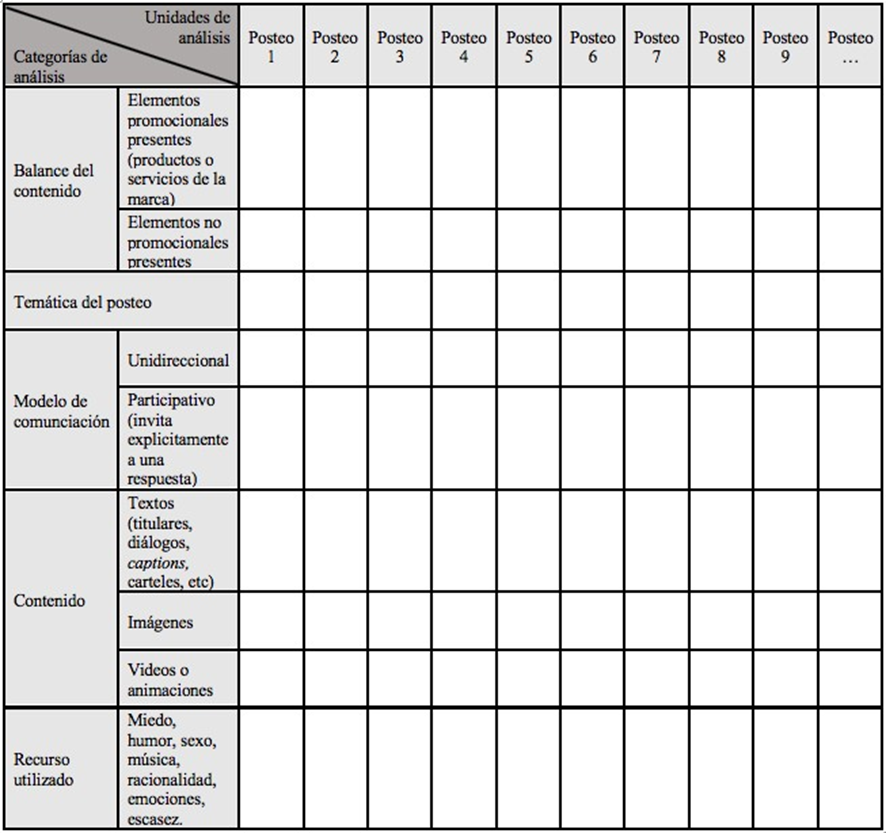
Analysis
The data collected were qualitatively analyzed, taking into account the objectives specific to this research, and the results of which are detailed in the following section.
RESULTS
With the aim of analyzing the use of street marketing and content marketing as a strategy to achieve connection and interaction with users, an analysis of the publications was conducted in relation to the metrics that indicate user participation (comments and shares). In addition, the contents were examined using the generated analysis grid, in an analytical and comparative manner. We took the last two years as the time frame (December 2020 - September 2022) and obtained the following results:
General aspects
Regarding interactions, all posts in the sample exceed ten thousand shares on TikTok and a thousand comments both on that social network and on Instagram. On both, they reach more than a hundred thousand “likes.” The videos are short and do not exceed 30 seconds in duration (17,18).
Content balance
It was not very common to find mention of the brand in the posts, but when they do mention it, they do not call for action to purchase the product. The brand name goes unnoticed, unless, as indicated in the sample, they taught how to use the game, which we can see in the first of the posts, where they also show the different levels of the game.
As for the non-promotional elements present, we were able to observe many. They published phrases, emotional questions, or actions they carry out in the streets using the brand's colors (red, white, and black) but without mentioning it at any point. The most striking of these says, in English, “it is important to find people who make you realize that there is nothing wrong with being who you are.”
Post topic
As previously stated, their posts contain phrases such as “with you I feel completely myself,” and emotional questions. They are personal enough to be shared with another person. They address topics such as friendship, gratitude, feelings, self-improvement, and feeling loved, among others.
Communication model
It is highlighted that the brand avoids the use of one-way messages. On the contrary, as they are highly personal phrases or phrases that users would dedicate to a person, they use a participatory model, where they invite the mention of another user by writing “tag him if you’re brave” or “@ them,” alluding to the mention, or encouraging them to answer questions in the comments.
Contents
In terms of content, we observed the use of posters in the street or on house balconies with phrases; stop-motion animations of other handwritten posters located at different points in the city that gradually complement each other; graffiti on walls; writings on sheets of paper or in mobile phone “notes”; and people holding a mobile device displaying a phrase or some kind of experience that somehow achieves a connection with another human being.
These posts were videos or images, and we found no difference in shares or comments. Both types of content contain a great deal of interaction and are disseminated equally.
Resource used
It was possible to observe that they use 2 main resources: music and emotions.
In the case of music, we observed that they use it in all videos but not in images, since the posts selected for the sample were made before a new Instagram update, after which the platform allows music to be added to photos in the feed. The songs or melodies accompanying the content have a melancholic, sad, and calm character.
Emotions were used in almost all the posts in the sample (only a single post did not use this resource). Friendship, romance, trust, and happiness were the most common, as can be seen, for example, in a post that says “thank you for giving me a friendship that I wanted and needed all my life” or in another that contains a phrase such as “I know we met for a reason.” It was possible to identify up to 2 or 3 of them in some publications.
DISCUSSION
Returning to the general objective of this research, which is to analyze the use of street marketing and content marketing as a strategy to achieve connection and interaction with users, and having analyzed the case of We’re Not Really Strangers based on the exhaustive analysis of the sample using the instruments previously mentioned, it was possible to answer the questions posed in the introduction.
The conclusions drawn from this research in relation to the specific objectives proposed are as follows:
Having established as the first specific objective the identification of the 10 most shared and commented posts on TikTok and the 10 most commented posts on Instagram, in order to understand the factors that generate content dissemination and the connection among users who follow the brand on both social networks, we were able to identify all publications in the sample that met the requirement of being highly commented and shared. It is important to highlight that no notable differences were found in these user actions between posts that contain promotional elements of the brand and those that do not. Regarding the latter, it can be concluded that they do not make the mistake of making invasive mentions or saturating references to the brand or product within their content strategy.(10)
With this said, we move on to the second specific objective (to identify 5 posts containing promotional elements), which could not be fulfilled in its entirety. Of the total sample (20 posts), only 2 (two) contained promotional elements: brand name; but, with the curious observation that they have not made a call to action to purchase the product in either of the two publications, but that the name went unnoticed or they simply taught how to use the game.
They have a particular approach to creating content on social media. By using emotions as their primary resource, they create a strong impact on users who follow this brand or who view it on their home page (or “For You” on TikTok). As reflected in the results, the most prevalent emotions are friendship, romance, trust, and happiness.
Since the brand's product is the card game containing questions designed to generate a deep emotional connection among players, it could be understood that they use the same objective on social media. By posting phrases, sayings, questions, or street actions in which they invite users to share or mention others in the comments, they also establish this form of bond among them, thereby creating the viralization of this type of content.
Thus, we can complement a rule shared by BBC News Media:(13): it is not necessary to use humor as a resource to generate the viralization of audiovisual content. However, not all brands adapt to this style, and there are specific products that can handle other tones with notable success.
The third objective was to analyze the impact of content marketing and street marketing on viralization:
Among the strategies they have used to generate content is that of street marketing (or street marketing). By posting short videos or images of posters and those placed in the street or on house balconies, stop-motion animations of other posters written and pasted at different points in a city, and also showing graffiti on walls, which contain phrases that the public would dedicate to another person, they attract attention and generate this type of response, whether by sending them directly or by mentioning other users in the comments of the posts.
This strategy and the content marketing strategy, which also provides value to users,(6), have been a combination that generated a great impact. Thousands of users have shared this type of content generated by this brand, and this could be seen reflected in the number of shares and comments that each post in the sample has. Both on Tik Tok and Instagram, we found a button that allows, quickly and instantaneously, sending the post to another user. Although they have encouraged users to perform these actions (comment, mention, or send), it may go unnoticed, since these calls to action are only written in the caption or description of each post.
A publication from the sample to highlight is a video on Tik Tok, titled “una flor para alguien,” from a street action in which a basket with flowers was left in a plaza along with a sign that reads “una flor para alguien que la necesite hoy,” showing people taking a flower and carrying it away. This publication, which has more than 20 thousand shares, nearly 20 thousand comments, and more than 3 million “likes,” can be used as an example of valuable content for consumers of both the brand and this type of content.(9)
Thus, we arrive at the fourth and final objective: to evaluate the benefits of using content marketing.
The use of this strategy for social media is important for brands, since it allows them to convey their values without the need to focus on the products or services they offer. It is a good way to understand the interests of the users who follow them, whether they are customers or potential consumers, or simply to provide valuable content for future followers.
In all the posts of the sample, and as previously mentioned, the colors red, white, and black have been observed, both in the words and in the backgrounds of the painted posters, which means that upon seeing them, it is quickly identified that We`re Not Really Strangers is the account that disseminates that type of content, favoring the brand's identity and its recognition on social media.
Therefore, if we seek to answer the question posed in the introduction of this work, we can say that by knowing how to combine a street marketing strategy and a content marketing strategy, it can become successful content on Tik Tok and Instagram. If we return to the case of Guillermo Pachelo, we can realize that his art, having been so widely shared and disseminated, has been requested by different important brands, such as, for example, Dot Baires Shopping, in Buenos Aires.
Lastly, we confirm that users feel identified with the dissemination of the high emotional content generated by this brand and see themselves reflected in what it conveys, and this consequently leads to the need to share it.
CONCLUSIONS
We can conclude that this type of short, direct messages—and why not also call them empathetic—favors the perceived positive attitude toward the brand, creating a kind of loyalty to it and making its audience await its new publications. Virality is, therefore, a consequence of all the aforementioned, so we have recognized that there is a clear strategy of it by using emotions as a resource.
Therefore, it is not necessary to make large investments in order to achieve a massive dissemination of brand values at a global level. Social media and their users help make this possible, since there are no barriers of space and time when publishing and sharing content.
If we speak of a local brand with a similar proposal, we can find En Palabras (@enpalabrass), which is also a card game of personal questions and for connecting with other people. Its social media strategy focuses on Instagram, where in its posts it invites users to answer questions in the comments or to share their experiences with the game, but not to share them with others. They also publish advice on mental health, sexual identity, and reflections. In their reels, they show different people, mostly influencers, answering a question from a card in the game. They also use street marketing with posters containing questions, but they do not invite their followers to answer them in the comments. On Tik Tok, they do not have as many views or shares, and a strong emphasis on and mention of the game can be appreciated.
If this brand followed the We're Not Really Strangers strategy, both on TikTok and Instagram, where it invites its followers to share the posts or dedicate them to someone else in the comments, just so that they connect, without making much mention of the game, it could achieve greater recognition on social media, leading potential users to learn about the brand and subsequently desire to purchase the product.
What was previously presented must be understood considering the inherent limitations of the process, since this is an exploratory, non-experimental investigation, without fieldwork, in which a non-probabilistic and relatively small sample of one single case was analyzed: We’re Not Really Strangers.
Any application of these conclusions to a new advertising strategy must be made taking into account the key actors of each case, such as the brand, the context, the audience, and the social network.
This research, however, is valuable in nature, since it has been possible to understand that with few resources, the emotional resource can be used in a street marketing strategy to create a content marketing strategy.
Nevertheless, we recommend continuing this line of research with a descriptive scope and a qualitative approach, in order to understand whether users are indeed the ones who share and disseminate this type of content on their personal social media, and whether brands also do so, using interviews and surveys to analyze reception and their perceptions as well. Ideally, the account's own metrics and commercial and return-on-investment data would be available.
References
- 1 López García S. Arte callejero vs. Street marketing: un estudio comparado de la difusión en Internet de casos de éxito [Trabajo Final de Grado]. Universidad de Valladolid; 2015. Disponible en: http://uvadoc.uva.es/handle/10324/14089
- 2 Queija A. Guillermo Pachelo: un artista urbano romántico y positivo. 2018.
- 3 Celaya J. La empresa en la Web 2.0. Barcelona: Grupo Planeta; 2008.
- 4 Iturralde MF. Content marketing: innovación e información a través de las redes sociales. Revista de Investigación Sigma. 2015.
- 5 Kotler P. Preguntas más frecuentes del marketing. Bogotá: Grupo Editorial Norma; 2005.
- 6 Ramos J. Marketing de contenidos: guía práctica. 2016.
- 7 Lehu J. Fidelizar al cliente: marketing, Internet e imagen de marca. Barcelona: Paidós; 2001.
- 8 Zubiaur I. ¿Qué es el marketing emocional?. Titular. 2022 feb 1. Disponible en: https://www.titular.com/blog/que-es-el-marketing-emocional
- 9 Kotler P, Kartajaya H, Setiawan I. Marketing 4.0: transforma tu estrategia para atraer al consumidor digital. LID Editorial; 2010. Disponible en: https://epub834fb101ee9db5b9ecb63131b63a57de.odilotk.es/#/e6425330-9e10-411f-afab-4ed069618fed/4f900ec8d3612690f90a55195e3c01fb58840f001bc3020cb8f0deb5eda1ebe2
- 10 Cuevas Callejas J. 5 claves en el marketing de contenidos. Increnta. 2018. Disponible en: https://www.academia.edu/19629678/5_claves_en_elmarketing_contenidos
- 11 Migoya M. Experiencias digitales para el consumidor actual. Revista UNO. 2016. Disponible en: https://www.revista-uno.com/numero-24
- 12 Clow KE, Baack D. Publicidad, promoción y comunicación integral en marketing. Pearson; 2010.
- 13 BBC News Mundo. ¿Cómo hacer un video viral?. YouTube. 2015 mar 16. Disponible en: https://www.youtube.com/watch?v=pq68tjkPnIA
- 14 Monge Rabadán L. Trabajo Final de Grado. Universidad de Valladolid; 2016. Disponible en: http://uvadoc.uva.es/handle/10324/18164
- 15 Moreno López B. De la guerrilla de la comunicación a la comunicación de guerrilla: conceptualización, análisis de la cuestión y dimensiones estéticas y estratégicas para la comunicación publicitaria [Tesis Doctoral]. Universidad de Valladolid; s. f. Disponible en: http://uvadoc.uva.es/handle/10324/14284
- 16 Hernández Sampieri R, Fernández Collado C, Baptista Lucio MdP. Metodología de la investigación. 5.ª ed. México: McGraw-Hill; 2010. Disponible en: https://www.academia.edu/20792455/Metodología_de_la_Investigación_5ta_edición_Roberto_Hernández_Sampieri
- 17 Kemp S. ¡La audiencia publicitaria de TikTok llega a 1.002 millones! (y otras estadísticas impactantes). Hootsuite Blog. 2022 ago 15. Disponible en: https://blog.hootsuite.com/es/informe-digital-estadisticas-de-redes-sociales
- 18 Revista Oh La La. Guillermo Pachelo: un artista urbano romántico y positivo. 2017 ene 8. Disponible en: https://www.somosohlala.com/actualidad/ultimas-noticias/guillermo-pachelo-un-artista-urbano-romantico-y-positivo-nid08012017
Declarations
Funding
None.
Conflict of interest
None.
Authorship contributions
Conceptualization: Paulina Soini, Ignacio Pagliano.
Data curation: Paulina Soini, Ignacio Pagliano.
Formal analysis: Paulina Soini, Ignacio Pagliano.
Investigation: Paulina Soini, Ignacio Pagliano.
Methodology: Paulina Soini, Ignacio Pagliano.
Project administration: Paulina Soini, Ignacio Pagliano.
Software: Paulina Soini, Ignacio Pagliano.
Supervision: Paulina Soini, Ignacio Pagliano.
Validation: Paulina Soini, Ignacio Pagliano.
Visualization: Paulina Soini, Ignacio Pagliano.
Writing – original draft: Paulina Soini, Ignacio Pagliano.
Writing – review and editing: Paulina Soini, Ignacio Pagliano.