
Abstract
Introduction: Perinatal mourning is a consequence of perinatal loss; for them it is important that a humanized management is given, since, in some cases, mourning occurs silently. This care must be carried out both for the mother and her family. For them, the role of the nurse in the approach with comprehensive accompaniment and support is important. Objective: To determine qualities are the most effective nursing interventions for the management of perinatal grief for the mother and her family. Methodology: Narrative review through the search for research articles on perinatal grief and effective interventions for the management of perinatal grief. These searches were carried out by means of a peak question in which a specific population was selected, additional inclusion and exclusion criteria were taken into account according to the ProQuest, Dialnet, Google Scholar databases. Results: Finally, a total of 15 articles that answered the research question were selected, a series of effective nursing disorders for the mother and her family were identified, such as support groups, active listening by the staff, expression of feelings, implementation of rituals among others. Conclusions: From the nursing discipline, effective nursing interventions are implemented for the management of grief due to perinatal death, such as creating memories, emotional support, active listening, among others; but it is worth noting the need to include other disciplines that address perinatal grief, for this reason new guidelines and protocols must be generated for a multidisciplinary approach.
Keywords
Perinatal grief, eruption, Effective, Perinatal death
INTRODUCTION
The process of gestational loss is a situation that leads to perinatal bereavement, where common sense and humanization should prevail.(1,2,3,4,5) Perinatal grief manifests itself as a silent grief, since many mothers keep their grief bottled up and do not express it.(6,7,8,9,10) This is seen from the perspective of nursing professionals, since their roles are fundamental in the approach, because they are the ones who have continuous and immediate contact with the mother, the father and other family members, through accompaniment activities, care, advice on administrative procedures and comprehensive support.(11,12,13,14,15)
Perinatal loss brings complications and is one of the most important risk factors for public health problems worldwide, nationally and locally, since this event implies high costs for the health system such as:(16,17,18,19,20)
The role of nursing, which is a key factor during the bereavement, since it allows to assess the feelings of the mothers and their families so that the activities are focused on the nursing staff learning to take care of themselves emotionally and prevent the bereavement from becoming permanent and leading to problems of depression and anxiety. This is why the nursing staff can have a significant influence on the way in which the bereavement process is faced, avoiding the development of pathological processes.(1)
What are the most effective nursing interventions for the management of perinatal bereavement in the mother and her family?
Objective
To determine the effective nursing interventions for perinatal bereavement management provided to the mother and family based on literature review.
METHOD
Design
The research focuses on a narrative review using information from research articles in the database of the Universidad Cooperativa de Colombia on effective interventions to manage maternal and family perinatal bereavement.
Population
This narrative review includes quantitative and qualitative articles, scientific journals, research narratives, research theses from the Cooperative University of Colombia database and open databases related to effective interventions for managing maternal and family perinatal bereavement.
Sample
Quantitative and qualitative articles, scientific journals, research narratives, research theses that meet the inclusion and exclusion criteria will be included in the following narrative review.
Search for information
For the search and selection of quantitative and qualitative articles, scientific journals, research narratives, and research narratives, we consulted the health sciences descriptors (DeCS) page, which are described in Spanish, English and Portuguese.
Spanish | English | Portuguese |
|---|---|---|
Perinatal death | Perinatal death | Perinatal death |
Depression | Adjustmentdisorders | Adjustment Disorders |
Grief | Grief | Grief |
Depression postpartum | Postpartum Depression | Postpartum Depression |
Pregnancy | Pregnancy | Gravidity |
Nursing Care | Nursing Care | Nursing Care |
Death | Death | Death |
Nursing Education | Education, Nursing | Nursing Education |
Search strategy
The present narrative review will include the Boolean connectors AND, OR to construct the search formulas in the database.
Table 2. Search Strategies
Strategy (Equation-Ensemble) | No. of articles | Database |
|---|---|---|
Perinatal depth AND Pregnancy AND nursing | 203 | Proquest Nursing & Allied Health Database |
Interventions and perinatal death | 42 | Dialnet |
Nursing and bereavement and perinatal | 18 | Dialnet |
Perinatal death AND Pregnancy AND nursing | 5264 | Proquest Public Health Database |
Intervention nursing and perinatal death | 22 718 | Proquest |
Nursing and perinatal death | 17 500 | Academic Google |
Nursing interventions in perinatal bereavement or maternal bereavement | 17 400 | Proquest |
Perinatal bereavement or family bereavement | 6090 | Google academic |
Nursing or perinatal or bereavement | 193 603 | Proquest |
Nurse or bereavement or family or perinatal | 1630 | Dialnet |
Perinatal or maternal or interventions or nursing | 53 142 | Proquest |
Bereavement or maternal or families or interventions or nursing | 2401 | Proquest |
Bereavement or nursing or interventions or perinatal or family | 6219 | Dianet |
Maternal or family or bereavement or perinatal | 29 067 | Proquest |
Family or intervention or nursing or bereavement | 19 083 | Proquest |
Maternal or perinatal or family or bereavement | 1394 | Proquest |
Nursing and bereavement and maternal and perinatal | 645 | Proquest |
Note: in this table the results of AND, OR, Boolean table are evidenced. | Note: in this table the results of AND, OR, Boolean table are evidenced. | Note: in this table the results of AND, OR, Boolean table are evidenced. |
Source of information
Institutional databases: the university's own databases will be consulted, such as the virtual health library, OVID Medicine and Nursing, Proquest Family Health Database, Proquest Health & Medical Collection, Proquest Nursing & Allied Health Database, Proquest Public Health Database, health journals and books. Visibility, Proquest Education Database, Proquest India Database, Proquest Latin America & Iberia Database, Proquest Middle East & Africa Database, Proquest Psychology Database, Proquest Research Library, Proquest Science Database, Proquest Social Science Database, Proquest UK & Ireland Database, Redalyc, Dialnet, Oxford, Proquest Central, Sage Journals, Science Direct, Springer journal, Taylor & Francis, Scopus.
Open databases: once the search in the university databases has been completed and the necessary saturation of articles has not been achieved, a search of open databases such as: Google Scholar, Scielo, Pubmed will be carried out.
Selection criteria
First, the variables and descriptors listed above will be considered, and the inclusion and exclusion criteria will be used as a reference for the search.
Inclusion criteria
Language: quantitative and qualitative articles, scientific journals, research narratives, full-text theses in Spanish, English or Portuguese will be included or considered.
Time range: quantitative and qualitative articles, scientific journals, research narratives, theses, from 2003 to the present will be included, since data on perinatal bereavement have been recorded since that time.
Type of publication: quantitative and qualitative articles, scientific journals, research narratives, theses will be included in the search.
Exclusion criteria
Articles will be excluded if they are found for perinatal death in traffic accidents, rape or perinatal death in indigenous communities, perinatal death in minors from 14 years of age.
Selection Criteria
After applying the inclusion and exclusion criteria, the aforementioned database will be searched and the articles will be exported to the "Mendeley" application to exclude possible identical articles from the results, in the process it will be possible to determine which articles will be extensively reviewed for inclusion. in this study and future analyses.
Analysis of the information
From the previously selected articles, a reading of the full text will be performed, obtaining the necessary information, which will be stored in a database created by the researcher, which will contain the following items: the title of the article, the journal in which the article was published. published, author or authoress, publication Dates, countries, scope, general and specific objectives, research design, population, sample, methods, tools used to describe nursing attitudes and knowledge in key services.
Search results and document selection
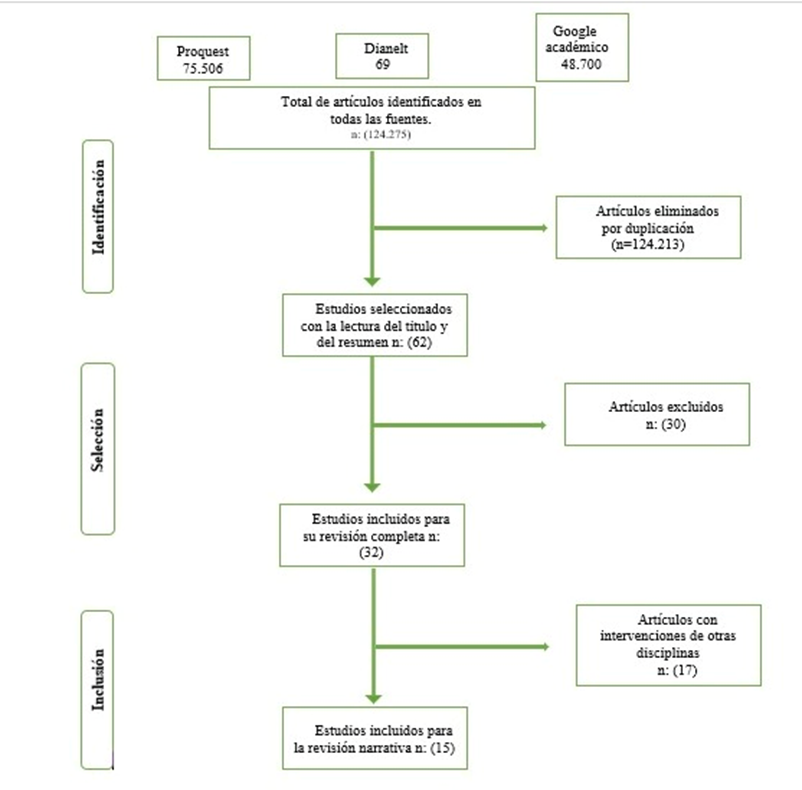
In the following narrative review, it is described that the search was focused on different databases such as proquest, Dialnet and Google Scholar, with a total of 124,275 articles which were eliminated by exclusion criteria 124,213 of which only 15 articles met the selection criteria and 32 articles are mentioned in the review since they perform interventions for this phenomenon, but from other disciplines as evidenced in figure 3.
RESULTS
Among the nursing interventions reported in this bibliographic review from 2005 to date of the 30 articles selected, there is evidence of care interventions which are applied in perinatal loss, which are shown in 2 groups: those directed to the mothers, those directed to the family and other contributions from the nursing experience to prepare for the care of this situation and interventions from other disciplines.
Interventions for the mother
Among the interventions that are applied for the care of the mother after the perinatal loss are those that favor privacy, understanding privacy as that space that contributes to the expression of feelings,(2) as for the creation of a bond there is the possibility of generating memories before the final farewell of the body by means of belonging kits that include footprints, locks of hair, and photographic records.(2,3,4,5)
At the psychological level, behavioral therapies that influence sleep,(6) relaxation techniques,(2,4) establishment of healthy habits are also implemented. On the other hand, the possibility of attending support groups is offered,(6,7) to encourage the expression of feelings,(3,8) strengthening active listening(4,6,8) and providing education about the grieving process(3,9) through simple and clear language avoiding technicality.
Care interventions for the family
At the family level, the nursing interventions that are applied after experiencing a loss due to perinatal death are the care provided focused on emotional support(7,10,11,12) highlighting understanding through active listening.(7,12)
Likewise allowing family members to create memories through photographs and contact with the body(7,10,11,13) as well as the implementation of spiritual rituals based on their customs and beliefs.(7,10,11,12,13)
It is also important to highlight the fact of facilitating support groups(10,11) and psychoeducation(7,12,13) in order to go through this grieving process with the support of experiences in other relatives and thus find ways to deal with this situation that does not only affect the mother but her family and social bond.
Other contributions to the review
Although the aim was to find nursing interventions for the management of grief, it is necessary to mention other findings relevant to the review, which are related to the preparation of nursing personnel who are present in the services where a perinatal death occurs and their approach in the course of the phenomenon.
The main finding found is that nurses present knowledge gaps in terms of communication skills (14) and how to approach at a physical level(14,15,16,17,18) psychological(14,17,18,19) and spiritual.(14,15) However, the little knowledge they have is due to the experience of former nurses.(20) On the other hand, they mention that they experience feelings of grief of their own, accompanied by anger, fear, pain, and frustration(14,15,19,21) manifesting attitudes of escape and avoidance.(14,18)
There are also disciplines such as psychology as a social science which supports perinatal bereavement support with cognitive behavioral therapies, eye movement desensitization and processing, debriefing, counseling, expressive writing, self-help materials, family support program, tetris, yoga and compassion-focused therapy.(22)
This same discipline proposes a mindfulness intervention in perinatal bereavement, which includes five main steps which are: 1. understanding and compassion 2. non-judgment 3. acceptance of the parents' emotional expression 4. deep listening and a place for storytelling 5. being able to process their emotions and are categorized as useful to enhance the benefits of counseling in parents after the death of a baby.(23)
Also in the science of medicine especially obstetrics where this type of phenomena occurs the literature recommends that the outstanding intervention is the psychological support provided by health personnel such as nursing, medicine, gynecologists, assistants, psychologists, highlighting that communication is a decisive factor in the doctor-patient relationship.(24)
Likewise psychiatry puts into consideration interpersonal therapy in non-pathological perinatal bereavement as an alternative of interventions focused on the mother and her family in this situation. However, it mentions that the approach of this intervention in pathological grief is not known, but it is effective in a normal perinatal grief process.(23)
Within the discipline of anthropology recommend psychological and emotional care focused on the experience in addition to contact with the deceased baby, this discipline also focuses on the state of knowledge, management of their own emotions and coping models are the guide for addressing this phenomenon in the grieving process of the mother and her family.(19)
Interventions in public and private hospitals are also highlighted, such as one found in Mexico named butterfly code which is based on an interdisciplinary psychological follow-up protocol for the care of the mother and family with safety and warmth and much respect who are going through the process of perinatal bereavement. With the above described, the importance of nursing can be considered multidisciplinary since it includes and evaluates the interventions and care of other health disciplines for the management of the bereavement process of perinatal loss of the mother and her family is highlighted.(25)
DISCUSSION
Every year the phenomenon of bereavement due to perinatal death is evident in millions of families that go through this situation in the world,(21,22,23,24,25) however, the literature shows few studies in the description of specific effective nursing interventions which can be focused in relation to the care of the mother and the family, as stated by the authors.(3,25,26,27,28,29) However, there are other disciplines that have also focused on interventions in the care of the mother and her family for the management of perinatal bereavement, such as psychology, psychiatry, medicine and sociology.(30,31,32,33,34)
When talking about the nursing interventions effective in the mother registered in the NIC mentioned above are similar to those reported by other sciences such as memory kits that include belongings of the deceased baby and photographic records, active listening,(35,36,37,38,39) relaxation therapies and support groups, by the discipline of psychology the accompaniment in the grieving process is implemented with programs for family support, yoga, as well as the mindfulness type intervention which has these interventions that are also developed in nursing.(26,40,41,42)
From the family the nursing interventions most highlighted as effective were emotional support and active listening, likewise from the discipline of psychiatry interpersonal therapy is implemented(26,43,44) and in anthropology care at the psychological and emotional level.(19,45,46)
In general there is little evidence available in the literature on effective interventions in nursing, this leads to the need to analyze those that are not specific to the discipline but can be implemented as a support system in the perinatal bereavement process of both the mother and her family, which could lead to the creation of new policies in public and private hospitals that witness this phenomenon and perform interdisciplinary work in this health situation.
CONCLUSIONS
Cases of perinatal death are more frequent than it seems, triggering the grieving process on the part of the mother and family, one of the complications generated by this process is the development of pathological grief, hence the importance of the role of nursing in interventions aimed at those involved in order to provide individualized care, approaching the subject of care in a holistic manner, where not only the physical dimension is influenced, but also includes attention at the emotional level.
According to the results obtained through the search for nursing interventions for the management of grief due to perinatal death, we found that the creation of memories by means of belonging kits that include fingerprints, locks of hair, and photographic records is the most prevalent intervention, followed by active listening and education in terms of relaxation techniques provided by the nursing staff.
It should be noted that the implementation of guidelines or protocols aimed at perinatal death bereavement is an urgent need, since nursing professionals recognize their lack of knowledge in this area, which has an impact on the psychological well-being of people who experience the loss due to perinatal death.
During the literature review, the contribution of other disciplines with effective interventions to improve the care of the mother and her family, preventing grief from becoming complicated, is evident.
It is important to recognize that for nursing professionals, facing the process of loss generates the appearance of negative feelings to the point of developing a grief of their own, which is why it is necessary to induce the preparation of the personnel in the face of grief.
RECOMMENDATIONS
For further research, it is recommended to conduct studies that address nursing interventions for the management of grief due to perinatal death due to the scarcity of evidence, as well as to implement the existing interventions to date, since nursing professionals have a fundamental role in the grieving process due to the direct contact they have with the mother and her family, therefore it is of utmost importance to have a correct approach with pertinent attitudes.
It is important to emphasize the training of nursing professionals, starting with their training process, in order to obtain optimal results in the care of perinatal bereavement.
Finally, we recommend applying the topic of perinatal bereavement within society to improve its importance and thus make its influence visible, resulting in the improvement of the care provided to people who go through this process.
It is important to implement interventions from other disciplines to improve the perinatal bereavement process for the mother and her family.
References
- 1 Kuforiji O, Mills TA, Lovell K. Women’s experiences of care and support following perinatal death in high burden countries: A metasynthesis. Women Birth. 2022. https://doi.org/10.1016/j.wombi.2022.07.170
- 2 Tejero Vidal LL, Barea Millán S. Nursing care plan for dealing with perinatal bereavement according to the theory of dysfunctional bereavement. Clinical case. Enferm Clin. 2023. https://doi.org/10.1016/j.enfcli.2022.12.002
- 3 Arthaud Manzanera P. TFG-H2312. 2021.
- 4 Borrego Cabezas L, Matas Rodríguez C, Del Fresno Serrano MA. Duelo en la maternidad y en la reproducción. Intervención de la matrona. 2022. https://revistasanitariadeinvestigacion.com/duelo-en-la-maternidad-y-en-la-reproduccion-intervencion-de-la-matrona/
- 5 Villalón MR, Quirós PG, García AN, Martín SM, Berrocal PG. Papel de la matrona ante el duelo perinatal en contexto actual de pandemia. Caso clínico. Enferm Cuidándote. 2022;5(2):8–16. https://enfermeriacuidandote.com/article/view/4461
- 6 Hollins Martin CJ, Reid K. A scoping review of therapies used to treat psychological trauma post perinatal bereavement. J Reprod Infant Psychol. 2022. https://doi.org/10.1080/02646838.2021.2021477
- 7 Castroagudín G, López S, Teijo P, Marra L, José M, Vidal R. Papel de la matrona en el manejo del duelo perinatal y neonatal. Cadernos de Atención Primaria. 2013;19(2):113–7. https://aplicacionesbiblioteca.udea.edu.co:2163/buscar/documentos?querysDismax.DOCUMENTAL_TODO=Papel+de+la+Matrona+en+el+manejo+del+duelo+perinatal+y+neonatal
- 8 Toro Bermúdez JI, Mesa Melgarejo L, Quintero Olivar JF. Abordaje del duelo en una unidad de cuidado intensivo neonatal: entre el protocolo y la intuición. Repert Med Cir. 2022;XX(X):1–8. https://doi.org/10.31260/Repert
- 9 Qian J, Wang W, Sun S, Wu M, Liu L, Sun Y, Yu X. Exploring interactions between women who have experienced pregnancy loss and obstetric nursing staff: a descriptive qualitative study in China. BMC Pregnancy Childbirth. 2022;22(1):1-11. https://doi.org/10.1186/s12884-022-04787-9
- 10 Fernández-Alcántara M, Cruz-Quintana F, Pérez-Marfil N, Robles-Ortega H. Factores psicológicos implicados en el duelo perinatal. Index Enferm. 2012;21(1-2). https://doi.org/10.4321/S1132-12962012000100011
- 11 Paraíso Pueyo E, González Alonso AV, Botigué T, Masot O, Escobar-Bravo MÁ, Lavedán Santamaría A. Nursing interventions for perinatal bereavement care in neonatal intensive care units: A scoping review. Int Nurs Rev. 2021;68(1):122-37. https://doi.org/10.1111/INR.12659
- 12 Steen SE. Perinatal death: bereavement interventions used by US and Spanish nurses and midwives. Int J Palliat Nurs. 2015;21(2):79–86. https://doi.org/10.12968/ijpn.2015.21.2.79
- 13 Contreras-García M, Ruiz-Soto B, Ortega-Irigaray A, Paredes-Gallo MF, Yáñez-Peralta P. Protocolo-guía muerte fetal HUMV. 2016. https://www.redelhuecodemivientre.es/
- 14 Lizcano Pabón LDM, Moreno Fergusson ME, Palacios AM. Experience of Perinatal Death from the Father’s Perspective. Nurs Res. 2019;68(5):E1–E9. https://doi.org/10.1097/NNR.0000000000000369
- 15 Martínez Dávalos CS. El profesional de enfermería ante el duelo por muerte perinatal. Enferm Investiga. 2018;3(1):10-15. https://doi.org/10.29033/ei.v3n1.2018.03
- 16 Páez Cala ML, Arteaga Hernández LF. Duelo por muerte perinatal. Necesidad de una atención diferencial e integral. Arch Med (Manizales). 2019;19(1):32-45. https://doi.org/10.30554/archmed.19.1.2853.2019
- 17 Martos-López IM, Sánchez-Guisado MM, Guedes-Arbelo C. Duelo por muerte perinatal, un duelo desautorizado = Bereavement for perinatal death, unauthorized bereavement. Rev Esp Comun Salud. 2016;7(2). https://doi.org/10.20318/recs.2016.3454
- 18 María S, Romero Sánchez JM, Montoro CH, Crespo ML, Gema A, Jaén V, et al. La vivencia de la pérdida perinatal desde la perspectiva de los profesionales de la salud. Rev Lat Am Enfermagem. 2011. http://www.eerp.usp.br/rlae
- 19 Garre JMH, Sánchez FCS, Pérez PE. Alumbrando la muerte. Profesionales de la vida gestionando el duelo. Rev Int Sociol. 2017;75(3). https://doi.org/10.3989/ris.2017.75.3.15.189
- 20 McCreight BS. Perinatal grief and emotional labour: A study of nurses’ experiences in gynae wards. Int J Nurs Stud. 2005;42(4):439-48. https://doi.org/10.1016/j.ijnurstu.2004.07.004
- 21 Valenzuela MT, Bernales M, Jaña P. Duelo perinatal: Perspectivas de los profesionales de la salud. Rev Chil Obstet Ginecol. 2020;85(3).
- 22 Koopmans L, Wilson T, Cacciatore J, Flenady V. Support for mothers, fathers and families after perinatal death. Cochrane Database Syst Rev. 2013;(6):CD000452. https://doi.org/10.1002/14651858.CD000452.pub3
- 23 Millán-González R, Solano-Medina N. Duelo, duelo patológico y terapia interpersonal. Rev Colomb Psiquiatr. 2010;39(2):375-88. https://doi.org/10.1016/s0034-7450(14)60257-2
- 24 Serrano Diana C, López del Cerro E, Castillo Cañadas AM, Gómez García MT, Amezcua Recover AN, González de Merlo G. Antepartum stillbirth. Perinatal bereavement. Prog Obstet Ginecol. 2015;58(8):368-72. https://doi.org/10.1016/j.pog.2015.02.017
- 25 González-Márquez M. TEXTO COMPLETO. 2023. https://bbibliograficas.ucc.edu.co/login?url=https://www.proquest.com/wire
- 26 Fernández-Alcántara M, Pérez-Marfil MN, Catena-Martínez A, Cruz-Quintana F. Duelo, pérdida y procesos de final de vida. Estud Psicol. 2017;38(3):553–60. https://doi.org/10.1080/02109395.2017.1342941
- 27 Amelia VL, Setiawan A, Sukihananto. Board game as an educational media for dengue prevention knowledge for school-aged children. Enferm Glob. 2019;18(4):254–63. doi:10.6018/eglobal.18.4.336611
- 28 Calderer A, Obregón N, Cobo JV, Goberna J. Muerte perinatal: acompañamiento a mujeres y parejas. Matronas Prof. 2018;19(3).
- 29 Consolidado Boletín Semana 36.
- 30 Dialnet. Elaboración y prueba piloto de un cuestionario para conocer. https://dialnet.unirioja.es/servlet/articulo?codigo=7668709
- 31 Dialnet. Los estilos de afrontamiento como predictores del duelo perinatal. https://dialnet.unirioja.es/servlet/articulo?codigo=7898562
- 32 Figueroa Ibarra C, Aranda Gallegos P. Experiencias del personal de enfermería ante la muerte perinatal. https://orcid.org/0000-0002-8675-3809
- 33 Garzón Patterson M, Izquierdo Medina R, Pascual Cuesta Y, Olivia Batista Pérez N, Ravelo Jiménez M. Teoría de Kristen M. Swanson vinculada al cuidado del cuidador principal de pacientes con enfermedad de Alzheimer. https://orcid.org/0000-0002-8413-0253
- 34 Intervenciones de enfermería ante la pérdida perinatal en una unidad neonatal. https://revistasanitariadeinvestigacion.com/intervenciones-de-enfermeria-ante-la-perdida-perinatal-en-una-unidad-neonatal/
- 35 Leyes desde 1992 - Vigencia expresa y control de constitucionalidad LEY 2244 de 2022.
- 36 Lizana C, Yuleisi K, Rodriguez P, Sanny B, Clara M, Deza T. ALUMNAS: ASESORA. 2018.
- 37 Ministerio de Salud y Protección Social. República de Colombia.
- 38 Ministerio de Salud y Protección Social. República de Colombia. Decreto 780 del 6 de mayo de 2016.
- 39 Ministerio de Salud y Protección Social (Colombia). Resolución 276 de 2019. Por la cual se establecen disposiciones para la atención en salud a la mujer gestante y al recién nacido.
- 40 Ministerio de Salud y Protección Social (Colombia). Resolución 3280 de 2018. Por la cual se adopta el Modelo de Acción Integral Territorial – MAITE.
- 41 Mortalidad perinatal y neonatal tardía. 2022. https://doi.org/10.33610/infoeventos.44
- 42 Número de identificación 44831277003.
- 43 Secretaría Distrital de Salud de Bogotá. https://www.saludcapital.gov.co
- 44 Significado de madre gestante.
- 45 Universidad Católica Santo Toribio de Mogrovejo.
- 46 Wynants L, van Calster B, Collins GS, Riley RD, Heinze G, Schuit E, et al. Prediction models for diagnosis and prognosis of COVID-19: systematic review and critical appraisal. BMJ. 2020;369:m1328. https://doi.org/10.1136/bmj.m1328
Declarations
Funding
None.
Conflict of interest
The authors declare that there is no conflict of interest. AUTHORSHIP CONTRIBUTION Conceptualization: Beatriz Alexandra Lobo Rincón, Darcy Tatiana Perdomo, Maria Andreina Pulido Montes, Adriana Paola Casadiegos Buitrago. Data curation: Beatriz Alexandra Lobo Rincón, Darcy Tatiana Perdomo, Maria Andreina Pulido Montes, Adriana Paola Casadiegos Buitrago. Formal analysis: Beatriz Alexandra Lobo Rincón, Darcy Tatiana Perdomo, Maria Andreina Pulido Montes, Adriana Paola Casadiegos Buitrago. Research: Beatriz Alexandra Lobo Rincón, Darcy Tatiana Perdomo, Maria Andreina Pulido Montes, Adriana Paola Casadiegos Buitrago. Methodology: Beatriz Alexandra Lobo Rincón, Darcy Tatiana Perdomo, Maria Andreina Pulido Montes, Adriana Paola Casadiegos Buitrago. Project Management: Beatriz Alexandra Lobo Rincón, Darcy Tatiana Perdomo, Maria Andreina Pulido Montes, Adriana Paola Casadiegos Buitrago. Software: Beatriz Alexandra Lobo Rincón, Darcy Tatiana Perdomo, Maria Andreina Pulido Montes, Adriana Paola Casadiegos Buitrago. Supervision: Beatriz Alexandra Lobo Rincón, Darcy Tatiana Perdomo, Maria Andreina Pulido Montes, Adriana Paola Casadiegos Buitrago. Validation: Beatriz Alexandra Lobo Rincón, Darcy Tatiana Perdomo, Maria Andreina Pulido Montes, Adriana Paola Casadiegos Buitrago. Visualization: Beatriz Alexandra Lobo Rincón, Darcy Tatiana Perdomo, Maria Andreina Pulido Montes, Adriana Paola Casadiegos Buitrago. Writing - original draft: Beatriz Alexandra Lobo Rincón, Darcy Tatiana Perdomo, Maria Andreina Pulido Montes, Adriana Paola Casadiegos Buitrago. Writing - proofreading and editing: Beatriz Alexandra Lobo Rincón, Darcy Tatiana Perdomo, Maria Andreina Pulido Montes, Adriana Paola Casadiegos Buitrago.
Authorship contributions
Drafting – original draft: Beatriz Alexandra Lobo Rincón, Darcy Tatiana Perdomo, Maria Andreina Pulido Montes, Adriana Paola Casadiegos Buitrago.
Writing–review and editing: Beatriz Alexandra Lobo Rincón, Darcy Tatiana Perdomo, Maria Andreina Pulido Montes, Adriana Paola Casadiegos Buitrago.