

Abstract
Introduction: Pregnancy was recognized as a stage of major physical, emotional and social changes, during which women faced risks that compromised their well-being and that of their babies. When perinatal death occurred, that moment of hope turned into deep sadness, affecting not only the mother but also her family. Globally and locally, as in Santander, the figures showed the magnitude of this public health problem. Development: Perinatal bereavement was a painful experience that was misunderstood and not adequately addressed by the health system. The mother experienced complex emotions such as guilt, frustration and anger. In this context, nursing played an essential role, providing empathetic support and comprehensive care. Trained professionals applied strategies to recognise emotional suffering and mitigate its consequences. Kristen Swanson's theory of care provided guidance based on close support, empathy and compassion. The Colombian legal framework established standards to protect pregnant women and ensure timely and humane interventions, recognising the right to dignified and respectful mourning. Conclusion: Perinatal death was a traumatic event that required a holistic response from nursing. It was necessary to integrate scientific knowledge, human sensitivity, and regulatory compliance to provide comfort and guidance to families. The intervention of nursing staff, based on theories such as Swanson's, made it possible to address this experience from an emotional, spiritual, and clinical perspective, strengthening the well-being of the mothers affected.
Keywords
grief, nursing, perinatal death, pregnancy, care
INTRODUCTION
The state of gestation has an important meaning, since it entails great changes at the physical, psychological and social levels, given that it is a process that can modify the lifestyle of the pregnant woman and in most cases generates illusion; the process of gestation makes the woman face a series of risks that threaten both her and her product; These can be counteracted by specific interventions that require follow-up, since perinatal grief is different from others, because it is unexpected, produces frustration in women, anger, because it is an event of happiness and illusion that turns into sadness when facing the whole process of the funeral and subsequent mourning not only of her but also of her family.(1,2)
Globally, 8 million perinatal deaths are reported, of which 40 to 60 % occur within the neonatal stage, which comprises the first four weeks of life, and that the most common causes of death in the neonatal stage in developing countries (Merdassa, Molla, Sibley 2018). Now, at the local level for santander to week 38 of 2019 Weekly epidemiological bulletin () 195 cases of perinatal death have been reported, which represents the rate is 10,1 % per 1 000 live births.
These figures are the representation of the impact of perinatal death both globally and locally, where it is possible to interpret a set of social factors that affect with causality of specialized medical care, based on these interpreted data can be established problematic in the quality of public health, affecting itself not only in the treatment of pregnant mothers who are at risk, but also in health centers with precarious systems to care for such cases.
The literature documents that the causes of perinatal mortality may be due to biological, genetic, social, geographic factors, the incidence of external factors that may produce losses that affect these dimensions in the mother and her family. These factors are important because they show a predictive capacity for perinatal mortality. The prevalence of these factors can be managed mainly through improvements in hospital infrastructure, availability of health care personnel, especially in the maternal-perinatal area, implementation of medical equipment, and including the education that should be provided to the mother and the nursing staff, identifying warning signs as well as the main risk factors.
For nursing as a health discipline, it is important to address perinatal losses in a comprehensive manner, where the pathophysiology is considered in favor of complications in pregnant women, as well as in the psychological part to avoid the aforementioned disorders, both in the emotional, spiritual and network support.
According to (3) "Perinatal grief is that which occurs after the loss of a baby during pregnancy, or in the moments before or after childbirth". This definition responds to the need for nursing to intervene to support these processes of loss; however, the attitudes and behaviors of the personnel who attend these families can mark a positive or negative experience according to the perception of the care provided. That is why, within the development of this research section, it is necessary to establish the existing interventions regarding the management of perinatal death and bereavement of the mother and her family by nursing professionals, based on the influence and its causes, taking into account the integral care that is understood as one of the essential points within the career, and defining in the same way the essential reason to cope in the right way with these situations of extreme delicacy within the professional environment.
Objective
To analyze the interventions of the nursing professional in the integral management of perinatal bereavement, in order to identify effective strategies of physical, emotional and spiritual accompaniment to the pregnant mother and her family, based on the legal, theoretical and disciplinary framework, which allows a humanized and quality care in the face of perinatal loss.(4) It aims to understand the grief and emotional crises that lead to the loss of physical and mental health.(5)
DEVELOPMENT
Frame of reference
Theoretical Framework
The death of a baby during pregnancy, childbirth or in the first days of life is one of the most misunderstood losses in our society. This is a difficult topic as it is a highly traumatic experience for parents and loved ones to face this process. Considering the inadequate care of parents in the eventuality of the death of their baby, we need greater accompaniment, understanding and support to express empathy, decrease guilt and lessen suffering in the face of this loss. Recommend changes in administrative procedures and hospital policies to ensure optimal care. He concluded that both parents had experienced a very painful loss and that the lack of companionship during the funeral could affect the spouse and even lead to the breakup of the family.(6)
López García (7) highlights the sensitivity of this problem which is influenced by various factors that provoke grief reactions of parents and situations that are difficult to address by health professionals without much awareness and reflection where complications can occur and lead to mental illness. This creates the need to understand what the loss means to the parents in order to avoid positions that do not meet expectations in the face of generalized care.
Ronald Knapp to identify some constants in the parental grieving process, among them the recognition of the presence of denial and forgetfulness, increased religious beliefs, change of perspective on life, better attunement to the details of the child, compassion for the suffering and constant pain of others, and avoidance of environmental stress.
Saenz (8) through the nursing care plan seeks to evidence and emphasize the role of nurses in perinatal bereavement, to be the closest professionals to the process from admission to discharge, and thus prepare them with training on perinatal bereavement and its important stages. etc. provide coping strategies to help you cope better with grief. Emphasize the need to humanize childbirth, provide intimacy, allow the mother to express herself and find comfort, and create a peaceful environment for her and her family members who are going through difficult times.
In addition, it is possible to talk about mourning in perinatal death as a theoretical process studied from different social spheres, in order to take into account not only the changes and psychological and emotional injuries that may be caused by perinatal death. The performance of health personnel in perinatal death is essential, as opposed to the experience of grief, being that health personnel should be trained in a congruent way to carry out a timely accompaniment, always respecting the decision to receive psychological help or not. According to (9) "information to parents about the death of the child should be brief, understandable and comprehensive, and should be given in an appropriate environment", this in order to provide information in an environment that is as comfortable as possible and extensively safe for the mother and family members to react to the news given, thus giving a necessary humanization to the death and the appropriate process subsequent to it.
Conceptual framework
Nursing intervention
It is understood as the systematic mechanism in which opinions, knowledge and skills are used for nursing practice focused on a principal diagnosis with the aim of providing care focused on actual and potential health problems.(10)
Perinatal death.
"It is the one that occurs in the period from 22 completed weeks (154 days) of gestation or with 500 grams or more of fetal weight, until seven days after birth",(11) the perception established within the District Secretariat of Bogotá is also conceived, where it is established that, "it occurs in the period between the twenty-eighth week of gestation and the first 7 days of life, or death of the fetus that reaches 1 000 gr of weight".(12)
Perinatal bereavement
"It is the process that can be suffered on the occasion of the death of the fetus or newborn during labor, delivery or postpartum".(13)
Pregnant mother
"Woman pregnant for a period of 280 days, i.e. 10 months".(14)
Disciplinary framework
Kristen Swanson's theory
This narrative review is going to be focused on Kristen Swanson's theory of informed care for the well-being of others that has been addressed in different areas of nursing care such as geriatrics (15), hypertensive (16), alzheimer's (17), surgery (18), vector diseases (19) among others and in perinatal losses.
In nursing science, knowledge and its performance is best supported through theories that attempt to explain and define various phenomena related to the discipline. Then kristen Swanson proposed the theory of care in 1991 as a way to educate a person who is valued and feels a personal commitment and responsibility towards her.(15,26)
Five core processes emerge from this theory: caring, knowing, being with, doing for, enabling, allows us to identify a vision of nursing, concluding that This theory supports the claim that nursing care is a fundamental phenomenon in the field of nursing, but not necessarily in nursing practice.
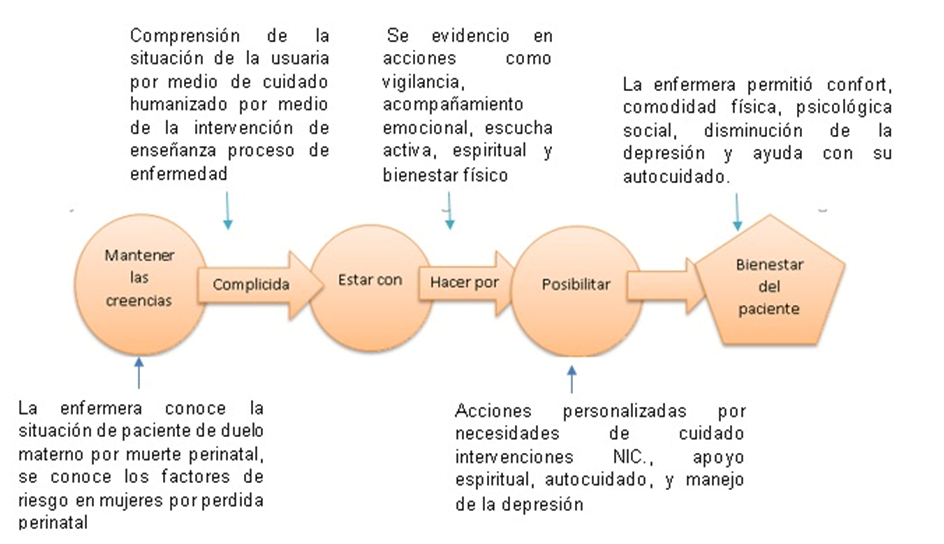
Source: Adapted from Kristen M. Swanson's Theory of Care, by K. Swanson, 1993.
Legal framework
In Colombia there are regulations in force that regulate the provision of health services, including care for pregnant women, from conception control to childbirth care and initial puerperium and newborn care. The regulatory framework is based on Resolution 429 of 2016 (PAIS Policy), which defines the operational framework through the comprehensive health care model (MIAS), but for its articulation it defines the territorial comprehensive care models (MAITE).
Based on the above, a brief description of the regulations in force to promote health and the provision of services to pregnant women is provided.
Regulations | Scope |
|---|---|
Resolution 3280 of 2018 | It aims to contribute to the promotion of health and the improvement of maternal and perinatal health outcomes through the identification of risk factors, and its general objective establishes the mandatory compliance with technical and operational standards to provide all newborns and women, during the preconception, pregnancy, perinatal and postpartum periods.(11,20) |
Resolution No. 000276 of 2019. | By means of this Resolution Resolution 3280 of 2019 is modified, where the interventions by the (RIAS) and Health Maintenance and Health Care for the maternal and perinatal population will be provided from the validity of said resolution.(11,21) |
Decree 780 2016 | Regarding pregnant women, they are covered and protected by the decree where it indicates that, if there are situations of transfer, disaffiliation or non-provision of services in the national territory either of subsidized or contributory regime, pregnant women and minors cannot be disaffiliated from the health system, on the contrary they are guaranteed the services of plan and benefits during the period of their gestation, as well as the right to autopsies as long as the death of the pregnant woman or the product of conception is present and there is suspicion of non-spontaneous abortion.(11,22) |
Law 2244 of 2022 | Its objective lies in the recognition and guarantee of the rights of all pregnant women during labor, postpartum, gestational and perinatal mourning, where freedom of decision, conscience, and guarantee of the rights of the newborn take precedence. The Ministry of Health and Social Protection should provide training and updating for health personnel regarding perinatal bereavement, as well as the dissemination of care policies.(11,23) |
Resolution No. 003202 of 2016. | It includes the adoption of the Comprehensive Health Care Routes (RIAS) for the population maternal-perinatal, which will be taken into account by the territorial entities where health promotion actions and interventions of sectoral and intersectoral nature will be addressed.(11) |
State of the art
Death is a process in which people face different changes in their lives, in which mourning becomes a rather tortuous process at a psychological and family level, since, they must face a new reality, in which the loved one is no longer on the earthly plane, nor in the everyday life, to which they were already accustomed.
Now, death in general is a hard process, however, this paper will focus on perinatal death, how this affects families and how to follow a process for emotional and physical recovery, both for the pregnant mother and the father, although often it is not considered necessary, the father also carries a grief where this is not considered relevant, because there is not a bond as deep as that of the mother, the father is part of the external emotional process of the fetus and the mother.
According to Valenzuela (24), the needs of the health team for the management of perinatal bereavement can be divided into three thematic categories: emotional needs, formal training and experiences for a better management of families and teams.
As is known, all bereavement processes are not similar, much less have the same duration, therefore, determining the emotional needs of each patient is linked to the formal capacity and experience of the nursing professional, who is in close contact with those affected, and who must ensure that the patient's recovery, both physical and emotional, is the most optimal, since, if a due process is not carried out, it is most likely that it will lead to other more serious psychological problems.
Although these cases are somewhat complicated for nursing professionals, Figueroa Ibarra & Gallegos Aranda (25) have stated that:
Although helping with perinatal deaths can be challenging, professionals consider it a privilege and a rewarding opportunity to work with these families. Despite the difficulties and lack of formal training, caregivers use other tools, such as personal experiences, to try to help holistically and initiate an appropriate transition through bereavement. Some nurses said that they had experienced perinatal miscarriages or deaths in close family members, and these events helped them provide better care because they helped them understand the situation.
It can be said that this type of case brings out the most human side of each of the professionals who are caring for the patient who is facing this process. It is also true to say that supporting these processes serves as a catharsis for the nurses who have gone through a similar process, since it has been proven that serving people who understand your pain helps to restore a little of the emotions that had to be faced and that at that moment are in imbalance.
This does not mean that the pains are the same, but that there is a higher level of understanding among those affected, since they come to understand how a person can feel emotionally when faced with a loss of a being that you have felt for a long period of time, but that in the end, you do not get to know or develop a greater bond, because he died before you have it.(28,29,30)
However, according to the research conducted by Jimenez et al.(17) it has been shown that: Grief due to the loss of a child is a very traumatic event, especially in the early stages of shock, when feelings such as disturbance and unreality dominate. According to several authors, the participation of parents in the care of their children as well as in decision making is an empowerment that favors adaptation to the loss.(31,32,33,34,35)
As expressed in the previous research, nursing professionals act as an important part of the initial recovery process, however, the family is the center of this recovery, and it is here that, as nursing professionals, by integrating with the family and the couple, they demonstrate the care and support that they should have, so that grief can be dealt with effectively. In short, not only should the patient be cared for physically, but, as stated by Martínez Dávalos (1) within the spiritual dimension, care by the nursing professional should also be included. Based on evidence about the subject, strength and hope are included as means of overcoming the loss of a child, directly related to the spiritual realm, because the purpose of life rests there, a relationship with a superior and transcendent being that provides support in times of grief.(36,37,38,39,40)
That is to say, it is necessary to be empathic with the circumstances, since those involved will seek to blame someone or something, this process is somewhat normal in the face of events, for this reason, this is a point where professional intervention should be more latent, this in order that the nursing professional helps the patient to face his new reality and overcome little by little the pain that has been obtained due to the loss.(41,42,43,44,45)
CONCLUSIONS
Perinatal death represents one of the most painful and complex experiences that a family can go through, especially the pregnant mother, not only because of the emotional impact, but also because of the physical, social and spiritual implications it entails. Through the analysis carried out, it is evident that this loss not only leaves a mark on the mental and emotional health of those who suffer it, but also poses important challenges for the health system, especially for the nursing staff, who play a fundamental role in the accompaniment, containment and integral care during this process.
First of all, it is necessary to recognize that perinatal bereavement cannot be approached from an exclusively medical perspective. It requires humanized, empathetic and skilled care in order to understand the magnitude of the suffering involved in losing a child who, although not consolidated in life, already represented illusions, plans and deep emotional bonds. Nursing, as a discipline and profession, has the ethical commitment to develop interventions based on scientific knowledge, human sensitivity and respect for the individual experience of each family.
Statistics both globally and regionally, as in the case of Santander, Colombia, show the persistence of a public health problem that reflects gaps in the quality of prenatal and perinatal care. This situation is aggravated by structural limitations, lack of specialized training and the lack of visibility of perinatal bereavement within the models of care. The implementation of theories such as Kristen Swanson's, centered on compassionate and meaningful care, allows focusing nursing work on five key aspects: knowing, caring, being with, doing for and allowing, facilitating a comprehensive response that goes beyond the clinical aspect.
In addition, the Colombian legal framework recognizes the need to guarantee the rights of pregnant women and in the grieving process, which obliges professionals to act in coherence with these regulations, providing safe environments, emotional support, clear communication and respect for family decisions. In conclusion, approaching perinatal death from the nursing perspective implies a holistic view, where technical knowledge is combined with empathy, and where the presence of the professional becomes a pillar of comfort and guidance in the midst of grief. This is the only way to truly contribute to the physical, psychological and spiritual well-being of the affected families.
References
- 1 Martínez Dávalos CS. El profesional de enfermería ante el duelo por muerte perinatal. Enferm Investiga. 2018;3(1):10-15. doi:10.29033/ei.v3n1.2018.03
- 2 Calderer A, Obregón N, Cobo JV, Goberna J. Muerte perinatal: acompañamiento a mujeres y parejas. Matronas Prof. 2018;19(3):[unknown pages].
- 3 González-Márquez M. TEXTO COMPLETO [Internet]. 2023 [cited 2023 May 25]. Available from: https://bbibliograficas.ucc.edu.co/login?url=https://www.proquest.com/wire
- 4 Paraíso Pueyo E, González Alonso AV, Botigué T, Masot O, Escobar-Bravo MÁ, Lavedán Santamaría A. Nursing interventions for perinatal bereavement care in neonatal intensive care units: A scoping review. Int Nurs Rev. 2021;68(1):122-37. doi:10.1111/INR.12659
- 5 Millán-González R, Solano-Medina N. Duelo, duelo patológico y terapia interpersonal. Rev Colomb Psiquiatr. 2010;39(2):375-88. doi:10.1016/s0034-7450(14)60257-2
- 6 Fernández-Alcántara M, Cruz-Quintana F, Pérez-Marfil N, Robles-Ortega H. Factores psicológicos implicados en el duelo perinatal. Index Enferm. 2012;21(1-2). doi:10.4321/S1132-12962012000100011
- 7 López García LG, María S, Romero Sánchez JM, Montoro CH, Crespo ML, Gema A, Jaén V, et al. La vivencia de la pérdida perinatal desde la perspectiva de los profesionales de la salud [Internet]. 2011 [cited unknown date]. Available from: http://www.eerp.usp.br/rlae
- 8 Sáenz S, Garre JMH, Sánchez FCS, Pérez PE. Alumbrando la muerte. Profesionales de la vida gestionando el duelo. Rev Int Sociol. 2017;75(3). doi:10.3989/ris.2017.75.3.15.189
- 9 Villalón MR, Quirós PG, García AN, Martín SM, Berrocal PG. Papel de la matrona ante el duelo perinatal en contexto actual de pandemia. Caso clínico. Enferm Cuidándote. 2022;5(2):8–16. doi:10.5281/zenodo.4461
- 10 Wynants L, van Calster B, Collins GS, Riley RD, Heinze G, Schuit E, et al. Prediction models for diagnosis and prognosis of COVID-19: systematic review and critical appraisal. BMJ. 2020;369:m1328. doi:10.1136/bmj.m1328
- 11 Ministerio de Salud y Protección Social. República de Colombia [Internet]. [Place unknown]: Ministerio de Salud y Protección Social; [cited unknown year].
- 12 Secretaría Distrital de Salud de Bogotá [Internet]. Bogotá: Secretaría Distrital de Salud; [cited unknown year]. Available from: https://www.saludcapital.gov.co
- 13 Toro Bermúdez JI, Mesa Melgarejo L, Quintero Olivar JF. Abordaje del duelo en una unidad de cuidado intensivo neonatal: entre el protocolo y la intuición. Repert Med Cir. 2022;XX(X):1–8. doi:10.31260/Repert
- 14 Fernández-Alcántara M, Pérez-Marfil MN, Catena-Martínez A, Cruz-Quintana F. Duelo, pérdida y procesos de final de vida. Estud Psicol. 2017;38(3):553–60. doi:10.1080/02109395.2017.1342941
- 15 Significado de madre gestante [Internet]. [date unknown] [cited unknown date].
- 16 Lizana C, Yuleisi K, Rodriguez P, Sanny B, Clara M, Deza T. ALUMNAS: ASESORA. [Incomplete data].
- 17 Garzón Patterson M, Izquierdo Medina R, Pascual Cuesta Y, Olivia Batista Pérez N, Ravelo Jiménez M. Teoría de Kristen M. Swanson vinculada al cuidado del cuidador principal de pacientes con enfermedad de Alzheimer [Internet]. [date unknown]. Available from: https://orcid.org/0000-0002-8413-0253
- 18 Mogollón, Páez Cala ML, Arteaga Hernández LF. Duelo por muerte perinatal. Necesidad de una atención diferencial e integral. Arch Med (Manizales). 2019;19(1):32-45. doi:10.30554/archmed.19.1.2853.2019
- 19 Amelia VL, Setiawan A, Sukihananto. Board game as an educational media for dengue prevention knowledge for school-aged children. Enferm Glob. 2019;18(4):254–63. doi:10.6018/eglobal.18.4.336611
- 20 Resolución 3280 [Internet]. [cited unknown date].
- 21 Resolución 276 de 2019 [Internet]. [cited unknown date].
- 22 Colombia. Decreto 780 del 6 de mayo de 2016 [Internet]. [Place unknown]: Diario Oficial; [cited unknown year].
- 23 Leyes desde 1992 - Vigencia expresa y control de constitucionalidad [LEY 2244 de 2022] [Internet]. [date unknown] [cited 2023 May 25].
- 24 Valenzuela MT, Bernales M, Jaña P. Duelo perinatal: Perspectivas de los profesionales de la salud. Rev Chil Obstet Ginecol. 2020;85(3).
- 25 Figueroa Ibarra C, Aranda Gallegos P. Experiencias del personal de enfermería ante la muerte perinatal [Internet]. [date unknown]. Available from: https://orcid.org/0000-0002-8675-3809
- 26 Número de identificación 44831277003 [Internet]. [Place unknown]: [publisher unknown]; [cited unknown year].
- 27 Arthaud Manzanera P. TFG-H2312 [Undergraduate thesis]. [Place unknown]: [publisher unknown]; 2021.
- 28 Castroagudín G, López S, Teijo P, Marra L, José M, Vidal R. Papel de la matrona en el manejo del duelo perinatal y neonatal. Cad Aten Primaria. 2013;19(2):113–7. Available from: https://aplicacionesbiblioteca.udea.edu.co:2163/buscar/documentos?querysDismax.DOCUMENTAL_TODO=Papel+de+la+Matrona+en+el+manejo+del+duelo+perinatal+y+neonatal
- 29 Consolidado Boletín Semana 36 [Internet]. [Place unknown]: [publisher unknown]; [cited unknown year].
- 30 Contreras-García M, Ruiz-Soto B, Ortega-Irigaray A, Paredes-Gallo MF, Yáñez-Peralta P. Protocolo-guía muerte fetal HUMV [Internet]. 2016 [cited 2025 May 17]. Available from: https://www.redelhuecodemivientre.es/
- 31 Elaboración y prueba piloto de un cuestionario para conocer... [Internet]. Dialnet; [cited unknown year]. Available from: https://dialnet.unirioja.es/servlet/articulo?codigo=7668709
- 32 Dialnet. Los estilos de afrontamiento como predictores del duelo perinatal [Internet]. [date unknown]. Available from: https://dialnet.unirioja.es/servlet/articulo?codigo=7898562
- 33 Hollins Martin CJ, Reid K. A scoping review of therapies used to treat psychological trauma post perinatal bereavement. J Reprod Infant Psychol [Internet]. 2022 [cited 2023 May 25]. Available from: https://doi.org/10.1080/02646838.2021.2021477
- 34 Intervenciones de enfermería ante la pérdida perinatal en una unidad neonatal [Internet]. [date unknown] [cited 2023 May 25]. Available from: https://revistasanitariadeinvestigacion.com/intervenciones-de-enfermeria-ante-la-perdida-perinatal-en-una-unidad-neonatal/
- 35 Koopmans L, Wilson T, Cacciatore J, Flenady V. Support for mothers, fathers and families after perinatal death. Cochrane Database Syst Rev [Internet]. 2013;(6):CD000452. Available from: https://doi.org/10.1002/14651858.CD000452.pub3
- 36 Kuforiji O, Mills TA, Lovell K. Women’s experiences of care and support following perinatal death in high burden countries: A metasynthesis. Women Birth [Internet]. 2022 [cited 2023 May 25]. Available from: https://doi.org/10.1016/j.wombi.2022.07.170
- 37 Borrego Cabezas L, Matas Rodríguez C, Del Fresno Serrano MA. Duelo en la maternidad y en la reproducción. Intervención de la matrona [Internet]. 2022 [cited 2023 May 25]. Available from: https://revistasanitariadeinvestigacion.com/duelo-en-la-maternidad-y-en-la-reproduccion-intervencion-de-la-matrona/
- 38 Lizcano Pabón LDM, Moreno Fergusson ME, Palacios AM. Experience of Perinatal Death from the Father’s Perspective. Nurs Res. 2019;68(5):E1–E9. doi:10.1097/NNR.0000000000000369
- 39 Martos-López IM, Sánchez-Guisado MM, Guedes-Arbelo C. Duelo por muerte perinatal, un duelo desautorizado = Bereavement for perinatal death, unauthorized bereavement. Rev Esp Comun Salud. 2016;7(2). doi:10.20318/recs.2016.3454
- 40 McCreight BS. Perinatal grief and emotional labour: A study of nurses’ experiences in gynae wards. Int J Nurs Stud. 2005;42(4):439-48. doi:10.1016/j.ijnurstu.2004.07.004
- 41 Mortalidad perinatal y neonatal tardía [Internet]. 2022 [cited unknown date]. doi:10.33610/infoeventos.44
- 42 Qian J, Wang W, Sun S, Wu M, Liu L, Sun Y, Yu X. Exploring interactions between women who have experienced pregnancy loss and obstetric nursing staff: a descriptive qualitative study in China. BMC Pregnancy Childbirth. 2022;22(1):1-11. doi:10.1186/s12884-022-04787-9
- 43 Serrano Diana C, López del Cerro E, Castillo Cañadas AM, Gómez García MT, Amezcua Recover AN, González de Merlo G. Antepartum stillbirth. Perinatal bereavement. Prog Obstet Ginecol. 2015;58(8):368-72. doi:10.1016/j.pog.2015.02.017
- 44 Steen SE. Perinatal death: bereavement interventions used by US and Spanish nurses and midwives. Int J Palliat Nurs. 2015;21(2):79–86. doi:10.12968/ijpn.2015.21.2.79
- 45 Tejero Vidal LL, Barea Millán S. Nursing care plan for dealing with perinatal bereavement according to the theory of dysfunctional bereavement. Clinical case. Enferm Clin. 2023. doi:10.1016/j.enfcli.2022.12.002
Declarations
Funding
None.
Conflict of interest
The authors declare that there is no conflict of interest. AUTHORSHIP CONTRIBUTION Conceptualization: Beatriz Alexandra Lobo Rincón, Darcy Tatiana Perdomo, Maria Andreina Pulido Montes, Adriana Paola Casadiegos Buitrago. Data curation: Beatriz Alexandra Lobo Rincón, Darcy Tatiana Perdomo, Maria Andreina Pulido Montes, Adriana Paola Casadiegos Buitrago. Formal analysis: Beatriz Alexandra Lobo Rincón, Darcy Tatiana Perdomo, Maria Andreina Pulido Montes, Adriana Paola Casadiegos Buitrago. Research: Beatriz Alexandra Lobo Rincón, Darcy Tatiana Perdomo, Maria Andreina Pulido Montes, Adriana Paola Casadiegos Buitrago. Methodology: Beatriz Alexandra Lobo Rincón, Darcy Tatiana Perdomo, Maria Andreina Pulido Montes, Adriana Paola Casadiegos Buitrago. Project Management: Beatriz Alexandra Lobo Rincón, Darcy Tatiana Perdomo, Maria Andreina Pulido Montes, Adriana Paola Casadiegos Buitrago. Software: Beatriz Alexandra Lobo Rincón, Darcy Tatiana Perdomo, Maria Andreina Pulido Montes, Adriana Paola Casadiegos Buitrago. Supervision: Beatriz Alexandra Lobo Rincón, Darcy Tatiana Perdomo, Maria Andreina Pulido Montes, Adriana Paola Casadiegos Buitrago. Validation: Beatriz Alexandra Lobo Rincón, Darcy Tatiana Perdomo, Maria Andreina Pulido Montes, Adriana Paola Casadiegos Buitrago. Display: Beatriz Alexandra Lobo Rincón, Darcy Tatiana Perdomo, Maria Andreina Pulido Montes, Adriana Paola Casadiegos Buitrago. Writing - original draft: Beatriz Alexandra Lobo Rincón, Darcy Tatiana Perdomo, Maria Andreina Pulido Montes, Adriana Paola Casadiegos Buitrago. Writing - proofreading and editing: Beatriz Alexandra Lobo Rincón, Darcy Tatiana Perdomo, Maria Andreina Pulido Montes, Adriana Paola Casadiegos Buitrago.
Authorship contributions
Drafting – original draft: Beatriz Alexandra Lobo Rincón, Darcy Tatiana Perdomo, Maria Andreina Pulido Montes, Adriana Paola Casadiegos Buitrago.
Writing–review and editing: Beatriz Alexandra Lobo Rincón, Darcy Tatiana Perdomo, Maria Andreina Pulido Montes, Adriana Paola Casadiegos Buitrago.