
Abstract
Introduction: Rehabilitation Nursing requires a distinct and evolving body of knowledge that strengthens its scientific and professional identity. The practice of Rehabilitation Nurse Specialists must be grounded in theoretical frameworks that support critical, reflective, and individualized care, ensuring quality and intentionality in interventions. Objective: this theoretical-reflective article aims to analyze the intervention of Rehabilitation Nursing in the community, focusing on fundamental, person- and family-centered care that promotes adaptation to lived experiences. Development: the analysis is structured around three complementary theoretical references: the Fundamentals of Care Framework, the Person-Centred Nursing Framework, and the Roy Adaptation Model. The interrelation of these frameworks allows rehabilitation nurse specialists to adjust care continuously to contextual, personal, and organizational changes, fostering evidence-based, integrated, and individualized community care. The home environment is a privileged setting for person-centered Rehabilitation Nursing that enhances autonomy and well-being. Given the complexity of care and population aging, it is essential for Rehabilitation Nurse Specialists to critically reflect on their practice, anchoring interventions in theoretical frameworks to ensure differentiated, humanized, and high-quality care. This perspective reinforces the ontological identity of nursing, rooted in person and family centred care. Conclusions: therefore, advancing Rehabilitation Nursing based on theoretical frameworks that correspond, in a comprehensive and individualized manner, to the real human responses of the population, contributing to improve quality of life, promote functional rehabilitation and independence among people receiving care.
Keywords
Rehabilitation Nursing, Nursing Theory, Patient-Centered Care
INTRODUCTION
The growing ageing population worldwide is one of the greatest challenges for health systems, leading to a higher prevalence of chronic diseases, disabilities, and dependency.(1,2,3) The World Health Organization’s Rehabilitation 2030 initiative highlights that in many low- and middle-income countries, more than 50 % of people in need of rehabilitation lack access to adequate services.(4,5) This scenario reflects not only the progressive ageing of the population, but also the increasing complexity of human responses associated with chronic diseases, dependency, and vulnerability.
It is widely recognized today that Rehabilitation Nursing (RN), requires its own body of knowledge, which is systematic and constantly evolving, to strengthen its scientific and professional identity. Thus, it is imperative that the practice of Rehabilitation Nursing Specialists (RNS) be anchored in solid theoretical frameworks capable of reinforcing the disciplinary identity of nursing and, simultaneously, promoting the quality and intentionality of the care provided. In this sense, for RNS to respond ethically, reflectively, and effectively to their social mandate, it is essential that their intervention be supported by theoretical frameworks that guide practice in a systematic, critical, and individualized manner. The Nursing Process structures this practice, promoting critical thinking and continuous evaluation of results, and is based on the concept of RNS competence, which integrates knowledge, skills and attitudes that are indispensable for the consolidation of a reflective, safe and quality practice.(6,7,8,9)
To sustain this perspective, three central theoretical frameworks will be considered: the Fundamentals of Care Framework (FoCF), the Person-Centred Nursing Framework (PCNF), and the Roy’s Adaptation Model.(10,11,12) Although individually recognized, there is a lack of literature integrating them into a cohesive model specifically applicable to RN in community settings. This article therefore aims to critically analyze and synthesize RN interventions in the community through the integrated lens of these frameworks, contributing to a transformative, person and family centred vision of care.
DEVELOPMENT
As a case manager and active agent in the community, the RNS aligns its approach with the principles of integrated continuing care, through a partnership based on care that is centered on and tailored to the human responses of the individual and their family, promoting their autonomy, empowerment and active participation in the decision-making process. Given the growing complexity and ageing of the population in Portugal, the work of the RNS in the home emerges as an essential and indispensable response, as it acts as a promoter of change and facilitator of the health-illness process, through the empowerment of the individual/family.(13,14,15) The home is not only a space that promotes the well-being of those receiving care, but also a place full of opportunities to achieve significant results throughout the rehabilitation process.(16) As it is a familiar environment, it is here that people, upon returning home, encounter the real difficulties and limitations in their daily activities, making this context a factor that enhances motivation and empowerment for the person/family/caregiver and, consequently, facilitates the adaptation and rehabilitation process through the intervention of the RNS.(17)
Their intervention transcends the act of caring, as it also incorporates the dimensions of teaching, training and empowerment, enhancing autonomy and contributing actively and significantly to the functional rehabilitation of the individual/family/caregiver.(18) To ensure comprehensive and person-centred practice, RN care should be guided by robust theoretical frameworks: FoCF; PCNF and Roy's Adaptation Model.(10,11,12)
Fundamentals of Care Framework
The FoCF structures nursing care into three interconnected dimensions: the therapeutic relationship, the integration of fundamental care, and the context of care.(10) The relationship emphasizes the quality of the bond between nurse and person, underpinned by empathy, trust, and effective communication, which is essential for understanding human responses and expectations.(19) The integration of care ensures human responses (physical, psychosocial, and relational), while the context of care recognizes the influence of organizational factors, resources, and safety on the quality of care, which are especially relevant in the community.
In community care, the context dimension poses unique challenges compared to hospitals. Unlike the structured and controlled hospital environment, the home is marked by limited space, scarce assistive devices, and reliance on informal caregivers, requiring the RNS to adapt creatively while balancing safety and autonomy.(20)
Person-Centred Nursing Framework
The PCNF is developed in five domains that value the person as an active agent in care, highlighting the importance of environments that promote empowerment and the construction of therapeutic relationships based on trust, sharing and mutual respect.(11) These domains encompass nursing knowledge, nursing prerequisites, the care environment, person-centred processes and outcomes, which reflect a positive experience and the promotion of autonomy.
In community, the principle of shared decision-making is particularly relevant, but also complex. When working with older adults with cognitive impairment, for example, decision-making processes must carefully integrate the person's preferences (when expressible), the family's perspective, and ethical considerations regarding their autonomy and safety. Here, the RNS plays a mediating role, ensuring that care plans respect dignity while remaining realistic and achievable, thereby strengthening the relationship of trust between the person, the family and the nurse.(21)
Roy’s Adaptation Model
In turn, Roy's Adaptation Model conceptualizes the person as a system in constant interaction with the environment, stimulating the person to respond through four adaptive modes: physiological (physical manifestations of human responses), self-concept (psychological and spiritual aspects), performance of responsibilities (social interaction and participation in society), and interdependence (closer relationships and how they enhance adaptation). This model emphasizes the magnitude and complexity of the responsibility that the RNS has in assessing these stimuli, formulating RN diagnoses, defining joint objectives and implementing interventions that promote effective adaptive responses, supporting practices that favor functional readaptation and the quality of life of the person/family.(7,12)
In the community, the mode of interdependence is crucial, as it reflects the quality of close relationships and their impact on adaptation. When assessing a family setting, the RNS examines care distribution, emotional interactions, and external support, using this analysis to design interventions that strengthen relationships and enhance rehabilitation.(22)
Integration of Frameworks
This articulation of theoretical frameworks allows for the integration of essential care in its various dimensions, the centrality of the person/family/caregiver, and the promotion of effective adaptive responses, ensuring well-founded and individualized interventions, in line not only with the complexity and multidimensionality of human responses, but also with the dynamic and challenging nature of the home as a care context.(6,10,11,12)
Therefore, a diagram was developed that represents this perspective of RN care through the lens of the three theoretical frameworks described above (figure 1).
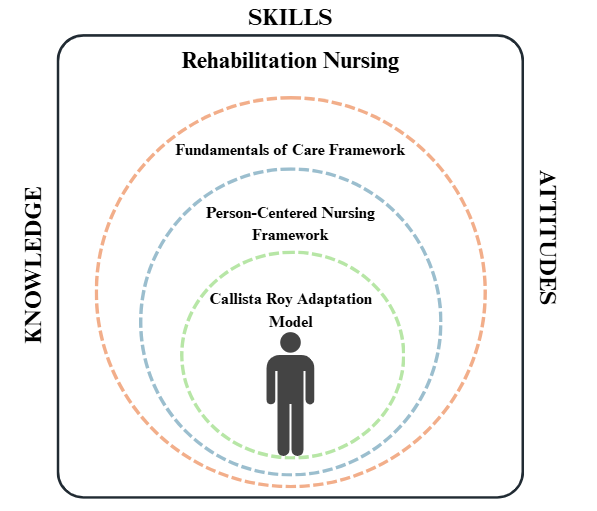
Legend: The person/family is placed at the center, surrounded by the Roy’s Adaptation Model, the PCNF, and the FoCF, which together structure RN practice through adaptive responses, person-centred processes, and integration of fundamental care. These frameworks are represented within the domains of knowledge, skills, and attitudes, reflecting the core competences of RNS in community settings.
This diagram highlights the FoCF in the outer circle as the basic structure, emphasizing essential care through an effective therapeutic relationship and the organizational/environmental context in which clinical practice takes place. This is particularly important in the community context, as it reveals itself to be a fundamental element in the rehabilitation process, namely empathic and effective communication with people, promoting the integration of their human responses into care planning, as well as ensuring the necessary environmental conditions and resources at home during interventions. In the intermediate circle, the PCNF deepens the centrality of the person as an active agent, highlighting the importance of therapeutic relationships and the joint construction of the care plan, supported by individual values, beliefs and expectations. This issue is addressed by setting goals and negotiating exercise plans and activities according to the preferences of the people receiving care, promoting empowerment and constituting a fundamental principle of RN.(11,12,13,24,25)
In addition, Roy's Adaptation Model introduces a dynamic perspective on the person's response to internal and external stimuli, structuring assessment and intervention around four modes, promoting functional readaptation. This perspective is closely linked to the community context, given the importance of the physical and social conditions of the person and their home, promoting the coordination of interventions in close collaboration with the transdisciplinary team and accessible community resources.(13) The diagram also emphasizes the permeability and interdependence between these frameworks (dashed circles), recognizing that the proposed frameworks are not rigid, but permeable and reciprocal, which demonstrates the ability of the RNS, in the community, to continuously adjust their intervention to contextual, personal and organizational changes, as a method of achieving the objectives of the rehabilitation process and improving its outcomes.(26)
This hierarchical and interrelated overlap of frameworks allows for the structuring of integrated, evidence-based, individualized care plans oriented towards meaningful results, ensuring evidence-based and person-centered practices, adjusted to the reality and multifactorial and complex nature of community care. Although evidence is still limited regarding the direct impact of person-centred care on rehabilitation outcomes, it is recognized that its integration into organizational models can promote significant gains in functional rehabilitation and quality of life for people receiving care. This integration requires the development of operationalization strategies, including consideration of different cultural contexts, adaptation of health systems to these contexts, and promotion of professional empowerment, enabling increasingly human-centred interventions. All of this is fully in line with the philosophy of nursing, based on compassion, respect, ethics and cultural safety, supporting an individualized approach that promotes the empowerment of the person, family and caregiver and supports their adaptation to the health-illness process.(27,28,29)
CONCLUSIONS
The home is a privileged space for person-centred RN practice that promotes autonomy and quality of life. Given the current challenges of complex care and an ageing population, it is essential that RNS critically reflect on their practice, anchoring it in theoretical frameworks that support differentiated, humanized and excellent interventions. Given this perspective on nursing care, we reinforce the essence of the ontological identity of nursing as a discipline and profession whose foundation and reason for being reside in person- and family-centred care.
References
- 1 Sun X, Li X. Editorial: Aging and chronic disease: public health challenge and education reform. Front Public Health. 2023 May 9;11:1175898. https://doi.org/10.3389/fpubh.2023.1175898
- 2 World Health Organization. Ageing and health. Geneva: WHO; 2022. https://www.who.int/news-room/fact-sheets/detail/ageing-and-health
- 3 Cieza A, Causey K, Kamenov K, Hanson SW, Chatterji S, Vos T. Global estimates of the need for rehabilitation based on the Global Burden of Disease study 2019. Lancet. 2021 Dec 19;396(10267):2006–17. https://doi.org/10.1016/S0140-6736(20)32340-0
- 4 World Health Organization. Rehabilitation 2030: a call for action. Geneva: WHO; 2017. https://www.who.int/initiatives/rehabilitation-2030
- 5 Andelic N, Moksnes H, Rasmussen M, Schäfer C, Hellstrøm T, Howe E, Sveen U, Perrin P, Røe C, Anke A, Soberg H. Needs for Community-Based Rehabilitation Services and Support 12 Months After Moderate and Severe Physical Traumatic Injuries. Am J Phys Med Rehabil. 2024;103(8):740-4. https://doi.org/10.1097/phm.0000000000002492
- 6 Ordem dos Enfermeiros. Regulamento dos Padrões de Qualidade dos Cuidados Especializados em Enfermagem de Reabilitação. 2018 Jan 26. https://www.ordemenfermeiros.pt/media/5682/ponto-4_regulamento-dos-padr%C3%B5es-qualidade-ceer.pdf
- 7 Ribeiro O, Moura M, Ventura J. Referenciais teóricos orientadores do exercício profissional dos enfermeiros especialistas em enfermagem de reabilitação. In: Enfermagem de Reabilitação - Conceções e Práticas. 1st ed. Lisboa: Lidel; 2021. p.48–55.
- 8 Registered Nurses’ Association of Ontario. Transitions in care and services. 2nd ed. Toronto (ON): RNAO; 2023.
- 9 Resolução da Assembleia da República n.º 392/2019, May 3. Diário da República, Série II (85). https://diariodarepublica.pt/dr/detalhe/regulamento/392-2019-122216893
- 10 Kitson AL. The fundamentals of care framework as a point-of-care nursing theory. Nurs Res. 2018 Mar;67(2):99–107. https://doi.org/10.1097/NNR.0000000000000271
- 11 McCance T, McCormack B. The Person-centred Nursing Framework: a mid-range theory for nursing practice. J Res Nurs. 2025 Feb;30(1):47–60. https://doi.org/10.1177/17449871241281428
- 12 Tomey A, Alligood M. Teóricas de enfermagem e a sua obra - modelos e teorias de enfermagem. 5ª ed. Lisboa: Lusociência; 2004.
- 13 Vieira M, Martins M, Martins R, Fernandes C. Traçado da intervenção do Enfermeiro de Reabilitação – organização de cuidados para um envelhecimento saudável e ativo. Rev Port Enf Reab. 2023 Jun 19;6(1):e316. https://doi.org/10.33194/rper.2023.316
- 14 Faria A, Martins M, Ribeiro O, Ventura-Silva J, Fonseca E, Ferreira L, Laredo-Aguilera J. Effect of the Active Aging-in-Place–Rehabilitation Nursing Program: A Randomized Controlled Trial. Healthcare. 2023 Jan 16;11(2):276. https://doi.org/10.3390/healthcare11020276
- 15 Sousa L, Martins M, Novo A. A enfermagem de reabilitação no empoderamento e capacitação da pessoa em processos de transição saúde e doença. Rev Port Enf Reab. 2020 Aug 8;3(1):64-9. https://doi.org/10.33194/rper.2020.v3.n1.8.5763
- 16 Dragosits A, Martinsen B, Hemingway A, Norlyk A. Coming home: older patients’ and their relatives’ experiences of well-being in the transition from hospital to home after early discharge. Int J Qual Stud Health Well-being. 2024 Jan 3;19(1). https://doi.org/10.1080/17482631.2023.2300154
- 17 Hjelle K, Tuntland H, Førland O, Alvsvåg H. Driving forces for home-based reablement; a qualitative study of older adults’ experiences. Health Soc Care Community. 2017 Sep;25(5):1581-9. https://doi.org/10.1111/hsc.12324
- 18 Oliveira C, Couto G, Silva R. Enfermagem de reabilitação nos cuidados de saúde primários. In: Enfermagem de Reabilitação - Conceções e Práticas. 1st ed. Lisboa: Lidel; 2021. p.654–70.
- 19 Kitson A, Conroy T, Kuluski K, Locock L, Lyons R. Reclaiming and redefining the Fundamentals of Care: Nursing’s response to meeting patients’ basic human needs. Adelaide (SA): University of Adelaide; 2013.
- 20 Sun W, Ashtarieh B, Zou P. The safety challenges of therapeutic self-care and informal caregiving in home care: A qualitative descriptive study. Arch Gerontol Geriatr. 2021;94:104344. https://doi.org/10.1016/j.gerinurse.2020.07.013
- 21 Mattos MK, Gibson JS, Wilson D, Jepson L, Ahn S. Shared decision-making in persons living with dementia: A scoping review. Dementia. 2023;22(2):450–68. https://doi.org/10.1177/14713012231156976
- 22 Chen L. Effectiveness of the Roy adaptation model-based nursing intervention in improving physiological, psychological, and social outcomes in patients with Parkinson's disease. BMC Neurol. 2025;25:232. https://doi.org/10.1186/s12883-025-04232-2
- 23 Morris JH, Kayes N, McCormack B. Person-centred rehabilitation–theory, practice, and research. Front Rehabil Sci. 2022 Jul 20;3:980314. https://doi.org/10.3389/fresc.2022.980314
- 24 Registered Nurses’ Association of Ontario. Person- and family-centred care. Toronto (ON): RNAO; 2015 May.
- 25 Kang E, Kim MY, Lipsey KL, Foster ER. Person-centered goal setting: a systematic review of intervention components and level of active engagement in rehabilitation goal-setting interventions. Arch Phys Med Rehabil. 2022 Jan;103(1):121-30.e3. https://doi.org/10.1016/j.apmr.2021.06.025
- 26 White J, Gunn M, Chiarella M, Catton H, Stewart D. Renewing the Definitions of “nursing” and “a nurse”. Geneva: International Council of Nurses; 2025 Jun. Available from: https://www.icn.ch/sites/default/files/2025-06/ICN_Definition-Nursing_Report_EN_Web_0.pdf
- 27 Yun D, Choi J. Person-centered rehabilitation care and outcomes: a systematic literature review. Int J Nurs Stud. 2019 May;93:74-83. https://doi.org/10.1016/j.ijnurstu.2019.02.012
- 28 Jesus TS, Papadimitriou C, Bright FA, Kayes NM, Pinho CS, Cott CA. Person-centered rehabilitation model: framing the concept and practice of person-centered adult physical rehabilitation based on a scoping review and thematic analysis of the literature. Arch Phys Med Rehabil. 2022 Jan;103(1):106-20. https://doi.org/10.1016/j.apmr.2021.05.005
- 29 Grover S, Fitzpatrick A, Azim FT, Ariza-Vega P, Bellwood P, Burns J, Burton E, Fleig L, Clemson L, Hoppmann CA, Madden KM. Defining and implementing patient-centered care: An umbrella review. Patient Educ Couns. 2022 Jul;105(7):1679-88. https://doi.org/10.1016/j.pec.2021.11.004
Declarations
Funding
The authors did not receive financing for the development of this research.
Conflict of interest
The authors declare that there is no conflict of interest. AUTHORSHIP CONTRIBUTION Conceptualization: Beatriz Novo, Sandy Severino. Methodology: Beatriz Novo, Sandy Severino. Validation: Sandy Severino, Luís Sousa. Drafting - original draft: Beatriz Novo. Writing - proofreading and editing: Luís Sousa, Nelson Guerra, Sandy Severino.
Authorship contributions
Drafting – original draft: Beatriz Novo, Nelson Guerra, Luís Sousa, Sandy Severino.
Writing–review and editing: Beatriz Novo, Nelson Guerra, Luís Sousa, Sandy Severino.