

Abstract
The transition from hospital to community care should begin during hospitalization and requires structured and collaborative planning. In this context, the Rehabilitation Nurse Specialist plays a key role in outlining a transdisciplinary plan that ensures continuity and effectiveness of care, promoting the client's autonomy and responding to their needs and those of the caregiver. This critical-reflective study analyzed relevant studies on the subject, with the aim of identifying interventions that can be implemented by the Rehabilitation Nurse Specialist to ensure a safe transition between different care settings. The results show that formal coordination between professionals, through the use of structured and confirmed communication tools, is essential for the effective transfer of clinical information. The early assessment of the client's social needs, as well as the implementation of educational strategies aimed at the client and the caregiver, are decisive for their safe reintegration into the community, contributing to the reduction of complications and hospital readmissions. In conclusion, Rehabilitation Nurse Specialists face challenges in maintaining continuity of care at the time of transition, and it is crucial to optimize communication between contexts in order to ensure the quality of the rehabilitation care provided.
Keywords
Continuity of Patient Care, Transitional Care, Rehabilitation Nursing, Interdisciplinary Communication
INTRODUCTION
A change in the level of care is, in the vast majority of cases, a preponderant factor in increasing the client's vulnerability.(1) Transition of care occurs when a client changes context, such as from hospital to the community, and it is essential to guarantee continuity of care. This process depends on effective organization and communication between different services and health units. Continuity between hospital and community care is fundamental to ensuring that the care provided to the client is appropriate to their needs, including clear communication between health professionals.(2)
The transition of care is characterized as an intentional, clearly defined process to which expectations and responsibilities are assigned and which should focus on the needs of the client and the caregiver. A study published in 2014 concluded that hospital readmissions in the first 30 days after discharge can be interpreted as a failure on the part of the transdisciplinary team to plan a safe and effective discharge. The following are identified as causes of hospital readmission: medication errors, inability to access necessary care, lack of self-care, illiteracy in health and low financial resources.(1)
It is desirable for the client's discharge planning to begin on the first day of hospitalization, with a view to linking care between the hospital environment and the community as a means of reducing the occurrence of hospital recurrences and readmissions, taking into account all the implications - social, economic or emotional - that these readmissions entail for the client, family and society.
In this way, continuity of care is a challenge and a growing need in the area of health, particularly in Rehabilitation Nursing, which is a specialty that aims to optimize the recovery of people with special needs, maximizing their functional capacities in the different dimensions of care.(3) In this way, the Rehabilitation Nurse Specialist (RNS) must be a precursor in the process of articulation between the two aforementioned contexts.
Objective
The reflection presented here aims to analyze the rehabilitation nursing interventions that facilitate continuity of care between hospital and community settings, with an emphasis on the link between the RNSs of both contexts. The main objective is to identify the interventions to be adopted by the RNS to ensure an effective transition of care between the hospital and community settings, improving the quality of the client's recovery.
METHOD
A search was conducted in the CINAHL, Medline, and Google Scholar databases for articles published in Portuguese and English between 2014 and 2025. The articles were analyzed to identify Registered Nurse Specialist (RNS) interventions aligned with the previously defined objective. Given the limited availability of studies explicitly focusing on RNS interventions, the analysis also included the practices of generalist nurses.
DEVELOPMENT
Throughout the process of transition from hospital care to the community, it is essential to guarantee continuity of care, which requires organization and coordinated communication between the different health services or units.(2,5) The link between hospital and community nurses is raised as a key intervention for a successful transition of care. Communication should be based on the official transmission of the discharge letter in computerized form, complemented in parallel by direct communication (e.g. via a telephone call) to ensure confirmation of receipt of the information and clarification of doubts.(4,6,7,8,9)
Since rehabilitation nursing care aims to empower clients and their caregivers to deal with the difficulties of everyday life, the Order of Nurses points out that rehabilitation nursing care includes "promoting early diagnosis and preventive rehabilitation nursing actions, in order to ensure the maintenance of functional capacities", "preventing complications and avoiding disabilities" by developing interventions that include "improving residual functions, maintaining or recovering independence in life activities and minimizing the impact of installed disabilities".(2,3) In this way, the empowerment of the client, caregiver and their family involves promoting the education of those being cared for, achieving gains in decision-making and autonomy.(9) In order to ensure this, continuity of care between the hospital and community settings is essential, establishing a discharge plan as early as possible.(6)
Some authors consider it crucial to empower the client to self-manage their health-disease condition in this care transition process.(6,7,12) The main objectives of this empowerment are the acquisition of skills to understand their health-disease condition, recognizing signs of decompensation, adaptive needs or management of drug therapy - essential in the change of level of care that occurs in the transition process.(5)
In order to guarantee quality and safety, prevent loss of functionality and hospital readmissions after discharge, the RNS must apply specialized techniques and educate the client, caregiver and family. The RNS must plan discharge together with the transdisciplinary team and thus ensure continuity of care, the client's reintegration into the family and the community, guaranteeing their right to dignity and quality of life.(3)
Another intervention considered relevant by different authors is the survey of social needs - which includes support materials, housing structure, home support of different types - so that transdisciplinary teams, both in hospital and in the community, can optimize resources and intervene in time for the client's discharge and reintegration into their daily lives. The home visit is considered to be an essential element in the transition of care.(6,7,9,11)
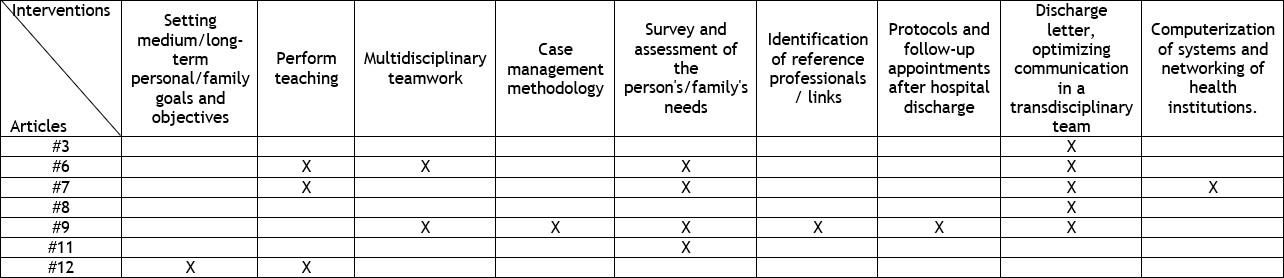
Providing health education to clients and their caregivers during hospitalization is also an intervention highlighted by several authors, and is inherent in clarifying doubts and preparing for discharge. The teaching of personalized exercises according to the client's needs by the RNS in a hospital setting is essential. These exercises must be adapted to the client's context, so that continuity can be provided by the rehabilitation nurse who provides care in the community - something that is ensured, for example, through a home visit prior to discharge. This doesn't mean that the knowledge acquired doesn't need to be validated, and that new needs in the area of health education need to be identified.(6,7,12) The interventions identified above have been summarized in the table below, and we can highlight the major reference made by different authors to interventions such as: drawing up a discharge letter in order to optimize communication within the transdisciplinary team(4,6,7,8,9), assessing and evaluating the needs of the client/family (7,8,10,12) or teaching in different areas of intervention,(6,7,12) thus giving them significance in terms of the implementation of these interventions when nurses transition from hospital to community care.
A qualitative study carried out in 2014 surveys issues that clients and caregivers consider to be threats to safety in a transition after hospital discharge, as well as facilitating factors. In general, it was concluded that the population interviewed identified the possibility of playing a more active role in planning the transition of care and managing self-care as a factor that promotes healthy and safe transitions.(13)
In this way, it is considered that including the client and their caregiver in the transition process from the very first moment of discharge planning, as protagonists and active elements in the continuity of care, will be essential for promoting a quality transition. In order for this to happen, the RNS must understand the needs, expectations and goals of the client and caregiver, always starting from these aspects when planning the transition between the hospital and community context - bearing in mind the main focus as being the promotion of autonomy. As a way of ensuring that the RNS plans and acquires this information effectively, the RNAO has drawn up and proposes a checklist entitled "My Transition Care Plan", which summarizes essential information to ensure a healthy and personalized transition.(2)
The presence of little scientific support regarding the interventions that the RNS can develop to facilitate continuity of care between hospital and community settings was a significant limitation in this reflection.
CONCLUSION
The articles found describe a generalized difficulty, particularly on the part of the RNS, in maintaining the transversality of a care plan when a client moves between different contexts, which can weaken its effectiveness.
It is possible to think of adopting a dynamic clinical process that is transversal to the entire care context. It is therefore crucial to optimize communication between the different care settings so that clinical information is available for planning, prescribing, implementing and evaluating the care provided, particularly rehabilitation care. These measures will result in a feeling of security for the client, caregiver and family.
References
- 1 Guerrero K S, Puls S E, Andrew D A. Transition of care and the impact on the environment of care. Journal of Nursing Education and Practice 4: 30-42. http://dx.doi.org/10.5430/jnep.v4n6p30
- 2 RNAO. Best practice guideline: Transitions care and services. 2nd Edition. 06/2023. https://rnao.ca/bpg/guidelines/transitions-in-care
- 3 Ordem dos enfermeiros. Regulamento das competências específicas do enfermeiro especialista em enfermagem de reabilitação. In: Diário da República, 2.ª série — N.º 85 3 de maio de 2019. Lisboa, Portugal. https://www.ordemenfermeiros.pt/media/11871/1356513568.pdf
- 4 Silva R, Sousa E. Continuidade de cuidados de reabilitação entre contextos de saúde: estudo de caso. RPER Oct 27 2020; 3(1): 71-75. DOI: 10.33194/rper.. 2020.v3.s1.9.5815
- 5 Weber L A, Lima M A, Acosta A M, Marques G Q. Transição do cuidado do hospital para o domicílio: revisão integrativa. Cogit enf Jul-Sep 2017 22(3):1-11. https://docs.bvsalud.org/biblioref/2017/12/876317/47615-209527- 1-pb.pdf
- 6 Allen, J, Hutchinson, A, Brown, R, & M Livingston, P. Quality care outcomes following transitional care. BMC Health Services Research. 2014. 14:346. http://www.biomedcentral.com/1472-6963/14/346
- 7 Batista C S. Continuidade de cuidados de enfermagem: Articulação entre hospital e centro de saúde [master's thesis on the Internet]. Coimbra, Portugal: Escola Superior de Enfermagem de Coimbra, 2018 141. https://repositorio.esenfc.pt/rc/
- 8 Pokojová R, Bártlová S. Effective Communication and Sharing Information at Clinical Handovers. Central European Journal of Nursing & Midwifery. 2018; 9(4):947 55.
- 9 https://cejnm.osu.cz/pdfs/cjn/2018/04/07.pdf
- 10 Santos M, Santo MI, Nascimento P, Silva P, Saraiva PR, Lopez PS. Transição de cuidados em saúde: pontos-chave para a criação e implementação de um projeto. Rev Portug Inv Comport Soc, Ap 2023 9 (1): 1-10. DOI: 10.31211/rpics.2023.9.1.290
- 11 Sousa L, Martins MM, Novo, A. A Enfermagem de Reabilitação no empoderamento e capacitação da pessoa em processos de transição saúde-doença. RPER Sep 16 2020; 3(1): 64-69. 10.33194/rper.2020.v3.n1.8.5763
- 12 Baixinho CL, Ferreira Ó. Do hospital para a Comunidade: a transição (in)segura. Rev baiana enferm.2019; 33:1-3. DOI:10.18471/rbe.v33.35797
- 13 Pinto MF, Grilo E. Continuidade dos Cuidados de Enfermagem de Reabilitação, na Transição da Pessoa Adulta em Situação de Doença, do Contexto Hospitalar para a Comunidade - Proposta de Intervenção [master's thesis on the Internet]. Setúbal, Portugal, Instituto Politécnico de Setúbal – Escola Superior de Saúde, 2023. https://comum.rcaap.pt/entities/publication/957c919c-b130- 4f77-a824-4a64027e7122
- 14 Jeffs L, Kitto S, Merkley J, Lyons RF, Bell CM. Safety threats and opportunities to improve interfacility care transitions: insights from patients and family members. Patient Preference and Adherence. Oct 4 2012:6 711–718. http://dx.doi.org/10.2147/PPA.S36797
Declarations
Funding
The authors received no funding for this research.
Conflict of interest
The authors declare no conflict of interest.
Authorship contributions
Conceptualization: Ana Margarida Gomes, Lúcia Marques, Susana Barreiros, Sofia Ribeiro, Sandy Severino
Research: Ana Margarida Gomes, Lúcia Marques, Susana Barreiros, Sofia Ribeiro.
Methodology: Ana Margarida Gomes, Lúcia Marques, Susana Barreiros,Sofia Ribeiro, Sandy Severino. Supervision: Sandy Severino.
Validation: Luís Sousa, Nelson Guerra, Sandy Severino.
Writing – Original draft: Ana Margarida Gomes, Lúcia Marques, Susana Barreiros, Sofia Ribeiro.
Writing – proofreading and editing: Ana Margarida Gomes, Lúcia Marques, Susana Barreiros, Sofia Ribeiro, Nelson Guerra, Luís Sousa, Sandy Severino.