
Abstract
HIV infection remains a major public health challenge, disproportionately affecting vulnerable populations. Late diagnosis and underdiagnosis contribute to the spread of the virus and hinder timely access to treatment. In this context, the study aimed to analyze the epidemiological profile of students, faculty, and other members of the Pontificia Universidad Católica del Ecuador, Esmeraldas campus, who voluntarily participated, in order to assess the effectiveness of preventive strategies. A cross-sectional, observational, and descriptive study was conducted at the university, where 212 participants underwent fourth-generation rapid tests for the detection of the HIV p24 antigen and HIV-1/2 antibodies as part of an awareness and prevention campaign. All participants tested negative for the combination of the p24 antigen and HIV-1/2 antibodies. A low detection rate was observed in the university population evaluated. Conclusions: The low prevalence of HIV in the university population does not eliminate the need to maintain and strengthen screening and education strategies. Collaboration between community service students and the Ministry of Public Health is essential to expand diagnostic coverage and facilitate early interventions.
Keywords
HIV Screening, Prevention, Epidemiology, Public Health
INTRODUCTION
The HIV/AIDS pandemic (human immunodeficiency virus/acquired immunodeficiency syndrome) has had a significant impact on global public health since its discovery in 1980. HIV infection compromises the immune system by attacking and destroying CD4 lymphocytes, which can eventually lead to acquired immunodeficiency syndrome if not treated promptly.(1) Among the main risk factors are unsafe sexual practices, early onset of sexual activity, and lack of access to preventive methods, which expose this population to health risks.(2)
Within the 75th World Health Assembly framework, Member States expressed their appreciation for the new Global Health Sector Strategies for addressing HIV, viral hepatitis, and sexually transmitted infections (STIs) for the period 2022-2030 and endorsed their implementation. These strategies seek to promote a faster, more targeted, efficient, innovative, and sustainable response to eliminate AIDS, STIs, and viral hepatitis as threats to public health in the Region of the Americas by 2030.(3)
In 2023, approximately 39,9 million people were living with HIV worldwide, including 1,4 million children. That year, there were 1,3 million new infections and 630,000 AIDS-related deaths, figures that, although significantly lower than historical peaks, are still far from the targets set for 2025. Eighty-six percent of people living with HIV knew their HIV status, and 77 % had access to antiretroviral therapy, with greater access for adult women (83 %) than for men (72 %). The epidemic continues to disproportionately affect women and girls, especially in sub-Saharan Africa, where they accounted for 62 % of new infections.(4,5)
HIV prevalence is significantly higher in key populations such as transgender people (9,2 %), men who have sex with men (7,7 %), and people who inject drugs (5 %), compared to the global average of 0,8 %. Although the number of people with access to treatment has increased (from 7,7 million in 2010 to 30,7 million in 2023), financial resources remain insufficient. In 2023, $19,8 billion was available, well below the $29,3 billion needed to eliminate AIDS as a public health threat by 2025. In addition, funding has declined in recent years, putting the progress made so far at risk.(6,7)
According to the Joint United Nations Programme on HIV/AIDS (UNAIDS), the current epidemiological landscape of HIV/AIDS in adults, defined as people aged 15 to 49, shows that Latin America ranks fourth in prevalence. At the same time, Western Europe and North America have the lowest rates. This suggests that the epidemic has a greater impact on regions with lower incomes and less access to adequate health services.(8) However, despite this statistic, US funding cuts for humanitarian programs, especially those aimed at combating HIV/AIDS, have caused great concern worldwide. UNAIDS Executive Director Winnie Byanyima warned that if this support is not restored, there could be 6,3 million deaths and 8,7 million new infections in the next four years. This situation has led to the closure of clinics and the dismissal of medical staff, critically affecting regions such as eastern and southern Africa, where 60 % of new infections among young people occur in women and girls. The cut also directly impacts initiatives such as PEPFAR, which has saved millions of lives since its creation in 2003, especially in countries such as the Democratic Republic of Congo, where hundreds of thousands depend on these treatments.(9)
The UNAIDS Global Strategy on HIV/AIDS for 2021–2026, entitled "Ending inequalities. Ending AIDS," is a comprehensive plan that seeks to end AIDS as a public health threat by 2030. This strategy focuses on addressing the inequalities that perpetuate the HIV epidemic, with a particular focus on the most vulnerable and marginalized populations. Among its main objectives are eliminating disparities that hinder access to HIV prevention, diagnosis, treatment, and care services and reducing new HIV infections and AIDS-related deaths by ensuring that all people—particularly those in vulnerable situations—have access to quality health services through three key priorities: first, maximizing equitable access to HIV services; ensuring that all people, regardless of their social or economic background, can benefit from them; second, eliminating structural and social barriers that prevent effective results, such as stigma, discrimination, and punitive laws; and third, financing and sustaining an efficient response to HIV, integrating these actions into health and social protection systems, with sufficient and sustainable resources.(9,10)
Among the goals proposed for 2025 are the 95-95-95 targets: to ensure that 95 % of people with HIV know their HIV status, that 95 % of those who know their status are on antiretroviral treatment, and that 95 % of those receiving treatment achieve viral suppression. It also aims to eliminate discriminatory laws and policies and significantly reduce new HIV infections and related deaths.(10) For this reason, at the global level, there is concern that the reduction in US funding is having severe repercussions on multiple UN agencies such as UNHCR, IOM, and UNICEF, making it challenging to provide care to vulnerable communities, migrants, and displaced persons. The abrupt dismantling of essential services not only compromises the fight against HIV but also advances in child health and general humanitarian assistance. Byanyima made an urgent call to restore funding and continue innovations such as biannual injectable HIV treatments, urging current leaders, such as President Donald Trump, to follow the example of previous initiatives such as PEPFAR to avoid a new global health crisis.(9)
In Ecuador, HIV was first detected in 1984, and since then, the number of cases has continued to rise despite the availability of antiretroviral treatment (ART) in designated health centers. Approximately ten people contract HIV every day in the country. Against this backdrop, the 2018-2022 National Multisectoral Strategic Plan (PENM) was implemented as a programmatic tool developed with a participatory approach, articulating the national response to HIV/AIDS in Ecuador. Its objective is to help curb the epidemic and meet the global targets proposed by the UN and the Sustainable Development Goals, which align with the National Development Plan 2017-2021. This document was developed with the participation of public institutions, civil society, private organizations, and cooperation agencies under the coordination of the Ecuadorian Multisectoral AIDS Committee (CEMSIDA) and the Ministry of Public Health (MSP) leadership. It was officially presented in October 2018 during the visit of Michel Sidibé, then director of UNAIDS, to ensure diagnosis, antiretroviral treatment, clinical follow-up, and adequate nutrition for perinatal exposure through a care network of 48 Comprehensive Care Units (UAI) of which the MSP manages 40.(11)
Despite advances such as greater access to health services and reduced discrimination, significant challenges remain related to stigma towards people living with HIV (PLHIV). In 2020, 3,823 new cases were reported nationwide, with a substantial concentration of 83,32 % in nine 24 provinces. Among these, Guayas tops the list with 31,68 % of new diagnoses, followed by Pichincha with 16,51 %, and seven other provinces that also show a high incidence: Manabí (5,99 %), Santo Domingo (5,86 %), El Oro (5,75 %), Los Ríos (5,34 %), Azuay (5,28 %), Esmeraldas (3,77 %), and Tungurahua (3,14 %).(2,11)
There is currently a consensus on the negative impact that underdiagnosis and late detection of HIV have on both the health of those affected and the continuity of the epidemic due to the inadvertent transmission of the virus. For this reason, it is essential to implement strategies to increase the number of diagnoses and carry them out at earlier stages.(12) HIV testing is crucial to determine whether a person has contracted the human immunodeficiency virus. Approximately 40 % of new HIV diagnoses come from individuals who are unaware of their serological status, underscoring the importance of knowing one's status to protect oneself and others. In addition, early and continuous treatment of HIV allows for a long and healthy life. The Centers for Disease Control and Prevention (CDC) recommends that everyone between the ages of 13 and 64 get tested for HIV at least once as part of a routine health checkup.(13)
To reduce the spread of HIV, the Ministry of Public Health and Ecuador's Comprehensive Public Health Network implement public health strategies that ensure that all people, regardless of gender, have access to information, prevention, treatment, and other social services related to HIV, while respecting the human rights of those living with the virus.(14) This includes a defined protocol for HIV screening through diagnostic testing. The fourth-generation rapid test, capable of identifying the p24 antigen and antibodies, has a sensitivity of over 99,5 % and requires specialized equipment and technical training. Fourth-generation enzyme immunoassay (EIA) tests combine antibody detection with p24 antigen identification, achieving a sensitivity of close to 100 %. In contrast, third-generation EIA tests only quantify antibodies, with a specificity of close to 99 % and a sensitivity of over 99,5 %.(15)
In addition to this, in April 2025, Ecuador reaffirmed its regional commitment to reducing mortality caused by opportunistic diseases associated with HIV, such as histoplasmosis, cryptococcosis, and tuberculosis. These conditions pose a significant threat to people living with advanced HIV, according to the First National Symposium on Advanced HIV Disease, which was attended by more than 80 health professionals and experts from the Pan American Health Organization (PAHO/WHO). During the event, an innovative strategy was presented that allows for rapid diagnosis of these diseases directly at the point of care, facilitating early detection and timely treatment. This initiative is part of a joint operational research effort between Ecuador and other countries in the region to standardize the clinical management of these diseases and generate valid evidence that will contribute to improving the quality of life of people living with HIV. The PAHO/WHO representative in Ecuador, Valeska Stempliuk, highlighted the importance of this collaboration in strengthening the health response and reducing preventable deaths associated with HIV.(16)
In this context, the Pontificia Universidad Católica del Ecuador Sede Esmeraldas (PUCESE), through its educational model and social commitment, emphasizing community outreach through the Ignatian pedagogical paradigm and experiential learning, establishes projects with a method of analysis, evaluation, and monitoring so that students can connect with society in the field of health and well-being to initiate prevention and promotion activities to reduce communicable diseases, contributing to the reduction of health inequality gaps by focusing efforts on the quality and warmth of care. Through a strategic alliance with the Ministry of Public Health to achieve this common goal, awareness talks and screening with fourth-generation rapid diagnostic tests for HIV detection were carried out in the university community as an effective strategy to expand diagnostic coverage, especially among young people at risk, as established in the UNAIDS Global Strategy on HIV/AIDS for 2021-2026, which emphasizes a people-centered response based on human rights, gender equality, and effective collaboration between governments, civil society, and affected communities, to generate a sustained impact on the eradication of AIDS.(10,17)
METHOD
This study is an observational, descriptive, cross-sectional study whose objective was to analyze the results of HIV screening using fourth-generation tests within the framework of an HIV awareness and prevention campaign carried out as part of the Project for the Linking of Health Care and Promotion Strategies at the Pontificia Universidad Católica del Ecuador, Esmeraldas Campus.
DEVELOPMENT
The study population consisted of teaching and administrative staff and students from the Pontificia Universidad Católica del Ecuador, Esmeralda's campus, who participated in educational talks on HIV awareness and prevention. The sample included individuals who, after giving their informed consent, agreed to undergo HIV serological screening using fourth-generation rapid diagnostic tests.
Data collection was carried out in conjunction with the Ministry of Public Health, the entity responsible for administering tests for HIV and other sexually transmitted infections (STIs). For HIV detection, a fourth-generation serological test was used, which allows for the combined detection of the p24 antigen and antibodies against HIV-1/2, improving sensitivity in the early stages of infection.
During the campaign, participants were informed about early screening and access to pre-exposure prophylaxis (PrEP) as a preventive strategy in high-risk populations.
The data obtained were processed anonymously, ensuring the confidentiality of the participants. The final database included only the variables gender and HIV test results. No information that could allow the identification of participants was recorded in compliance with ethical principles and current regulations on privacy and bioethics.
RESULTS
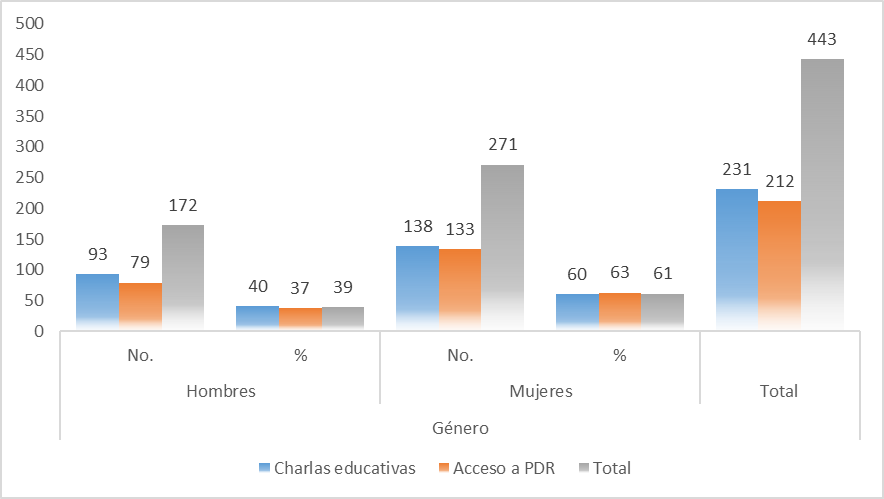
The data shows that women participate more than men in both activities. In educational talks, women represent 60 % of participants, while men represent only 40 %. In Access to PDR, the difference is even greater, with women accounting for 63 % of participation compared to 37 % for men. Overall, women represent 61 % of total participants, while men account for 39 %.
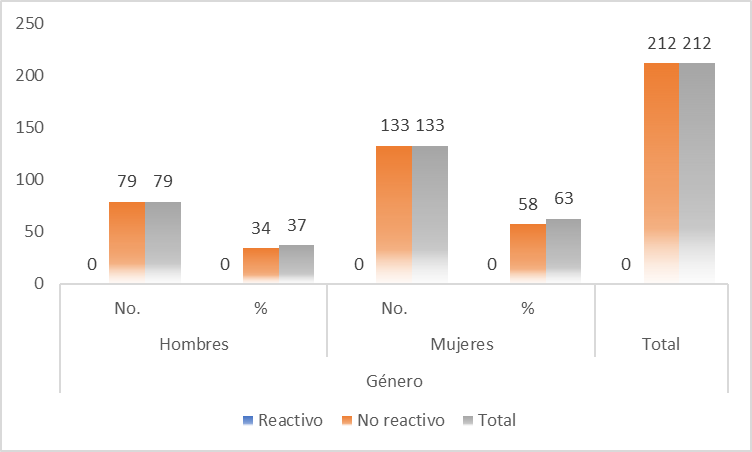
A total of 212 participants were screened, of whom 37 % (79) were women and 63 % (133) were men. All results were negative, suggesting a low detection rate in the population evaluated.
DISCUSSION
The results of this study indicate a low HIV detection rate in the university population evaluated. This finding is consistent with previous studies that have reported a lower prevalence of HIV in young adults aged 15 to 49 years compared to other at-risk populations, such as sex workers or people who inject drugs.(18) However, this does not necessarily imply a low actual prevalence of HIV in this age group but could reflect barriers to access to diagnostic testing, lack of risk perception among students, and stigma associated with HIV testing. Studies in young populations have shown that a lack of knowledge about HIV and a low perception of vulnerability contribute to a lack of access to preventive, diagnostic screening, and practical support.(19)
Despite this, the implementation of screening strategies in primary care and educational interventions are essential to raise awareness among the population, especially adolescents and young people, about modes of transmission, condom use, and the importance of early HIV diagnosis. An article by the Department of Family Medicine at the Catholic University of Chile highlights that screening people aged 15 to 65 allows for timely identification, facilitating early medical and behavioral interventions.(20)
A meta-analysis published in AIDS and Behavior reports that HIV education interventions achieve significant improvements in knowledge, attitudes, and practices related to safe sex.(10) Education and awareness in university settings are critical for HIV prevention. A study conducted in Colombia explored the social representations associated with HIV/AIDS among university students, revealing the need to strengthen educational strategies to change beliefs and attitudes toward the disease.(21)
While current HIV prevention strategies, such as screening and educational interventions, have proven effective, several studies agree on the need to improve their scope, follow-up, and evaluation, which involves expanding testing coverage in key populations, strengthening the ongoing monitoring of educational interventions, and conducting impact assessments that include long-term biological and behavioral indicators to ensure their sustained effectiveness.(22)
CONCLUSIONS
The implementation of screening tests and educational talks is an effective strategy backed by scientific evidence to prevent the spread of HIV. Both allow for early detection of infection, empower people with knowledge, reduce stigma, and encourage responsible behavior. In fact, despite the low prevalence of HIV in the university population evaluated, it is imperative to consolidate and strengthen screening and education strategies in these settings. Early detection and awareness are key in preventing virus transmission and reducing associated stigma. Incorporating these actions into public policies and community programs not only improves individual health but also has a substantial impact on public health.
Coordination between academia and the Ministry of Public Health is essential for achieving these objectives and allows for expanded diagnostic coverage, especially among young people with risk factors. This inter-institutional collaboration promotes timely case identification and the implementation of early interventions, thus contributing significantly to the strengthening of HIV prevention and control strategies in the university community.
References
- 1 Arancibia B, Blanco J, Guzman G, Muñoz V, Uribe V. Incidencia del VIH/SIDA en la región del Biobío entre 2010-2023: HIV/AIDS incidence in the Biobío region between 2010-2023. Rev Estud Med Sur. 2024;11(2):4. Disponible en: https://dialnet.unirioja.es/servlet/articulo?codigo=9899745&info=resumen&idioma=SPA
- 2 Carrera L, Zhingre A, Monge A, Razo M, Ramos M. Prevalencia de la infección por el virus de inmunodeficiencia humana (VIH) en un centro de rehabilitación social de la sierra ecuatoriana. Rev GICOS. 2022;7(1):94–106.
- 3 Organización Panamericana de la Salud. VIH/SIDA - OPS/OMS. Disponible en: https://www.paho.org/es/temas/vihsida
- 4 ONUSIDA. Hoja informativa — Últimas estadísticas sobre el estado de la epidemia de sida. Disponible en: https://www.unaids.org/es/resources/fact-sheet
- 5 HIV.gov. Estadísticas mundiales. Disponible en: https://www.hiv.gov/es/informacion-basica/descripcion-general/datos-y-tendecias/estadisticas-mundiales
- 6 ONUSIDA. Hoja informativa — Últimas estadísticas sobre el estado de la epidemia de sida. Disponible en: https://www.unaids.org/es/resources/fact-sheet
- 7 HIV.gov. Estadísticas mundiales. Disponible en: https://www.hiv.gov/es/informacion-basica/descripcion-general/datos-y-tendecias/estadisticas-mundiales
- 8 Teva I, Paz Bermúdez M, Ramiro MT, Buela-Casal G. Situación epidemiológica actual del VIH/SIDA en Latinoamérica en la primera década del siglo XXI: análisis de las diferencias entre países. Rev Med Chil. 2012;140(1):50–8. Disponible en: http://www.scielo.cl/scielo.php?script=sci_arttext&pid=S0034-98872012000100007
- 9 Naciones Unidas. ONUSIDA advierte de una vuelta a la mortalidad de los 90 por el VIH si EE.UU. no restablece la financiación. Disponible en: https://news.un.org/es/story/2025/03/1537476
- 10 ONUSIDA. Educación y VIH: de dónde venimos y a dónde debemos ir. Disponible en: https://www.unaids.org/es/resources/presscentre/featurestories/2014/april/20140401unesco
- 11 Ministerio de Salud Pública de Ecuador. VIH. Disponible en: https://www.salud.gob.ec/vih/
- 12 Moreno S, Berenguer J, Fuster-Ruizdeapodaca MJ, García Ontiveros M. Detección temprana. Enferm Infecc Microbiol Clin. 2018;36:35–9. Disponible en: https://www.elsevier.es/es-revista-enfermedades-infecciosas-microbiologia-clinica-28-articulo-deteccion-temprana-S0213005X18302453
- 13 NIH. Pruebas de VIH. Disponible en: https://hivinfo.nih.gov/understanding-hiv/fact-sheets/hiv-testing?utm_source=chatgpt.com
- 14 Intriago JDG, Medina PDM, Xavier F. Avances en políticas públicas y vigilancia epidemiológica relacionadas con el virus de inmunodeficiencia humana/sida en Ecuador. MediSur. 2023;21(6):1312–21. Disponible en: http://scielo.sld.cu/scielo.php?script=sci_arttext&pid=S1727-897X2023000601312
- 15 Villacreses WA, Moreno Lozano DY, Salazar Robles EJ. Sensibilidad y especificidad de las pruebas de diagnóstico para la detección de infecciones por hepatitis y virus de inmunodeficiencia humana. Rev Cient Salud BIOSANA. 2024;4(4):43–58. Disponible en: https://soeici.org/index.php/biosana/article/view/200/367
- 16 Organización Panamericana de la Salud. Ecuador comprometido con esfuerzo de la Región para evitar mortalidad por Enfermedad Avanzada de VIH. Disponible en: https://www.paho.org/es/noticias/10-4-2025-ecuador-comprometido-con-esfuerzo-region-para-evitar-mortalidad-por-enfermedad
- 17 Zúñiga Sosa EA. Prevention and health promotion: a strategy for linking academia with society. AG Salud. 2025;3:188. doi:10.62486/agsalud2025188
- 18 ONUSIDA. Estadísticas mundiales sobre el VIH y el sida: hoja informativa. Disponible en: https://www.unaids.org/en/resources/fact-sheet?utm_source=chatgpt.com
- 19 Cluver L, Shenderovich Y, Toska E, Rudgard WE, Zhou S, Orkin M, et al. Clinic and care: associations with adolescent antiretroviral therapy adherence in a prospective cohort in South Africa. AIDS. 2021;35(8):1263–71. Disponible en: https://journals.lww.com/aidsonline/fulltext/2021/07010/clinic_and_care__associations_with_adolescent.12.aspx
- 20 Alcántara GJ. Tamizaje de VIH en atención primaria. Escuela de Medicina, Pontificia Universidad Católica de Chile. Disponible en: https://medicina.uc.cl/publicacion/tamizaje-de-vih-en-atencion-primaria/
- 21 Hoyos-Hernández PA, Mazo JPS, Pineda LTO, Gallego ALV, Ceballos MG, Muñoz TO. Representaciones sociales asociadas al VIH/Sida en universitarios colombianos. Saúde Soc. 2019;28(2):227–38. Disponible en: https://www.scielo.br/j/sausoc/a/PqZ6rPHLqTMJ3YTkJjmQtpS/?lang=es&utm_source=chatgpt.com
- 22 Coates TJ, Richter L, Caceres C. Behavioural strategies to reduce HIV transmission: how to make them work better. Lancet. 2008;372(9639):669–84. Disponible en: https://www.thelancet.com/action/showFullText?pii=S0140673608608867
Declarations
Funding
The authors did not receive funding for the development of this research.
Conflict of interest
The authors declare that there is no conflict of interest.
Authorship contributions
Conceptualization: Karen Carolina Chila García, Evelin Alexandra Zúñiga Sosa, José Manuel Piguave Reyes.
Data curation: Karen Carolina Chila García.
Formal analysis: Karen Carolina Chila García
Research: Karen Carolina Chila García, Evelin Alexandra Zúñiga Sosa.
Methodology: Karen Carolina Chila García
Software: Karen Carolina Chila García, Evelin Alexandra Zúñiga Sosa, José Manuel Piguave Reyes.
Supervision: Karen Carolina Chila García.
Validation: Karen Carolina Chila García, Evelin Alexandra Zúñiga Sosa.
Visualization: Karen Carolina Chila García, Evelin Alexandra Zúñiga Sosa.
Writing – original draft: Karen Carolina Chila García, Evelin Alexandra Zúñiga Sosa.
Writing – review and editing: Karen Carolina Chila García, Evelin Alexandra Zúñiga Sosa, José Manuel Piguave Reyes.