
Abstract
Introduction: Attitudes "allows behavioral tendencies to be mobilized through cognitive, emotional and rational components" (Espinoza et al., 2016), being necessary within the development of nursing skills in palliative care, to know the attitudes towards the care of terminally ill people and of their families; worldwide there are several scales, one of them, the Frommelt Attitude Toward Care of the Dying (FADCO) scale, which measures nursing attitudes towards the care of dying patients and their families, which has been validated and used in different countries and languages. Objective: This study aims to identify nursing attitudes in end-of-life care described by the FATCOD scale. Method: A review of the literature was carried out, of scientific articles related to research on the FADCO scale, including articles with full text in Spanish, English and Portuguese, published between 1990 and 2022, including quantitative research, case and control studies, clinical trials, cohort studies and cross-sectional studies; A search was carried out in different databases such as virtual health library, OVID Medicine and Nursing, Proquest Family Health Database, Proquest Health & Medical Collection, Proquest Nursing & Allied Health Database, Proquest Public Health Database, among others. Results: The search for articles was carried out by means of 26 combinations of keywords to give search formulas, the total sample consisted of 40 articles included in the narrative review, finding that 20 % of the countries where the scale was most used was Turkey and China, another important aspect that was evidenced is that according to the culture and beliefs the instrument presented diversity of dimensions and linguistic adaptation according to the country; Regarding the population that was applied, it is distributed among nursing students and professionals with an average age of 36 years, 92 % were women, 95,5 % of the nurses practice some religion while 87,5 % of the students do not report or do not practice. A religion. The respondents have from 1 to 6 years of experience, the students report that only 9,1 % have had contact with death, compared to what was found in the professionals that 65 % of these had training and contact with death experiences, in In relation to the scale score for professionals it was 88 points and for students 84 points, which indicates that the attitudes of this group are in a medium range and can be an alert for the academy to strengthen skills in palliative care. necessary for the care of the patient and his family. Conclusion: It is important to highlight that there are scales or measurement instruments to know the state of preparation and level of competencies that are available to provide quality care. In this narrative review, it was documented that the FATCOD scale has been used in multiple countries with this purpose, highlighting that attitudes modify behavior trends according to their thinking and react in a context protecting their values and beliefs, which translates into attitudes that the professional has to handle a critical situation as it is in different contexts according to their professional profile.
Keywords
attitude, palliative care, end-of-life care, knowledge, FATCOD scale
INTRODUCTION
End-of-life care has gained significant relevance in the context of current health systems,(1,2,3,4,5) due to the progressive aging of the population and the increase in chronic noncommunicable diseases.(6,7,8,9,10) In this scenario, palliative care is recognized as a growing need that necessitates the intervention of trained professionals, particularly nurses,(11,12,13,14,15) whose work is crucial in supporting the dying patient and their family.(16,17,18,19,20) The quality of care offered at this vital stage depends not only on technical knowledge but also on the professional's attitudes,(21,22,23) communication skills, and ethical sensitivity.(24,25,26,27)
Several studies have pointed out that the attitudes of health care personnel towards death directly influence the care provided.(28,29,30,31,32) These attitudes are determined by factors such as academic training,(33,34,35,36) previous experiences, religious beliefs, sociocultural environment, and previous contact with death.(37,38,39,40,41) Therefore, it is necessary to explore and understand how these variables affect the behavior of professionals in critical end-of-life situations,(42,43,44,45,46) to strengthen their preparation during training.(47,48,49,50)
In response to this need, measurement instruments have been developed, such as the Frommelt Attitude Toward Care of the Dying Scale (FATCOD),(51,52,53,54,55) which has been widely used internationally to evaluate the attitudes of nursing students and professionals toward the care of terminally ill patients.(56,57,58,59,60) This tool enables the identification of areas for improvement in attitudinal competencies,(61,62,63,64,65) contributing to the design of more effective educational strategies.(66,67,68,69,70,71,72,73)
The purpose of this research was to conduct a review of the scientific literature available in institutional and open databases, aiming to identify the attitudes of nursing personnel towards palliative care, as well as the associated sociodemographic factors and the applicability of the FATCOD scale in various contexts. This work seeks to contribute to the strengthening of palliative care training, promoting the humanization of care, dignity in the dying process, and the development of competencies that guarantee comprehensive and empathetic care at the end of life.
What are the attitudes of nursing staff towards end-of-life care, and what factors influence them according to the scientific literature?
Objective
To analyze, through a review of the scientific literature, the attitudes of nursing staff towards end-of-life care, identifying the factors that condition them, and evaluating the applicability of the FATCOD scale in different contexts.
METHODS
Design
A literature review was conducted, which involved consulting and extracting information from scientific articles available on the Universidad Cooperativa de Colombia platform regarding the attitudes of healthcare personnel towards palliative care.
Population
The present research was conducted using scientific articles from the databases of the Universidad Cooperativa de Colombia and open-access databases, specifically those related to the Frommelt Attitude Toward Care of the Dying Scale (FATCOD).
Sample
The scientific articles that met the inclusion and exclusion criteria were included in the present study.
Variables
For this research, variables describing age, sex, working time in nursing, number of patients cared for, years of experience in palliative care, hours spent in palliative care, dimensions such as fear/discomfort, family care, communication, family as caregiver, relationship, active caregiving were taken into account (table 1).
Name | Definition | Nature | Level of measurement |
|---|---|---|---|
Age | Life span from birth | Quantitative - discrete | Ratio |
Sex | Characteristics that define a human being human being | Qualitative - dichotomous | Nominal |
Time working in nursing | Time in which you have worked as a nurse as a nurse | Quantitative - discrete | Ratio |
Number of patients seen | Patients seen during your working life working life | Quantitative - discrete | Ratio |
Years of experience in palliative care | Time spent in the palliative care field palliative care | Quantitative - discrete | Ratio |
Hours spent in palliative care | Number of hours spent providing palliative care | Quantitative - discrete | Rationale |
Fear/discomfort | Feeling that something is going to happen, either real or imagined real or imagined. | Quantitative - discrete | Reason |
Family caregiver | Those people in the family who are responsible for assisting in the activities of daily living for people who are ill or dependent. | Quantitative - discrete | Rationale |
Communication | The delivery of information from one person to another, which can be verbal and non-verbal. | Quantitative - discrete | Reason |
Family as care | The family group is defined as a unit that provides care support during the course of the disease. | Quantitative - discrete | Ratio |
[empty cell] | They are connections between two or more people, which intervenes in the process of health-illness, where it implies a therapeutic communication between the subject of care, family and nursing staff, it is indispensable in the process as it gives response to the suffering suffered by the sick person. | Quantitative - discrete | Nominal |
Relationship | [empty cell] | [empty cell] | [empty cell] |
Active care | Holistic care for people who are ill. holistic assistance to people who are ill. | Quantitative - discrete | Ratio |
In order to carry out the search and selection process of the keywords for the present study, the following words were obtained from the Health Sciences Descriptors (DeCS) and Medical Subject Headings (MeSH) page (figure 1- Annex).
Combination with Booleans
For the present research, the Boolean connectors AND and OR were used to construct the formulas used for the search (Figure 2 – Annex).
Sources of information
Institutional databases: the university's databases were consulted, such as the virtual health library, OVID Medicine and Nursing, Proquest Family Health Database, Proquest Healt & Medical Collection, Proquest Nursing & Allied Health Database, Proquest Public Health Database, Health Journals and Books Visibility, Proquest Education Database, Proquest India Database, Proquest Latin America & Iberia Database, Proquest Middle East & Africa Database, Proquest Psychology Database, Proquest Research Library, Proquest Science Database, Proquest Social Science Database, Proquest UK & Ireland Database, Redalyc, Dialnet, Oxford, Proquest Central, Sage Journals, Science Direct, Springer journal, Taylor & Francis, Scopus.
Open databases: once the search in the university databases was completed and the necessary saturation of articles was not achieved, a search of open databases, such as Google Scholar, Scielo, and PubMed, was carried out.
Selection
First, the variables and descriptors previously identified as referents for the search were taken into account as inclusion and exclusion criteria.
Inclusion criteria
Language: articles were included whose full text was in Spanish, English, and Portuguese.
Time range: articles were included from 1990 to the present, since the application of this scale has been reported since that time.
Type of publication: quantitative articles, such as case-control studies, clinical trials, cohort studies, and cross-sectional studies, were included in the search.
Exclusion criteria
Open Access articles were excluded.
Inclusion
After applying inclusion and exclusion criteria, a search was made in the databases described above, after which the articles were exported to the bibliographic reference manager "Mendeley" to eliminate possible identical articles among the results, with this process articles were selected that were reviewed in full for their inclusion in this study and subsequent analysis.
Analysis of the information
Using the previously selected articles, a complete reading of the text was performed, extracting the necessary information that was stored in a database created by the researchers which contained the following items: name of the article, journal in which it was published, author or authors, date of publication, country, field of performance, general objective and specific objectives, study design, population, sample, methodology, instruments used, to describe the attitudes and knowledge of nurses in critical services.
Ethical Aspects
According to regulation 008430 of 1993, article 11, this research is classified as "no risk" research because "no type of intervention will be carried out, it will be a review of the literature" (Ministry of Health, 1993).
RESULTS
For this narrative review the search for articles was carried out using 26 combinations of key words to give search formulas described above, the articles investigated on the subject matter in this narrative review were found distributed in each database as follows: Redalyc with 0,77 % (5392), Dialnet with 6 % (43), Google academic with 0,20 % (1474), Proquest Central 73 % (516), Pubmed Central 13 % (93), other databases 11 % (83 420), yielding a total of 703 011 articles (100 %), of which were included and excluded according to the criteria set out in the methodology of this literature review, resulting in a total of 40 articles corresponding to 100 % of which finally for the databases were found with: Redalyc with 12,5 % (5), Dialnet with 7,5 % (3), Google academic 22,5 % (9), Proquest Central 35 % (14), Pubmed Central 15 % (6), other databases.
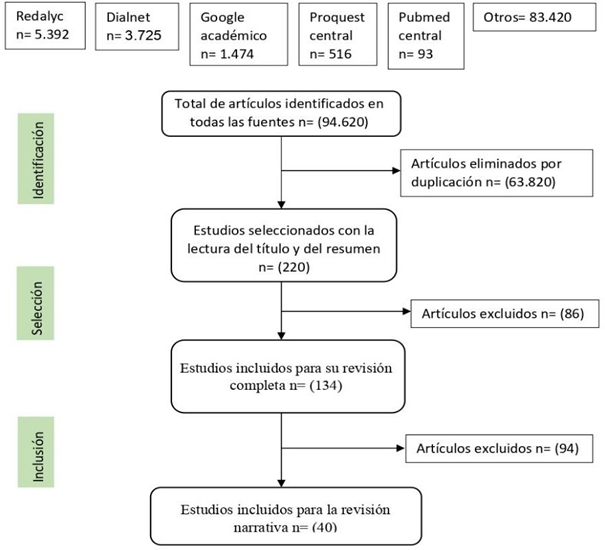
Of the 40 articles reviewed, the highest prevalence was found between 2019 and 2022, with 10 % (4) corresponding to 2019, 17,5 % (7) corresponding to 2020, 17,5 % (7) to 2021, and 12,5 % (5) to 2022. (7) 2021 and 12,5 % (5) for the year (2022). According to the countries with the highest publication of articles, the top three were: Turkey (10 %, 4), China (10 %, 4), followed by Italy (7,5 %, 3) and Spain. 7,5 % (3), Sweden 5 % (2), South Korea 5 % (2), United States 5 % (2), Japan 5 % (2), Australia 5 % (2); and ending with those countries with the lowest number of publications, among them Iran, Greece, Egypt, Switzerland, Nigeria, Vietnam, Mongolia, Indonesia, Poland, Chile, United Kingdom, Israel, Africa, India with 55 % (1). On the other hand, 100 % (40) of the articles reviewed in the following table are the most outstanding findings.
Description of findings
Table 2. Results of sociodemographic variables and FATCOD scale in students
Findings | Reference |
|---|---|
Students' ages ranged from 17 to 49 years old. | (2,3,4,5,6,7,8,9,10,11,12,13,14,15) |
In terms of gender, females predominate in a range between 73,2 % and 92,9 %. | (2,3,4,5,6,7,8,9,10,11,12,16,13,14,15) |
Only four articles asked about religion and in three of them the Catholic religion predominates with a range between 61 % and 81 %. | (2,5,6,14) |
Only three articles asked whether they received pre-death education with a range between 39,46 % and 74 %. | (2,6,9) |
A FATCOD scale score was found to be between 74,69 and 132 points. | (2,3,4,5,6,7,8,9,10,11,12,13,14,15,16) |
According to the literature review, this scale has been applied to professional nurses and nursing students; for students, the results were as follows: the average age was 33 years, and the sex of the participants was predominantly female, with 83. As for religion, 71 % of them were Catholics, 57 % of them had had training in palliative care, and their attitudes were favorable, with a score of 103 on the scale in the care of the patient and family in a palliative situation, see table 2.
Table 3. Results of sociodemographic variables and FATCOD scale in professionals
Findings | References |
|---|---|
Within the review it was found that ages ranged from 16 to 67 years. | (17,18,19,20,21,22,23,24,25,26,27,28,29,30,31,32,33,34,35,36,37) |
In terms of gender, females predominate with a range of 56,3 % and 98,6 %. | (17,19,20,21,22,23,24,25,26,27,28,29,30,31,33,34,35,36) |
Only six articles asked about religion and in 2 articles it mentions that Buddhism was professed with 56,9 % and Jewish with 89 % (Braun et al., 2010). | (21,24,26,29,32) |
The remaining only mentioned that they professed a religion, but did not specify which one religion, but did not specify which one. | [empty cell] |
In 8 items the marital status was asked, where 7 items responded that they were married, ranging from 51,8 % to 78,7 %. | (19,21,25,26,29,31,32,37) |
It was found that 10 articles questioned work experience, of which 6 articles were nursing graduates with a range of 45,4 % and 85,4 %; in 4 articles it mentions that they they were pursuing a postgraduate degree. | (24,25,29,31,32,33,35,36) |
A score was found to be between 51,173 and 125,7 points. | (17,18,19,20,21,22,23,24,25,26,27,28,29,30,31,32,33,34,35,36,37) |
As for the professionals, it was found that the average age of 41,5, 77 % of the interviewees were female, 15 % of the reviewed articles ask about religion and 5 % of the articles mentioned professing Buddhism with and Jewish, the remaining 95 % only mentioned professing a religion, but did not specify which one, 20 % of the articles in the narrative review questioned the population studied on marital status, 65 % being married, 65 % of the professionals selected for the studies had experience in the area of palliative care for them the scale was favorable with a mean of 88, this being attributed to administrative and legal functions and work overload.
Table 4. Results of sociodemographic variables and FATCOD scale in professionals and students
Findings | References |
|---|---|
The ages of the students and professionals ranged from 23 to 49 years old. | (38,39,40,41) |
In terms of sex, females predominate in a range of 87 % to 98 %. | (38,39,40,41) |
Only one article asked the practice of any religion 95,5 % of the nurses practice a religion and 87,5 % of the students do not practice a religion. | (38) |
Only one article asked the degree of study 53,9 % of the nursing students were pursuing a graduate degree. | (38) |
Respondents had from 1 to 16 years of work experience. | (38,40,41) |
Only in one article if they had education prior to death between 9,1 % and 60,4 %. | (38) |
It was found a score between 29,96 and 139,20 points. | (38,39,40,41) |
In the studies that included students and professionals, the mean age of the population studied was 36 years. The sample consisted of 92 % women. Nurses practiced some form of religion, with 95,5 % of the nurses identifying as practicing a religion. In contrast, 87,5 % of the students did not report or practice a religion. The respondents have 1 to 6 years of experience. If they have had contact with death 9,1 % of the students, and 60,4 % of the professionals when comparing the score of these two groups it is evident that it found a score of 84 which indicates that the attitudes of this group are in a medium range and can be an alert for the academy to strengthen competencies in palliative care necessary for the care of the patient and his family.
CONCLUSIONS
In this narrative review it was documented that the FATCOD scale has been used in multiple countries for this purpose, highlighting that attitudes modify behavioral tendencies according to their thinking and react in a context protecting their values and beliefs, which is translated into attitudes that the professional has to handle a critical situation as it is in different contexts according to their professional profile.
For the nursing discipline, the specific competencies that professionals need in their daily practice are essential. According to the narrative review carried out, it was concluded that the services where the FATCOD scale has been most applied are the palliative care and intensive care unit areas.
Based on geographical location, the continent where the FATCOD scale has been applied and used most is Asia, followed by Europe, making it essential to apply it in the rest of the world.
RECOMMENDATIONS
For future research, the FATCOD scale measurement should be considered for the training needs of nursing students and professionals regarding end-of-life care competencies, to identify potential training gaps.
Likewise, it is recommended that future research using the FATCOD scale considers conducting analyses associated with the usefulness of the educational content provided on end-of-life care during the student stage, with the aim of the consolidation of this knowledge from the academy.
It is necessary to validate the FATCOD scale in Colombia to develop contextualized research evaluating attitudes towards end-of-life care. This will provide reliable theoretical support for designing educational strategies that promote curriculum improvement for both nurse-in-training and professional nurses.
References
- 1 Ministerio de Salud. Resolución número 8430 de 1993. [Internet]. 1993 [cited 2025 May 24]. https://www.minsalud.gov.co/sites/rid/Lists/BibliotecaDigital/RIDE/DE/DIJ/RESOLUCION-8430-DE-1993.PDF
- 2 Dame L, Hoebeke R. Effects of a simulation exercise on nursing students’ end-of-life care attitudes. J Nurs Educ. 2016;55(12):701–5. doi:10.3928/01484834-20161114-07
- 3 Yu H, Sun C, Xie L, Wang L, Song J, Zhu Y, et al. Using a mediating model of death attitude and meaning in life to understand nursing students attitude about hospice care. Nurse Educ Today. 2022;116:105448. doi:10.1016/j.nedt.2022.105448
- 4 Mastroianni C, Piredda M, Taboga C, Mirabella F, Marfoli E, Casale G, et al. Frommelt attitudes toward care of the dying scale form B: Psychometric testing of the Italian version for students. Omega (Westport). 2015;70(3):227–50. doi:10.1177/0030222815568944
- 5 Jafari M, Rafiei H, Nassehi A, Soleimani F, Arab M, Noormohammadi M. Caring for dying patients: Attitude of nursing students and effects of education. Indian J Palliat Care. 2015;21(2):192–7. doi:10.4103/0973-1075.156497
- 6 Mastroianni C, Marchetti A, D’Angelo D, Artico M, Giannarelli D, Magna E, et al. Italian nursing students’ attitudes towards care of the dying patient: A multi-center descriptive study. Nurse Educ Today. 2021;104:104991. doi:10.1016/j.nedt.2021.104991
- 7 Edo M, Tomás J, Gómez J, Monforte C, Aradilla A. Spanish Adaptation of the Frommelt Attitude Toward Care of the Dying Scale (FATCOD-S) in Nursing Undergraduates. Omega (Westport). 2018;78(2):120–42. doi:10.1177/0030222816688294
- 8 Leombruni P, Miniotti M, Bovero A, Zizzi F, Castelli L, Torta R. Attitudes toward caring for dying patients: An overview among Italian nursing students and preliminary psychometrics of the FATCOD-B scale. J Nurs Educ Pract. 2013;4(3):1–9. doi:10.5430/jnep.v4n3p188
- 9 Gurdogan EP, Kınıcı E, Aksoy B. The relationship between death anxiety and attitudes toward the care of dying patient in nursing students. Psychol Health Med. 2019;24(1):843–52. doi:10.1080/13548506.2019.1576914
- 10 Lemos SA, Aguiar AR, Sousa AR, Almeida M, Raposo M. Nursing students’ attitudes towards death and end-of-life care. Rev Enferm Referência. 2021;5(6):1–8. doi:10.12707/RV20111
- 11 Dunn KS, Otten C, Stephens E. Nursing experience and the care of dying patients. Oncol Nurs Forum. 2005;32(1):97–104. doi:10.1188/05.ONF.97-104
- 12 Laporte P, Juvet T, Desbiens JF, Tapp D, Pasquier J, Bornet MA. Factors affecting attitudes towards caring for terminally ill patients among nursing students in Switzerland: A cross-sectional study. BMJ Open. 2020;10(9):e037553. doi:10.1136/bmjopen-2020-037553
- 13 Henoch I, Browall M, Melin-Johansson C, Danielson E, Udo C, Sundler AJ, et al. The Swedish version of the Frommelt Attitude Toward Care of the Dying Scale: Aspects of validity and factors influencing nurses’ and nursing students’ attitudes. Cancer Nurs. 2014;37(1):1–11. doi:10.1097/NCC.0b013e318279106b
- 14 Gelegjamts D, Yong Yoo J, Kim J, Sun Kim J. Undergraduate nursing students’ palliative care knowledge and attitudes towards end-of-life care: a cross-sectional descriptive study. Contemp Nurse. 2020;56(5–6):477–90. doi:10.1080/10376178.2021.1890165
- 15 Dimoula M, Kotronoulas G, Katsaragakis S, Christou M, Sgourou S, Patiraki E. Undergraduate nursing students’ knowledge about palliative care and attitudes towards end-of-life care: A three-cohort, cross-sectional survey. Nurse Educ Today. 2019;74:7–14. doi:10.1016/j.nedt.2018.11.025
- 16 Zhang J, Fu Y, Zhang H, Tang T, Yin M, Shi L. Analysis of factors influencing the attitudes towards the elderly of nursing students based on empathy and end-of-life care: A cross-sectional study. Nurs Open. 2022;9(5):2348–55. doi:10.1002/nop2.1245
- 17 Tait V, Higgs M, Magann L, Dixon J, Davis JM, Fernandez R. Attitudes of nonpalliative care nurses towards palliative care. Int J Palliat Care. 2015;2015:1–6. doi:10.1155/2015/469174
- 18 Etafa W, Wakuma B, Fetensa G, Tsegaye R, Abdisa E, Oluma A, et al. Nurses’ knowledge about palliative care and attitude towards end-of-life care in public hospitals in Wollega zones: A multicenter cross-sectional study. PLoS One. 2020;15(10):e0238357. doi:10.1371/journal.pone.0238357
- 19 Seven A, Sert H. How the nurses’ attitude for dying patients and their knowledge about palliative care? Bezmialem Sci. 2020;8(3):250–7. doi:10.14235/bas.galenos.2019.3419
- 20 Lange M, Thom B, Kline NE. Assessing nurses’ attitudes toward death and caring for dying patients in a comprehensive cancer center. Oncol Nurs Forum. 2008;35(6):955–9. doi:10.1188/08.ONF.955-959
- 21 Braun M, Gordon D, Uziely B. Associations between oncology nurses’ attitudes toward death and caring for dying patients. Oncol Nurs Forum. 2010;37(1):E43–9. doi:10.1188/10.ONF.E43-E49
- 22 Abu Hasheesh MO, Al-Sayed AboZeid S, Goda El-Said S, Alhujaili AD. Nurses’ characteristics and their attitudes toward death and caring for dying patients in a public hospital in Jordan. Health Sci J. 2013;7(4):384–94. https://www-proquest-com.bbibliograficas.ucc.edu.co/docview/1462404136?pq-origsite=primo&accountid=44394
- 23 Ford R, McInerney F. An evaluation of aged-care workers’ knowledge of and attitudes toward the palliative approach. Res Gerontol Nurs. 2011;4(4):251–9. doi:10.3928/19404921-20101103-01
- 24 Espinoza M, Luengo L, Sanhueza O. Atitudes em profissionais de enfermagem chilenos para o cuidado no final da vida. Análise multivariada. Aquichan. 2016;16(4):430–46. doi:10.5294/aqui.2016.16.4.3
- 25 Akbolat M, Ünal Ö, Karakaya BG. Turkish Adaptation of the Frommelt Attitude Toward Care of the Dying Scale. Omega (Westport). 2022;84(4):1160–74. doi:10.1177/0030222820930139
- 26 Oses M, Casas J, Seguel F. Competencias en fin de vida entre un grupo de enfermeros españoles y chilenos. Ene. 2020;14(2):1–20. doi:10.4321/s1988-348x2020000200012
- 27 Miyashita M, Nakai Y, Sasahara T, Koyama Y, Shimizu Y, Tsukamoto N, et al. Nursing autonomy plays an important role in nurses’ attitudes toward caring for dying patients. Am J Hosp Palliat Med. 2007;24(3):202–10. doi:10.1177/1049909106298396
- 28 Huriah T, Hidayah N, Mikami A. Attitudes and associated factors towards care for dying patients among non-palliative care nurses, Yogyakarta, Indonesia. Indones J Nurs Pract. 2021;5(1):9–16. doi:10.18196/ijnp.v5i1.10131
- 29 Kim JS, Kim J, Gelegjamts D. Knowledge, attitude and self-efficacy towards palliative care among nurses in Mongolia: A cross-sectional descriptive study. PLoS One. 2020;15(7):e0236390. doi:10.1371/journal.pone.0236390
- 30 Thi Thanh Vu H, Hoang Nguyen L, Xuan Nguyen T, Thi Hoai Nguyen T, Ngoc Nguyen T, Thi Thu Nguyen H, et al. Knowledge and attitude toward geriatric palliative care among health professionals in Vietnam. Int J Environ Res Public Health. 2019;16(15):2656. doi:10.3390/ijerph16152656
- 31 Ajisegiri WS, Abubakar AA, Gobir AA, Balogun MS, Sabitu K. Palliative care for people living with HIV/AIDS: Factors influencing healthcare workers’ knowledge, attitude and practice in public health facilities, Abuja, Nigeria. PLoS One. 2019;14(12):e0207499. doi:10.1371/journal.pone.0207499
- 32 Seo K. Moderating effect of nurse’s character on the relationship between attitudes toward nursing care of the dying and performance of terminal care in South Korea. Healthc (Basel). 2021;9(9):1195. doi:10.3390/healthcare9091195
- 33 Gameel W, Saied N. Nurses’ attitudes toward caring for dying patient in Mansoura University Hospitals. J Med Biomed Sci. 2010;10:16–23. https://www.academia.edu/5030870/ِ_NURSES_ATTITUDES_TOWARD_CARING_FOR_DYING_PATIENT_IN_MANSOURA_UNIVERSITY_HOSPITALS
- 34 Hao Y, Zhan L, Huang M, Cui X, Zhou Y, Xu E. Nurses’ knowledge and attitudes towards palliative care and death: a learning intervention. BMC Palliat Care. 2021;20(1):1–9. doi:10.1186/s12904-021-00738-x
- 35 Richoux DN, Chatmon BN, Davis AH, Sweeney B. Factors impacting pediatric registered nurse attitudes toward caring for dying children and their families: A descriptive study. J Pediatr Nurs. 2022;67:155–60. doi:10.1016/j.pedn.2022.09.010
- 36 Boatemaa A, Basour A, Setorglo J, Tetteh M, Bonsu L. Palliative care practices among nurses at Cape Coast Teaching Hospital, Ghana: A cross-sectional study. Int J Afr Nurs Sci. 2022;17:100454. doi:10.1016/j.ijans.2022.100454
- 37 Karadag E, Parlar Kilic S, Ugur O, Akyol MA. Attitudes of nurses in Turkey toward care of dying individual and the associated religious and cultural factors. J Relig Health. 2019;58(1):303–16. doi:10.1007/s10943-018-0657-4
- 38 Wang LP, Li YJ, Yan WZ, Li GM. Development and psychometric testing Chinese version of the Frommelt Attitude Toward Care of the Dying Scale, Form B in nurses and nursing students. J Cancer Educ. 2016;31(1):123–30. doi:10.1007/s13187-015-0810-7
- 39 Sadowska A, Nowak M, Czarkowska-Pączek B. Assessment of the reliability of the Polish language version of the FATCOD-B scale among nursing students. J Cancer Educ. 2021;36(3):561–6. doi:10.1007/s13187-019-01665-5
- 40 Yamagata C, Matsumoto S, Miyashita M, Kanno Y, Taguchi A, Sato K, Fukahori H. Preliminary effect and acceptability of an intervention to improve end-of-life care in long-term-care facilities: A feasibility study. Healthc (Basel). 2021;9(9):1194. doi:10.3390/healthcare9091194
- 41 Fristedt S, Grynne A, Melin-Johansson C, Henoch I, Hagelin CL, Browall M. Registered nurses and undergraduate nursing students’ attitudes to performing end-of-life care. Nurse Educ Today. 2021;98:104772. doi:10.1016/j.nedt.2021.104772
- 42 Lee SY, Hung CL, Lee JH, Shih SC, Weng YL, Chang WH, et al. Attaining good end-of-life care in intensive care units in Taiwan - The dilemma and the strategy. Int J Gerontol. 2009;3(1):26–30. doi:10.1016/S1873-9598(09)70017-1
- 43 Simkin H, Quintero S. Validación de la Escala de Miedo a la Muerte. Psocial. 2017;3(1):1–7. https://publicaciones.sociales.uba.ar/index.php/psicologiasocial/article/view/2340/1985
- 44 Secpal. Guía de Cuidados Paliativos [Internet]. 2014 [cited 2025 May 24]. https://www.secpal.com/biblioteca_guia-cuidados-paliativos_2-definicion-de-enfermedad-terminal
- 45 Redaelli A. Hospice. El cuidado personalizado y humanizado del enfermo terminal. Ministri Degli Infermi. 2014. https://www.camilliani.org/a-redaelli-hospice-el-cuidado-personalizado-y-humanizado-del-enfermo-terminal/
- 46 Mohamed A, Saied N. Nurses’ attitudes toward caring for dying patient in Mansoura University Hospitals. J Med Biomed Sci. 2010;1(1):16–23. https://www.academia.edu/5030870/ِ_NURSES_ATTITUDES_TOWARD_CARING_FOR_DYING_PATIENT_IN_MANSOURA_UNIVERSITY_HOSPITALS
- 47 Morita T, Murata H, Hirai K, Tamura K, Kataoka J, Ohnishi H, et al. Meaninglessness in terminally ill cancer patients: A validation study and nurse education intervention trial. J Pain Symptom Manage. 2007;34(2):160–70. doi:10.1016/j.jpainsymman.2006.10.021
- 48 Organización Panamericana de la Salud. Cuidados paliativos [Internet]. 2021 [cited 2025 May 24]. https://www.paho.org/es/temas/cuidados-paliativos
- 49 Organización Mundial de la Salud. La OMS toma medidas para abordar la flagrante escasez de servicios de cuidados paliativos de calidad [Internet]. 2021 [cited 2025 May 24]. https://www.who.int/es/news/item/05-10-2021-who-takes-steps-to-address-glaring-shortage-of-quality-palliative-care-services
- 50 Ortega D, Ortega JA, Guerrero RF. Conocimientos sobre cuidados paliativos en un grupo de enfermeras en México. Rev Colomb Enferm. 2019;18(1):1–8. doi:10.18270/rce.v18i1.2368
- 51 Leombruni P, Loera B, Miniotti M, Zizzi F, Castelli L, Torta R. Confirmatory factor analysis of the Frommelt Attitude Toward Care of the Dying Scale (FATCOD-B) among Italian medical students. Palliat Support Care. 2015;13(5):1391–8. doi:10.1017/S1478951515000139
- 52 Henoch I, Melin-Johansson C, Bergh I, Strang S, Ek K, Hammarlund K, et al. Undergraduate nursing students’ attitudes and preparedness toward caring for dying persons – A longitudinal study. Nurse Educ Pract. 2017;26:12–20. doi:10.1016/j.nepr.2017.06.007
- 53 González M, Díaz de Herrera P, Martínez ML. The role of the nurse at the end of the life of a critically ill patient. Enferm Intensiva. 2019;30(2):78–91. doi:10.1016/j.enfi.2018.02.001
- 54 García DJ, Ochoa MC, Briceño II. Actitud del personal de enfermería ante la muerte de la persona en la unidad de cuidados intensivos: estudio cuantitativo. Duazary. 2018;15(3):281. doi:10.21676/2389783x.2421
- 55 Frommelt KH. Attitudes toward care of the terminally ill: An educational intervention. Am J Hosp Palliat Care. 2003;20(1):13–22. doi:10.1177/104990910302000108
- 56 Espinosa S. Afrontamiento del profesional de enfermería ante la muerte de pacientes en unidades de paliativos y oncología. NURE Investig. 2016;13(82):1–12. https://dialnet.unirioja.es/servlet/articulo?codigo=6277911
- 57 Duran T, Vidales MAM, Aguilar MLM, Sánchez GG, Alpirez HÁ, Guevara SJL. Fear of death and quality of life in older adults. Enferm Glob. 2020;19(2):296–304. doi:10.6018/eglobal.364291
- 58 Browall M, Pakpour AH, Melin-Johansson C, Lundh Hagelin C, Österlind J, Henoch I. Development and Psychometric Evaluation of a New Short Version of the Swedish Frommelt Attitudes Toward Care of the Dying Scale. Cancer Nurs. 2021;44(4):305–13. doi:10.1097/NCC.0000000000000794
- 59 Alligood MR, Marriner Tomey A. Modelos y teorías de enfermería. 8a ed. Elsevier; 2015. https://www.congresohistoriaenfermeria2015.com/modelos.html
- 60 Avalos MA. La salud-enfermedad y muerte desde un abordaje etnográfico. Misiones-Argentina. Rev Urug Antropol Etnogr. 2018;3(1):79–90. http://www.scielo.edu.uy/scielo.php?script=sci_arttext&pid=S2393-68862018000100079
- 61 Bach V, Ploeg J, Black M. Nursing roles in end-of-life decision making in critical care settings. West J Nurs Res. 2009;31(4):496–512. doi:10.1177/0193945908331178
- 62 Bermejo JC, Villacieros M, Hassoun H. Attitudes towards end-of-life patient care and fear of death in a healthcare student sample. Med Paliat. 2018;25(3):168–74. doi:10.1016/j.medipa.2017.02.004
- 63 Betancur MAL. Nursing care of patients during the dying process: A painful professional and human function. Investig Educ Enferm. 2015;33(2):297–304. doi:10.17533/udea.iee.v33n2a12
- 64 Cáceres DI, Cristancho LY, López LA. Attitudes of nurses towards the death of patients in an intensive care unit. Rev Cienc Salud. 2019;17(3):98–110. doi:10.12804/revistas.urosario.edu.co/revsalud/a.8368
- 65 Cobbs E, Blackstone K, Lynn J. El paciente moribundo - Temas especiales - Manual MSD versión para profesionales. Manual MSD; 2019. https://www.msdmanuals.com/es-mx/professional/temas-especiales/el-paciente-moribundo/el-paciente-moribundo
- 66 Congreso de la República. Ley 1733 de 2014. Diario Oficial Congreso de La República. 2014. https://www.funcionpublica.gov.co/eva/gestornormativo/norma.php?i=59379
- 67 Cordeiro FR, Griebeler Oliveira S, Zeppini Giudice J, Pellegrini Fernandes V, Timm Oliveira A. Definitions for “palliative care”, “end-of-life” and “terminally ill” in oncology: a scoping review. Enferm Cuid Human. 2020;9(2):205–28. doi:10.22235/ech.v9i2.2317
- 68 Kirchhoff KT. Promoting a peaceful death in the ICU. Crit Care Nurs Clin North Am. 2002;14(2):201–6. doi:10.1016/S0899-5885(01)00012-0
- 69 Kongsuwan W, Chaipetch O, Matchim Y. Thai Buddhist families’ perspective of a peaceful death in ICUs. Nurs Crit Care. 2012;17(3):151–9. doi:10.1111/j.1478-5153.2012.00495.x
- 70 Kongsuwan W, Locsin R. Promoting peaceful death in the intensive care unit in Thailand. Int Nurs Rev. 2009;56(1):116–22. doi:10.1111/j.1466-7657.2008.00674.x
- 71 Lynch G, Oddone J. La percepción de la muerte en el curso de la vida. Un estudio del papel de la muerte en los cambios y eventos biográficos. Rev Cienc Soc. 2017;30(40):129–50. http://www.scielo.edu.uy/scielo.php?script=sci_arttext&pid=S0797-55382017000100007
- 72 Souza LP, Mota J, Barbosa R, Ribeiro RC, Oliveira CS, Barbosa DA. A morte e o processo de morrer: sentimentos manifestados por enfermeiros. Enferm Glob. 2013;12(32):230–7. http://search.ebscohost.com/login.aspx?direct=true&db=a9h&AN=93609100&lang=es&site=ehost-live
- 73 Steinberg A, Sprung CL. The dying patient: New Israeli legislation. Intensive Care Med. 2006;32(8):1234–7. doi:10.1007/s00134-006-0186-6
Declarations
Funding
None.
Conflict of interest
The authors declare that there is no conflict of interest. AUTHORSHIP CONTRIBUTION Conceptualization: Angy L Camargo Angel, Daniel J Duran González, Lizeth N Vásquez Rondón, Marlyn S Galvis Caro, María A Pulido Montes, Luz M Contreras Ramos. Data curation: Angy L Camargo Angel, Daniel J Duran González, Lizeth N Vásquez Rondón, Marlyn S Galvis Caro, María A Pulido Montes, Luz M Contreras Ramos. Formal analysis: Angy L Camargo Angel, Daniel J Duran González, Lizeth N Vásquez Rondón, Marlyn S Galvis Caro, María A Pulido Montes, Luz M Contreras Ramos. Research: Angy L Camargo Angel, Daniel J Duran González, Lizeth N Vásquez Rondón, Marlyn S Galvis Caro, María A Pulido Montes, Luz M Contreras Ramos. Methodology: Angy L Camargo Angel, Daniel J Duran González, Lizeth N Vásquez Rondón, Marlyn S Galvis Caro, María A Pulido Montes, Luz M Contreras Ramos. Project Management: Angy L Camargo Angel, Daniel J Duran González, Lizeth N Vásquez Rondón, Marlyn S Galvis Caro, María A Pulido Montes, Luz M Contreras Ramos. Resources: Angy L Camargo Angel, Daniel J Duran González, Lizeth N Vásquez Rondón, Marlyn S Galvis Caro, María A Pulido Montes, Luz M Contreras Ramos. Software: Angy L Camargo Angel, Daniel J Duran González, Lizeth N Vásquez Rondón, Marlyn S Galvis Caro, María A Pulido Montes, Luz M Contreras Ramos. Supervision: Angy L Camargo Angel, Daniel J Duran González, Lizeth N Vásquez Rondón, Marlyn S Galvis Caro, María A Pulido Montes, Luz M Contreras Ramos. Validation: Angy L Camargo Angel, Daniel J Duran González, Lizeth N Vásquez Rondón, Marlyn S Galvis Caro, María A Pulido Montes, Luz M Contreras Ramos. Visualization: Angy L Camargo Angel, Daniel J Duran González, Lizeth N Vásquez Rondón, Marlyn S Galvis Caro, María A Pulido Montes, Luz M Contreras Ramos. Writing - original draft: Angy L Camargo Angel, Daniel J Duran González, Lizeth N Vásquez Rondón, Marlyn S Galvis Caro, María A Pulido Montes, Luz M Contreras Ramos. Writing - proofreading and editing: Angy L Camargo Angel, Daniel J Duran González, Lizeth N Vásquez Rondón, Marlyn S Galvis Caro, María A Pulido Montes, Luz M Contreras Ramos. ANNEX Figure 1. DeCS and MeSH Descriptors Figure 2. Combination with Booleans
Authorship contributions
Drafting – original draft: Angy L Camargo Angel, Daniel J Duran González, Lizeth N Vásquez Rondón, Marlyn S Galvis Caro, María A Pulido Montes, Luz M Contreras Ramos.
Writing–review and editing: Angy L Camargo Angel, Daniel J Duran González, Lizeth N Vásquez Rondón, Marlyn S Galvis Caro, María A Pulido Montes, Luz M Contreras Ramos.