

Abstract
Citizen-science platforms depend on volunteers who keep contributing, and gamification is often proposed to secure that continuity. This narrative review contrasted what the literature published between 2013 and 2025 in or about Latin America reports on gamified and non-gamified citizen-science initiatives. The core corpus contained 36 studies, 11 gamified and 25 non-gamified, from 7 countries. All gamified studies described game mechanics, but none reported participation beyond its evaluation window in its abstract. Funding and institutional anchoring were reported by 14 non-gamified studies and by none of the gamified ones. Multi-year programs documented hundreds or thousands of contributors, yet participation concentrated in a few users, municipalities and regions, and technology, goal mismatch and funding limited continuity. These patterns suggest that the sustainability of gamified platforms in the region has been designed more than measured. Reporting retention, maintenance status and funding alongside game mechanics would allow direct comparison.
Keywords
citizen science, gamification, Latin America, volunteer retention, crowdsourcing
INTRODUCTION
Citizen-science platforms live on the continued attention of volunteers. An analysis of online accounts from more than 14 million participants over two decades found steady growth in nature sensing, whereas participation in crowdsourcing and distributed computing declined.(1) A survey of players of the gamified project Eyewire described sustained engagement as essential to the success of a citizen-science project.(2) Gamification, the use of game elements in contexts that are not games, has been proposed as a remedy. A review of 819 studies reported results that lean toward effectiveness but include a large amount of mixed findings, with crowdsourcing among the most common contexts and points, badges and leaderboards among the most common mechanics.(3)
The evidence on gamification is also context dependent. A review of 77 articles from seven disciplines, crowdsourcing among them, organized the field around mechanics, psychological mediators and desired outcomes, and concluded that gamification depends on the setting more than on any independent theory.(4) A framework of participant motivation adds that motivation differs with the type of citizen-science project and matters both to start and to sustain participation.(5) These two points make a regional reading necessary, because the conditions that shape motivation and continuity in Latin America differ from those of the platforms most often studied.
In Latin America the practice is younger and less documented. A review of participatory aquatic biomonitoring in Latin America and the Caribbean described the field as being at an initial stage, with most experiences starting after 2010.(6) In Brazil, the participation of volunteers in environmental research was described as limited.(7) Beyond the region, a mapping of citizen science in low and middle income country cities found fewer projects in low income than in middle income countries and named the lack of long-term funding among the main challenges.(8)
Two bodies of work approach the problem from different directions. One comes from computing, design and learning-technology groups in Argentina, Brazil and Mexico, and builds platforms around game elements. The other comes from biodiversity, public health and community-monitoring teams, and relies on institutions, networks and personal motivation. Reading them together is informative because they appear to report different things: the first mechanics and short evaluations, the second programs that span years and the arrangements that carry them.
The evidence is scattered across conference proceedings in computing, regional journals in Portuguese and Spanish, and international journals of citizen science. The prologue of a report on citizen science in Latin America recalls that open science requires knowledge production that is inclusive, equitable and sustainable, and presents citizen science as one of its components.( 9) An editorial on citizen science in Latin America and the Global South adds that social studies of the field have paid attention to non-scientists who work outside, or even against, the interests of institutional science.( 10)
The aim of this narrative review was to synthesize what the literature published between 2013 and 2025 in or about Latin America reports on the sustainability of gamified citizen-science platforms. Four questions guided it. How were game mechanics designed and evaluated in the region? How do gamified and non-gamified initiatives compare in engagement and retention? How do they compare in funding, institutional anchoring and data infrastructure? Which gaps define a research agenda?
DEVELOPMENT
The corpus and its two groups
The synthesis rests on 36 core studies, 11 gamified and 25 non-gamified, and on 22 support references used only in the Introduction and Discussion. Brazil contributed 6 of the gamified studies, Argentina 3, Mexico 1 and El Salvador 1 (Table 1).
Study | Country | Platform or task | Game elements | Evaluation |
|---|---|---|---|---|
(11) | Brazil | Food-additive citizen sensing | Gameplay | Proposal |
(12) | El Salvador | Cooperative card game on hypotheses | Card game | Five neighborhoods |
(13) | Brazil | E-participation platform | Extrinsic rewards | Real context |
(14) | Brazil | Crowdsourcing micro-tasks | Badges, feedback, rankings | Case study and experiment |
(15) | Brazil | Online image classification projects | Points, badges, leaderboards | Interface observation |
(16) | Argentina | Astronomy photo-classification tutorial | Points, badges, competition | Evaluation of tutorial |
(17) | Argentina | Galaxy Conqueror, Cientópolis | Badges, peer credit | Initial evaluation |
(18) | Argentina | Agriculture knowledge wiki | Reward layer | Simulation |
(19) | Brazil | Real-time data mapping | Gamification strategies | Design |
(20) | Brazil | Public transportation apps | G.A.M.E. framework | Controlled navigation tests |
(21) | Mexico | Citizen-science games for learning | Game-based learning | Framework |
The two groups differ in setting as well. Among the gamified studies, Brazil contributed e-participation, micro-task, image-classification, food-sensing, data-mapping and transportation applications, while Argentina contributed an astronomy tutorial, an astronomy game and an agriculture wiki. Two of the three Argentine studies appeared in proceedings of the Latin American conference on learning technologies or learning objects,(16,17) which shows that part of this literature circulates in computing venues that biodiversity journals do not index.
Among the non-gamified studies, Brazil contributed 11 and Mexico 4, with two each from Ecuador and Peru, one from Chile and five pan-regional reports. The non-gamified studies concentrated on biodiversity, health surveillance, water and public statistics, which are domains where a state institution, a museum or a university can host a platform for years.
The gamified literature is older. Of its 11 studies, 7 appeared between 2013 and 2019 and 4 from 2020. In the non-gamified group, only 1 of 25 studies predates 2020, and 24 appeared from 2020 onward.
Design logic: reward mechanics against purpose and values
Every gamified study described mechanics. Points, badges and leaderboards dominated the interfaces of the online citizen-science projects examined in a Brazilian observation, and the contributions made by participants stayed inaccessible to them in almost all of the initiatives.( 15) In Argentina, a gamified tutorial for an astronomy photo-classification project found aesthetics, point-based evaluation, badges and competition promising.( 16)
The game Galaxy Conqueror, part of the Cientópolis platform, awarded badges according to performance and let other players credit or discredit a potential discovery.(17) A Brazilian e-participation platform recorded greater participation in its gamified version, especially when extrinsic motivation resources were applied.(13) The crowdsourcing application ConTask added recognition badges, feedback and user rankings, and its authors concluded that gamification and contribution filtering can improve participation.(14)
Whereas these reports emphasized rewards, two others cautioned against them. A Brazilian framework argued that reward-based design is dangerous in collaborative systems because it may turn point gathering into the primary purpose instead of collaboration.( 20) An Argentine simulation built on the history of the agriculture community of Wikipedia between 2001 and 2018 showed that a system of awards was not obvious to generate, because knowledge accumulates in very small portions that can be confused with corrections.( 18)
Two designs departed from reward logic. The cooperative card game PACMAP aimed to introduce hypotheses and falsifiability, and it proved approachable for participants of different demographics in five neighborhoods of El Salvador.( 12) A Brazilian proposal for citizen sensing of food additives argued that gameplay can engage voluntary participation, including in repetitive data tasks, and called for an ethical and critical use of the technique.( 11)
In the non-gamified group, 8 studies addressed why people join and stay. In the Guardiões da Chapada project, most participants were women, and every function of the functional theory of motivations influenced them, with conservation values especially.( 22) The Big Seaweed Search Mexico engaged young people, mainly aged 12 to 19 years, from two coastal communities, and its facilitators recommended continuous formal and informal training.( 23)
The social framing of participation also differed. The editorial on citizen science in Latin America and the Global South contrasts a dominant scientific definition, in which non-scientists perform outsourced work, with social studies that follow non-scientists acting outside or against institutional science.(10) Brazilian university professors, surveyed about public engagement across the stages of citizen science, saw it as positive and educational, and they raised methodological and practical limitations.(24) Neither framing is a reward system.
In Mexican birding, practitioners increased largely through institutional arrangements and top-down initiatives of government environmental agencies, which led the author to propose that public policy can legitimately create publics.(25) Compared with that policy-driven route, an action-research on the Brazilian coastline placed affected communities as protagonists in risk mapping, under a right-to-research approach.(26) In Ecuador, participatory models for four urban rivers proved more effective than technocratic hierarchies.(27)
Participation and retention: short evaluations against multi-year programs
In the gamified group, 6 of 11 studies were evaluated with participants, 2 by simulation or observation, and 3 remained proposals. None of their abstracts reported participation beyond the evaluation window.
Multi-year programs appeared only among non-gamified initiatives. The citizen-science program of the Instituto Nacional da Mata Atlântica developed seven projects from 2019 and, until May 2023, engaged 2,320 collaborators who contributed data on 600 species in 67 municipalities.(28) All its projects were of the contributory type, and the authors described a diverse public that required different engagement strategies.
The WhatsBarb platform received 465 insect records between 2019 and 2024, with contacts from 20 of the 26 Brazilian states and the Federal District.(29) Guardians of Health, a participatory surveillance platform, was used during the 2016 Olympic Games in Rio de Janeiro and was officially used by the Brazilian Ministry of Health to monitor outbreaks and epidemics.(30) In the coastal monitoring initiative, five training workshops reached 51 citizen scientists, and their data resembled those of specialists.(31)
Training and data quality appeared as conditions of continuity. In the Brazilian coastal initiative, data collected by citizen scientists were validated against specialists and showed high similarity, although variation among specialists themselves pointed to a need for prior alignment among those who train citizens, and bivalve zones proved more complex than other parts of the habitat.(31) In Guardiões da Chapada, a questionnaire applied before and after two strategies, one online and one in person, identified the profile and motivations of the target public.(22)
The Brazilian Citizen Science Network offers an organizational answer to dispersion. Its launch workshop took place online in March 2021, and the report derived from it presents the network as a means of exchanging knowledge between initiatives and of raising funding.( 32) The same report describes citizen science as a growing practice in the country that still faces several challenges, a description that agrees with the early-stage characterization given for aquatic biomonitoring in the wider region.( 6)
Failure to engage was also documented. The first attempt of a bird-banding project begun in 2016 engaged only ten citizens, too few for the planned analysis.( 33) The CrowdWater app, implemented with community groups in five Latin American countries, was limited by a mismatch of goals between users and scientists and by technological barriers, whereas direct communication with users improved its use.( 34)
Participation also concentrated. In Chile, more than 63,000 fungal observations of 1,245 species on iNaturalist were concentrated in central and southern urban areas, and a small group of hyperprolific users generated 44.40% of the records.( 35) Across 5,565 Brazilian municipalities, WikiAves activity was positively related to population and economic development, and negatively to population density.( 36)
Funding and institutional anchoring: project-bound against institution-anchored
None of the gamified studies addressed funding or institutional anchoring, compared with 14 non-gamified studies. The first workshop of the Brazilian Citizen Science Network listed financial sustainability, technology, data quality, engagement and good practices among its topics, and an open letter registered the factors that favor or constrain citizen science in the country.( 32)
A review of Brazilian and international projects identified key matches between proponents and participants, project goals and local priorities, participant profiles, scientific methods and funding as factors of success and longevity.( 7) In participatory aquatic biomonitoring of Latin America and the Caribbean, experiences were concentrated in Mexico and Colombia, and the review stressed strategic alliances to gain credibility with funders.( 6)
Interviews with strategic stakeholders in Mexico showed that adopting citizen science in the national statistics and geography institute required resources, data integration models, workflows and an organizational structure, and that adoption depended on interest driven by leadership.( 37) Compared with that formal route, Mexican birding relied on government agencies to create its publics.( 25)
Existing arrangements stood in for dedicated funding in two settings. In Mexico City, waste collectors were engaged as citizen scientists in a colony of 5,797 inhabitants and 1,747 houses, because traditional household-waste data collection in developing countries is hampered by jurisdictional and budgetary constraints.( 38) In Ecuador, a national assessment of wildlife mortality on roads combined systematic surveys from ten studies with citizen-science and other nonsystematic records.( 39)
Funding and training also limited Chilean mycology, where the authors called for more effort and resources to close knowledge gaps.( 35) The UNESCO-linked report places citizen science within open science, and its prologue asks for sustainable knowledge production.( 9) Brazilian faculty members, in a survey of 170 professors from 32 federal universities, pointed to the recognition of volunteer contributions among the perspectives for the field.( 24)
Data and infrastructure
The gamified group reported no data-infrastructure outcome, and 10 non-gamified studies did. A Peruvian proposal found high heterogeneity in metadata documentation across citizen-science projects, which hampers interoperability, and discussed Darwin Core and Dublin Core as references.( 40) Open geographical data infrastructures in Latin America were described as early in development, and only a limited number allowed unrestricted use and reuse of their data.( 41)
Platform records were also reused as research data. In Ecuador, citizen-science and other nonsystematic sources supplied 1,705 of the 5,010 roadkill records of the national assessment, and these covered all 24 provinces.( 39) In Peru, 1,180 breeding records of 325 bird species for the period 2000 to 2021 were compiled from the Macaulay Library and iNaturalist, in a region where this information is scarce for most Neotropical species.( 42)
Concentration of activity also had a geographic and economic profile. Brazilian birdwatching records remained concentrated in municipalities that combined wealth, lower density, high biodiversity and tourism appeal, while protected areas had a minor influence.( 36) The CrowdWater experience in five countries concluded that inclusive data management practices are required so that the needs of users are met.( 34)
Governance and data justice appeared at the edge of the corpus. The Ecuadorian study of four urban rivers developed social indicators and participatory mapping to strengthen local capacities and to identify priority areas for management.(27) The Brazilian right-to-research study combined citizen science with participatory geographic information systems and social cartography to map risks of disasters caused by extreme climate events in affected communities.( 26) Both treated data as a means of local decision making and not as the product of a platform.
Synthesis by axis
Across the four axes, the two groups barely overlapped (Table 2, Figure 1). The gamified group concentrated on design logic and, to a lesser extent, on participation, whereas the non-gamified group spread over all four axes and was the only one to address funding and infrastructure.
Axis | Gamified (number of studies) | Non-gamified (number of studies) | Total (number of studies) |
|---|---|---|---|
Design logic | 11 | 8 | 19 |
Participation and retention | 6 | 9 | 15 |
Funding and institutional anchoring | 0 | 14 | 14 |
Data and infrastructure | 0 | 10 | 10 |
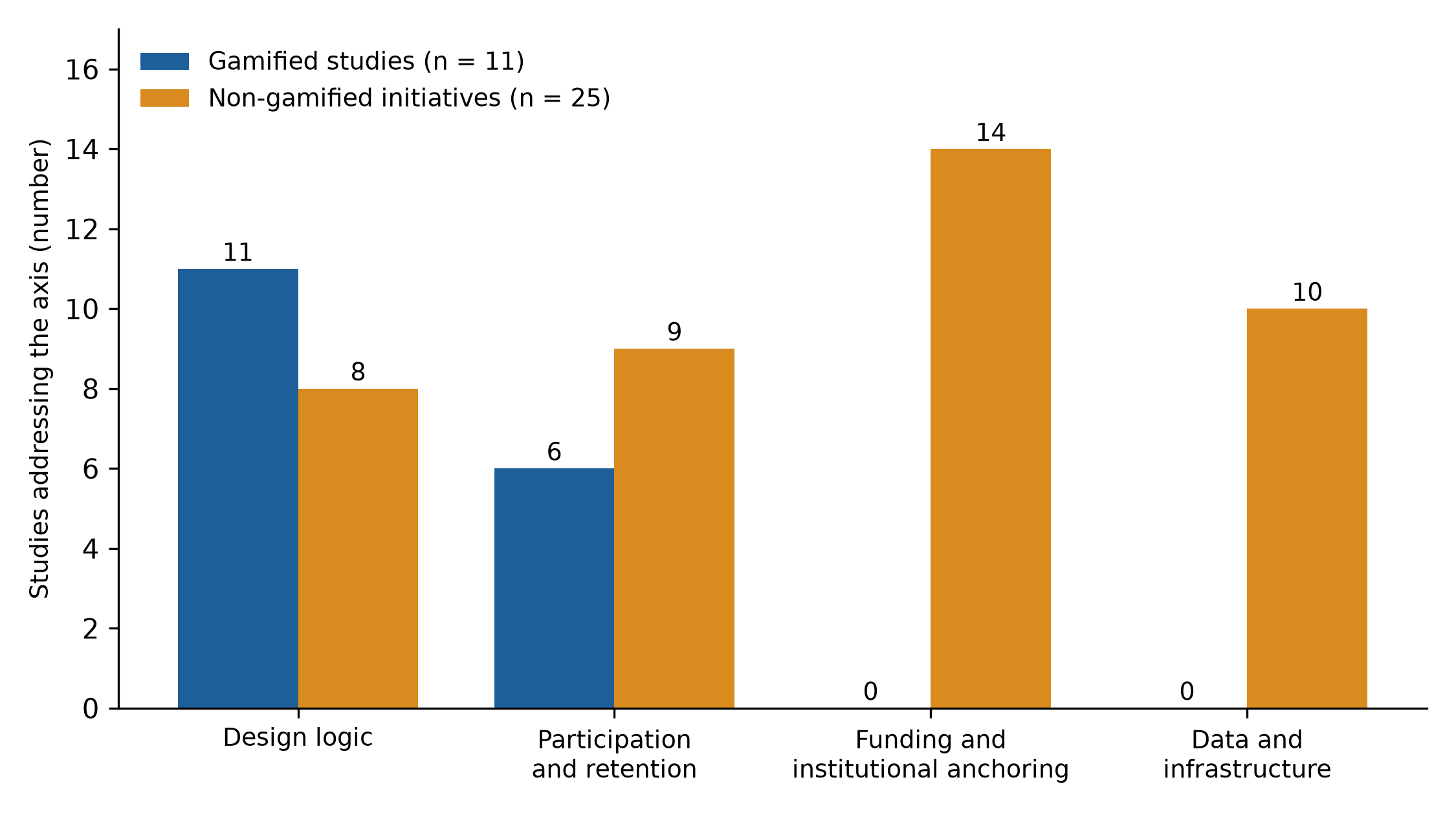
Figure 1. Number of core studies addressing each axis, by group.
DISCUSSION
A literature built around rewards would be expected to say most about retention, yet the gamified studies from the region said most about mechanics and said nothing in their abstracts about participation after the evaluation. The non-gamified initiatives, which were not designed around retention, documented programs that lasted years and the arrangements that carried them. This inversion between expectation and record is the main finding of the review, and it has to be read as a pattern in reporting, not as proof that game elements fail to sustain participation.
The word sustainability can carry three meanings in this corpus, and the groups used different ones. For the gamified studies it meant continued contribution by individuals, which a mechanic tries to raise. For the non-gamified studies it meant resources, partnerships and procedures that allow a program to continue, as in the funding alliances stressed for aquatic biomonitoring.( 6) For the infrastructure papers it meant that data remain interoperable and open.( 41) A platform is sustainable in the full sense only when the three hold together, and no study in the corpus measured all of them.
Part of the inversion comes from the type of document. Of the 11 gamified studies, 3 were proposals or frameworks and 2 were simulations or observations, so that only 6 tested a design with participants. Such papers answer the question of how to build a mechanic, and a platform that survives for years usually leaves other kinds of records, such as program reports, workshop minutes and data papers. A comparison of retention between the two groups would therefore be unfair to the gamified literature, and the review does not offer one.
The short horizon of the regional evaluations matches what is reported elsewhere. A survey of 185 players of nine citizen-science games found that these games still suffer the recruitment and retention problems of traditional projects, and its players raised concerns about scientific communication, instructional design, interface, task quality and software.(43) A mixed-methods field trial with students found that points, streaks and leaderboards enhanced the sense of accomplishment and early motivation, whereas deep immersion was less robust and long-term participation only moderate.(44) The Argentine and Brazilian evaluations of tutorials, badges and rankings sit in the same early-stage window.
The broader gamification literature explains why short evaluations are hard to interpret. The review of 819 studies found that results lean toward effectiveness yet include many mixed findings, and that research models and variables lack coherence.(3) The cross-disciplinary review of 77 articles reached a compatible conclusion, because it describes gamification as dependent on context.(4) Compared with those syntheses, the abstracts of the regional studies rarely name the psychological mediator they target, so an increase in contributions cannot be assigned to competence, recognition or competition.
The contrast between rewards and purpose has a theoretical counterpart. In a web experiment, game elements that offered rewards, recognition or progress reminders influenced extrinsic motivation, whereas elements that created a fantasy scene strengthened intrinsic motivation, and the effects weakened when tasks were complex.( 45) The Brazilian result of greater participation under extrinsic resources( 13) agrees with the first part of that finding, while the warning about point gathering replacing collaboration( 20) points to the risk of relying on it alone. Compared with the reward-based interfaces described in Brazil,( 15) the El Salvador card game aimed at understanding hypotheses( 12) addressed competence rather than points.
Evidence on what keeps volunteers is broader than game elements. Players of Eyewire grouped the features that affect long-term engagement into four categories that combine intrinsic and extrinsic motivations.(2) In online citizen science on the Zooniverse, participation related mainly to the satisfaction of the needs of autonomy, competence and relatedness, autonomy being the most supported and relatedness the least.(46) Interviews with 28 volunteers and 11 researchers showed that the more aspects of a project volunteers join, the more likely they are to sustain participation.(47) The Guardiões da Chapada result, with conservation values leading motivations,(22) is consistent with these accounts and would not be captured by a leaderboard.
Motivation also varies with context, which limits transfer. Among smallholder farmers in India, Ethiopia and Honduras, motivations differed by country and education, and the authors suggested that gamification may increase the egoistic intrinsic motivation of farmers whose main motivation is sharing information, as reported for Ethiopian and Honduran farmers.(48) A framework that classifies motivation by project typology makes a similar point: the factors that recruit participants are not always those that sustain them.(5) A survey of an Italian long-term initiative on protected species reached 22.3% of invited volunteers and modeled the drivers of continued participation, which indicates that retention needs its own measurement.(49)
The Brazilian e-participation study offers the clearest baseline problem. Its authors noted that platforms for electronic participation usually have low audience and that collaboration between governments and citizens does not occur easily, which motivated the use of game elements.( 13) That context differs from biodiversity platforms, where observers already enjoy the activity, and it suggests that rewards may be more necessary where intrinsic interest is weaker. The suggestion remains a hypothesis, because the corpus has no study that tests the same mechanic in both settings.
Ethical and design costs of rewards deserve attention. Gamers in gamified, crowdsourced citizen science fall through the cracks of research protections and regulations, which raises issues of exploitation and of responsibility.( 50) The Brazilian observation that contributions stayed inaccessible to participants( 15) and the call for an ethical use of gameplay in citizen sensing( 11) belong to the same concern. No abstract in the corpus mentioned how participants were informed of data use or protected.
Training and data quality link the two groups. In a systematic review of 56 water-quality articles, success factors included the knowledge, awareness and motivation of citizens and the communication and feedback between citizens and institutions.( 51) The Brazilian coastal initiative, which trained 51 volunteers and compared their data with those of specialists,( 31) illustrates the first set, and the inaccessibility of contributions to participants in gamified projects( 15) illustrates a failure of the second. Feedback is therefore a design variable that both groups share, and only the non-gamified group reported it as part of training.
Learning outcomes belong to the same discussion. Citizen science that is aligned with education requires, according to a review of challenges, that learning outcomes and project goals be aligned at the planning stage through co-creation, with accessibility and inclusivity throughout.(52) The Mexican framework linking citizen-science games and computational thinking proposes that game-based learning could increase engagement and teamwork in data collection,(21) which is a plausible route but one that the abstract presents as potential and not as a result.
Anchoring explains much of what the non-gamified initiatives documented. Long-running Australian programs attributed their persistence to a clear vision, knowledge management, relationship building, meaningful volunteer engagement and the capacity to adapt.(53) In water quality monitoring, consistent and adequate funding appeared among the attributes of institutions that predict success.(51) The Italian initiative that began as a European LIFE project changed its name when it received national funds and ended in 2024, after enrolling more than 1,600 participants.(49) Compared with that sequence of grants, Mexican birding was sustained by agencies that created their publics,(25) and the national statistics institute described leadership and structure as conditions of adoption.(37)
Technology adds a third condition that the gamified literature does not discuss. The CrowdWater experience in five countries found that technological barriers and a mismatch of goals between users and scientists limited the use of the app, even though the app was designed for global use.( 34) A gamified layer may assume devices, connectivity and time that community monitoring groups may lack. The Big Seaweed Search Mexico, with participants who had limited technological access and some educational disadvantages, centered its recommendations on training and facilitation.( 23)
Funding fragility is not unique to the region. A South African commentary identified challenges to establishing and sustaining projects from the researcher perspective,( 54) and the mapping of low and middle income country cities named the lack of long-term funding.( 8) Whereas those reports describe funding as a barrier, the Latin American reports add a second mechanism, in which institutional creation of publics can accelerate growth while leaving participation dependent on the agency. A German butterfly scheme shows the opposite pole, where social networks of volunteers and coordinators carry a national scheme.( 55) No gamified platform in the corpus reported either mechanism.
The concentration of participation matches wider patterns. In the global analysis of online accounts, most projects other than nature sensing were heavily dominated by men,(1) and nature-sensing platforms are those in which the Latin American concentration was documented: 44.40% of Chilean fungal records came from hyperprolific users,(35) and Brazilian birdwatching clustered in wealthy, tourism-rich municipalities.(36) A review of water citizen science found that studies testing whether participants actually benefit were uncommon, especially in the Global South,(56) so the equity of participation in the region remains largely unmeasured. A review of air-quality initiatives, which included Latin America, found little research on how citizen-generated data feed evidence-based policy.( 57)
Hyperprolific users deserve a specific reading. Their weight can mean that a platform survives thanks to a few committed people, which makes relevant the comparison of drivers of participation by level of commitment and seniority in a long-term initiative( 49) and the study of the motivations of highly committed participants.( 58) It can also mean fragility, because the departure of a few contributors would change coverage. No regional study measured that dependence over time, and the Chilean report only describes a cross-section.( 35)
Data governance is the least explored axis in the gamified literature. The Peruvian metadata proposal and the Latin American review of open geographical data infrastructures describe heterogeneity and limited reuse,(40,41) and both conditions threaten the value of any data that a gamified platform collects. A framework on citizen science and sustainability transitions adds that projects must increase the diversity, level and intensity of participation and reduce tensions with academic institutions,( 59) which places infrastructure and governance inside, not beside, participation.
The reuse of platform data suggests a different route to sustainability. The Ecuadorian roadkill assessment and the Peruvian breeding records turned citizen-science and platform contributions into national datasets.(39,42) When data are reused in this way, the value of a platform does not depend only on the number of active users in a given year, and a funder or institution can justify maintenance by the archive it builds. Gamified studies did not describe how their data would be archived, and the Peruvian proposal on metadata standards treats interoperability and reuse as the basis of citizen-science data.( 40)
This review has limitations that qualify these readings. The search was not exhaustive and relied on keyword and abstract screening, so relevant records without those terms may be missing; a systematic protocol with dual screening would reduce this risk. Three gamified records could not be verified and the synthesis rests on abstracts, so a statement that a study did not report retention may reflect abstract brevity; reading the full texts of the 11 gamified studies would settle it.
The groups differ in age, as 7 of 11 gamified studies predate 2020, so differences may reflect period more than approach; a comparison restricted to the years from 2020 would address this. Finally, only 7 countries are represented, and Colombia, Peru and Central America are nearly absent, so regional claims should be tested with searches directed to those countries.
The use of citizen-generated data by public bodies is a further test of continuity. In Mexico, the national statistics institute considered citizen science as a source of official geospatial data and identified the institutional processes that facilitate or hinder it.(37) A review of air-quality initiatives found little research on how citizen-generated data can serve policymaking and proposed a methodology that combines evidence, participation and deliberation.(57) For a gamified platform, the lesson is that rewards given to individuals do not replace a route by which data reach decisions.
Three practical implications follow for platform teams in the region. Reporting retention at fixed intervals, the share of contributions that come from the most active users, and the maintenance and funding status of the platform would make gamified and non-gamified initiatives comparable. Designing mechanics that return contributions to participants would address the inaccessibility described in Brazil. Pairing game elements with an institutional host and a funding plan would follow the pattern of the multi-year programs.
Funders and institutions face a parallel set of choices. A lack of long-term funding has been named as a challenge in low and middle income country cities,( 8) and the corpus contains many prototypes. Programs of several years, such as the Brazilian program in the Atlantic Forest, showed contributory projects for which the authors pointed to the need to encourage other levels of participation and a greater openness of data.( 28) Funders could request, as a condition of support, a maintenance plan, a statement on who hosts the data after the grant ends, and a plan for returning results to volunteers.
The research agenda is concrete. Controlled comparisons of the same platform with and without game elements, with retention measured over at least one year, would test the claims that the regional evaluations made over short windows. Longitudinal log data from platforms such as iNaturalist and WikiAves could test whether hyperprolific users sustain or replace broader participation. Evaluations of the institutional-creation route in Mexico could estimate what happens to participation when agency support changes.
CONCLUSIONS
Game mechanics in Latin American citizen-science platforms were documented in Argentina, Brazil and Mexico, but they were evaluated over short windows, and no abstract reported participation beyond the evaluation.
Gamified and non-gamified initiatives differ in what they report: the first describe rewards and early engagement, and the second describe multi-year participation, failures to engage and the concentration of contributors.
Funding, institutional anchoring and data infrastructure were reported by non-gamified initiatives and not by gamified ones, so the continuity of gamified platforms in the region cannot yet be judged.
The research agenda requires comparisons of the same platform with and without game elements, retention measured over a year or more, and routine reporting of funding, maintenance and the concentration of contributions.
References
- 1 Strasser BJ, Tancoigne E, Baudry J, Piguet S, Spiers H, Luis-Fernandez Marquez J, et al. Quantifying online citizen science: Dynamics and demographics of public participation in science. PLoS ONE. 2023;18(11):e0293289. doi: 10.1371/journal.pone.0293289
- 2 Tinati R, Luczak-Roesch M, Simperl E, Hall W. An investigation of player motivations in Eyewire, a gamified citizen science project. Computers in Human Behavior. 2017;73:527-540. doi: 10.1016/j.chb.2016.12.074
- 3 Koivisto J, Hamari J. The rise of motivational information systems: A review of gamification research. International Journal of Information Management. 2019;45:191-210. doi: 10.1016/j.ijinfomgt.2018.10.013
- 4 Helmefalk M. An interdisciplinary perspective on gamification: Mechanics, psychological mediators and outcomes. IJSG. 2019;6(1):3-26. doi: 10.17083/ijsg.v6i1.262
- 5 Lotfian M, Ingensand J, Brovelli MA. A Framework for Classifying Participant Motivation that Considers the Typology of Citizen Science Projects. IJGI. 2020;9(12):704. doi: 10.3390/ijgi9120704
- 6 Walteros Rodriguez JM. UNA REVISIÓN SOBRE EL BIOMONITOREO ACUÁTICO PARTICIPATIVO EN AMÉRICA LATINA Y EL CARIBE. Acta biol Colomb. 2023;28(2):178-188. doi: 10.15446/abc.v28n2.104017
- 7 CUNHA DGF, MARQUES JF, RESENDE JCD, FALCO PBD, SOUZA CMD, LOISELLE SA. Citizen science participation in research in the environmental sciences: key factors related to projects’ success and longevity. An Acad Bras Ciênc. 2017;89(3 suppl):2229-2245. doi: 10.1590/0001-3765201720160548
- 8 Pateman R, Tuhkanen H, Cinderby S. Citizen Science and the Sustainable Development Goals in Low and Middle Income Country Cities. Sustainability. 2021;13(17):9534. doi: 10.3390/su13179534
- 9 D’Onofrio G, Arza V, Actis G. Ciencia ciudadana en América Latina. PE. 2024;46(184):194-204. doi: 10.22201/iisue.24486167e.2024.184.61781
- 10 Piña-Romero J, Reyes-Galindo L, Novoa LAV. Citizen science in Latin America and the Global South, Part 1. Tapuya: Latin American Science, Technology and Society. 2022;5(1):2145040. doi: 10.1080/25729861.2022.2145040
- 11 Spitz R, Pereira Junior C, Queiroz F, Leite LC, Dam P, Rezende AC. Gamification, citizen science, and civic technologies: In search of the common good. Strategic Design Research Journal. 2018;11(3):263-273. doi: 10.4013/sdrj.2018.113.11
- 12 Velis E, Torres D, Caballero G. Gamification for social perception: introducing scientific literacy to dabblers in citizen science. JCOM. 2021;20(06):A08. doi: 10.22323/2.20060208
- 13 Classe TMD, Silva J, Pimentel M, Mendes de Araujo R. Uma Experiência de uso da Gamificação em Plataformas de Participação Social. iSys. 2016;9(1):58-80. doi: 10.5753/isys.2016.300
- 14 Amorim AM, Ribeiro A, Arouca MG, Meijon I, Cavalheiro V, Pestana MC, et al. Gamification Techniques and Contribution Filtering in Crowdsourcing Micro-Task Applications. JIS. 2024;15(1):401-416. doi: 10.5753/jis.2024.3727
- 15 Brazil AL, Albagli S. Os usos da gamificação na mobilização cognitiva da ciência cidadã online. Encontros Bibli. 2020;25:01-21. doi: 10.5007/1518-2924.2020.e66373
- 16 Kanner AI, Torres D, Lombardelli J, Peri C. Analyzing the use of Gamification in a Tutorial for a Citizen Science Project. 2018 XIII Latin American Conference on Learning Technologies (LACLO). 2018:208-215. doi: 10.1109/laclo.2018.00048
- 17 Celasco M, Yanez JI, Gamen R, Fernandez A, Diaz A, Torres D. Galaxy conqueror: Astronomy, citizen science and gamification. 2016 XI Latin American Conference on Learning Objects and Technology (LACLO). 2016:1-10. doi: 10.1109/laclo.2016.7751798
- 18 Martin J, Torres D, Fernandez A, Pravisani S, Briend G. Using Citizen Science Gamification in Agriculture Collaborative Knowledge Production. Proceedings of the XIX International Conference on Human Computer Interaction. 2018:1-8. doi: 10.1145/3233824.3233859
- 19 de Franga FA, Vivacqua AS, Campos MLM. Designing a gamification mechanism to encourage contributions in a crowdsourcing system. 2015 IEEE 19th International Conference on Computer Supported Cooperative Work in Design (CSCWD). 2015:462-466. doi: 10.1109/cscwd.2015.7231003
- 20 Brito J, Vieira V, Duran A. Towards a Framework for Gamification Design on Crowdsourcing Systems: The G.A.M.E. Approach. 2015 12th International Conference on Information Technology - New Generations. 2015:445-450. doi: 10.1109/itng.2015.78
- 21 Alfaro-Ponce B, Patiño A, Sanabria-Z J. Components of computational thinking in citizen science games and its contribution to reasoning for complexity through digital game-based learning: A framework proposal. Cogent Education. 2023;10(1):2191751. doi: 10.1080/2331186x.2023.2191751
- 22 Almeida PDS, Queiroz-Souza C, Viana BF. Quem quer ser um Guardião da Biodiversidade? Aplicação e avaliação de estratégias de engajamento em um projeto de Ciência Cidadã para o monitoramento do serviço ecossistêmico de polinização. Boletim MBML. 2025;1(2). doi: 10.70525/2024.19
- 23 Paredes-Chi A, Vázquez-Delfín E, Benavides-Lahnstein A, Galindo-De Santiago C, Rios-Vázquez A, Brodie J. A Framework for Learning Through Citizen Science: The Case Study of the Big Seaweed Search Mexico. CSTP. 2025;10(1):18. doi: 10.5334/cstp.826
- 24 Lameira HLN, Guerrero-Moreno MA, Silva EC, Santos PRB, Teodósio MA, Oliveira-Junior JMB. Citizen Science from the Perspective of Higher Education Professors. Education Sciences. 2025;15(6):738. doi: 10.3390/educsci15060738
- 25 Vallejo-Novoa LA. Critical mass: the creation of Pajarero /Birder communities in Mexico for citizen science. Tapuya: Latin American Science, Technology and Society. 2023;6(1):2254620. doi: 10.1080/25729861.2023.2254620
- 26 Albagli S, Iwama AY. Citizen science and the right to research: building local knowledge of climate change impacts. Humanit Soc Sci Commun. 2022;9(1):39. doi: 10.1057/s41599-022-01040-8
- 27 Alvarado-Arias N, Soria-Delgado J, Staines J, Moya-Almeida V. Towards Participatory River Governance Through Citizen Science. Water. 2025;17(9):1358. doi: 10.3390/w17091358
- 28 Ghilardi-Lopes NPGL, Baptista MNDM, Braga L, Lacerda JVA, Guimarães A, França JS, et al. Desafios e potencialidades da ciência cidadã para o estudo da biodiversidade: resultados do Programa de Ciência Cidadã do Instituto Nacional da Mata Atlântica de 2019 a 2023. Boletim MBML. 2025;1(2):155-171. doi: 10.70525/2024.27
- 29 Paz MDA, Meireles ACA, Galvão C, Gil-Santana HR, Julião GR. “WhatsBarb” Citizen Surveillance: Survey of Insects Mistaken for Triatomines. Rev Soc Bras Med Trop. 2025;58:e00403-2025. doi: 10.1590/0037-8682-0240-2024
- 30 Leal Neto O, Cruz O, Albuquerque J, Nacarato de Sousa M, Smolinski M, Pessoa Cesse EÂ, et al. Participatory Surveillance Based on Crowdsourcing During the Rio 2016 Olympic Games Using the Guardians of Health Platform: Descriptive Study. JMIR Public Health Surveill. 2020;6(2):e16119. doi: 10.2196/16119
- 31 Kasten P, Jenkins SR, Christofoletti RA. Participatory Monitoring—A Citizen Science Approach for Coastal Environments. Front Mar Sci. 2021;8:681969. doi: 10.3389/fmars.2021.681969
- 32 Queiroz-Souza C, Viana B, Ghilardi-Lopes N, Kawabe L, Alexandrino E, França J, et al. Opportunities and Barriers for Citizen Science Growth in Brazil: Reflections from the First Workshop of the Brazilian Citizen Science Network. CSTP. 2023;8(1):13. doi: 10.5334/cstp.521
- 33 Alexandrino ER, Alcantara MC, Ermenegildo H, Campos LKND, Costa GI, Bessi TC, et al. Como a curiosidade humana norteou um projeto de ciência cidadã que monitora aves anilhadas? Lições aos futuros projetos brasileiros. Boletim MBML. 2025;1(2):87-95. doi: 10.70525/2024.23
- 34 Blanco-Ramírez S, Bañales-Seguel C, Guardado-Torrez C, Seibert J, Van Meerveld I. Implementation of a Global Citizen Science App in Community-Based Water Monitoring: Lessons Learned from the CrowdWater Experiences in Latin America. CSTP. 2025;10(1):10. doi: 10.5334/cstp.749
- 35 Riquelme C. iNaturalist as a platform for documenting Chilean funga. LIL. 2025;62(1):61-88. doi: 10.30550/j.lil/2082
- 36 Félix R, Vilela B, Santos S, Igari A, Viana B, El-Hani C. Social and Environmental Drivers of Birdwatching in Brazil: Implications for Conservation Planning. Tropical Conservation Science. 2025;18:19400829251405826. doi: 10.1177/19400829251405826
- 37 Jacquin C, Merodio Gómez P, Arriaga V, Santiago A. Citizen science interactions with official geospatial information; Case studies from Mexico. Front Environ Sci. 2023;10:800247. doi: 10.3389/fenvs.2022.800247
- 38 Shruti VC, Kutralam-Muniasamy G, Pérez-Guevara F, Roy PD. An assessment of higher-value recyclable wastes in Mexico City households using a novel waste collector citizen science approach. Science of The Total Environment. 2023;863:161024. doi: 10.1016/j.scitotenv.2022.161024
- 39 Medrano‐Vizcaíno P, Brito‐Zapata D, Rueda‐Vera A, Jarrín‐V P, García‐Carrasco J, Medina D, et al. First national assessment of wildlife mortality in Ecuador: An effort from citizens and academia to collect roadkill data at country scale. Ecology and Evolution. 2023;13(3):e9916. doi: 10.1002/ece3.9916
- 40 Mantari Mincami LD, Giron HR, Sanabria EMQ, Lago LAP, Vittes JFVYR, Artica JV, et al. Development of Standards for Metadata Documentation in Citizen Science Projects. ICST Transactions on Scalable Information Systems. 2024. doi: 10.4108/eetsis.5704
- 41 Ballari D, Siabato W, Claramunt C, Mata M, Zagal R, Franco R. On the development of open geographical data infrastructures in Latin America: progress and challenges. JOSIS. 2025;(30):3-23. doi: 10.5311/josis.2025.30.364
- 42 Díaz A, Amanqui E, Saravia‐Llaja KG, Mandujano Collantes JR, Jiménez M, Zárate‐Gómez R, et al. Breeding records of 325 bird species from Peru over 21 years based on citizen science data. Ecological Research. 2024;39(5):789-799. doi: 10.1111/1440-1703.12496
- 43 Miller JA, Gandhi K, Gander A, Cooper S. A Survey of Citizen Science Gaming Experiences. CSTP. 2022;7(1):34. doi: 10.5334/cstp.500
- 44 Vergara-Borge F, López-de-Ipiña D, Emaldi M, Olivares-Rodríguez C, Khan Z, Soomro K. Gamifying Engagement in Spatial Crowdsourcing: An Exploratory Mixed-Methods Study on Gamification Impact Among University Students. Systems. 2025;13(7):519. doi: 10.3390/systems13070519
- 45 Zeng Z, Tang J, Wang T. Motivation mechanism of gamification in crowdsourcing projects. IJCS. 2017;1(1):71-82. doi: 10.1108/ijcs-12-2016-0001
- 46 Dowthwaite L, Spence A, Lintott C, Miller G, Sprinks J, Blickhan S, et al. Exploring the Relationship between Basic Psychological Needs and Motivation in Online Citizen Science. Trans Soc Comput. 2025;8(1-2):1-36. doi: 10.1145/3702210
- 47 Jennett C, Kloetzer L, Schneider D, Iacovides I, Cox A, Gold M, et al. Motivations, learning and creativity in online citizen science. JCOM. 2016;15(03):A05. doi: 10.22323/2.15030205
- 48 Beza E, Steinke J, van Etten J, Reidsma P, Fadda C, Mittra S, et al. What are the prospects for citizen science in agriculture? Evidence from three continents on motivation and mobile telephone use of resource-poor farmers. PLoS ONE. 2017;12(5):e0175700. doi: 10.1371/journal.pone.0175700
- 49 Gisondi S, Giardullo P, Lenzi A, Di Buccio E, Roversi PF, Campanaro A. Engaging me softly: Comparing social drivers for continuative citizens’ participation in a long-term citizen science initiative on protected species monitoring. PLoS One. 2025;20(6):e0324701. doi: 10.1371/journal.pone.0324701
- 50 Kreitmair KV, Magnus DC. Citizen Science and Gamification. Hastings Center Report. 2019;49(2):40-46. doi: 10.1002/hast.992
- 51 San Llorente Capdevila A, Kokimova A, Sinha Ray S, Avellán T, Kim J, Kirschke S. Success factors for citizen science projects in water quality monitoring. Science of The Total Environment. 2020;728:137843. doi: 10.1016/j.scitotenv.2020.137843
- 52 Roche J, Bell L, Galvão C, Golumbic YN, Kloetzer L, Knoben N, et al. Citizen Science, Education, and Learning: Challenges and Opportunities. Front Sociol. 2020;5:613814. doi: 10.3389/fsoc.2020.613814
- 53 Hansen B, Bonney P. Learning from successful long-term citizen science programs. Pacific Conservation Biology. 2023;29(4):292-299. doi: 10.1071/pc21065
- 54 Hulbert JM, Turner SC, Scott SL. Challenges and solutions to establishing and sustaining citizen science projects in South Africa. S Afr J Sci. 2019;115(7/8). doi: 10.17159/sajs.2019/5844
- 55 Richter A, Hauck J, Feldmann R, Kühn E, Harpke A, Hirneisen N, et al. The social fabric of citizen science—drivers for long-term engagement in the German butterfly monitoring scheme. J Insect Conserv. 2018;22(5-6):731-743. doi: 10.1007/s10841-018-0097-1
- 56 Walker DW, Smigaj M, Tani M. The benefits and negative impacts of citizen science applications to water as experienced by participants and communities. WIREs Water. 2021;8(1):e1488. doi: 10.1002/wat2.1488
- 57 Mahajan S, Chung MK, Martinez J, Olaya Y, Helbing D, Chen LJ. Translating citizen-generated air quality data into evidence for shaping policy. Humanit Soc Sci Commun. 2022;9(1):122. doi: 10.1057/s41599-022-01135-2
- 58 Pelacho M, Orejudo S, Clemente-Gallardo J. Science as a commons: Motivations for continued participation in citizen science projects. PLoS One. 2025;20(6):e0325593. doi: 10.1371/journal.pone.0325593
- 59 Sauermann H, Vohland K, Antoniou V, Balázs B, Göbel C, Karatzas K, et al. Citizen science and sustainability transitions. Research Policy. 2020;49(5):103978. doi: 10.1016/j.respol.2020.103978
Declarations
Funding
No financing
Conflict of interest
None
Authorship contributions
Drafting – original draft: Dennyse María Patricia Hermosa Guzmán, Medardo Rodríguez López, Semiramis Alejandra Gómez Sánchez.
Writing–review and editing: Dennyse María Patricia Hermosa Guzmán, Medardo Rodríguez López, Semiramis Alejandra Gómez Sánchez.