

Abstract
Introduction: Digital game-based learning is widely studied, but the profile of Brazilian graduate research on it, by educational level, discipline and game mechanic, has not been described from the national repository. Methods: Descriptive study of open metadata from the Brazilian Digital Library of Theses and Dissertations. Records deposited from 2013 to 2025 were retrieved with a digital game query and screened with explicit rules. Educational level, discipline and game mechanic were coded with a bilingual dictionary applied to titles, keywords and abstracts. Growth was modelled with Poisson regression with total deposits as offset, and groups were compared with Holm-adjusted tests. Results: Of 2,787 records retrieved, 1,156 theses were eligible (907 master's and 249 doctoral). Eligible theses rose from 0.53 to 2.42 per 1,000 deposits, a rate ratio of 1.08 per year (95% CI 1.06-1.11). Basic education appeared in 35.1% of theses, and the level was not identifiable in 44.7%. Portuguese language and literacy (20.2%), health sciences (18.2%) and computing (16.9%) led the disciplines. A game mechanic was identifiable in 46.2% of theses, most often points and rewards (14.0%) and quizzes (13.5%). Simulation, health sciences and engineering were more frequent in higher education theses, and mathematics in basic education theses. Conclusions: Brazilian theses on digital game-based learning grew faster than total deposits, concentrated in basic education and in language, health and computing, and described game mechanics only partly.
Keywords
digital game-based learning, serious games, theses and dissertations, Brazil, game mechanics, educational technology
INTRODUCTION
Digital game-based learning (DGBL) uses games played on computers, consoles or mobile devices to pursue defined learning goals. Plass et al.(1) separate game-based learning from gamification and describe the design elements that engage learners cognitively, behaviourally, affectively and socioculturally. Syntheses of controlled studies report that serious games produced larger learning gains than conventional instruction, with a standardised difference of 0.29 in a meta-analysis of 77 comparisons,(2) and that digital games outperformed non-game conditions for students from kindergarten to university.(3) Mayer (4) distinguishes three research genres, namely value-added, cognitive consequences and media comparison studies, and identifies science, mathematics and second-language learning as areas where games may outperform conventional media.
The evidence is not uniform across the dimensions that define a DGBL intervention. A meta-analysis of games for mathematics reported a small and only marginally significant overall effect with heterogeneous results.(5) A review of serious games in science and mathematics also recorded negative reports, such as demotivation and anxiety.(6) Reviews exist for specific levels, such as primary mathematics(7) and K-12 science,(8) whereas reviews for higher education and for health professions address different populations and outcomes.(9,10) The game mechanic is a fourth dimension, because the translation of learning goals into mechanical elements of gameplay shapes what a game can teach.(11)
Bibliometric reviews describe the international growth of this literature. A dual-database analysis of 34,125 documents from 2015 to 2024 found steady expansion in Scopus and weaker collaboration ties involving developing countries.(12) A study of gamification and game-based learning in teacher education reported rapid output growth between 2012 and 2021, with an annual growth rate of 12.26%.(13) These analyses rely on journal databases and say little about graduate research written in Portuguese and deposited in national repositories.
In Brazil, graduate theses are a main channel for research on educational games, and their metadata are openly available in the Brazilian Digital Library of Theses and Dissertations (BDTD). Reviews of Brazilian work usually address one educational level or one subject, such as early childhood education,(14) programming,(15) mathematics,(16) professional and technological education (17) or special education.(18) A review of BDTD theses on digital games in chemistry teaching found that the Northeast region produced the largest number of works and that initial teacher training was the most frequent application context.(19) No study has described, across all disciplines, the educational levels, disciplines and game mechanics of Brazilian theses on DGBL, or measured their growth relative to total deposits.
The objective of this study was to describe the production of Brazilian master's and doctoral theses on digital game-based learning deposited in the BDTD between 2013 and 2025, by volume and growth, educational level, discipline and game mechanic, and by the relations among these dimensions.
METHODS
Design and data source
A descriptive study of open repository metadata was conducted, with deposit year as the unit of time. The source was the BDTD, operated by the Brazilian Institute of Information in Science and Technology (IBICT).(20) The BDTD aggregates metadata that participating institutional repositories expose through the OAI-PMH protocol. The OAI-PMH endpoint paths tested for direct harvesting did not respond, so the records were retrieved from the public search API of the BDTD web interface, which returns the same harvested fields (title, keywords, abstract, degree, institution, language, deposit year). No login was required. Reporting followed the principles of STROBE for descriptive observational studies, adapted to metadata analysis.
The query combined the terms "jogos digitais", "jogo digital", "jogos eletrônicos", videogame, "video game", "jogos educacionais", "serious games" and "jogos sérios" in all fields, with the deposit year restricted to 2013 to 2025. Because the interface limits the number of records that can be paged per query, the query was run separately for each year and every page of up to 100 records was stored. Total deposits per year were obtained with an empty query restricted to the same year. Records were identified by their repository identifier, and no duplicates were found.
Eligibility
A record was eligible when it met two conditions. The first was a digital game focus, defined as a core term of digital games (digital, electronic, computer, mobile or online games, videogames, serious games) in the title or keywords, a game term together with a digital technology term in the title or keywords, or at least three core terms in the abstract. The second was an educational focus, defined as an education or learning term in the title or keywords, or at least two such terms in the abstract. The terms were matched in Portuguese and English after removal of accents and conversion to lower case. A strict version of the rule, which required both conditions in the title or keywords alone, was applied as a sensitivity analysis.
Dimension 1: production
The outcomes were the annual number of eligible theses and their number per 1,000 deposits in the BDTD for the same year. Annual growth was estimated with a Poisson regression with a log link, year as a continuous variable and the logarithm of total deposits as offset. Because counts were overdispersed, standard errors were scaled by the Pearson chi-square statistic. The result is a rate ratio per year with a 95% confidence interval (CI). Spearman correlation between year and the yearly rate was added as a nonparametric check. The share of doctoral theses and its change between 2013 to 2018 and 2019 to 2025 were compared with a chi-square test.
Dimension 2: educational level
The educational level was coded with a dictionary of nine categories: early childhood, primary, secondary, youth and adult, vocational and technical, higher education (undergraduate), teacher education, postgraduate and workforce training, and special and inclusive education. A thesis could receive more than one level, and theses without any matching term were coded as not specified. A composite category, basic education (any level), combined early childhood, primary, secondary, and youth and adult education. Proportions are reported with Wilson 95% CIs. The share of basic education was compared between master's and doctoral theses with a chi-square test, Cramér V and an odds ratio.
Dimension 3: discipline
The discipline was coded with a dictionary of twelve categories: mathematics, physics, chemistry, biology and natural sciences, history, geography and social sciences, Portuguese language and literacy, foreign languages, computing and programming, health sciences, arts, music and physical education, environment and sustainability, and business, law and engineering. Coding was multi-label, and theses without a match were coded as not specified. Proportions were reported with Wilson 95% CIs. Each category was compared between the 2013 to 2018 and 2019 to 2025 periods with Fisher or chi-square tests, and p values were adjusted with the Holm method within the family of comparisons.
Dimension 4: game mechanic
The game mechanic was coded with a dictionary of eleven categories: quiz and question-answer, puzzle and problem solving, simulation, role-playing and narrative adventure, action, platform and arcade, strategy, card and board adaptation, immersive (virtual and augmented reality), collaborative and competitive play, points, levels and rewards, and sandbox and student game creation. A thesis was classed as describing a mechanic when at least one term appeared in its title, keywords or abstract; otherwise it was coded as none identified. Agreement between the any-mechanic flag derived from titles and keywords alone and the flag derived from all text was summarised with Cohen kappa. Period comparisons followed the procedure used for disciplines.
Dictionary construction
The dictionaries were written from curricular and disciplinary vocabulary in Portuguese and English, such as ensino fundamental, ensino médio, educação de jovens e adultos, formação de professores, pensamento computacional and realidade aumentada, and were applied to the concatenated title, keywords and abstract. Two categories, postgraduate and workforce training and sandbox and student game creation, were narrowed after a first run showed that some of their terms matched generic wording, such as the verb training or the phrase game development used for the thesis author's own game. The frequencies of that first run are not reported. Samples of included and excluded titles were read to check the screening rules, and the rules were not changed afterwards.
Relations among dimensions
Relations were examined for theses that referred to basic education only and theses that referred to higher education only. Each of the 11 mechanics and 12 disciplines was compared between the two groups with Fisher or chi-square tests, odds ratios with Haldane-Anscombe correction when a cell was empty, and Holm adjustment over the 23 comparisons. The association between the main discipline of each thesis and the presence of a mechanic was summarised with a chi-square test and Cramér V.
RESULTS
Study corpus
The query returned 2,787 records deposited between 2013 and 2025, of which 2,725 (97.8%) had an abstract. After screening, 1,156 theses (41.5%) were eligible and 1,631 were excluded for not meeting the digital game or educational criteria. Master's theses numbered 907 and doctoral theses 249 (21.5%; 95% CI 19.30-24.00).
The eligible theses came from 109 institutions. The largest contributor was UNESP with 69 theses (6.0%), and the five largest contributors together accounted for 24.7%. Portuguese was the language of 98.4% of the theses and English of 1.6%. The strict rule retained 999 theses, among which basic education appeared in 37.1% and higher education in 13.9%.
Production
In the dimension of production, eligible theses obtained a yearly count of 27 in 2013 and 117 in 2025. The count concentrated in 2024, with 147 theses. Per 1,000 deposits, the rate was 0.53 in 2013 and 2.42 in 2025, and the overall rate was 1.51 (Table 1). The yearly pattern is shown in the figure (Figure 1).
Year | BDTD deposits | Records retrieved | Eligible theses | Eligible per 1,000 deposits |
|---|---|---|---|---|
2013 | 51159 | 104 | 27 | 0.53 |
2014 | 51283 | 143 | 44 | 0.86 |
2015 | 54912 | 154 | 54 | 0.98 |
2016 | 60477 | 168 | 67 | 1.11 |
2017 | 62568 | 214 | 99 | 1.58 |
2018 | 66006 | 262 | 102 | 1.55 |
2019 | 67622 | 240 | 100 | 1.48 |
2020 | 56774 | 240 | 103 | 1.81 |
2021 | 57394 | 223 | 86 | 1.50 |
2022 | 58160 | 246 | 112 | 1.93 |
2023 | 63181 | 262 | 98 | 1.55 |
2024 | 69404 | 290 | 147 | 2.12 |
2025 | 48435 | 241 | 117 | 2.42 |
Total | 767375 | 2787 | 1156 | 1.51 |
Note: Deposits are all theses and dissertations in the BDTD by deposit year. Eligible per 1,000 deposits = eligible theses / total deposits x 1,000. The 2025 total reflects the deposits available for that year in the BDTD.
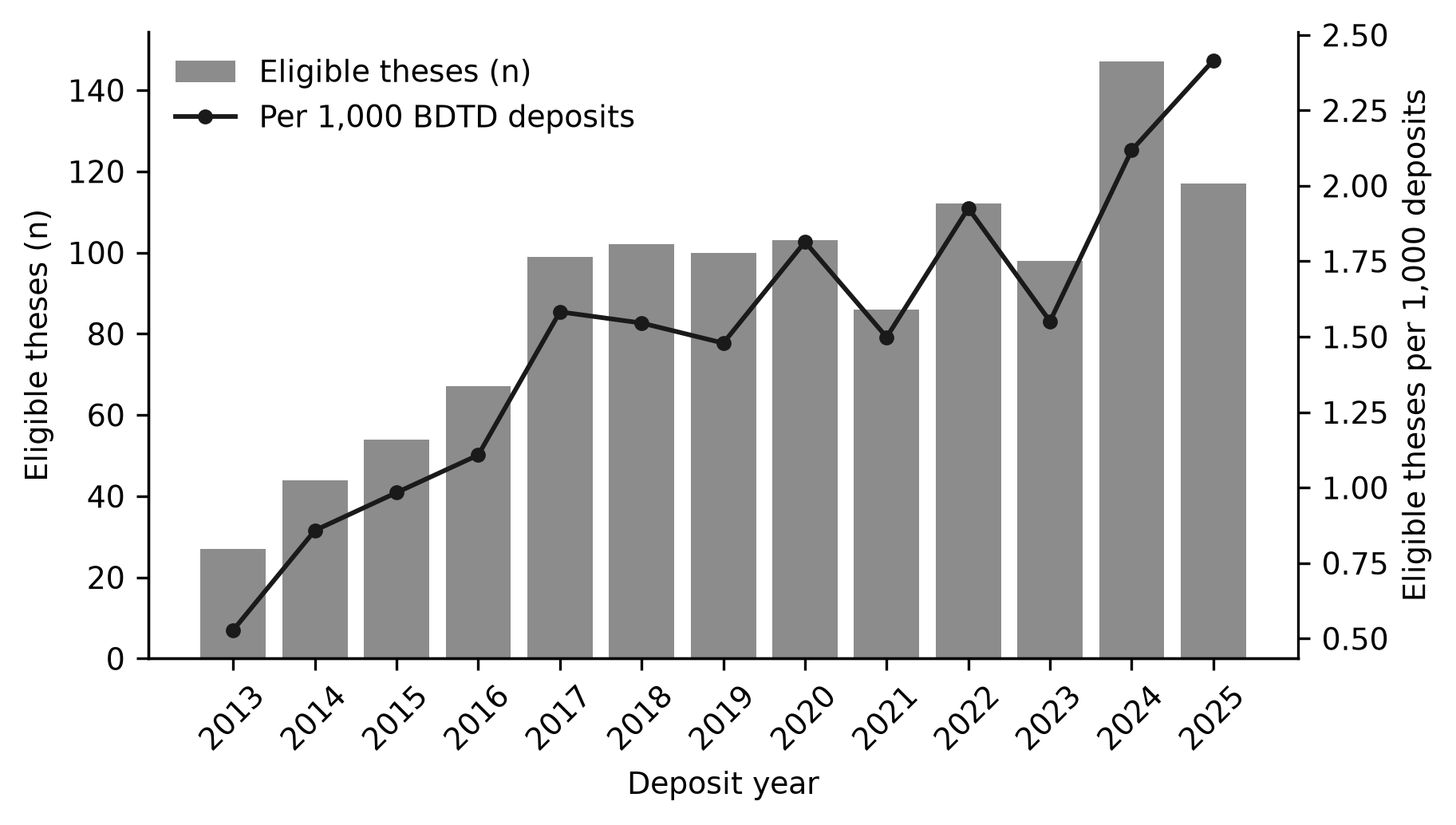
Figure 1. Eligible theses per deposit year and per 1,000 BDTD deposits, 2013-2025.
Note: Bars show the number of eligible theses (left axis), and the line shows the rate per 1,000 deposits (right axis).The Poisson model with total deposits as offset estimated a rate ratio of 1.08 per year (95% CI 1.06-1.11; p <0.001), with a Pearson dispersion of 2.49. The Spearman correlation between year and yearly rate was 0.88 (p <0.001). The strict rule produced a rate ratio of 1.09 (95% CI 1.07-1.12).
By degree, doctoral theses represented 21.6% of the 2013 to 2018 theses (393) and 21.5% of the 2019 to 2025 theses (763), without a difference between periods (p = 0.96).
Educational level
For this variable, 517 theses (44.7%) had no identifiable level. Primary education was the most frequent named level, with 282 theses (24.4%; 95% CI 22.0-27.0), followed by higher education at 148 (12.8%) and special and inclusive education at 139 (12.0%). Basic education in any level appeared in 406 theses (35.1%), and 18.0% of the theses carried more than one level (Table 2).
Educational level | n | % | 95% CI | Master n (%) | Doctoral n (%) |
|---|---|---|---|---|---|
Not specified | 517 | 44.7 | 41.9-47.6 | 387 (42.7) | 130 (52.2) |
Basic education (any level) | 406 | 35.1 | 32.4-37.9 | 344 (37.9) | 62 (24.9) |
Primary education | 282 | 24.4 | 22.0-27.0 | 235 (25.9) | 47 (18.9) |
Higher education (undergraduate) | 148 | 12.8 | 11.0-14.9 | 110 (12.1) | 38 (15.3) |
Special and inclusive education | 139 | 12.0 | 10.3-14.0 | 116 (12.8) | 23 (9.2) |
Secondary education | 134 | 11.6 | 9.9-13.6 | 118 (13.0) | 16 (6.4) |
Postgraduate and workforce training | 70 | 6.1 | 4.8-7.6 | 54 (6.0) | 16 (6.4) |
Teacher education | 61 | 5.3 | 4.1-6.7 | 45 (5.0) | 16 (6.4) |
Early childhood education | 28 | 2.4 | 1.7-3.5 | 25 (2.8) | 3 (1.2) |
Vocational and technical education | 28 | 2.4 | 1.7-3.5 | 21 (2.3) | 7 (2.8) |
Youth and adult education | 13 | 1.1 | 0.7-1.9 | 12 (1.3) | 1 (0.4) |
Note: Levels are not mutually exclusive, so percentages do not sum to 100. CI = Wilson 95% confidence interval. Basic education (any level) combines early childhood, primary, secondary, and youth and adult education.
Basic education was associated with the degree. It appeared in 37.9% of master's theses and 24.9% of doctoral theses (chi-square = 14.55; p <0.001; Cramér V = 0.112), an odds ratio of 1.84 for the master's group (95% CI 1.34-2.53) when the doctoral group was the reference.
Across periods, basic education appeared in 29.8% of the 2013 to 2018 theses and 37.9% of the 2019 to 2025 theses, with an adjusted p of 0.06. Special and inclusive education rose from 8.1% to 14.0% (odds ratio 0.54; Holm p = 0.036).
Discipline
In the dimension of discipline, Portuguese language and literacy presented the highest share, with 233 theses (20.2%; 95% CI 17.9-22.6). Health sciences obtained 210 theses (18.2%), computing and programming 195 (16.9%) and mathematics 183 (15.8%). No discipline was identifiable in 208 theses (18.0%), and 35.3% of the theses carried more than one discipline (Table 3).
Discipline | n | % | 95% CI |
|---|---|---|---|
Portuguese language and literacy | 233 | 20.2 | 17.9-22.6 |
Health sciences | 210 | 18.2 | 16.1-20.5 |
Not specified | 208 | 18.0 | 15.9-20.3 |
Computing and programming | 195 | 16.9 | 14.8-19.1 |
Mathematics | 183 | 15.8 | 13.8-18.0 |
Arts, music and physical education | 166 | 14.4 | 12.5-16.5 |
Physics | 116 | 10.0 | 8.4-11.9 |
Business, law and engineering | 114 | 9.9 | 8.3-11.7 |
Biology and natural sciences | 85 | 7.4 | 6.0-9.0 |
History, geography and social sciences | 73 | 6.3 | 5.1-7.9 |
Foreign languages | 57 | 4.9 | 3.8-6.3 |
Chemistry | 34 | 2.9 | 2.1-4.1 |
Environment and sustainability | 28 | 2.4 | 1.7-3.5 |
Note: Disciplines are not mutually exclusive, so percentages do not sum to 100. CI = Wilson 95% confidence interval.
For this variable, no discipline differed between the 2013 to 2018 and 2019 to 2025 periods after Holm adjustment (smallest adjusted p = 0.13, for Portuguese language and literacy). Biology and natural sciences had an adjusted p of 0.11. The CNPq subject classification, available for 295 theses (25.5%), was not used for coding.
Against the other dimensions, the main discipline of 948 theses and the presence of a mechanic were not associated (chi-square = 15.8; p = 0.15; Cramér V = 0.129).
Game mechanic
Within this component, 622 theses (53.8%) had no identifiable mechanic, and 534 (46.2%) had at least one. Points, levels and rewards concentrated 162 theses (14.0%), quiz and question-answer 156 (13.5%) and simulation 97 (8.4%). Immersive technologies obtained 79 theses (6.8%) and strategy 6 (0.5%) (Table 4).
Game mechanic | n | % | 95% CI |
|---|---|---|---|
None identified | 622 | 53.8 | 50.9-56.7 |
Points, levels and rewards | 162 | 14.0 | 12.1-16.1 |
Quiz and question-answer | 156 | 13.5 | 11.6-15.6 |
Simulation | 97 | 8.4 | 6.9-10.1 |
Immersive (virtual and augmented reality) | 79 | 6.8 | 5.5-8.4 |
Sandbox and student game creation | 62 | 5.4 | 4.2-6.8 |
Role-playing and narrative adventure | 56 | 4.8 | 3.7-6.2 |
Card and board adaptation | 34 | 2.9 | 2.1-4.1 |
Action, platform and arcade | 22 | 1.9 | 1.3-2.9 |
Puzzle and problem solving | 14 | 1.2 | 0.7-2.0 |
Collaborative and competitive play | 12 | 1.0 | 0.6-1.8 |
Strategy | 6 | 0.5 | 0.2-1.1 |
Note: Mechanics are not mutually exclusive, so percentages do not sum to 100. CI = Wilson 95% confidence interval. None identified = no dictionary term present in title, keywords or abstract.
Among theses with a mechanic, the median number of mechanics was 1.0 (interquartile range 1.00-2.00), and 12.5% of all eligible theses carried more than one mechanic. A mechanic was identifiable in 46.7% of theses with an abstract and in 20.8% of those without one. Using titles and keywords alone, 22.2% of theses had a mechanic, and the agreement with the full-text flag was moderate (kappa = 0.50).
In relation to period, no mechanic differed between 2013 to 2018 and 2019 to 2025 after Holm adjustment (smallest adjusted p = 0.29, for sandbox and student game creation).
Relations among dimensions
The comparison included 373 theses on basic education only and 115 on higher education only, among 488 theses with exactly one of the two levels. Of the 23 comparisons, 5 remained significant after Holm adjustment (Table 5).
Dimension | Category | Basic education only (n=373), % | Higher education only (n=115), % | OR (95% CI) | Holm p |
|---|---|---|---|---|---|
Discipline | Health sciences | 6.7 | 24.3 | 0.22 (0.12-0.40) | <0.001 |
Mechanic | Simulation | 3.5 | 17.4 | 0.17 (0.08-0.36) | <0.001 |
Discipline | Business, law and engineering | 5.6 | 17.4 | 0.28 (0.15-0.54) | 0.001 |
Discipline | Mathematics | 23.9 | 7.8 | 3.69 (1.79-7.59) | 0.004 |
Mechanic | Sandbox and student game creation | 8.0 | 0.0 | 20.51 (1.24-338.11) | 0.009 |
Mechanic | Immersive (virtual and augmented reality) | 3.8 | 8.7 | 0.41 (0.18-0.95) | 0.578 |
Mechanic | Points, levels and rewards | 13.1 | 20.9 | 0.57 (0.33-0.98) | 0.715 |
Discipline | Environment and sustainability | 3.8 | 0.0 | 9.32 (0.55-157.41) | 0.771 |
Discipline | Physics | 12.6 | 6.1 | 2.22 (0.98-5.07) | 0.774 |
Discipline | Foreign languages | 4.3 | 0.9 | 5.11 (0.67-38.95) | 1.000 |
Note: OR = odds ratio for basic education relative to higher education, with Haldane-Anscombe correction when a cell was zero; CI = 95% confidence interval; Holm p = p value adjusted over 23 comparisons (11 mechanics and 12 disciplines). The ten smallest unadjusted p values are shown.
Health sciences were less frequent in basic education only theses (6.7%) than in higher education only theses (24.3%). Simulation presented the same direction (3.5% against 17.4%), as did business, law and engineering (5.6% against 17.4%).
Mathematics was associated with basic education (23.9% against 7.8%), and so was sandbox and student game creation (8.0% against 0.0%, with an empty cell in the higher education group). Points, levels and rewards (Holm p = 0.72) and immersive mechanics (Holm p = 0.58) did not differ after adjustment.
DISCUSSION
This study set out to describe the volume, educational level, discipline and game mechanic of Brazilian theses on digital game-based learning. The eligible theses grew faster than total deposits, basic education and language, health and computing led the profile, and the metadata described game mechanics for fewer than half of the theses. The discussion follows the order of the dimensions.
Production
The rate of eligible theses rose by about 1.085 per year, and the rate per 1,000 deposits was 4.6 times higher in the last year than in the first. Growth of this kind has been recorded internationally. A dual-database analysis described steady expansion of game-based learning research in Scopus between 2015 and 2024, with a decline in the Web of Science series in 2020,(12) and a bibliometric study of teacher education found rapid growth between 2012 and 2021.(13) Studies restricted to science education also report yearly growth.(21) The Brazilian thesis series shows no decline in 2020 (the eligible count was similar to that of 2019, as the table of annual counts shows), a pattern that the available metadata cannot explain.
The international literature offers a thematic reference. A review of the 100 most cited game-based learning studies described the game types, devices and participants most used,(22) and a bibliometric analysis of digital game-based learning identified motivation maintenance, in-game feedback and post-game motivation as key topics.(23) Neither work describes the Portuguese-language graduate literature, which is why a national repository series complements them.
The comparison with Brazilian reviews is limited by scope. The BDTD review of chemistry teaching described a supposedly growing number of theses on educational games and few works engaging with learning theory.(19) The present series, which covers all disciplines, agrees on the growth and places chemistry at 2.9% of the eligible theses. The relative measure matters: because the rate is expressed per 1,000 deposits, the rise is not an artefact of changes in repository size. The 2025 total deposits are the lowest of the series, so the final-year rate should be read with caution.
Educational level
Basic education was the named setting of about one in three theses, and primary education led. This agrees with the emphasis on schooling found in reviews of games for primary mathematics,(7) primary STEM(24) and K-12 science, where most interventions took place in elementary and junior high school.(8) Brazilian reviews show the same pattern for programming, where research focused mainly on secondary education,(15) and for early childhood education, where games were treated as useful pedagogical tools with remaining gaps.(14)
Early childhood, youth and adult, and vocational education had small shares. Reviews outside Brazil also describe early development as a setting with few quantitative designs,(25) and a Brazilian review of professional and technological education found few articles on games in technical subjects and no dominant learning theory.(17) Higher education appeared in about one in eight theses, a level for which international work examines students' prior perceptions of games.(9) Teacher education was marked in only 5.3% of the theses, even though a review of K-12 educators calls for structured training programmes in digital games(26) and the chemistry thesis review found initial teacher training to be the most frequent application context.(19) The difference may arise from the wider scope of the present corpus or from the keyword-based coding, which captured teacher education only when the thesis named it.
Syntheses that cover several levels show that digital game-based learning spans the whole educational system. A meta-analysis of games for students from kindergarten to university reported learning gains relative to non-game conditions,(3) a review of biology games found applications from elementary school to higher and professional education,(27) and a meta-analysis of science games found that students across educational levels benefited, without a significant difference between subgroup means.(28) The Brazilian profile, with a large share of unspecified levels, cannot be compared level by level with these pooled estimates.
The larger share of basic education in master's than in doctoral theses may reflect master's programmes oriented to classroom intervention, but the metadata do not identify programme type, so this explanation remains a hypothesis. The level could not be identified for 44.7% of the theses, which is a limit on every figure of this dimension.
Discipline
Portuguese language and literacy, health sciences, computing and mathematics formed the leading group. For language, international syntheses report positive effects of digital games on vocabulary(29,30) and, in one review, on oral communication and grammar,(29) and a meta-analysis of mobile games found larger effects for secondary students than for elementary students and preschoolers.(31) These reviews address English as a foreign language, whereas the largest Brazilian category was the first language, so the international evidence transfers only partly. The share of foreign languages (4.9%) was small.
Mathematics presented 15.8%. International evidence is mixed, with a small and marginally significant overall effect of mathematics games,(5) a meta-analysis of K-12 mathematics that could compute an effect size for 17 of 33 studies,(32) and a Brazilian review concluding that serious games support mathematics learning in basic education.(16) The association of mathematics with basic education in the present data agrees with the school focus of the reviews of mathematics games for primary and K-12 students.(7,32)
For science and mathematics jointly, an umbrella review of 16 systematic reviews and meta-analyses covering 535 primary studies concluded that serious games can motivate students and improve learning outcomes, while also recording demotivation and anxiety.(6) A meta-analysis of digital games in STEM reported a strong positive overall effect, with moderators such as game design and intervention time,(33) and a three-level meta-analysis found that digital games improved problem-solving ability with significant heterogeneity.(34) Thesis metadata carry no effect sizes, so the present study can show where Brazilian graduate attention lies but not whether the games worked.
Computing and programming accounted for 16.9%. Reviews describe serious games as a means to support computational thinking and programming in K-12(35) and report that primary students struggle with loops and with interpreting graphical command symbols.(36) A Brazilian review of programming games found the work concentrated in secondary education,(15) and a mapping of evaluations of serious games in computer science higher education retained only 10 of 2,174 publications for full analysis.(37) Games for introductory programming had already been catalogued by type.(38) The thesis profile suggests that computing is a discipline both taught with games and used to build them, a distinction that the dictionary could not separate.
Health sciences were the second most frequent discipline and the one most associated with higher education. Reviews of serious games in medical education describe moderate evidence of effectiveness, with behaviourist and cognitivist strategies predominating,(39) a systematic review of randomised trials in health professions education found that heterogeneity prevented meta-analysis,(10) and a meta-analysis of randomised trials in nursing education reported improvements in knowledge.(40) The concentration of health theses in higher education matches this literature, which is built on professional students. Science disciplines were less frequent: biology and natural sciences reached 7.4%, physics 10.0% and chemistry 2.9%, although reviews of biology(27) and chemistry(41) describe active international research. Special education and its Brazilian reviews(18,42) are consistent with the 12.0% observed here, and with the rise of this level between periods, but the rise should be considered exploratory given its adjusted p near the threshold.
Game mechanic
Points and rewards, quizzes and simulation were the mechanics most often identified. Game design elements in medical education reviews follow a similar order, with points, storyline and feedback as the most common elements,(43) and language reviews single out narrative, goals, rewards and feedback.(29) Quizzes and simulations resemble the formats that medical educators were reported to prefer for knowledge retention and repetition.(39) The prominence of reward systems in the thesis metadata may partly reflect that the dictionary included the gamification vocabulary, a vocabulary that the literature treats as a separate approach from game-based learning.(1,44)
A meta-analysis of serious games found that learners learned more than with conventional instruction when the game was supplemented with other instruction methods, when multiple sessions were involved and when players worked in groups.(2) These moderators concern implementation rather than the mechanic, and they were not coded here.
Mechanics with a strong role in the international literature were rare in the theses. Strategy, puzzle and collaborative play each had about one percent or less, although a meta-analysis found larger effects for adventure games among mobile language games and no difference between individual and collaborative play.(31) Role-playing and narrative adventure reached 4.8%, while a Brazilian review of digital narratives in game-based learning identified 28 studies linking narrative theory to learning.(45) Immersive mechanics reached 6.8%, and the meta-analytic evidence that sophisticated technology such as augmented and virtual reality produced the best effects in STEM games(33) suggests room for growth.
Feedback is a mechanic that the dictionary did not code, although a meta-analysis in nursing found a moderate effect of outcome feedback on knowledge and a large effect of immediate feedback on skills,(46) and a bibliometric analysis identified in-game feedback as a factor in sustainable digital learning.(23) A framework that maps learning mechanics to game mechanics offers a more complete vocabulary for future coding.(11) Clark et al. found that effects varied across game mechanics characteristics,(3) and a meta-analysis of science games found that learning and gaming mechanisms contributed about equally, with high variance across educational levels.(28) These findings explain why describing the mechanic matters, and why the finding that 53.8% of the theses described none is a gap in documentation rather than evidence of absence.
The association of simulation with higher education and of student game creation with basic education fits the literature on professional training and on sandbox games, where a broad review of Minecraft in learners from children to young adults reported positive effects on mathematics and science but a medium or high risk of bias in every included study.(47) The Holm-adjusted odds ratio for sandbox and game creation is imprecise, because the higher education group had no case.
Joint reading
Read together, the dimensions describe a field that expands in volume while its documentation remains uneven. The level, the discipline and the mechanic were identifiable in different proportions, from 18.0% unidentified for discipline to 44.7% for level and 53.8% for mechanic. Level and discipline were related, as health and engineering clustered in higher education and mathematics in basic education, and the discipline was not associated with the presence of a mechanic. This pattern is compatible with the view that value-added design questions, which Mayer places among the three research genres,(4) receive less attention in theses than the use of games as such.
Strengths and limitations
The main strength is a complete, year-by-year retrieval of an open national repository with a denominator, which allows a rate rather than a count. The analysis was scripted and reproduced identical results on repeated execution, and a strict eligibility rule gave similar results (37.1% of basic education against 35.1%).
Several limitations apply. First, the coding was dictionary-based and not validated against manual coding, so misclassification is likely in both directions; a random sample coded by two reviewers would estimate precision and recall. Second, the query depended on Portuguese and English terms for games, and theses using other terms, such as "gamificação" alone or "ludic" vocabulary, were not retrieved; a complementary query on gamification would delimit the overlap. Third, abstracts were present for most theses, but mechanics are likely described mostly in the full text, so a mechanic was identified in 46.7% of theses with an abstract and 20.8% of those without one; coding from the full text of a sample would estimate the underestimation. Fourth, the screening rules admit theses on games in clinical or rehabilitation settings with an educational term, which may inflate health sciences; excluding records without a school or training context would test this. Fifth, the repository composition may change over time as institutions join the BDTD, and the 2025 deposits may be incomplete; a sensitivity analysis restricted to institutions present throughout the period would address both issues. Finally, the data are metadata and do not describe the quality or the results of the theses.
Implications
For graduate programmes and funders, the profile suggests a gap in early childhood, youth and adult, vocational and teacher education, and in games with collaborative, strategy or puzzle mechanics. For repositories, requiring structured fields for educational level, discipline and game genre in thesis metadata would make this type of monitoring accurate. For researchers, reporting the mechanic in the abstract would allow value-added comparisons across Brazilian studies.
CONCLUSIONS
The BDTD held a substantial set of eligible theses on digital game-based learning, and their number per 1,000 deposits grew steadily between 2013 and 2025.
Basic education was the most frequent named setting, with primary education leading, and the educational level could not be identified in a large share of the theses.
Portuguese language and literacy, health sciences and computing led the disciplines, and mathematics, health and engineering differentiated basic from higher education.
A game mechanic was identifiable in fewer than half of the theses, most often points and rewards and quizzes.
Level and discipline were related, and the discipline was not associated with the presence of a mechanic.
References
- 1 Plass JL, Homer BD, Kinzer CK. Foundations of Game-Based Learning. Educational Psychologist. 2015;50(4):258-283. doi: 10.1080/00461520.2015.1122533
- 2 Wouters P, van Nimwegen C, van Oostendorp H, van der Spek ED. A meta-analysis of the cognitive and motivational effects of serious games. Journal of Educational Psychology. 2013;105(2):249-265. doi: 10.1037/a0031311
- 3 Clark DB, Tanner-Smith EE, Killingsworth SS. Digital Games, Design, and Learning. Review of Educational Research. 2016;86(1):79-122. doi: 10.3102/0034654315582065
- 4 Mayer RE. Computer Games in Education. Annu Rev Psychol. 2019;70(1):531-549. doi: 10.1146/annurev-psych-010418-102744
- 5 Tokac U, Novak E, Thompson CG. Effects of game‐based learning on students' mathematics achievement: A meta‐analysis. Computer Assisted Learning. 2019;35(3):407-420. doi: 10.1111/jcal.12347
- 6 Karimov A, Saarela M, Kärkkäinen T. Serious games in Science and Mathematics Education: a scoping umbrella review. IJSG. 2024;11(4):3-20. doi: 10.17083/ijsg.v11i3.765
- 7 Dan NN, Trung LTBT, Nga NT, Dung TM. Digital game-based learning in mathematics education at primary school level: A systematic literature review. EURASIA J Math Sci Tech Ed. 2024;20(4):em2423. doi: 10.29333/ejmste/14377
- 8 Hussein MH, Sulaiman NL, Noroozi O, Elaish MM, Alhasan A. Value-added digital game-based learning in K-12 science education: a systematic literature review. Interactive Learning Environments. 2025;33(5):3282-3316. doi: 10.1080/10494820.2025.2450652
- 9 Henry J, Li F, Arnab S. On the Pre-Perception of Gamification and Game-Based Learning in Higher Education Students: A Systematic Mapping Study. Simulation & Gaming. 2024;55(6):985-1010. doi: 10.1177/10468781241271082
- 10 Gentry SV, Gauthier A, L’Estrade Ehrstrom B, Wortley D, Lilienthal A, Tudor Car L, et al. Serious Gaming and Gamification Education in Health Professions: Systematic Review. J Med Internet Res. 2019;21(3):e12994. doi: 10.2196/12994
- 11 Arnab S, Lim T, Carvalho MB, Bellotti F, de Freitas S, Louchart S, et al. Mapping learning and game mechanics for serious games analysis. Brit J Educational Tech. 2015;46(2):391-411. doi: 10.1111/bjet.12113
- 12 Akhmetova AI, Seitenova SS, Khodjaev BK, Jamoldinova OR, Yerkebaeva SZ, Kazybayeva KU. Evolution of game-based learning research: A cross-database bibliometric analysis and visualization study (2015-2024). CONT ED TECHNOLOGY. 2025;17(3):ep585. doi: 10.30935/cedtech/16451
- 13 Islam MN, Karimi A, Ahmad S, Wani JA, Butdisuwan S, Rahman MH, et al. Gamification and Game-Based Learning in Teacher Training and Education: Quantifying Through Bibliometric Paradigms. Journal of Education. 2025:00220574251406241. doi: 10.1177/00220574251406241
- 14 Cruz Araújo L, Andryê Galvão Madeira C. Jogos Educacionais Digitais no Ensino Infantil: Uma Revisão Sistemática da Literatura. RENOTE. 2021;18(2):286-295. doi: 10.22456/1679-1916.110238
- 15 Jesus Medeiros T, Reis da Silva T, Henrique da Silva Aranha E. Ensino de programação utilizando jogos digitais: uma revisão sistemática da literatura. RENOTE. 2014;11(3). doi: 10.22456/1679-1916.44363
- 16 Tamássia dos Santos SL, Hideraldo Bíscaro H. Revisão sistemática sobre a utilização de jogos sérios na aprendizagem de matemática. CQD. 2019;14:12-25. doi: 10.21167/cqdvol14ermac201923169664sltshhb1225
- 17 Ribeiro AFSRF, Gomes RMM, Silva JRCE, Matos JDV, Ferreira JC, Matos FB. Uso de Jogos Digitais Educativos na Educação Profissional e Tecnológica fundamentados em Teorias de Aprendizagem. Inform educ. 2019;22(2). doi: 10.22456/1982-1654.89784
- 18 Ramos Oliveira JV, De Melo Pedrosa I, Pereira Torres J. Tendências em Jogos Digitais sobre Educação Especial. Br J Ed, Tech Soc. 2022;15(1):83-97. doi: 10.14571/brajets.v15.n1.83-97
- 19 Matheus da Silva Nascimento A, SILVA LEITE B. JOGOS DIGITAIS EDUCACIONAIS: O QUE AS DISSERTAÇÕES E TESES DIZEM?. IJET. 2024;7(2):62-87. doi: 10.31692/2595-2498.v7i2.332
- 20 Instituto Brasileiro de Informação em Ciência e Tecnologia (IBICT). Biblioteca Digital Brasileira de Teses e Dissertações (BDTD) [Internet]. IBICT; 2025. Available from: https://bdtd.ibict.br/
- 21 Haryandi S, Misbah M, Arlinda R, Harto M, Muhammad N, Qamariah Q. Game-based Learning in Science Education: Bibliometric Analysis. OLER. 2025;5(1):113-128. doi: 10.58524/oler.v5i1.626
- 22 Chu HC, Wang CC, Hwang GJ, Kuo FR, Chen YH. Trends of Game-Based Learning in the Mobile Era: A Review of the Top 100 Highly Cited Empirical Studies. JIT. 2025;26(5):653-661. doi: 10.70003/160792642025092605008
- 23 Wang P, Yi H. A bibliometric analysis of digital game-based learning in educational contexts. RPTEL. 2025;20:037. doi: 10.58459/rptel.2025.20037
- 24 Behnamnia N, Kamsin A, Hayati S. Impact of Digital Game-Based Learning on STEM education in primary schools: a meta-analysis of learning approaches. IJTEI. 2024;10(2):113-140. doi: 10.24310/ijtei.102.2024.19694
- 25 Utami A, Crescenzi-Lanna L. Research design and implementation of digital play and digital games-based learning in early development (0 to 6 years): a systematic review. Education 3-13. 2025:1-18. doi: 10.1080/03004279.2025.2537102
- 26 Dan NN, Trung LTBT, Nga NT, Dung TM. A systematic review of digital game‐based learning studies focusing on K‐12 educators. Review of Education. 2025;13(1):e70051. doi: 10.1002/rev3.70051
- 27 Situmorang RP, Suwono H, Munzil M, Susanto H, Chang CY, Liu SY. Learn biology using digital game-based learning: A systematic literature review. EURASIA J Math Sci Tech Ed. 2024;20(6):em2459. doi: 10.29333/ejmste/14658
- 28 Tsai Y, Tsai C. A meta‐analysis of research on digital game‐based science learning. Computer Assisted Learning. 2020;36(3):280-294. doi: 10.1111/jcal.12430
- 29 Esteban AJ. Theories, Principles, and Game Elements that Support Digital Game-Based Language Learning (DGBLL): A Systematic Review. IJLTER. 2024;23(3):1-22. doi: 10.26803/ijlter.23.3.1
- 30 Morales L, Castillo J, Cuarte R. A Systematic Review on the Effectiveness of Digital Game-Based Learning in the Development of Vocabulary Skills. IJMSHE. 2024;1(1):55-62. doi: 10.70847/586368
- 31 Liu S, Zhang S, Dai Y. Do mobile games improve language learning? A meta-analysis. Computer Assisted Language Learning. 2025:1-29. doi: 10.1080/09588221.2025.2528786
- 32 Byun J, Joung E. Digital game‐based learning for K–12 mathematics education: A meta‐analysis. School Sci & Mathematics. 2018;118(3-4):113-126. doi: 10.1111/ssm.12271
- 33 Fitriyah IJ, Erlangga SY, Muqoyyidin AW, Aprilia S. Exploring the role of moderators in the effectiveness of digital games for stem education: a systematic review and meta-analysis. Discov Educ. 2025;4(1):297. doi: 10.1007/s44217-025-00756-4
- 34 Cai Z, Zhang X, Liu C, Zhan J. Effects of Digital Game‐Based Learning on Student's Problem‐Solving Ability: A Three‐Level Meta‐Analysis. Computer Assisted Learning. 2025;41(2):e70002. doi: 10.1111/jcal.70002
- 35 Gundersen SW, Lampropoulos G. Using Serious Games and Digital Games to Improve Students’ Computational Thinking and Programming Skills in K-12 Education: A Systematic Literature Review. Technologies. 2025;13(3):113. doi: 10.3390/technologies13030113
- 36 Giannakoulas A, Xinogalos S. A Critical Review of Primary School Students’ Difficulties in Learning Programming Through Educational Games. Journal of Educational Computing Research. 2025;63(3):627-661. doi: 10.1177/07356331241309074
- 37 Krassmann AL, Paschoal LN, Falcade A, Medina RD. Evaluation of Game-Based Learning Approaches through Digital Serious Games in Computer Science Higher Education: A Systematic Mapping. 2015 14th Brazilian Symposium on Computer Games and Digital Entertainment (SBGames). 2015:43-51. doi: 10.1109/sbgames.2015.18
- 38 Vahldick A, Mendes AJ, Marcelino MJ. A review of games designed to improve introductory computer programming competencies. 2014 IEEE Frontiers in Education Conference (FIE) Proceedings. 2014:1-7. doi: 10.1109/fie.2014.7044114
- 39 Gorbanev I, Agudelo-Londoño S, González RA, Cortes A, Pomares A, Delgadillo V, et al. A systematic review of serious games in medical education: quality of evidence and pedagogical strategy. Medical Education Online. 2018;23(1):1438718. doi: 10.1080/10872981.2018.1438718
- 40 Lee M, Shin S, Lee M, Hong E. Educational outcomes of digital serious games in nursing education: a systematic review and meta-analysis of randomized controlled trials. BMC Med Educ. 2024;24(1):1458. doi: 10.1186/s12909-024-06464-1
- 41 Xu JJ, Sun XF, Liu YN, Zhang SY, Zhou Q. Effects of Game-Based Learning on Students’ Motivation in Chemistry: A Meta-analysis. J Chem Educ. 2025;102(3):1117-1128. doi: 10.1021/acs.jchemed.4c01304
- 42 Fernandes M, Nohama P. Jogos Digitais para Pessoas com Transtornos do Espectro do Autismo (TEA): Uma Revisão Sistemática. TEyET. 2020;(26):e8. doi: 10.24215/18509959.26.e8
- 43 Aster A, Laupichler MC, Zimmer S, Raupach T. Game design elements of serious games in the education of medical and healthcare professions: a mixed-methods systematic review of underlying theories and teaching effectiveness. Adv in Health Sci Educ. 2024;29(5):1825-1848. doi: 10.1007/s10459-024-10327-1
- 44 Sailer M, Homner L. The Gamification of Learning: a Meta-analysis. Educ Psychol Rev. 2020;32(1):77-112. doi: 10.1007/s10648-019-09498-w
- 45 Aoki RL, Fiuza PJ, Lemos RR. Utilização de narrativas digitais em ambientes de aprendizagem baseada em jogos digitais: uma revisão sistemática da literatura. ETD - Educ temat digit. 2018;20(4):1138-1160. doi: 10.20396/etd.v20i4.8649913
- 46 Liu Z, Yu R, Yao X, Yan Q. The impact of feedback elements in serious games on nursing learning outcomes: A systematic review and meta-analysis. Nurse Education Today. 2025;150:106689. doi: 10.1016/j.nedt.2025.106689
- 47 Slattery EJ, Lehane P, Butler D, O'Leary M, Marshall K. Assessing the benefits of digital game‐based learning with Minecraft in children, adolescents and young adults: A broad systematic review. Review of Education. 2025;13(1):e70035. doi: 10.1002/rev3.70035
Declarations
Funding
No financing
Conflict of interest
None
Authorship contributions
Drafting – original draft: Dhamelis Anaya Rios, Erik Ricardo Condori.
Writing–review and editing: Dhamelis Anaya Rios, Erik Ricardo Condori.