

Abstract
A healthy lifestyle is important for good cardiometabolic health, especially in the prevention of chronic noncommunicable diseases, in accordance with the fundamental guidelines of the ILO and WHO. Objective: To determine the lifestyle of Venezuelan industrial workers who stand upright using the FANTASTIC questionnaire, which will serve as a pilot study to test the methodological aspects of a larger study. Methods: This was a quantitative, field-based, cross-sectional, nonexperimental study with a sample of 30 industrial workers from central Venezuela selected using simple random sampling. Results: When the FANTASTIC questionnaire was administered to Venezuelan industrial workers who stood upright, 53.33% had healthy lifestyles, 26.66% had regular lifestyles, and 20% had unhealthy lifestyles. Women predominated in each of the lifestyle groups: 33.33% in the healthy group, 23.33% in the regular group, and 20% in the unhealthy group. No male workers were included in the unhealthy lifestyle group. Conclusions: Most workers have a healthy lifestyle. Furthermore, this research demonstrates that the FANTASTIC questionnaire can be used with any work group, regardless of age, educational level, cultural background, position, or seniority in companies with industrial labor, to understand the lifestyles of Venezuelan workers.
Keywords
Lifestyle, Worker, Healthy Nutrition, Cardiometabolic Risk, Chronic Diseases
INTRODUCTION
The International Labor Organization (ILO) has emphasized the importance of a safe and healthy work environment for the working population. This message, reaffirmed at its 110th Conference in 2022, includes among its obligations the promotion of programs to “protect the lives and health of workers in all occupations”(1).
For its part, the World Health Organization (WHO), in Ottawa, Canada, in 1986, adopted health promotion, focusing its efforts on worker well-being (2). Define a safe and healthy workplace as one in which both workers and their supervisors work hand in hand to establish a process of continuous improvement for the protection and promotion of workers’ health, safety, and well-being, as well as the sustainable development of the workplace (3) .
Within the scope of health protection, as highlighted by both organizations, the promotion of healthy lifestyles is closely related to workers’ attitudes, values, and outlook on life, particularly in the workplace, where unhealthy habits can lead to health problems(4,5).
Lifestyles were conceptualized by Weber in the late 19th century as the result of the socioeconomic conditions to which people were exposed, related to the habits and customs of the individuals themselves; however, some authors disagree with this definition and emphasize the importance of personal attitudes, arguing that lifestyles are the result of the behavioral patterns, practices, and routines employed by individuals(6–9) .
In Venezuela, the practice of healthy lifestyles among the working population is rare, and the diet is unbalanced and lacking in variety, as noted by Diaz and Peña in 2022 in their study on the Validation of the Fantástico Scale: Lifestyle of Venezuelan Adults, which also indicates that 48–67% of the adult population has a sedentary lifestyle, with a smoking prevalence of 22.4%, an unbalanced diet among 45% of Venezuelans, sleep disorders in 78.3% of people, and metabolic disorders of Type I obesity in 53%(7).
Upon reviewing the literature, no published studies were found in which this questionnaire regarding the lifestyles of Venezuelan industrial workers who work in a standing position was applied; therefore, it was decided to conduct this study as a pilot test for a larger investigation.
METHODS
The objective is to determine the lifestyle of Venezuelan industrial workers in standing positions using the FANTÁSTICO questionnaire, which will serve as a pilot study to test the methodological aspects of a larger-scale study to evaluate the study site, access to participants, availability of information, and collaboration from study participants.
This is a quantitative, field-based, cross-sectional, nonexperimental study, with a sample size of 30 industrial workers from central Venezuela, selected through simple random sampling, taking into account the sample size determination for a pilot test reported in the statistical review conducted by Bujang, who concluded that 30 respondents are sufficient to assess the reliability of the questionnaire (10).
Sociodemographic variables such as age, age groups, sex, and length of service will be evaluated, along with the responses to the 10 domains of the Fantástico questionnaire, namely, Family and Friends, Social Engagement and Worker Activity, Nutritional Status, Relationships with Tobacco, Drugs, and Alcohol, Aspects Related to Sleep, Rest, and Stress, Work and Personality Type, and the individual’s self-perception, health monitoring, and sexual behavior and other behaviors, including behavior as a pedestrian, public transportation passenger, adherence to rules, and seatbelt use (11).
The questionnaire consists of 30 questions, each with 3 response options: 0 is almost never, 1 is sometimes, and 2 is always; these are scored using a Likert scale. The final score is multiplied by 2, yielding a final score ranging from 0 to 120, which is classified into the following categories:
0 to 46: Risk present
47 to 72: Poor lifestyle
73 to 84: Fair lifestyle
85 to 102: Good lifestyles
103 to 120: Excellent lifestyle
For the analysis, measures of central tendency will be used to observe where the data are concentrated, as well as box plots to visualize and compare the dispersion among groups, as recommended by Belzu and Calani in their review article on lifestyles and healthy environments, using the FANTASTICO questionnaire (12).
RESULTS AND DISCUSSION
Thirty workers participated in the study and responded to the questionnaire appropriately. The sample was predominantly female (76.67%) rather than male (23.33%). This finding is similar to the data reported in the 2022 study by Díaz and Peña, “Validation of the FANTASTICO Scale in Venezuelan Adults,” where more than half of the population—207 adults—were female (68.1%) compared with male (31.9%)(7).
The mean age in this study was 40.76 years, with a standard deviation of 11.01. The 50–59 age group was the most common (30%). This finding contrasts with the findings of Rodríguez and Maigualema in their study on the lifestyles of construction workers, where males (65%) outnumbered females (35%), and the 29–38 age group was the most prevalent (55%)(13). The average length of service was 5.23 years, with a standard deviation of 5.11. The group with 0 to 4 years of service predominated (76.67%). Secondary education (63.33%) stood out as the most common level of education. This aligns with the results of the study by Mendinueta et al. on the lifestyles of workers in the informal sector, where low educational attainment (95.9%; primary, secondary, and technical) was prevalent (14) (see Table 1).
For the purposes of this study, lifestyles were classified as healthy, moderate, and unhealthy, taking into account the results of the responses for each dimension of the FANTASTICO questionnaire: a healthy lifestyle scored between 85 and 120, a moderate lifestyle between 73 and 84, and an unhealthy lifestyle scored between 0 and 72.
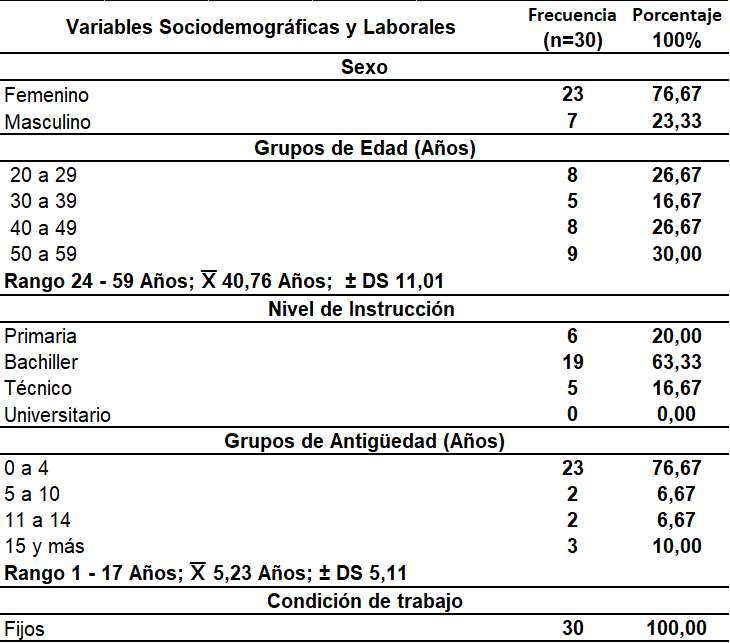
Table 1. Sociodemographic and occupational variables of Venezuelan industrial workers in standing positions. Pilot study.
Source: Research data
The lower the score is, the higher the level of health risk; therefore, results such as “dangerous” or “poor lifestyle” indicate unhealthy habits that put health at risk. “Average” implies both a benefit and a risk, and “a good lifestyle” and “an excellent lifestyle” indicate positive influences and protective factors for health (11) .
As shown in Table 2, 20% of the workers were at risk for poor lifestyles, whereas 53.33% of the workers reported a healthy lifestyle (good or excellent), and 26.67% of the workers reported a regular lifestyle(15–17).
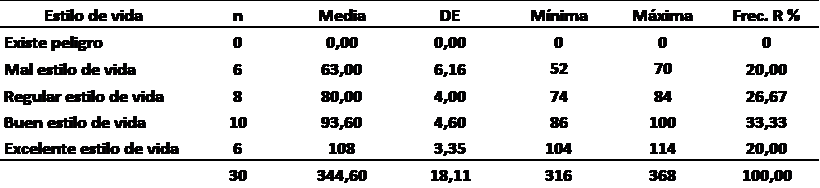
Table 2. Lifestyle of Venezuelan industrial workers in standing positions. Descriptive statistics. Pilot study.
Source: Research data
An analysis of lifestyle habits by age group and sex revealed that 20% of female workers in the 20–29 and 40–59 age groups had unhealthy lifestyle habits. This study needs to be conducted in larger groups to determine whether these findings hold true (see Table 3). Additionally, 23.33% of female workers were found to have moderate lifestyles, and 33.33% had healthy lifestyles, with both groups distributed across the four different age groups from 20 to 59 years old.
Among male workers, none reported unhealthy lifestyles. A healthy lifestyle was most prevalent (10%) in the 40–49 age group, with a similar result of 3.33% in the 20–39 and 50–59 age groups.
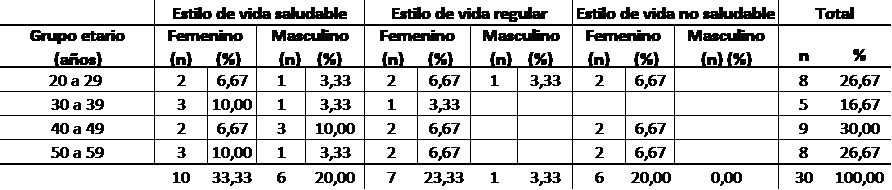
Table3. Lifestyles by age group and sex among Venezuelan industrial workers in standing positions. Pilot study
Source: Research data
The relationships between the dimensions contained in the FANTASTICO questionnaire and lifestyles expressed as percentages (Table 4 and Figure 1) allow for the identification of areas requiring action plans, health promotion, and proposals for improvements for all workers, especially for Venezuelan industrial manual laborers(4,18,19).
Table 4 highlights that 80% of workers in the pilot study almost always have someone to talk to, in addition to having emotional connections in their lives. Approximately 13.3% of them sometimes discuss personal matters with friends and receive affection. In contrast, 6.67% of workers do not receive affection and find it difficult to interact with others and communicate effectively.
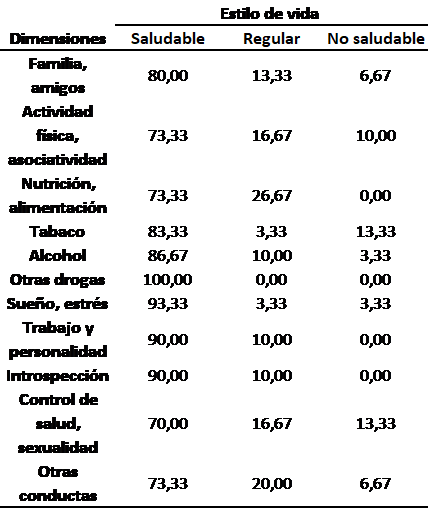
Table4. Dimensions of the FANTASTICO questionnaire according to lifestyle among Venezuelan industrial workers. Pilot study.
Source: Research data
Similarly, 73.33% of the subjects reported, in both the Physical Activity and Social Interaction domain and the Nutrition domain, that they placed great importance on participating in groups that engage in exercise—primarily walking in the vast majority of cases—and performing physical activities, supported by dietary habits that include portions of vegetables and fruits, but with unhealthy practices, such as frequent consumption of sugar, salt, junk food, or fats, in 90% of the cases. Additionally, 46.67% reported being between 0 and 4 kilograms above their ideal weight, suggesting that nearly half the group is close to their target weight. In contrast, 53.33% of workers reported being 8 kilograms above their ideal weight. Exercise and healthy nutritional habits are fundamental factors in the prevention of cardiometabolic diseases(20,21).
With respect to tobacco, alcohol, and other drug use, the vast majority of workers did not smoke; 76.67% reported having no more than 4 drinks on occasion, 26.67% admitted to consuming more than 12 drinks per week, and 6.67% consumed between 8 and 12 drinks per week. One hundred percent deny using drugs or purchasing medications without a prescription; however, they report a high coffee intake of 3 to 6 cups per day. It is important to implement behavioral changes to improve lifestyles related to alcohol consumption, smoking, and physical activity (22).
More than half of the workers (56.67%) reported having trouble sleeping and feeling rested only sometimes; on the other hand, 40% reported sleeping well and feeling rested for the next day, and 3.33% reported that they almost never sleep well or get adequate rest.
With respect to stress management, 53.33% of the workers reported that they were able to manage stress, 30% could manage it only sometimes, and 16.67% almost never managed to handle stress or tension in their lives. In addition, 60% are able to relax and enjoy their free time, while 30% sometimes relax, and 10% almost never.
In terms of work and personality type, 60% of the workers reported feeling rushed sometimes, 6.66% often, and 33.33% almost never felt that way. Moreover, 43.33% of the workers reported feeling angry or aggressive sometimes, 26.67% reported feeling that way often, and 30% rarely expressed those emotions. In terms of their level of satisfaction with their work and work activities, 76.67% reported that they were almost always happy with their work, in contrast to the 23.33% who reported feeling satisfied only sometimes.
With respect to introspection, 80% of workers almost always exhibit a mental disposition toward positive or optimistic thinking, whereas the remaining 20% do so only sometimes. The assessment of feelings of stress or overwhelm revealed that the majority of participants in this pilot study (60%) experienced these feelings sometimes, and 10% felt them very often, in contrast to 30% who almost never experienced these types of feelings. However, the emotional state related to feelings of sadness or depression revealed that a significant group of workers (56.67%) experienced these emotions sometimes, followed by 6.67% who experienced them very often. In contrast, 36.67% never felt that way in their work or at their workplace. These findings in the introspection dimension highlight the need to implement strategies to manage stress and promote emotional well-being (23,24).
With respect to health checkups and sexual behavior, nearly half of the workers (46.67%) sometimes underwent health screenings, whereas 36.67% did so regularly. In contrast, 16.67% almost never underwent preventive health screenings. With respect to communication with a partner or family about sexuality, 53.33% of workers do so always, and 20% do so only sometimes, whereas 26.67% almost never discuss it. With respect to self-care and that of their partner, 63.33% of workers are always concerned about it, whereas 16.67% do so only sometimes. Additionally, 20% are almost never concerned about their own sexual behavior or that of their partner (25) .
The final dimension, related to other behaviors, revealed that 83.33% of workers always obey traffic laws as drivers or pedestrians; furthermore, 46.67% of them state that they always wear a seatbelt, demonstrating exemplary road safety practices.
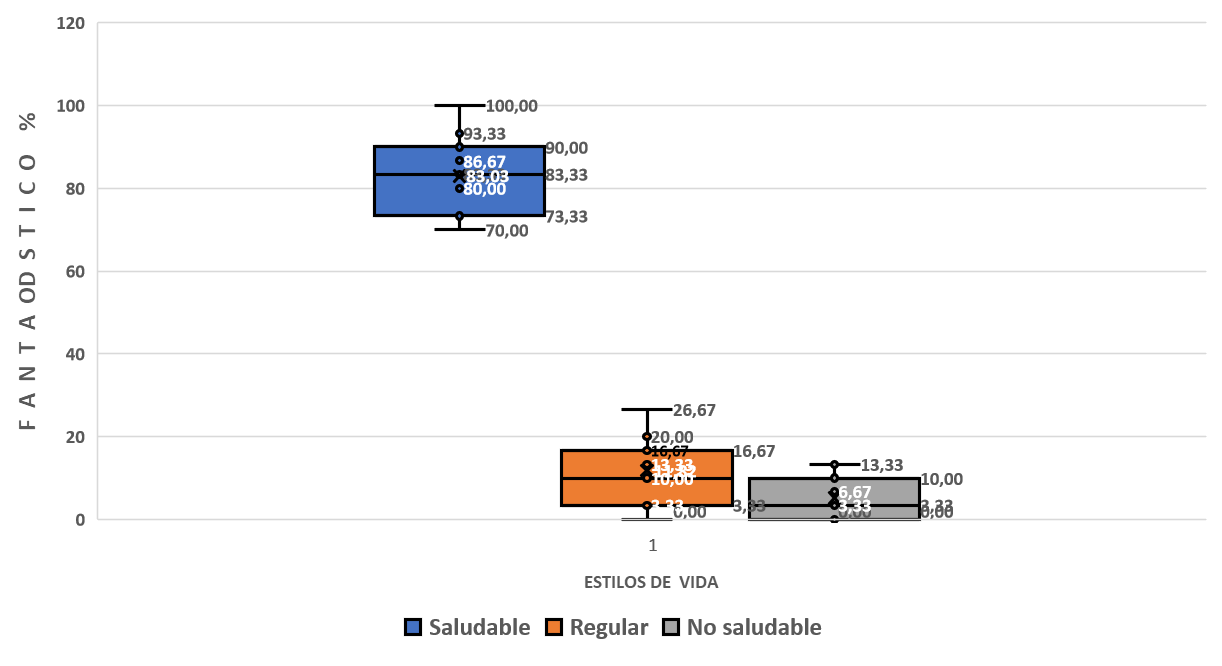
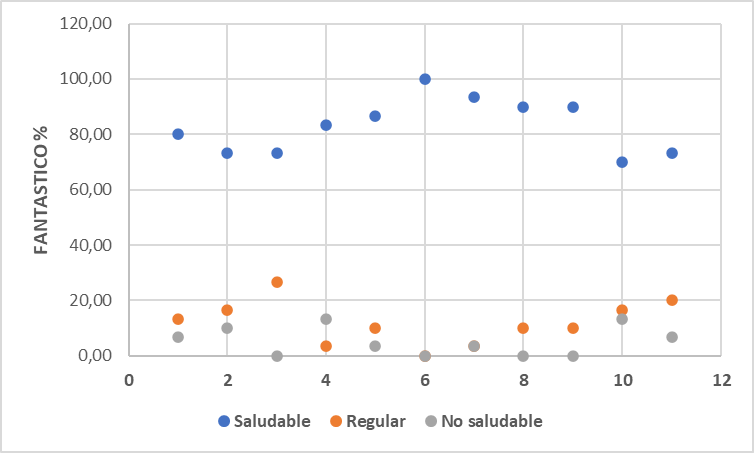
Among the 30 workers who voluntarily agreed to participate in this pilot study, 16 (53.33%) scored between 85 and 103; 8 (26.67%) scored between 73 and 84; and 6 (20%) scored between 46 and 72. Therefore, more than half of the Venezuelan industrial workers in standing positions demonstrated healthy lifestyles. (See Figure 1).
Source: Research data
Source: Research data
Figures 1 and 2 show the predominance of a healthy lifestyle among this group of workers who participated in the pilot test, with a SD of 9.83, a maximum of 100%, a minimum of 70%, and a mean of 83.03%. A regular lifestyle has a standard deviation of 7.94, a maximum of 26.67%, a minimum of 0.0%, and a mean of 11.82%; an unhealthy lifestyle has a standard deviation of 5.24, a maximum of 13.33%, a minimum of 0.0%, and a mean of 5.15%.
CONCLUSIONS
When the FANTÁSTICO questionnaire was applied to Venezuelan industrial workers in standing positions in the central region of the country, the majority of them were found to have healthy lifestyles (53.33%). A total of 26.66% of the respondents had a regular lifestyle. Only 20% of the population included in this study had unhealthy lifestyles. Notably, when these results are broken down by sex, women predominate in each of the lifestyle groups: 33.33% in the healthy group, 23.33% in the moderate group, and 20% in the unhealthy group. Notably, within this last group—the unhealthy group—no male workers were found.
Similarly, the findings show that 73.33% of workers have a healthy lifestyle in terms of nutrition; however, when this dimension was broken down in the questions, 90% of these workers reported high consumption of sugar or salt or intake of junk food with high fat content, and although it was observed that they are aware of and understand how harmful or dangerous this is to their health.
Problems related to poor stress management were also observed in 43.33% of the workers, with 33.33% being female and the remaining 10% being male; thus, in-depth studies are needed to assess the mental health of these workers.
It was also observed that 83.33% of the surveyed workers comply with traffic regulations both as pedestrians and as drivers. Similarly, 46.67% use seat belts to ensure their own safety.
This research demonstrates that the FANTÁSTICO questionnaire is easily accessible and can be used in any workforce, regardless of age, educational or cultural background, job title, or length of service in companies with industrial workforces; this is the first study to use this questionnaire to examine the lifestyles of Venezuelan workers.
References
- 1 International Labour Office. Un entorno de trabajo seguro y saludable es un principio y un derecho fundamental en el trabajo 2022.
- 2 Organización Panamericana de la Salud. Guía de estilos de vida saludables en el ámbito laboral 2016:87.
- 3 Burton J. Healthy workplaces: a model for action. OMS 2010. https://iris.who.int/server/api/core/bitstreams/ee234256-bd0d-4d0c-9daf-c6df4e9eabd8/content
- 4 Calpa A, Santacruz G, Álvarez M, Zambrano C, Hernández E, Matabanchoy S. Promoción de estilos de vida saludables: estrategias y escenarios. Hacia promoc Salud 2019;24:139-55. https://doi.org/https://doi.org/10.17151/hpsal.2019.24.2.11..
- 5 De la Cruz S, Paredes M, Iguarán A, Ramos E. Promoción de estilos de vida saludables en trabajadores administrativos de una institución técnica. Duazary: Revista internacional de Ciencias de la Salud 2022;19:214-28.
- 6 León J. Introducción a la Psicología de la salud desde un enfoque psicosocial. Psicología Social de la Salud 1995.
- 7 Díaz D, Peña H. Validación de la escala fantástico: estilo de vida en adultos venezolanos. Revista Comunidad y Salud 2022;20:36-47.
- 8 Cockerham WC. Health Lifestyle Theory. The Wiley-Blackwell Encyclopedia of Social Theory, John Wiley & Sons, Ltd; 2017, p. 1-3. https://doi.org/10.1002/9781118430873.est0160..
- 9 Becker M. The Health Belief Model and Sick Role Behavior*. Health Education Monographs 1974;2:409-19. https://doi.org/10.1177/109019817400200407..
- 10 Bujang M, Omar E, Foo D, Hon Y. Sample size determination for conducting a pilot study to assess reliability of a questionnaire. Restor Dent Endod 2024;49. https://doi.org/10.5395/rde.2024.49.e3..
- 11 López M, Sueldo Y, Gutiérrez C, Angulo Y. Análisis de la confiabilidad del test Fantástico para medir Estilos de vida saludables en trabajadores evaluados por el Programa “Reforma de Vida”del Seguro Social de Salud (Essalud). Revista Peruana de Medicina Integrativa 2016;1:17-26. https://doi.org/10.26722/rpmi.2016.12.15..
- 12 Belzu L, Calani F. Estilos de vida y entornos saludables: Cuestionario FANTÁSTICO, propiedades de medición y fundamentos de estadística descriptiva, para la interpretación de resultados. MED-FMENT Salud Pública en Acción 2026;7:1-13. https://doi.org/10.53287/dbre3993ay94j..
- 13 Rodríguez Nuñez JL, Maygualema León BM. Estilos de vida y riesgos en la salud de los trabajadores de la construcción mediante el “test fantástico”. Polo del Conocimiento: Revista científico - profesional 2021;6:23.
- 14 Mendinueta M, Herazo Y, Fernandez J, Hernández T, Escorcia N, Prada K, et al. Estilos de vida en trabajadores del sector informal. Archivos Venezolanos de Farmacología y Terapéutica 2020;39:21-5.
- 15 Ramírez-Vélez R, Triana-Reina HR, Carrillo HA, Ramos-Sepúlveda JA, Rubio F, Poches-Franco L, et al. A cross-sectional study of Colombian University students’ self-perceived lifestyle. Springerplus 2015;4:289. https://doi.org/10.1186/s40064-015-1043-2..
- 16 Batista P, Neves-Amado J, Pereira A, Amado J. FANTASTIC lifestyle questionnaire from 1983 until 2022: A review. Health Promot Perspect 2023;13:88-98. https://doi.org/10.34172/hpp.2023.11..
- 17 Batista P, Neves-Amado J, Pereira A, Amado J. Application of the FANTASTIC Lifestyle Questionnaire in the Academic Context. Healthcare (Basel) 2022;10:2503. https://doi.org/10.3390/healthcare10122503..
- 18 López L, Solar O. Repensar la Carta de Ottawa 30 años después. Gaceta Sanitaria 2017;31:443-5. https://doi.org/10.1016/j.gaceta.2016.12.013..
- 19 Salud S de. CARTA DE OTTAWA publicado por la DGPS. gob.mx. 2025 http://www.gob.mx/salud/documentos/carta-de-ottawa-publicado-por-la-dgps.
- 20 González de Paz A, Escalona E. Physical fitness at work and its relationship with cardiovascular, respiratory and metabolic health. A systematic review. Health Leadership and Quality of Life 2024;3:1.
- 21 Triviño L, Dosman V, Uribe Y, Agredo R, Jerez A, Ramírez R. Estudio del estilo de vida y su relación con factores de riesgo de síndrome metabólico en adultos de mediana edad s. f.
- 22 Bully P, Sánchez Á, Zabaleta E, Pombo H, Grandes G. Evidence from interventions based on theoretical models for lifestyle modification (physical activity, diet, alcohol and tobacco use) in primary care settings: A systematic review. Prev Med 2015;76 Suppl:S76-93. https://doi.org/10.1016/j.ypmed.2014.12.020..
- 23 Córdoba García R, Camarelles Guillem F, Muñoz Seco E, Gómez Puente JM, San José Arango J, Ramírez Manent JI, et al. Recomendaciones sobre el estilo de vida. Actualización PAPPS 2024. Atención Primaria 2024;56:103133. https://doi.org/10.1016/j.aprim.2024.103133..
- 24 Fajardo GHV. Equipo Salud Mental SURA ARL-Consultoría Gestión del Riesgo. 2025.
- 25 Young Silva YR. Creencias de la población española sobre la relación de sus aptitudes frente a su salud. http://purl.org/dc/dcmitype/Text. Universitat de Girona, 2024.
Declarations
Funding
No financing.
Conflict of interest
None.
Authorship contributions
Drafting – original draft: Aixa González de Paz, Carlos Paz-Gañan, Evelin Escalona.
Writing–review and editing: Aixa González de Paz, Carlos Paz-Gañan, Evelin Escalona.