

Abstract
Introduction: When a company lacks an explicit management model, its organizational philosophy, human talent practices and job performance tend to operate separately. The problem is sharper in unstable economies such as Venezuela. The aim was to identify the elements that an organizational management model should include to strengthen the job performance of human talent in a Venezuelan food company. Methods: Qualitative, interpretive study using a hermeneutic-phenomenological method in a food company in Aragua State. Three purposively selected managers were interviewed in depth, and participant observation was conducted. Data were categorized, structured, contrasted with theory and triangulated. Results: Three categories emerged: competency-based hiring policies; staff training and updating; and performance, motivation and professional growth. Written job profiles exist, but two informants reported that they are not always applied in hiring. Training was perceived differently depending on the informant's position, and all three called for continuous evaluation, feedback and non-monetary recognition. Conclusions: The proposed model is built on a documented organizational philosophy and has four dimensions: competency-based hiring, continuous training, performance management, and motivation and labor relations. Leadership and communication cut across all four. The model is reviewed annually, with quarterly follow-up.
Keywords
organizational management, human talent, job performance, competency-based management, qualitative research
INTRODUCTION
In the business sphere, organizational management is understood as the process that articulates strategy, structure, and people so that daily activities contribute to achieving the organization's objectives. Within this process, job performance, defined as the effectiveness with which the worker fulfills assigned responsibilities and contributes to common goals, depends on their competencies and on the conditions that the organization provides to develop them. In this sense, human talent practices do not operate uniformly, since the context conditions their emergence, meaning, and implementation [1].
Regarding regional evidence, various studies conducted in Latin America have documented the relationship between human talent management and performance. In one Ecuadorian university, with a sample of 163 workers, 3 dimensions significantly associated with organizational performance were identified: recruitment and retention, development, and evaluation and improvement [2]. Likewise, in health services in the region, this relationship has been examined through non-experimental designs [3]. On the other hand, a recent systematic review indicates that human resource management is positively linked to satisfaction, commitment, and performance, although it can also generate adverse effects such as burnout, so that leadership and worker well-being act as mediators of this relationship [4].
From a theoretical perspective, four areas of human talent management are relevant to this study. First, competency-based management in personnel recruitment, whose empirical basis indicates that structured procedures based on job content have greater predictive validity for performance [5]. Second, on-the-job training, whose effectiveness depends on needs assessment, instructional design, and the transfer of what is learned to the job [6]. Third, performance management, in which the frequency of feedback is associated with better individual outcomes [7]. Fourth, motivation, explained by self-determination theory based on the satisfaction of the needs for autonomy, competence, and relatedness [8].
It is important to highlight that a large part of the available evidence comes from quantitative designs that measure associations between variables but provide scarce information on how managers interpret management practices and make decisions about them. Likewise, in the Venezuelan case, productive organizations operate under conditions of high economic instability and within a regulatory framework, the Organic Law on Labor, Workers and Working Women (LOTTT), which specifically regulates labor relations, collective bargaining, and union participation [9]. These conditions confer particularities on personnel entry, training, and retention that are not always captured in management models developed in other contexts.
In relation to the study setting, the company is engaged in food production in Aragua State. Through an exploratory interview with the Human Talent Coordination, it was found that the organization had explicitly defined its mission, vision, and structure, but did not have a document integrating its values, objectives, and strategies. Likewise, it was determined that the company had not conducted a diagnosis of its organizational situation and that the dissemination of the institutional philosophy was limited to entry induction, with no subsequent processes aimed at staff well-being.
Consequently, the absence of an explicit management model affected personnel's decision-making, as they lacked a frame of reference regarding the appropriate procedures in the different situations of organizational dynamics. For the above reasons, the purpose of the study was to unveil the elements that an organizational management model oriented toward strengthening and promoting the job performance of the human talent of said company should consider, based on the interpretation of those who manage it.
METHODS
Design
Given the nature of the purpose, one qualitative study with an interpretive approach was developed, based on the phenomenological-hermeneutic method. This method aims to understand the meaning that subjects attribute to their experience, through a circular movement between the parts of the discourse and its totality, in which the researcher makes explicit their own assumptions [10]. In this sense, the fieldwork was conducted during the year 2025 and was organized into four phases: documentary review; approach to the setting through observation and interaction with the informants; recognition of the assumptions of the researchers and the informants; and theoretical interpretation of the findings.
Setting and key informants
Regarding the setting, it was a large Venezuelan food company located in Aragua State, whose staff is grouped into 3 levels: daily payroll, employees, and high level. For the selection of informants, an intentional criterion was applied, with the following requirements: hold a managerial position with decision-making capacity over personnel management, have at least 10 years of service in the company, and possess postgraduate training.
According to these criteria, the following participated: the general director (I1), a mechanical engineer with a master's degree and 22 years of service; the plant manager (I2), an industrial engineer with a master's degree in management and 15 years of service; and the human talent manager (I3), an administrator with a master's degree in personnel development and 12 years of service. It is important to highlight that sample sufficiency was assessed according to the criterion of "information power", which justifies a reduced number of participants when the purpose is specific, the informants possess dense knowledge of the phenomenon, and the analytical dialogue is solid [11].
Data collection techniques
For data collection, a semi-structured in-depth interview was applied, with a script of 6 questions referring to the competencies used in the recruitment of daily payroll personnel, employees, and high-level staff; the application of job profiles; the training and development plans; the informant's participation in their planning; performance-oriented strategies; and the convenience of incorporating new strategies and their frequency. Likewise, non-covert participant observation was conducted at the company's facilities, in order to contrast the informants' discourse with observable practices.
Analysis of the information
Regarding processing, the interviews were transcribed and numbered by lines for each informant. The analysis followed four successive procedures. First, categorization, through the coding of units of meaning and their grouping into categories. Second, structuring, to integrate the categories into a network of relationships. Third, contrasting, through the confrontation of findings with theoretical referents. Fourth, triangulation among informants, observation, and institutional documentation.
It should be noted that transparency of the analytical process and reflexivity of the researchers were sought as quality criteria [12]. Likewise, since the three participants held managerial positions, triangulation was used to mitigate the bias inherent in interviews with organizational elites, in which discourse tends to reproduce the institutional version of events [13].
ETHICAL CONSIDERATIONS
Regarding ethical aspects, the study had the academic endorsement of the Universidad Nacional Experimental de los Llanos Centrales «Rómulo Gallegos». The three informants signed an informed consent form after receiving information about the purpose of the study, the voluntary nature of their participation, and the exclusively academic use of the information. Likewise, codes (I1, I2, and I3) were assigned to preserve the confidentiality of the participants, and the company name was omitted.
RESULTS
First, three categories emerged from the categorization process: competency-based admission policies; staff training and updating; and performance, motivation, and professional growth. Table 1 summarizes the emerging subcategories and the position of each informant.
Category | Emerging subcategories | Position of the informants |
|---|---|---|
Competency-based admission policies | Competency catalog by level; job profile; entry factors; entry through union agreement | I3: current catalog and profiles. I1 and I2: the profile is not always applied in practice. |
Personnel training and updating | Training plans; legal updates; administrative procedure; study funding | I2 and I3: technical and postgraduate plans. I1: no written procedure or periodic training. |
Performance, motivation, and professional growth | Continuous evaluation; feedback from multiple sources; recognition; organizational climate; professional growth | They agree on innovating; they propose a quarterly frequency and an annual review. |
Note: I1 = general director; I2 = plant manager; I3 = human talent manager. Source: own elaboration.
Competency-based admission policies
Regarding this category, the informants agreed that the company has formal entry criteria, although they disagreed about their application. I3 described a catalog of competencies differentiated by level of responsibility: for the daily payroll, technical competencies, industrial safety, teamwork, and compliance with quality standards; for employees, planning, motivation, management of technological tools, assertive communication, and service orientation; and for the high level, strategic leadership, decision-making under pressure, business vision, and change management.
Similarly, I3 indicated that each position has a “job profile” that stipulates the required academic knowledge and attitudinal competencies, although I3 acknowledged the need for these competencies “not to remain only on paper in the job manual, but to be lived in daily performance.” In turn, I2 considered that the human talent area evaluates competencies and profiles, especially in operational positions; however, I2 noted that in recruitment “there is no filter as such,” since workers without full mastery of the subject matter enter, as well as others through agreements between the union and the employer.
In contrast, I1 stated that in practice neither the profile nor competencies are considered to evaluate personnel entry, even though they acknowledged the existence of pre-established protocols and criteria. In this sense, a gap is interpreted between the competency-based management prescribed in the company's documents and that exercised in hiring decisions, a gap that widens in the entry pathways derived from collective hiring.
Personnel Training and Updating
Regarding training, the informants' perceptions varied according to their position in the structure. I3, as head of the human capital area with access to the identification of training needs, reported "robust" technical training plans for daily payroll personnel, focused on machinery operation and on the International Organization for Standardization (ISO) standards, as well as legal, administrative, and leadership updates for employees and managers. Likewise, they mentioned their participation in planning workshops on the LOTTT, conflict prevention, and improvement of the organizational climate.
For their part, I2 confirmed the existence of these plans, affirmed having participated in 90 % of the training activities promoted by Human Talent Management, and highlighted the funding of master's studies and diploma programs, as well as the granting of permits for fourth- and fifth-level training. By contrast, I1 indicated that there is no written procedure or formal requirement for permanent updating and that, beyond the mandatory occupational safety courses, the only training activity in which they participated took place 6 years earlier.
It is important to highlight that I1 and I2 agreed to propose training activities on a quarterly basis. In the case of I1, the proposal included establishing alliances with external institutions, such as the Fire Department, Civil Protection, and the National Institute for Prevention, Occupational Health and Safety (INPSASEL), to develop courses and workshops in different areas of knowledge.
Performance, motivation, and professional growth
Regarding the third category, I3 rated the current strategies as "solid and traditional," focused on operability, and raised the need to innovate in response to environmental changes through "continuous evaluation and 360° feedback," as well as "recognition programs that are not only monetary, but also emotional." Likewise, I3 proposed an annual review of the strategies with quarterly monitoring to adjust tactics according to the performance observed in the plant.
On the other hand, I2 linked periodic staff updating to the reduction of weaknesses and to achievement motivation, and noted that learning processes must keep pace with knowledge innovation. In contrast, I1 warned of the absence of professional growth strategies, a situation that, in their view, places staff at a disadvantage in the face of the demands of the current context.
Proposed organizational management model
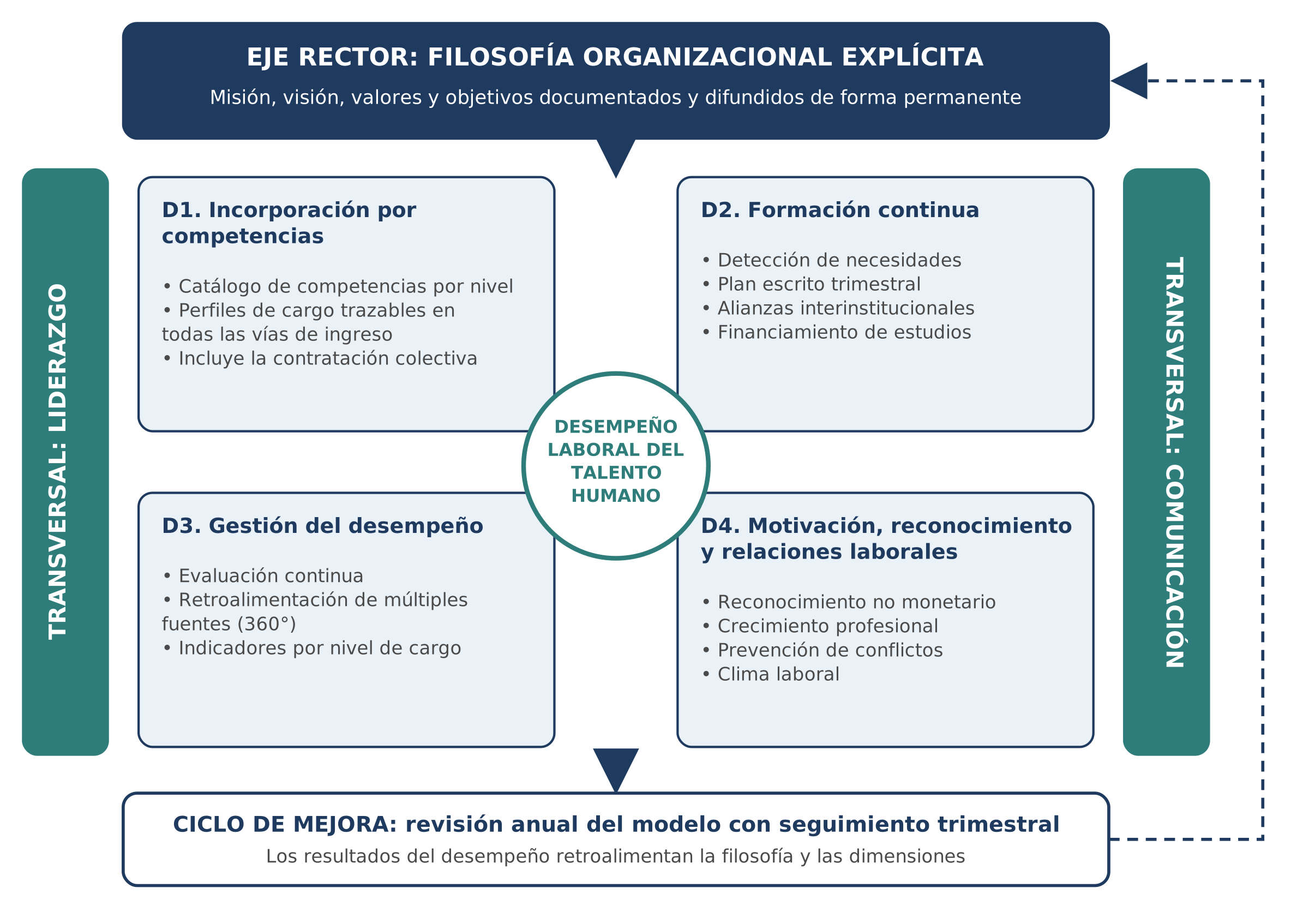
Based on the structuring of the categories, the model presented in Figure 1 was configured. Its guiding axis is the explicit organizational philosophy, which integrates the mission, vision, values, and objectives into a document disseminated on a permanent basis rather than only during induction. Around this axis, 4 operational dimensions, 2 cross-cutting components, and a review cycle are articulated.
In this sense, the first dimension, competency-based incorporation, makes job profiles traceable across all entry pathways, including those derived from collective bargaining. The second, continuous training, is based on the identification of needs and a written quarterly plan, with interinstitutional alliances and support for postgraduate study. The third, performance management, is based on continuous assessment and feedback from multiple sources. The fourth, motivation, recognition, and labor relations, combines non-monetary recognition, professional growth, and conflict prevention.
Similarly, leadership and communication act as cross-cutting components across the 4 dimensions, and the whole is adjusted through an annual review cycle with quarterly monitoring. Table 2 details, for each component, the proposed actions, their frequency, and the responsible body.
Source: Own elaboration based on the findings.
Table 2. Model components, proposed actions, frequency, and responsible parties.
Component | Proposed actions | Periodicity | Responsible |
|---|---|---|---|
Guiding axis: organizational philosophy | Document the mission, vision, values, and objectives; disseminate them during induction, on bulletin boards, and in area meetings | Annual (update) | General Directorate |
D1. Incorporation by competencies | Apply the job profile and structured interview across all entry pathways, including collective hiring | At each admission | Human Talent Management |
D2. Continuing education | Identify needs, prepare a written plan, establish interinstitutional partnerships, and fund postgraduate studies | Quarterly | Human Talent Management and Plant Management |
D3. Performance management | Evaluate continuously, apply feedback from multiple sources, and define indicators by job level | Quarterly (monitoring) and annual (evaluation) | Supervisors and Human Talent Management |
D4. Motivation, recognition, and labor relations | Implement non-monetary recognition and conduct workshops on the LOTTT and conflict prevention | Quarterly | Human Talent Management |
Cross-cutting: leadership and communication | Train supervisors in leadership and establish internal communication channels | Semiannual | General Management |
Note: LOTTT = Organic Law on Labor, Workers and Working Women. Source: Own elaboration.
DISCUSSION
In general terms, the findings indicate that the main obstacle to performance is located in the weak articulation of existing management instruments and in their unequal appropriation within the organization. In this sense, the divergence among the informants coincides with that described in a qualitative study with 31 participants in Brazilian public universities, in which managers and teams perceived the same human resources practices differently [14]. Consequently, the proposed model puts a common organizational philosophy before the incorporation of new practices, in accordance with the contextual nature of talent management [1].
With respect to staff recruitment, the discrepancy between the prescribed profile and actual hiring has direct implications for performance, because structured procedures based on job content, such as the structured interview, are among the most valid predictors in personnel selection [5]. It is important to note that, in the Venezuelan context, part of recruitment is channeled through agreements with the union organization within the framework of the LOTTT [9]. Consequently, the dimension of competency-based incorporation is formulated as a transparency criterion that also applies to such recruitment, in order to verify the fit between the worker and the position, without replacing what has been agreed upon in collective bargaining.
Similarly, heterogeneous perceptions of training suggest that the existence of plans does not guarantee their effect on performance. Evidence on workplace learning indicates that the effectiveness of training depends on its design, the prior identification of needs, and the conditions that favor the transfer of learning to the position [6]. Therefore, the model proposes a written plan, with defined periodicity and assigned responsibilities, which responds to the absence of procedures identified by I1 and to the quarterly frequency suggested by 2 of the informants.
In relation to performance management, the demand for continuous evaluation and feedback is supported by a field study conducted in various organizations, according to which a higher frequency of feedback is associated with better performance and greater satisfaction, with no evidence of a point of decline in higher frequencies [7]. Likewise, the feedback from multiple sources proposed by I3 allows us to contrast the supervisor's assessment with that of peers and collaborators, which is consistent with the divergence of perceptions found in this study.
With respect to motivation, the non-monetary recognition proposed by I3 is based on self-determination theory, which assigns a central role to the satisfaction of the needs for autonomy, competence, and relatedness in intrinsic motivation [8]. Similarly, recognition has been shown to increase the meaning attributed to work and the employee's behavioral involvement [15]. In Latin America, a review of 60 studies places the implementation of the so-called "emotional salary" at an intermediate level and identifies recognition and growth as two of its components [16], which is consistent with the funding of studies described by I2.
On the other hand, the transversal nature attributed to leadership and communication is supported by the accumulated evidence on the effectiveness of transformational leadership [17]. In this sense, in a study with 845 employees in the hotel sector, the effect of this leadership style on performance was mediated in part by the commitment of the worker [18], and in another study its relationship with job satisfaction occurred through the climate of labor relations [19]. Likewise, in a Mexican manufacturing company, a correlation of 0.797 was observed between organizational climate and work performance [20]. These results justify the inclusion of conflict prevention and labor relations in the fourth dimension of the model.
Regarding the limitations, the study relied on 3 management-level informants and therefore does not capture the perspectives of day-to-day payroll personnel or employees, whose interpretations of the same practices could differ [14]. Similarly, the model is a proposal derived from the interpretation of the findings and has not been empirically validated. Therefore, future research should incorporate workers from different levels, submit the model to expert judgment, and evaluate its application using performance indicators.
CONCLUSIONS
In summary, the company studied has human talent management components, such as the competency catalog, job profiles, and training plans; however, these components lack explicit integration and are perceived unevenly according to the hierarchical level of the person describing them. Likewise, the gap between what is prescribed and what is practiced is concentrated in personnel entry and in the periodicity of training.
Consequently, the elements that the organizational management model must consider are a documented and disseminated organizational philosophy as a guiding axis; competency-based incorporation with traceable criteria; planned continuous training; performance management based on continuous assessment and feedback; and motivation, recognition, and attention to labor relations. It is important to highlight that leadership and communication operate as cross-cutting components and that the model is adjusted through an annual review cycle with quarterly monitoring. Finally, validation of the model with workers at all levels constitutes the step prior to its application in the company.
References
- 1 Gallardo-Gallardo E, Thunnissen M, Scullion H. Talent management: context matters. Int J Hum Resour Manag. 2020;31(4):457-73. doi:10.1080/09585192.2019.1642645
- 2 Saltos García P, Barcia Maridueña AM, D'Armas Regnault M, González González NJ. Gestión de talento humano y desempeño organizacional: análisis de dimensiones esenciales. Rev Venez Gerenc. 2025;30(Esp 14):1412-27. doi:10.52080/rvgluz.30.especial14.34
- 3 García Dávila JD. Human talent management and job performance: a non-experimental study in an interregional clinic. Sapienza Int J Interdiscip Stud. 2023;4(4):e23054. doi:10.51798/sijis.v4i4.711
- 4 Diep TPT, Horváthová P. Human resource management, employee well-being, and performance: a systematic review. Hum Syst Manag. 2026;45(1):89-108. doi:10.1177/01672533251355886
- 5 Sackett PR, Zhang C, Berry CM, Lievens F. Revisiting meta-analytic estimates of validity in personnel selection: addressing systematic overcorrection for restriction of range. J Appl Psychol. 2022;107(11):2040-68. doi:10.1037/apl0000994
- 6 Kraiger K, Ford JK. The science of workplace instruction: learning and development applied to work. Annu Rev Organ Psychol Organ Behav. 2021;8:45-72. doi:10.1146/annurev-orgpsych-012420-060109
- 7 Mertens S, Schollaert E, Anseel F. How much feedback do employees need? A field study of absolute feedback frequency reports and performance. Int J Sel Assess. 2021;29(3-4):326-35. doi:10.1111/ijsa.12352
- 8 Ryan RM, Deci EL. Intrinsic and extrinsic motivation from a self-determination theory perspective: definitions, theory, practices, and future directions. Contemp Educ Psychol. 2020;61:101860. doi:10.1016/j.cedpsych.2020.101860
- 9 Decreto con Rango, Valor y Fuerza de Ley Orgánica del Trabajo, los Trabajadores y las Trabajadoras. Gaceta Oficial de la República Bolivariana de Venezuela N.º 6.076 (Extraordinario), 7 de mayo de 2012.
- 10 Alsaigh R, Coyne I. Doing a hermeneutic phenomenology research underpinned by Gadamer's philosophy: a framework to facilitate data analysis. Int J Qual Methods. 2021;20. doi:10.1177/16094069211047820
- 11 Malterud K, Siersma VD, Guassora AD. Sample size in qualitative interview studies: guided by information power. Qual Health Res. 2016;26(13):1753-60. doi:10.1177/1049732315617444
- 12 Braun V, Clarke V. One size fits all? What counts as quality practice in (reflexive) thematic analysis? Qual Res Psychol. 2021;18(3):328-52. doi:10.1080/14780887.2020.1769238
- 13 Natow RS. The use of triangulation in qualitative studies employing elite interviews. Qual Res. 2020;20(2):160-73. doi:10.1177/1468794119830077
- 14 Storti BC, Sticca MG, Pérez-Nebra AR. Production and reception of human resource management practices for health promotion. Front Psychol. 2023;14:1104512. doi:10.3389/fpsyg.2023.1104512
- 15 Montani F, Boudrias JS, Pigeon M. Employee recognition, meaningfulness and behavioural involvement: test of a moderated mediation model. Int J Hum Resour Manag. 2020;31(3):356-84. doi:10.1080/09585192.2017.1288153
- 16 Bravo-Espinoza MBM, Vargas-Rojas DM, Amaya-Arana GR. Salario emocional: perspectiva organizacional en países de América Latina. Rev Venez Gerenc. 2024;29(107):1130-43. doi:10.52080/rvgluz.29.107.9
- 17 Deng C, Gulseren D, Isola C, Grocutt K, Turner N. Transformational leadership effectiveness: an evidence-based primer. Hum Resour Dev Int. 2023;26(5):627-41. doi:10.1080/13678868.2022.2135938
- 18 Wang J, Wang Z, Alam M, Murad M, Gul F, Gill SA. The impact of transformational leadership on affective organizational commitment and job performance: the mediating role of employee engagement. Front Psychol. 2022;13:831060. doi:10.3389/fpsyg.2022.831060
- 19 Chen C, Ding X, Li J. Transformational leadership and employee job satisfaction: the mediating role of employee relations climate and the moderating role of subordinate gender. Int J Environ Res Public Health. 2022;19(1):233. doi:10.3390/ijerph19010233
- 20 Rojas Estrada E, Marín Villanueva JL, Ramos Yáñez AM, Alonso Reyes A. El clima organizacional y su relación con el desempeño laboral: estudio de caso en empresa fabricante de empaques corrugados del Estado de México. Ibero Ciencias. 2026;5(2):1951-66. doi:10.63371/ic.v5.n2.a1121
Declarations
Funding
The research did not receive external funding. Conflicto de intereses The authors declare that they have no conflicts of interest. Contribución de las autoras Betania Andara: Conceptualization, Investigation, Formal analysis, and Writing – original draft. Mariolga García: Methodology, Investigation, Formal analysis, and Writing – review & editing. Both authors approved the final version. Agradecimientos The authors thank the key informants for their participation and Dr. Raúl J. Bello F. for the supervision of the degree work from which this article derives. Declaración sobre el uso de inteligencia artificial Durante la preparación del manuscrito se utilizó Claude (Anthropic; modelo claude-opus-5-5) exclusivamente para mejorar la redacción y el estilo del texto en la etapa de escritura. Las autoras revisaron y editaron el contenido y asumen plena responsabilidad por él.
Conflict of interest
None.
Authorship contributions
Drafting – original draft: Betania Andara, Mariolga García.
Writing–review and editing: Betania Andara, Mariolga García.