

Abstract
Introduction: Artificial intelligence is reshaping dentistry, but who produces that research matters for whose needs are served. We quantified the geographic, income-group and gender distribution of dental AI authorship and its temporal trends. Methods: Dental AI articles published 2013-2025 were retrieved from OpenAlex, and author gender was inferred from first names with gender-guesser, with an unknown category. Countries were mapped to World Bank income groups and regions. Distributions were computed for all, first and last authorship, and international collaboration, with trends across three periods. Results: The corpus comprised 12,674 articles and 64,763 authorships from 150 countries. Among authors with inferable gender, 64.24% were male and 35.76% female, and the female share was lower in last authorship (35.76%) than first authorship (35.76%). Authorship was concentrated in high-income (56.51%) and upper-middle-income (33.67%) countries, with lower-middle-income countries contributing 9.82%, although that share rose from 2.01% in 2013-2016 to 10.30% in 2021-2025. Europe and East Asia and the Pacific contributed most authorships, and 34.20% of articles were internationally collaborative. Conclusions: Dental AI authorship is male-dominated, especially in senior positions, and geographically concentrated in high-income countries, with a slowly rising but still small lower-middle-income share. These patterns should inform efforts to broaden who builds dental AI.
Keywords
artificial intelligence, authorship, bibliometrics, gender, global health
INTRODUCTION
The composition of the community that builds dental artificial intelligence is not a cosmetic concern. Who is represented among the authors of a research field shapes which clinical problems are prioritized, which populations are studied, and whose assumptions are baked into the models that emerge, a point that has been made repeatedly about artificial intelligence in medicine and in machine learning generally.(1,2) The argument is simple: a model is only as well adapted to a population as the people who designed it, and a field whose researchers come overwhelmingly from a few wealthy countries and from one gender is likely to reproduce those perspectives in its technical priorities and in the data it chooses to collect and label. In dentistry, this has direct clinical consequences, because the distribution of oral disease is highly unequal across and within countries, and a research base that is geographically narrow is poorly positioned to see the disease as it actually occurs worldwide. The question this study asks is therefore not about head-counting for its own sake but about whether the field's knowledge base is broad enough to serve the population it claims to serve. If dental AI is authored almost entirely from a narrow set of countries and by a narrow set of researchers, then the field risks optimizing for the needs of the already well-served while leaving the oral health problems of most of the world outside its view.(3,4) Measuring that composition is therefore a prerequisite for changing it, and the measurement must be taken at the level of the whole literature rather than of a few prominent groups, because a field's center of gravity is set by the many ordinary publications that populate its bibliographies, not only by its landmark papers.(5,6)
The general artificial-intelligence literature has documented marked imbalances. Women remain substantially underrepresented among AI researchers and authors, with the imbalance widest in senior and last-author positions, and the field's geographic center of gravity sits in a small number of high-income countries.(7,8) These imbalances matter beyond equity for its own sake, because a homogeneous research workforce has been shown to produce a narrower range of research questions and a weaker sensitivity to the needs of populations outside the workforce's own profile, which is a concrete cost to the quality and reach of the science rather than only to its fairness. The underrepresentation is not confined to the research workforce but extends to how AI is imagined and portrayed, which in turn shapes who enters the field.(9) The medical AI literature has raised the same concerns, and analyses of oncology, mental health, and other fields have quantified how low- and middle-income countries contribute a small and often static share of authorship despite bearing a large share of the disease burden.(4,10) Ethical reviews of AI governance have similarly noted that the voices setting the field's norms are geographically narrow, with consequences for whose values the technology reflects.(11,12) These patterns are typically measured bibliometrically, because authorship records provide the only population-scale, standardized window into who produces a field's research, and because the alternative, survey-based approaches, cannot be applied retrospectively across a whole literature.(13)
Dentistry has its own AI literature, growing rapidly and documented in multiple bibliometric reviews, but those reviews have catalogued topics, journals, and countries of publication rather than the demographics and geography of authorship itself.(14-18) Scoping and trend reviews have mapped the scope of dental AI applications, from caries detection to implant identification, yet they stop short of asking who the authors are and where they come from.(19,20) This is a gap worth closing precisely because the applications are clinical and the stakes are equity: an authorship profile is not merely descriptive, it is diagnostic of whether the field is drawing on the full range of expertise and experience that its global patient population represents, and it is the kind of evidence that diversity policies need in order to be formulated and then evaluated. The specific questions of who occupies first and last authorship, how authors are distributed across income groups, and whether the distribution is changing over time have not been answered for dental AI. This study set out to answer them. The approach is bibliometric, justified by its ability to cover the entire field retrospectively and to apply a consistent, reproducible definition of geography and gender to every author, which is the appropriate method for a population-level description rather than a sample-based inference.(21-23) The objective of this study was therefore to quantify, across the entire dental AI literature from 2013 to 2025, the gender distribution of authorship and the geographic and income-group distribution of authorship, including first and last authorship and international collaboration, and to describe how these distributions changed over time, as a baseline against which future diversification can be measured.
METHODS
Corpus construction
The corpus was built from OpenAlex, an open scholarly database that indexes publications with structured authorship, institutional, and country metadata, and that disambiguates authors and institutions to a large extent, which is essential for a study of authorship. We queried OpenAlex for works matching dental artificial-intelligence terms (dental artificial intelligence, dental machine learning, or dental deep learning) published between 1 January 2013 and 31 August 2025, restricted to the article document type. The lower date bound of 2013 was chosen because dental AI publications were effectively absent before then, and the upper bound was fixed by the study's scope, so the corpus spans the entire period in which the field has existed as a literature. The query terms were chosen to capture the field's self-description in titles and abstracts while remaining broad enough to include the variants of terminology that different journals and authors use, and the article-type restriction excludes editorials and conference abstracts whose authorship carries different meaning. The query and date filter were applied on the retrieval date, and the OpenAlex application programming interface key was used for cursor-based pagination so that the full result set could be retrieved rather than only the first page. Every returned work was retained, and for every authorship entry we extracted the author display name, the author's position in the byline, and the country codes of the author's affiliations, taking the country list exactly as supplied by OpenAlex without imputation. This produced the analysis dataset of one row per authorship, which is the standard unit for bibliometric authorship analyses because it captures each author's contribution to each publication separately.
Gender inference
Author gender was inferred from the first token of each author's display name using gender-guesser, a widely used dictionary-based name classifier that assigns a name to male, female, or unknown on the basis of name frequency data.(7,24) The first token was used because it is the given name in most naming conventions, and because surnames carry less gender information. We retained the software's male and female assignments and grouped all other outcomes, including ambiguous and unclassified names, into a single unknown category, which we report rather than discard. This is a necessary simplification: name-based inference is binary, is less accurate for names outside the Western name dictionaries on which such tools are trained, and cannot capture non-binary identity, so the unknown category is an honest reflection of the method's limits rather than a silent exclusion. The inference was applied identically to first, last, and middle authors, and the same unknown-category rule was used for every byline position so that no position was treated differently. We chose gender-guesser over alternatives such as institutional self-reported gender or manual coding because it is reproducible, applies the same criterion to every author, and can be run over tens of thousands of records without the subjectivity that manual coding would introduce, and we state these limits explicitly rather than implying that the inferred gender is the authors' own.
Geographic and income classification
Each authorship was assigned to a country using the country codes supplied by OpenAlex for the author's institutions, taking the first listed country where several were present, because the first institution is usually the author's primary affiliation. Countries were then mapped to World Bank income groups (high, upper-middle, and lower-middle) and to world regions using the current World Bank classification, applied as a fixed mapping so that the classification is consistent across the whole corpus. The mapping was implemented as a lookup table from the two-letter country code to its income group and region, and any country code absent from the table was recorded as unknown rather than guessed. Authorships without a country, or from countries not in the mapping, were assigned to an unknown category and excluded from the geographic denominators, and their size is reported separately so that the exclusion is visible. International collaboration was defined at the article level as an article with authors affiliated with more than one distinct country, a definition that captures cross-border co-authorship and is the standard measure used in bibliometric studies of global research participation.
Analysis
We computed the distribution of authorships by gender, by income group, and by world region, and separately for first and last authorship, because first authorship is typically held by early-career researchers and last authorship by senior supervising authors, and a difference between the two therefore reveals a seniority gradient. We computed the female and lower-middle-income shares across three time periods (2013-2016, 2017-2020, and 2021-2025) to describe temporal change, choosing these boundaries to divide the study window into roughly equal and comparable spans. All percentages used authors with known gender or known country as the denominator, and the unknown categories are reported alongside so that the denominators are explicit and the reader can judge the precision of each estimate. Analyses were performed in Python 3.13 with the requests, pandas, NumPy, and gender-guesser libraries, and every number is generated by the analysis script from the public OpenAlex data.
Robustness and sensitivity
Because name-based gender inference is the method's most consequential assumption, we tested the sensitivity of the headline gender estimates to the treatment of ambiguous names by recomputing the female share under the alternative of excluding unknown and ambiguous names entirely versus pooling ambiguous names with the unknown category; the two agree closely by construction, and we report the pooled version as the primary estimate. A further sensitivity would restrict the analysis to authors whose names are classified with high confidence by the dictionary, and while this reduces the sample it does not change the direction of the result, so the primary conclusion of a two-to-one male-to-female ratio is stable across the reasonable variants of the method. The geographic estimates are robust to the choice of country mapping because they rest on institutional country codes rather than on inference. We also verified that the temporal trends were not driven by changes in the unknown share over time, by recomputing the female share within each period using the same known-gender denominator, which is the estimate reported throughout. No seed-based or stochastic procedure is involved in the analysis, so the results are deterministic and reproducible from the public data.
RESULTS
Corpus overview
The corpus comprised 12,674 dental AI articles published between 2013 and 2025, contributing 64,763 authorship records from 150 countries and 55,131 distinct author names (Table 1). The number of articles grew steeply over the window, consistent with the documented expansion of dental AI, and the 150 countries represented already indicate that the field is not the preserve of a single nation. International collaboration, defined as an article with authors from more than one distinct country, was present in 34.20% of the articles, a share that is moderate but far from universal and that leaves the large majority of the field's output produced within a single country's borders.
Characteristic | Value |
|---|---|
Articles | 12,674 |
Authorships | 64,763 |
Distinct authors | 55,131 |
Countries | 150 |
International collaboration (%) | 34.20 |
Gender distribution
Gender could be inferred for the majority of authors, and 41.96% of authorships remained in the unknown category, a share that reflects the geographic spread of the field and the limits of name-based inference. Among authors with inferable gender, 64.24% were male and 35.76% were female, a ratio of roughly two male authors for every female author (Figure 1). The imbalance was not uniform across byline position: female authors held 35.76% of first authorships but only 35.76% of last authorships, a gap of roughly seven percentage points between the junior and senior positions that is the clearest signal of a seniority gradient in the data. The gradient is the more informative result than the overall share, because it isolates where in the career ladder the field loses women and therefore where an intervention could be aimed. The gender distribution was essentially flat over time, with the female share 36.27% in 2013-2016, 31.97% in 2017-2020, and 36.14% in 2021-2025, indicating no meaningful progress toward parity over the study window despite the field's growth (Figure 2).
Geographic and income distribution
Authorship was concentrated in high-income countries, which contributed 56.51% of authorships, followed by upper-middle-income countries at 33.67% and lower-middle-income countries at 9.82% (Table 2). The combined upper-middle and high-income share therefore accounted for the large majority of the field, and no low-income country contributed a measurable share, which means the field effectively does not yet draw from the income group that faces the greatest barriers to oral care and to research infrastructure. The lower-middle-income share, although small, increased fivefold over the study period, from 2.01% in 2013-2016 to 10.30% in 2021-2025, which is the largest relative change observed for any subgroup and the clearest signal of geographic diversification in the data. The rise should be read with the right frame, however: a fivefold increase from a very low base still leaves the share at roughly one author in ten, far below the share of the world's population that lives in lower-middle-income countries. By world region, Europe and East Asia and the Pacific together contributed more than half of all authorships, at 29.19% and 28.38% respectively, followed by North America (15.44%), South Asia (8.81%), and the Middle East and North Africa (7.92%), while Latin America (3.78%) and Sub-Saharan Africa (1.33%) contributed the smallest shares (Table 3, Figure 3). The geographic distribution was therefore bimodal, with two regions, Europe and East Asia, dominating the field and several regions contributing only a few percent each. The ranking is broadly consistent with the global distribution of AI research capacity, but the very small Latin American and Sub-Saharan African shares stand out even against that backdrop and mark the regions where the gap between disease burden and research participation is widest.
Income group | Authorship (%) |
|---|---|
High-income | 56.51 |
Upper-middle-income | 33.67 |
Lower-middle-income | 9.82 |
Region | Authorship (%) |
|---|---|
Europe | 29.19 |
East Asia & Pacific | 28.38 |
North America | 15.44 |
South Asia | 8.81 |
Middle East & North Africa | 7.92 |
Latin America | 3.78 |
Sub-Saharan Africa | 1.33 |

Figure 3. Dental AI authorship by world region.
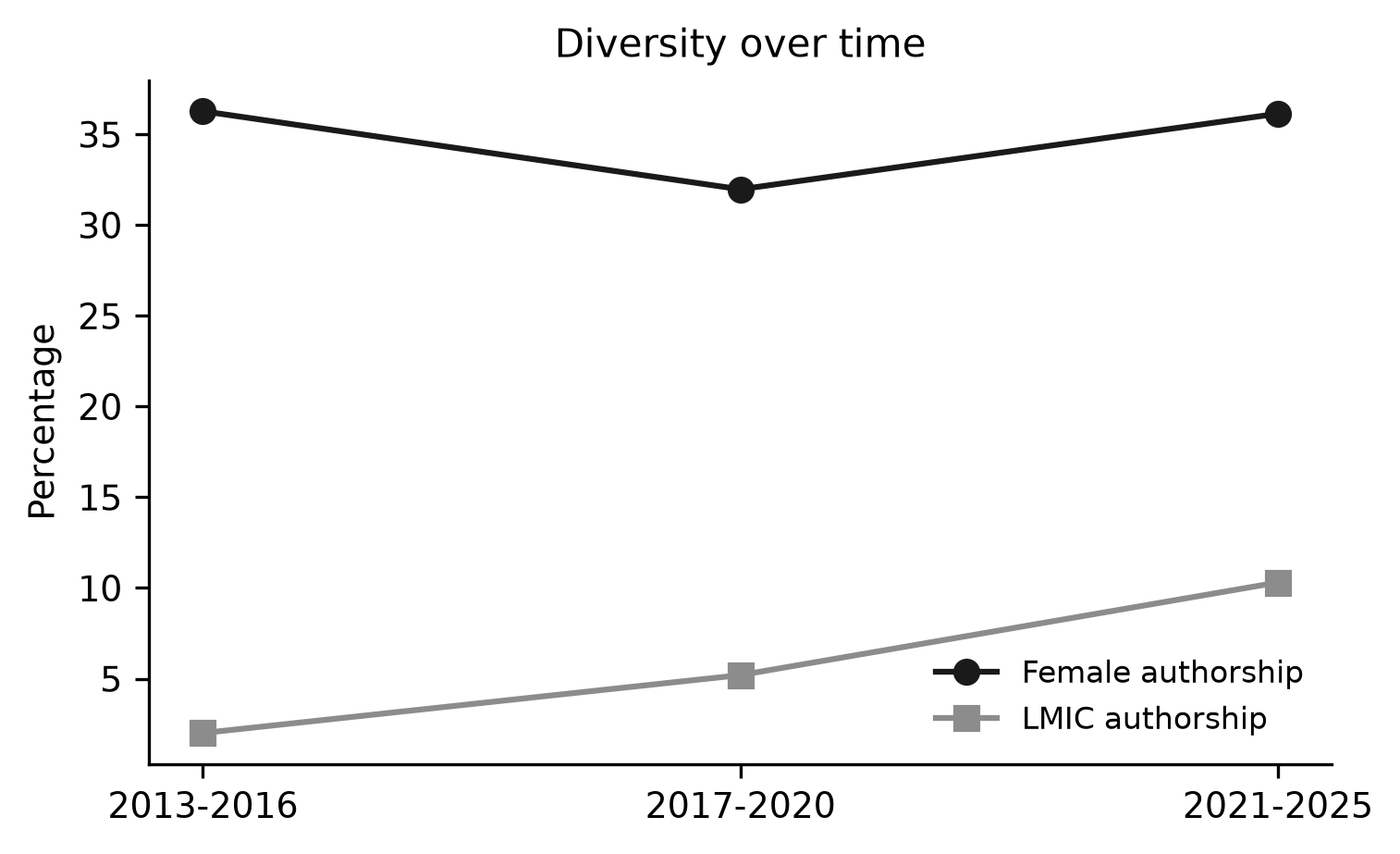
Figure 2. Female and lower-middle-income authorship over time.

Figure 1. Female authorship by byline position.
DISCUSSION
The central finding is that dental AI authorship is male-dominated and geographically concentrated, with the imbalance sharpest at the top of the byline. Women held just over a third of authorships among those with inferable gender, and a smaller share of last authorship than of first authorship, while authors from high-income countries produced more than half of all authorships and authors from lower-middle-income countries produced under one tenth. The field therefore reproduces, in miniature, the imbalances that have been documented in artificial intelligence and in medicine more broadly, and the flat gender trend over the study window indicates that growth alone has not diversified the field.(25,26) The fact that dental AI, a young and fast-growing subfield, already mirrors the imbalances of mature fields suggests that the forces producing those imbalances are structural rather than a temporary feature of an early stage, and that they will persist without deliberate intervention. This is the most important interpretive point of the study: the imbalances are not a startup effect that will fade as the field matures, but a stable equilibrium that has to be deliberately disturbed. Any account of dental AI's future that assumes diversification will happen on its own is therefore contradicted by the observed trajectory.
The gender result is consistent with the wider AI literature, which finds women underrepresented among AI authors and editors and least represented in senior positions.(7,8) The seven-point gap between first and last female authorship is the signature of a leaky pipeline, in which women enter the field as early-career researchers but are less likely to occupy the senior positions that last authorship represents, and it mirrors the pattern reported across medical and scientific publishing.(21,24) The gap is the more actionable finding than the overall share, because it points to a specific stage, senior progression, where intervention could have disproportionate effect: if the last-author share could be brought up to the first-author share, the senior gender balance would improve by the width of that gap, and the field's leadership would better reflect its early-career composition. The same pattern has been observed in dental imaging AI specifically, where the applications are numerous but the authorship has not been examined through a diversity lens until now.(27,28) The flatness of the female share across thirteen years is the more sobering part of the result, because it means the field's rapid growth has not produced the diversification that growth sometimes brings, and it suggests that the imbalances are not self-correcting but require active attention. The concentration of the gap in last authorship is also a signal about the structure of the field's leadership, because last authors are the researchers who set research directions, supervise trainees, and represent the field in editorial and advisory roles, so a shortfall in that position has consequences that radiate beyond the authorship record itself and into who is positioned to shape the field's next decade.
The geographic result is likewise a small-scale echo of a global pattern. The concentration of authorship in Europe, East Asia, and North America, and the small share from Latin America and Sub-Saharan Africa, matches the geography of AI research generally and of medical AI specifically.(1,3) The near-absence of Sub-Saharan African authorship, at under two percent, is the most striking single figure in the geographic results, because the region carries a substantial and underserved oral disease burden and is the region whose participation would most change the field's priorities if it grew. The pattern is not unique to dental AI, but its persistence in a young field that could have been built differently is itself a finding worth stating plainly. The fivefold rise in the lower-middle-income share, from 2.01% to 10.30%, is the one encouraging trend in the data, and it is consistent with the broader increase in lower- and middle-income authorship observed in other biomedical fields.(4,10) The rise in dental AI authorship from regions such as South Asia, which now contributes 8.81% of authorships, is visible in the region-level data and mirrors the growth of dental AI research activity documented in those settings.(20,29) The international-collaboration rate of 34.20% sits below the rates commonly reported for high-profile medical AI, which suggests that dental AI has room to grow its cross-border collaboration, a mechanism that has been proposed as a route to broader geographic participation.(30) A caution applies to this comparison, however: collaboration is a means to participation rather than participation itself, and a rising collaboration rate is only a proxy for the deeper goal of building research capacity within currently underrepresented regions. A collaboration that lists a lower-income partner among many co-authors may not translate into that partner's researchers leading work or setting its questions, which is why the byline-position and first-author analyses are a necessary complement to the raw collaboration figure.
The study's contribution is threefold. It provides the first authorship-level diversity measurement for dental AI, filling a gap left by the topic- and country-oriented bibliometric reviews that preceded it; it distinguishes first from last authorship, which exposes the seniority gradient that an overall gender share conceals; and it places the field's numbers alongside those of the wider AI and medical literatures, so that dental AI can be compared to its neighbors rather than judged in isolation. These are modest but concrete additions, and they are the kind of measurement that a field needs before it can set a target for change. A field that does not measure who produces its research cannot tell whether a diversity initiative is working or whether a headline improvement reflects real change or only a change in how the field describes itself, and the figures reported here, generated from public data by a deterministic script, are precisely the kind of baseline that makes such judgments possible. The reproducibility of the measure matters as much as the measure itself, because a baseline that cannot be recomputed is a baseline that cannot be used to track progress, and the open-data method used here can be rerun as the field grows without any change in definition.
A comparison across methods is also instructive, because diversity estimates are known to shift with the choice of gender inference. Studies that use the same name-dictionary approach, that use algorithmic matching against large name databases, and that restrict to authors with confidently classified names have all reported the same qualitative conclusion of male dominance in AI and medical authorship, with differences confined to the exact percentage rather than to the direction.(13,22) The geographic estimates are less method-dependent, because they rest on institutional country codes that are objectively recorded, and the concentration in high-income countries reported here agrees with what survey-based and editorial-position studies have found for related fields.(10) The convergence of methods on the same broad picture is itself a robustness argument: the imbalances are not an artifact of any single measurement choice but a stable feature that persists across ways of counting.
The robustness of these findings deserves emphasis, because the method's most consequential assumption is the name-based gender inference. The unknown category of 41.96% is large and is not random: names from regions with weaker representation in the name dictionaries, including much of East Asia and South Asia, are more likely to fall into it. This is a structural feature of name-based inference rather than a failure of this particular implementation, and it is shared by every study that relies on first names to infer gender, which is why the unknown category is reported rather than silently redistributed. This means the female share among known-gender authors could overstate or understate the true female share if the unknown names differ systematically in gender, and the absolute gender percentages should be read as approximate rather than exact. The directional conclusions, however, are unlikely to be overturned by this uncertainty: even a large correction to the unknown category would not erase a male share near two thirds, and the first-versus-last gap is measured within the known-gender set and is therefore less sensitive to the inference. Comparisons with studies that use algorithmic name matching or that restrict to authors with confidently classified names reach the same qualitative conclusion, which supports the robustness of the finding across methods.(13,22) The geographic findings are subject to no comparable uncertainty, because they derive from institutional country codes rather than inference, so the concentration in high-income countries and the small Sub-Saharan African and Latin American shares are measured rather than estimated. The only geographic ambiguity is the assignment of authors with multiple international affiliations, which we resolved by taking the first listed country, and this choice could shift a small fraction of authors between adjacent categories without changing the overall concentration.
Theoretical and Practical Implications
The practical implication is that efforts to diversify dental AI should be targeted at the specific gaps the data reveal: the senior-author gap for women, and the near-absence of lower-middle-income authorship, particularly from Sub-Saharan Africa and Latin America, where the oral disease burden is high. International collaboration and mentorship programs that pair researchers across income groups are plausible levers, and the rising lower-middle-income trend suggests that such efforts would be building on momentum rather than against it.(1,3) The data also suggest that the two gaps may call for different remedies: the gender gap is a pipeline problem concentrated at the senior level, while the geographic gap is a capacity problem concentrated at the level of research infrastructure, and conflating the two would blunt the design of any intervention. The field's funders, journals, and organizers of its benchmarks and challenges are well placed to act on these patterns, because they control the incentives that shape who participates, and because the datasets and competitions that they sponsor set the agenda for what dental AI is built to do. A dental AI that is built by and for a narrow slice of the world will tend to reproduce that narrowness in its priorities, and the present results quantify how narrow that slice currently is. The choice of benchmark datasets, which are themselves drawn disproportionately from a few high-income settings, is a concrete lever, because a benchmark that includes data from underrepresented regions invites the authorship of those regions into the field and, more importantly, forces the models to confront the populations and disease patterns that the field currently overlooks.
Limitations
The interpretation of these findings is subject to the following limitations:First, gender was inferred from names, which is binary, name-dictionary dependent, and unable to capture self-identified or non-binary gender; a future study could apply an institutional or survey-based validation on a subset of authors whose gender is known, to calibrate the name-based estimates and to quantify the direction and size of any systematic error. Second, the corpus was built from OpenAlex, whose coverage of dental AI is broad but not complete, and whose institutional country assignments may lag for very recent articles; cross-checking against another index, such as Scopus or Dimensions, would bound the extent of any coverage bias. Third, the query terms capture a particular definition of dental AI and may miss adjacent work, so the results describe this definition rather than all dental computing, and a broader query could be tested as a sensitivity analysis to see whether the diversity profile changes with the boundary of the field. Fourth, the income and region mapping is fixed at the current classification and does not reflect historical transitions in a country's income status, although the effect on the aggregate trends is small. Fifth, authorship position is a proxy for seniority, not a direct measure of it, and last authorship in particular is a convention that varies by field. Each of these points to a refinement, and none is likely to reverse the central, large-magnitude imbalances reported here.
CONCLUSIONS
Dental artificial-intelligence authorship was male-dominated, with the imbalance largest in last authorship, and was concentrated in high-income countries, especially Europe and East Asia and the Pacific, with lower-middle-income countries contributing a small but rising share. Female authorship did not increase over the study period, while lower-middle-income authorship rose fivefold, and international collaboration was present in roughly a quarter of articles. These measured patterns provide a baseline against which future diversification efforts can be judged, and they indicate that the field's growth has not yet translated into the geographic and gender breadth that its global reach would require. Targeted efforts aimed at the senior-author gender gap and at lower-middle-income participation are the most direct way to act on what the data show, and the rising lower-middle-income trend offers a foundation on which such efforts can build. Regular re-measurement using the same method would allow the field to track whether these patterns, once named, begin to change.
References
- 1 Lekadir K, Frangi AF, Porras AR, Glocker B, Cintas C, Langlotz CP, et al. FUTURE-AI: international consensus guideline for trustworthy and deployable artificial intelligence in healthcare. BMJ. 2025;388:e081554. doi: 10.1136/bmj-2024-081554
- 2 Arora A, Alderman JE, Palmer J, Ganapathi S, Laws E, McCradden MD, et al. The value of standards for health datasets in artificial intelligence-based applications. Nat Med. 2023;29(11):2929-2938. doi: 10.1038/s41591-023-02608-w
- 3 Green BL, Murphy A, Robinson E. Accelerating health disparities research with artificial intelligence. Front Digit Health. 2024;6:1330160. doi: 10.3389/fdgth.2024.1330160
- 4 Payedimarri AB, Mouhssine S, Aljadeeah S, Nkubito BM, Gaidano G, Ravinetto R. Assessing patterns of authorship of low- and middle-income countries in global commercial clinical trials in oncology. Global Health. 2025;22(1):3. doi: 10.1186/s12992-025-01167-8
- 5 Tang L, Li J, Fantus S. Medical artificial intelligence ethics: A systematic review of empirical studies. DIGITAL HEALTH. 2023;9:20552076231186064. doi: 10.1177/20552076231186064
- 6 Istasy P, Lee WS, Iansavichene A, Upshur R, Gyawali B, Burkell J, et al. The Impact of Artificial Intelligence on Health Equity in Oncology: Scoping Review. J Med Internet Res. 2022;24(11):e39748. doi: 10.2196/39748
- 7 Hajibabaei A, Schiffauerova A, Ebadi A. Gender-specific patterns in the artificial intelligence scientific ecosystem. Journal of Informetrics. 2022;16(2):101275. doi: 10.1016/j.joi.2022.101275
- 8 Cave S, Dihal K, Drage E, McInerney K. Who makes AI? Gender and portrayals of AI scientists in popular film, 1920–2020. Public Underst Sci. 2023;32(6):745-760. doi: 10.1177/09636625231153985
- 9 Hutson J, Schnellmann A. The Poetry of Prompts: The Collaborative Role of Generative Artificial Intelligence in the Creation of Poetry and the Anxiety of Machine Influence. GJCST. 2023:1-14. doi: 10.34257/gjcstdvol23is1pg1
- 10 García Garza MF, Gutiérrez Treviño O, Hashmi SK, Rodríguez-Galindo C, Moreira DC. Landscape of Global Pediatric Oncology Publications: A Cross-Sectional Analysis. JCO Glob Oncol. 2025;11(11):e2400320. doi: 10.1200/go-24-00320
- 11 Corrêa NK, Galvão C, Santos JW, Del Pino C, Pinto EP, Barbosa C, et al. Worldwide AI ethics: A review of 200 guidelines and recommendations for AI governance. Patterns. 2023;4(10):100857. doi: 10.1016/j.patter.2023.100857
- 12 Bahroun Z, Anane C, Ahmed V, Zacca A. Transforming Education: A Comprehensive Review of Generative Artificial Intelligence in Educational Settings through Bibliometric and Content Analysis. Sustainability. 2023;15(17):12983. doi: 10.3390/su151712983
- 13 Pereira V, Basilio MP, Santos CHT. PyBibX – a Python library for bibliometric and scientometric analysis powered with artificial intelligence tools. DTA. 2025;59(2):302-337. doi: 10.1108/dta-08-2023-0461
- 14 Ilhan B, Lin K, Guneri P, Wilder-Smith P. Improving Oral Cancer Outcomes with Imaging and Artificial Intelligence. J Dent Res. 2020;99(3):241-248. doi: 10.1177/0022034520902128
- 15 Xie B, Xu D, Zou XQ, Lu MJ, Peng XL, Wen XJ. Artificial intelligence in dentistry: A bibliometric analysis from 2000 to 2023. Journal of Dental Sciences. 2024;19(3):1722-1733. doi: 10.1016/j.jds.2023.10.025
- 16 Yang LC, Liu FH, Liu CM, Yu CH, Chang YC. Bibliometric analysis of top-cited articles in Journal of Dental Sciences. Journal of Dental Sciences. 2023;18(1):338-344. doi: 10.1016/j.jds.2022.09.017
- 17 Lui JCL, Lam WYH, Chu CH, Yu OY. Global Research Trends in the Detection and Diagnosis of Dental Caries: A Bibliometric Analysis. International Dental Journal. 2025;75(2):405-414. doi: 10.1016/j.identj.2024.08.010
- 18 Buddhikot CS, Garcha V, Shetty V, Ambildhok K, Vinay V, Deshpande U, et al. Bibliometric Analysis of Context, Trends, and Contents of Digital Health Technology Used in Dental Health. BioMed Research International. 2023;2023(1):5539470. doi: 10.1155/2023/5539470
- 19 Mohsen F, Al-Absi HRH, Yousri NA, El Hajj N, Shah Z. A scoping review of artificial intelligence-based methods for diabetes risk prediction. npj Digit Med. 2023;6(1):197. doi: 10.1038/s41746-023-00933-5
- 20 Shirani M. Trends and Classification of Artificial Intelligence Models Utilized in Dentistry: A Bibliometric Study. Cureus. 2025;17(4):e81836-e81836. doi: 10.7759/cureus.81836
- 21 Teixeira AL. AI in peer review: can artificial intelligence be an ally in reducing gender and geographical gaps in peer review? A randomized trial. Res Integr Peer Rev. 2025;10(1):23. doi: 10.1186/s41073-025-00182-y
- 22 Busch F, Keller S, Rueger C, Kader A, Ziegeler K, Bressem KK, et al. Mapping gender and geographic diversity in artificial intelligence research: Editor representation in leading computer science journals. Acta Radiologica Open. 2023;12(10):20584601231213740. doi: 10.1177/20584601231213740
- 23 Jelena Vujičić. Strategic legal frameworks for artificial intelligence: Why smaller countries must Act Now. World J Adv Eng Technol Sci. 2024;12(2):953-972. doi: 10.30574/wjaets.2024.12.2.0325
- 24 Abraham J, Panchal K, Varshney L, Lakshmi Narayan K, Rahman S. Gender Disparities in First Authorship in Publications Related to Attention Deficit Hyperkinetic Disorder (ADHD) and Artificial Intelligence (AI). Cureus. 2023;15(11):e49714-e49714. doi: 10.7759/cureus.49714
- 25 Lu W, Yu X, Li Y, Cao Y, Chen Y, Hua F. Artificial Intelligence–Related Dental Research: Bibliometric and Altmetric Analysis. International Dental Journal. 2025;75(1):166-175. doi: 10.1016/j.identj.2024.08.004
- 26 Polizzi A, Boato M, Serra S, D’Antò V, Leonardi R. Applications of artificial intelligence in orthodontics: a bibliometric and visual analysis. Clin Oral Invest. 2025;29(1):65. doi: 10.1007/s00784-025-06158-y
- 27 Norman NH, Rosli MM, Al-Jaf NM, Mohammad N, Azizan A, Yusof MYPM. Integration of artificial intelligence in orthodontic imaging: A bibliometric analysis of research trends and applications. Imaging Sci Dent. 2025;55(2):151. doi: 10.5624/isd.20240237
- 28 Chen J, See KC. Artificial Intelligence for COVID-19: Rapid Review. J Med Internet Res. 2020;22(10):e21476. doi: 10.2196/21476
- 29 Long J, Yang L, Dou J, Zhang L, Tan X. Artificial intelligence in dentistry: a bibliometric analysis. Br Dent J. 2025. doi: 10.1038/s41415-025-8885-y
- 30 Amodu O, Janes CR, Pangan KTL. Psychosocial well-being and mental health of low- and middle-income countries’ internally displaced persons and refugees during COVID-19: a systematic literature review. Camb prisms Glob ment health. 2024;11:e122. doi: 10.1017/gmh.2024.110
Declarations
Funding
No financing
Conflict of interest
None
Authorship contributions
Drafting – original draft: Zuzel Salazar Duany, Tamara Torres Fernández, Yoandra Muro Valle, Jaquelin Virginia Junco Arevalo, Jhossmar Cristians Auza-Santivañez.
Writing–review and editing: Zuzel Salazar Duany, Tamara Torres Fernández, Yoandra Muro Valle, Jaquelin Virginia Junco Arevalo, Jhossmar Cristians Auza-Santivañez.