CH 01
 OPEN ACCESS
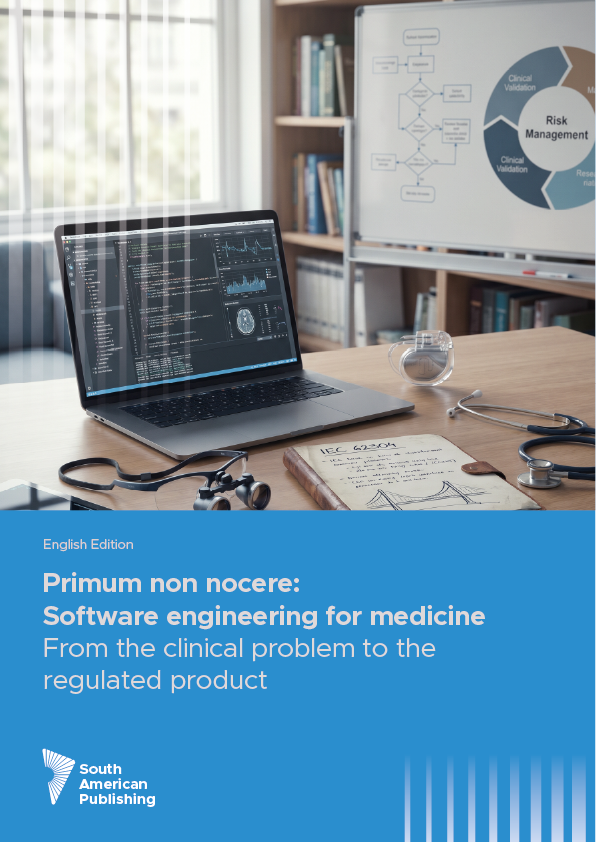
 Primum non nocere: Software engineering for medicine
From the clinical problem to the regulated product
Annier Jesús Fajardo Quesada (Author)· Eduardo Antonio Hernández González (Author)· René Herrero Pacheco (Author) ·and 1 additional contributor
About this book
Description
Software has become part of the clinical environment, where technical defects, ambiguous data, poor usability, or unvalidated models can translate into direct consequences for patients and professionals. This volume examines medical software as a multidisciplinary product whose development requires the integration of software engineering, clinical reasoning, quality management, regulation, data standards, cybersecurity, and evidence generation. It begins by defining the digital health ecosystem and the boundary between general-purpose software and Software as a Medical Device. It then addresses regulated development through ISO 13485, IEC 62304, ISO 14971, and IEC 62366, linking lifecycle processes with traceability, risk control, verification, and human factors. Subsequent chapters examine clinical terminologies, FHIR, HL7, DICOM, healthcare architectures, and security requirements that support interoperable systems. The treatment of artificial intelligence covers clinical dataset construction, internal and external validation, dataset shift, MLOps, large language models, hallucinations, explainability, and communication of algorithmic risk. The final section considers prospective and retrospective study design, real-world evidence, economic evaluation, bias, informed consent, liability, reimbursement, technology transfer, and regulatory pathways in the United States, Europe, Latin America, and Spain. Throughout the book, technical choices are interpreted in relation to clinical context and patient safety rather than as isolated engineering decisions. The accompanying appendices provide terminology, a readiness checklist, and templates for risk management and verification. The result is a lifecycle-oriented framework for clinicians, engineers, researchers, and multidisciplinary teams working on software intended for healthcare use.
Medical softwareSoftware as a Medical DeviceDigital healthClinical artificial intelligenceMedical device regulationPatient safety
Contents
Chapters
18 chapters
CH 02
CH 03
CH 04
CH 05
CH 06
CH 07
CH 08
CH 09
CH 10
CH 11
CH 12
CH 13
CH 14
CH 15
CH 16
CH 17
CH 18
No chapters match this search.
Citation
How to cite
Annier Jesús Fajardo Quesada, Eduardo Antonio Hernández González, René Herrero Pacheco, Rolando Javier Álvarez Pérez. Primum non nocere: Software engineering for medicine: From the clinical problem to the regulated product. South American Publishing. 2026. https://doi.org/10.62486/978-9915-9876-8-2
Authors and affiliations
All contributors are shown here. Affiliations are grouped when they are available in the book metadata.
Granma University of Medical Sciences. Granma, Cuba.
University of Medical Sciences of Pinar del Río. Pinar del Río, Cuba.
Metadata
Bibliographic information
- Book title
- Primum non nocere: Software engineering for medicine
- Book subtitle
- From the clinical problem to the regulated product
- Authors
- Annier Jesús Fajardo Quesada, Eduardo Antonio Hernández González, René Herrero Pacheco, Rolando Javier Álvarez Pérez
- DOI
- https://doi.org/10.62486/978-9915-9876-8-2
- Publisher
- South American Publishing
- Imprint
- South American Publishing
- ISBN
- 978-9915-9876-8-2 (eBook, English)
978-9915-9876-9-9 (Softcover, English) - Published
- 2026-09-29
- Language
- English
- Edition number
- 1
- Publication type
- monograph
- Subject area
- Health Sciences
- BISAC
- MED117000 (Primary)
COM051230
TEC059000
MED003040 - THEMA
- MBPM
- License
- Creative Commons Attribution 4.0 International
- Copyright
- © 2026 The Authors
Publish with us
Planning a scholarly book?
Explore the editorial policies or send an initial proposal to the South American Publishing Books team.